AGO Vs IGO - What's the difference and how to increase webinar registrants through both channels?

Casey Zeman
Published on Sep 29, 2026 • 35 min read

TL;DR
- Ad Generated Organic is reach you buy with media spend. Influencer Generated Organic is reach you borrow from a partner audience and pay for in commission after revenue.
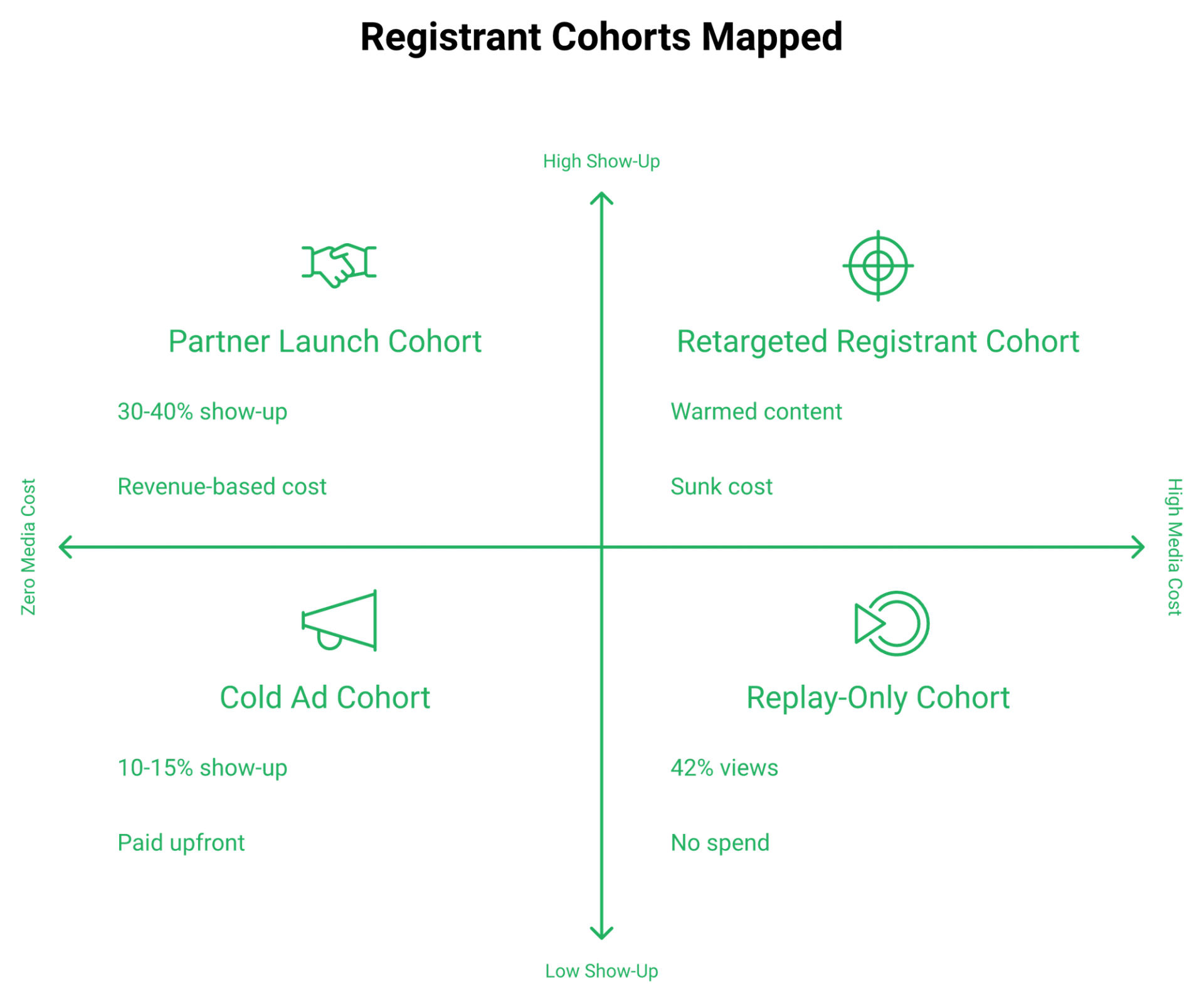
- Cold paid registrants show up at 10 to 15 percent while partner registrants show up at 30 to 40 percent, so equal registrant counts are not equal assets.
- Cold cost per registrant runs $8 to $12 for general audiences, near $18 at median, and $25 to $60 on LinkedIn; the back-end offer decides whether that works.
- IGO hits a hard ceiling set by partner list sizes and promo frequency, while AGO has no structural ceiling, making IGO the launchpad and AGO the engine.
- Run both channels through duplicated funnels, one tagged link per partner, and hold registration, attendance, replay, and CTA clicks as four separate states.
- Validate live, clear 10 percent attendee-to-buyer, then graduate into Simulated Live or Evergreen. Just-in-Time scheduling belongs to Evergreen only.
Q1. What's the actual difference between Ad Generated Organic and Influencer Generated Organic?
Last spring, a course creator I consult with pulled up two registration reports side by side. One webinar had 412 registrants from Meta ads. The other had 388 from a single partner email. Same offer, same deck, same week. Her question was simple, and she could not answer it from the dashboard: which of these two rooms is worth filling again?
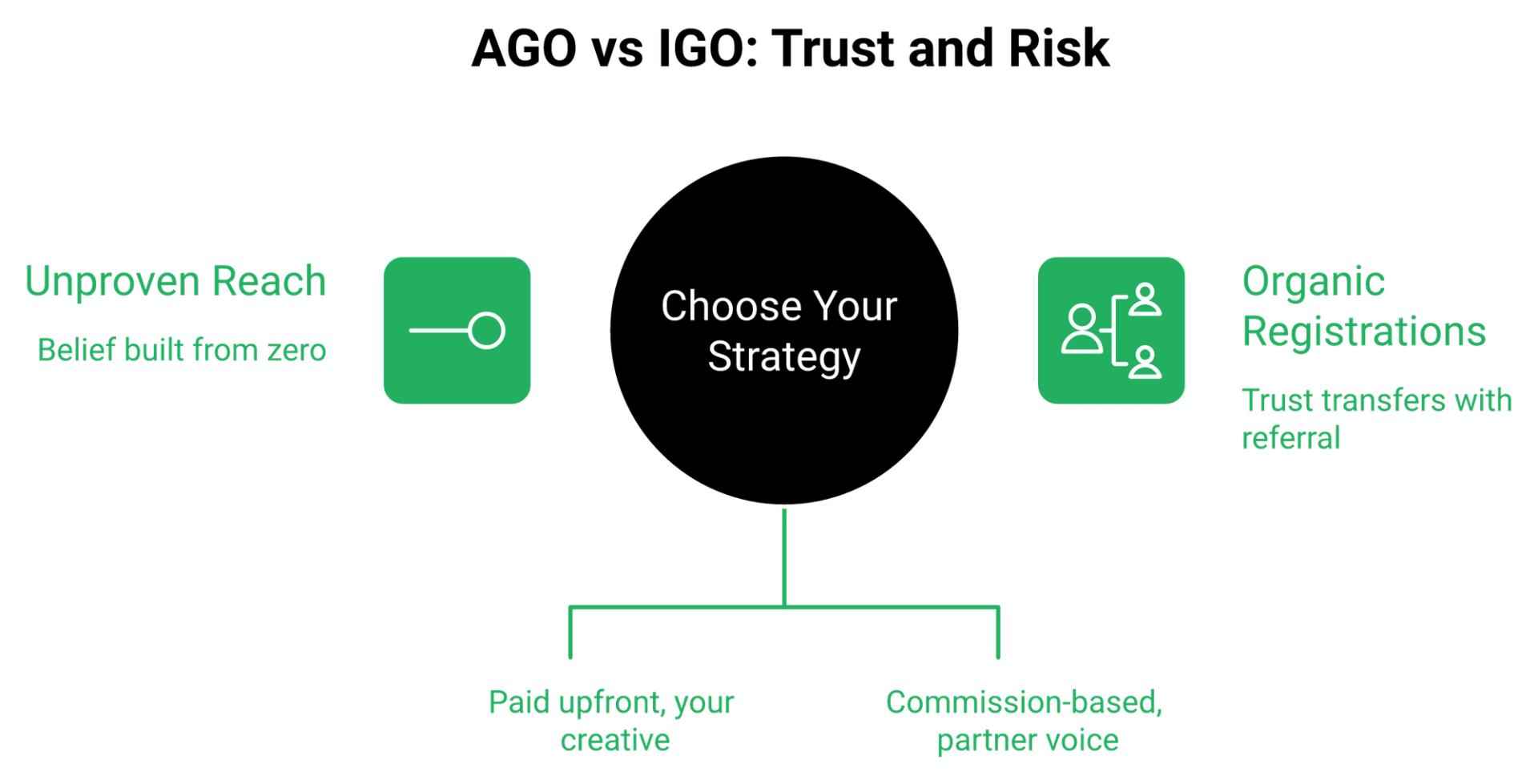
Ad Generated Organic (AGO) is reach you buy: your creative, your targeting, your registration page, paid upfront in cash. Influencer Generated Organic (IGO) is reach you borrow: a partner promoting your webinar in their voice to their audience, paid in commission after the fact. Both produce registrants who feel organic to the person clicking. The difference is who owns the trust and who carries the risk. AGO is uncapped but front-loads financial exposure. IGO is nearly risk-free but capped by someone else's list size and promo calendar.
⭐ Why "paid versus organic" is the wrong split
The old binary sorts traffic by whether money changed hands. That tells you almost nothing about how the registrant behaves once they are in the room.
A paid ad can produce deeply organic behaviour. People share it, save it, and tag a colleague. Creator content, meanwhile, is often paid for too, just on the back end through commission or usage rights. Sorting by invoice hides the thing you actually need to know.
✅ The two questions that actually separate them
Ask two questions instead. Who owns the trust in this transaction? Who fronts the risk?
- AGO: you own the message, you front the cash, and the audience arrives cold.
- IGO: your partner owns the trust, they front the reputation, and the audience arrives warm.
That reframe is the whole article. EasyWebinar's registrant records treat source as a property of the person, not a property of the campaign, which is why both channels can run into one event on the same webinar platform and still be told apart afterwards.
⚠️ The same webinar, promoted two ways
Take one evergreen session on a $2,000 coaching offer. Run it on AGO and you can open the tap tomorrow, scale to 5,000 registrants a month, and pay for every single one before you know if the deck converts.
Run the same session on IGO and you wait three weeks for a partner slot, pay nothing upfront, and get a smaller room full of people who already trust the person who sent them. I learned the hard way that format beats channel here. My first course took six months to build and sold nothing until a webinar carried it, and that first year of live webinars built a 14,000 person list and $245,000 in sales. The traffic was not the variable. The borrowed belief was.
💰 What this means for your next promotion
Neither label is a strategy. AGO is a spend decision. IGO is a relationship decision. They fail for completely different reasons, which means you cannot diagnose them with one blended report.
EasyWebinar was built for the operator running both motions into one event, which is why registration source and UTM parameters are first-class filters in the People section rather than something you bolt on. When a partner-sourced and an ad-sourced registrant land in the same room, you can still tell them apart. That is what turns this comparison into something you measure.
Q2. How do AGO and IGO compare across cost, speed, control, trust, scale, and measurability?
AGO costs media budget, produces its first registrant in days, gives you total creative control, carries lower perceived trust, scales without a ceiling, and tracks cleanly through UTMs. IGO costs commission or product, takes weeks to arrange, is creator-led by design, carries high borrowed trust, hits a hard audience ceiling, and loses attribution regularly. Neither wins outright. AGO buys precision and volume; IGO buys belief and show-up rate. EasyWebinar records attendance, replay watch status, and CTA engagement against the same registrant record that stores the source, so both channels stay separately measurable.
⏰ The six criteria that actually decide it
| Criterion | AGO (paid ads) | IGO (partner or creator) |
|---|---|---|
| Cost model | Media spend, paid before results | Commission or product, paid after revenue |
| Speed to first registrant | Days | Two to four weeks of negotiation |
| Creative control | Total | Creator-led, you get input, not veto |
| Perceived trust | Low, audience is cold | High, trust transfers with the referral |
| Scalability | No structural ceiling | Capped by partner list size and promo frequency |
| Measurability | Clean UTM capture | Breaks on redirects and embedded forms |
Influencer campaigns are widely reported at roughly $5.78 returned per $1 spent against about $2 for paid media, and the honest read is that this buys trust at the cost of control and measurement.
✅ How to read the matrix at your stage
Two rows dominate at any given revenue level. Below roughly $30,000 a month, cost model and trust decide everything, because you cannot absorb a failed test. IGO wins there.
Above that, scalability and measurability take over. AGO's weaknesses are solvable with money and iteration. IGO's ceiling is not solvable at all, because you cannot buy more of someone else's list.
⚠️ Where operators say the measurement row breaks
The measurability row is the one most teams assume is fixed. Reviews suggest it is the row that fails most often, which is also why webinar analytics deserve more attention than the ad account.
"The detailed analytics are great as they save me the hassle of calculating KPIs, and the registration and email notification features are really handy."- Eliza W., EasyWebinar G2 - Verified Review, 4.5/5
"The integrations with 3rd party software such as mailchimp is inconsistent on both the pushing the registrants over and the custom form field population... Their email service doesn't consistently send to registrants, or report emails that have been sent."- Tara G., WebinarJam G2 - Verified Review, 0/5
"It's hard to integrate into Hubspot. We use a third party capture form and had to do several zaps to get all data to flow accurately from our form to Hubspot to Demio."- Verified User in Education Management, Demio G2 - Verified Review, 4/5
Three zaps between a form and a room is three places your source data can quietly disappear. My read is that most operators do not have an IGO measurement problem. They have a plumbing problem that looks like one, and a shortlist of Demio alternatives is usually where that search starts.
EasyWebinar changes exactly one row in that table, which is measurability. Because attendance, replay watch status, and CTA engagement sit on the same registrant record as the source that brought them in, IGO stops being the unmeasurable channel by default.
Q3. What does each channel actually cost per registrant, and per registration-page visitor?
Cold Facebook or YouTube traffic runs roughly $8 to $12 per registrant for general-audience offers, with a market median near $18 and $25 to $60 on LinkedIn for high-ticket B2B. Documented YouTube accounts have held around $8.03 per webinar registration. IGO carries no media cost, and its commission triggers only on revenue. EasyWebinar records the revenue events after registration, including paid webinar tickets and in-webinar timed offers, in the same system that captured the registrant's source.
💸 The math almost nobody does before launch
Here is the pattern I see most often. An operator asks how much they should spend on ads. That is the wrong question. The right question is what the back-end offer looks like.
Paid-media operators who manage large webinar accounts are blunt about the consequence. Plenty of people front budget without modelling the worst-case version of each number in the chain, then spend willingly into a threshold where the math never closed.
⚠️ Model the worst case, line by line
Run the pessimistic version before the optimistic one:
- Cost per registrant at the top of your documented CPR band, not the bottom. Use $18, not $8.
- Show-up rate at the bottom of the cold-traffic range.
- Attendee-to-buyer at half your live-webinar best.
- Refund rate at double last quarter's.
If the model still clears your cash reserve, you can test. If it does not, your problem is the offer price, not the ad account. Documented YouTube accounts have held around $8.03 per webinar registration, which is the floor, not the expectation.
⏰ Registration pages do not convert equally by source
The visitor-level number matters as much as the lead-level one. Channel-to-registered rates differ sharply by traffic source, with LinkedIn consistently converting registration pages harder than Meta or Google in several verticals, and organic and partner traffic converting in the 20 to 40 percent range against 15 to 30 percent for Meta ads.
So IGO can be cheaper twice over. No media cost, and a better page conversion rate on the same page. If your page is the constraint, start with webinar landing page examples that convert before you touch the bids.
📊 Where the influencer ROI claim does not transfer
That $5.78-per-dollar influencer figure is real, and it is mostly measured on ecommerce purchases. Webinars behave differently. Your revenue event sits 40 minutes into a presentation, days after the click, so channel-level ROI multipliers do not map cleanly onto a $5,000 coaching program.
❌ What happens when the cost data is not yours
Cost per registrant is only useful if you can still read it next quarter.
"After canceling, I was shocked to find out I couldn't export the list unless I subscribed again. Support confirmed this."- Sheida M., Demio G2 - Verified Review, 0/5
"If using a Zoom registration form then the registration information does not sync to Marketo. This is inferior to other webinar providers."- Pavel P., Zoom Events and Webinars G2 - Verified Review, 1/5
"EasyWebinar is the only one on the market who makes a product built specifically to scale... This is especially important for solo entrepreneurs wearing 800 different hats."- Ash A., EasyWebinar G2 - Verified Review, 5/5
EasyWebinar sits on the back-end side of that equation, which is where AGO math is actually won. Paid and ticketed webinars, in-webinar timed offers, and a native sales CRM with auto-dialer mean revenue events are instrumented alongside the registration itself.
Q4. Which channel produces better registrants once you measure show-up, replay, and CTA behaviour?
Partner and influencer traffic typically shows up at 30 to 40 percent. Ice-cold paid traffic shows up at 10 to 15 percent. A thousand IGO registrants fill a room with roughly 350 people, while a thousand AGO registrants fill it with 125. Replay shifts the picture further, since about 42 percent of webinar views now happen on replay, so a channel that looks weak live can still convert later. Normalise to cost per live attendee and cost per CTA click, never cost per registrant.
⚠️ A blended attendance number is two cohorts averaged into a lie
Industry benchmarks report one number. ON24's 2026 data shows around 60 percent registration-to-attendance including on-demand, with 239 average attendees per webinar. Contrast's dataset of over a million registrants puts the watch rate at 61 percent.
Both are useful, and neither is actionable, because they blend every source together. If your dashboard says 58 percent, you might be averaging a 40 percent partner cohort with a 12 percent ad cohort and calling it health.
✅ The normalisation math that fixes it
Do this once and the argument ends. Take each channel and divide spend by live attendees, then by CTA clicks.
At $12 per registrant and a 12 percent show-up rate, AGO costs $100 per live attendee. At zero media cost and a 35 percent show-up rate, IGO costs nothing per live attendee until someone buys. With CTA conversion sitting near 22 percent of attendees in 2026 benchmark data, the cost-per-CTA gap widens further.
⏰ Replay is where AGO quietly recovers
Cold registrants who miss the live session are not dead. With 42 percent of views happening on replay, the replay window is a second, cheaper show-up event, which is the whole argument in pre-recorded webinar platforms versus live.
This is also the number most tools lose. EasyWebinar tags watch behaviour against exact timestamps, so a replay-only viewer from an ad campaign and a live attendee from a partner email trigger different follow-up.
❌ What breaks registrant quality in practice
"It didn't fully integrate with my CRM (Highlevel) and the replay didn't show the live polls and CTAs."- Ivanhoe S., Demio G2 - Verified Review, 4/5
"Inability to clone webinars without serious resulting issues... duplicate chat messages, emails not being sent to registrants, pop-ups not working."- Kaylen M., EverWebinar G2 - Verified Review, 0/5
"I have usually hard time with all zapier connnections."- Saana K., Demio G2 - Verified Review, 4/5
A replay stripped of its CTA is not a lower-quality registrant. It is a lower-quality room, and that is the gap most webinar integrations are quietly papering over.
📊 My own honest baseline, and the gap in the data
My weekly numbers were 60 registered, 30 showed, and 3 bought a $1,000 program. That is $12,000 a month at a 50 percent show-up rate, and the only reason it was 50 percent is that the list was mine, not rented. Operators report similar shapes, around 150 registrations at 30 percent attendance on mixed email and Facebook traffic.
"Our best webinar was 150 registrations, 30% attendance rate, and 30% conversion rate on the offer we presented. That was a mix of email blasts and fb ads."- u/deleted, r/PPC Reddit Thread
I should flag the limit clearly. No public benchmark splits show-up rate by acquisition source, so the 10 to 15 versus 30 to 40 ranges come from operator practice, not a published dataset. I could be reading the spread too confidently, and the only way to settle it is your own cohort table.
EasyWebinar customer K21 Academy holds a 47 percent show-up rate, roughly triple the cold-ad benchmark, alongside 5x registrant growth. Their registrations arrive through community and partner channels where trust already exists, then land in a system that records source, watch timestamp, and CTA behaviour per person.
Q5. Why does IGO hit a ceiling that AGO doesn't?
IGO is constrained by arithmetic you do not control: how large your partners' lists are, and how often they will mail them. You can own a niche completely and still stall, because there are a finite number of aligned audiences and each promotes you a limited number of times a year. Cold paid traffic has no structural ceiling, which is why million-a-month webinars are almost always cold-traffic webinars. The counterweight is real too. One enormous partner with the right offer can out-earn a full year of ad spend.
⭐ The comfortable view, and why operators default to it
Most creators I talk to reach for partnerships first, and the logic is sound. No media spend, warm audiences, and a show-up rate that makes your dashboard look healthy.
So the plan becomes: line up six partners, run a launch, and repeat next quarter. It works. It also quietly sets your revenue ceiling for the next three years.
⚠️ Run the arithmetic on your own partner list
Here is the math nobody does before signing the JV deals. Say you find eight genuinely aligned partners. Average list size 25,000. Each mails you twice a year.
- 16 promotions a year, total.
- At a 3 percent click-to-register rate, that is about 750 registrants per promotion.
- Roughly 12,000 registrants a year, or 1,000 a month.
- At a 35 percent show-up rate and an 8 percent close on a $2,000 offer, you land near $56,000 a month.
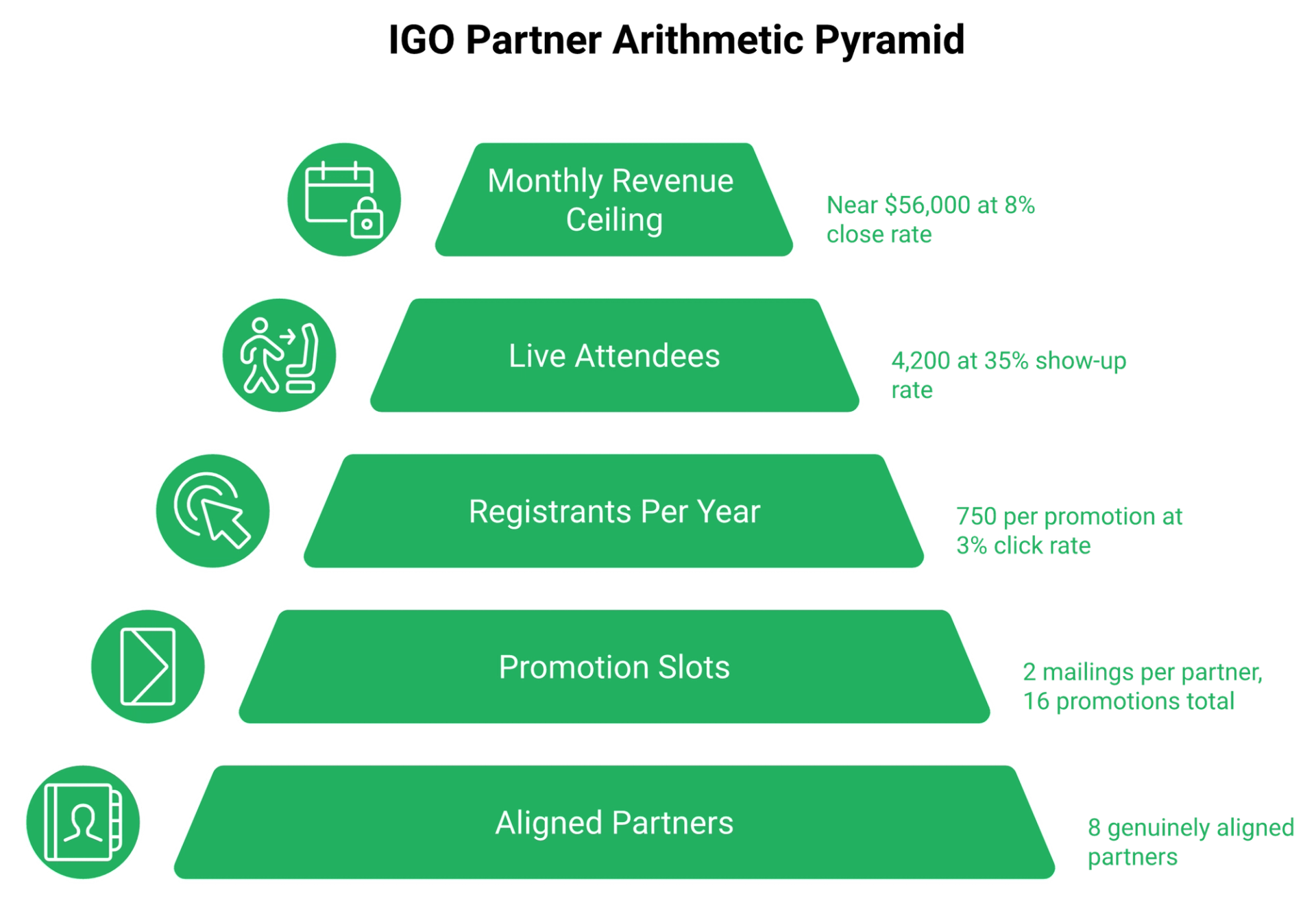
That is a good business. It is also a hard stop. You cannot buy more of someone else's list, and asking a partner for a third mailing usually costs you the fourth. This is the ceiling that sends operators looking for a webinar lead generation motion they actually control.
✅ The counter-case that keeps me honest
I do not want to flatten this into "ads win." Jason Fladlien set the record for the largest affiliate commission in our space, $9.8 million in eight days, selling someone else's Amazon training product through webinars. He out-earned the second-place affiliate by roughly $8 million.
His method was not more traffic. It was one question: what is this audience not hearing that would cause them to buy if they did hear it? One partner promotion, executed at that level, beats a year of mediocre ad spend. Paid-media operators running large webinar accounts say the same thing from the other direction. Warm audiences cap you in the low hundreds of thousands a month, and cold conversion is what makes a million-a-month webinar possible at all.
💰 The better frame: launchpad, then engine
My own history sits on both sides of this. My first year of live webinars built a 14,000 person list and $245,000 in course sales, almost entirely on warm and partner traffic. The next order of magnitude needed a different motion, and I could not talk my way around that.
So stop treating this as a choice. IGO is the launchpad, because it proves the offer with borrowed trust and zero media risk. AGO is the engine, because it has no ceiling and will take a proven offer as far as your cash reserve allows.
EasyWebinar operators run both sequences constantly, and I will say plainly where the platform is not the answer. If your product sits under $200, or you are hosting a one-off internal team meeting, a webinar revenue system is not mathematically required. The ceiling problem only matters once the offer economics work, which is the same reason webinar pricing should be checked against your back-end offer, not your traffic plan.
Q6. How do you fund cold-ad testing without burning capital you can't replace?
Run IGO first and treat the profit as house money. Partner and warm audiences convert on an unpolished deck, so they generate the cash cushion that funds the expensive iteration cold traffic demands. Cold ads punish every weakness in your hook, page, and pitch at once, and you pay for each lesson at $8 to $30 a lead. EasyWebinar's maturity path gates automation on a validated live session, so operators graduate a proven webinar into Simulated Live or Evergreen rather than paying ad traffic to discover the offer does not convert.
⏰ The situation: $20,000 and one shot
A real-estate client ran this exact test. A $70,000 offer, a $20,000 ad budget, roughly 1,000 registrants at a $20 cost per lead, and about 150 live attendees.
Webinar one netted $40,000 in profit. On paper, the channel was proven, and the obvious move was to scale.
❌ What actually broke, and it was not the traffic
Before webinar two, the client built a brand new three-hour slide deck. Unvetted, untested, and assembled on instinct.
The presentation dragged. Energy dropped. That webinar produced one sale. Same ads, same audience, and the same cost per lead. The variable was the room, not the traffic. This is why I say ads amplify whatever conversion rate you already have, including a bad one.
✅ The three-phase house-money sequence
- Phase one, borrow the trust. Run two to four IGO promotions with aligned partners. Zero media spend. Target a 30 percent or better show-up rate.
- Phase two, bank the cushion. Set aside the profit from those promotions as your ad-testing fund. That is your house money, and it is the only budget cold traffic should touch.
- Phase three, buy the scale. Open paid traffic only after a live session clears roughly 10 percent attendee-to-buyer. Below that gate, you are paying to fill a room that does not convert.
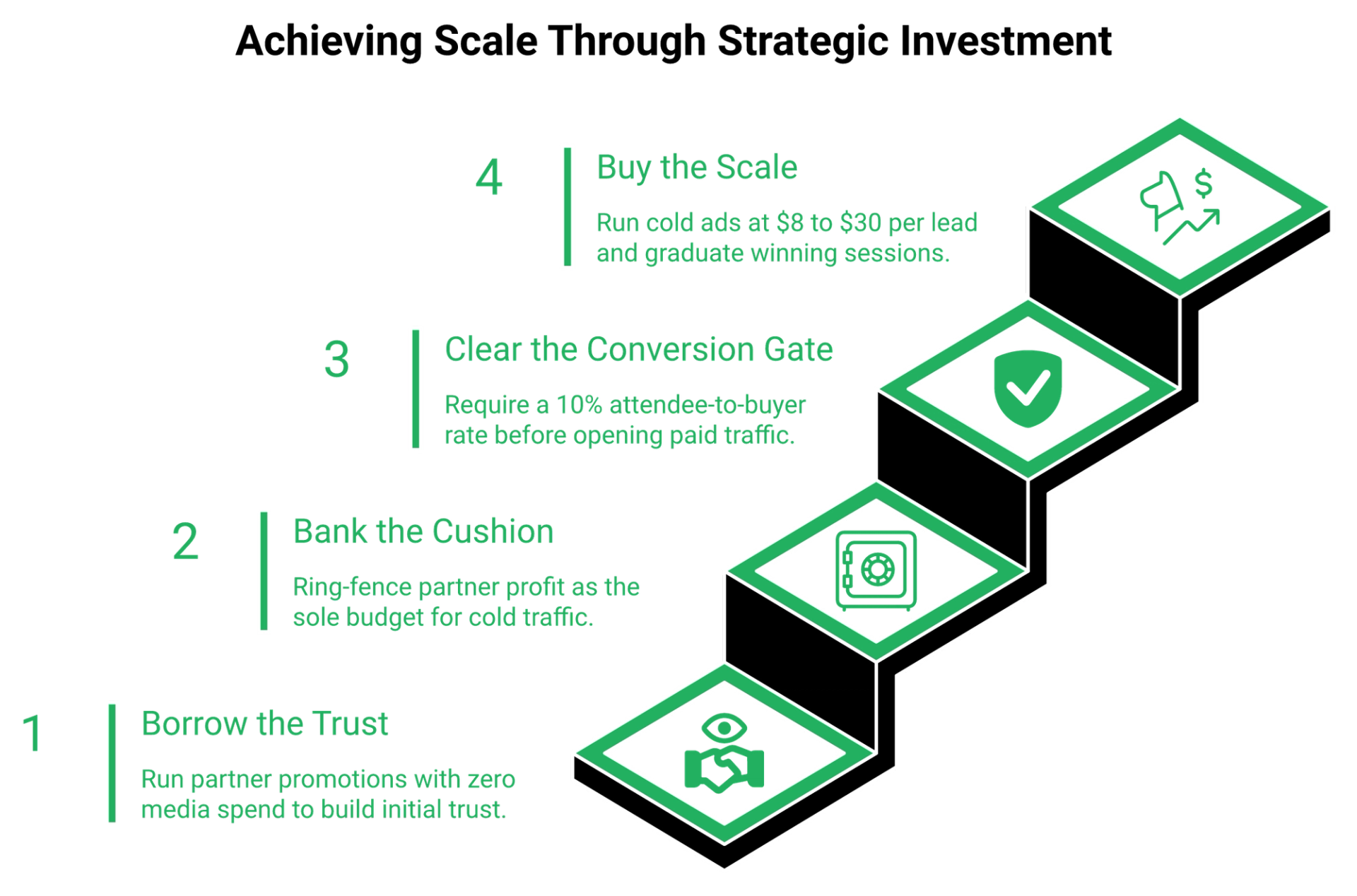
EasyWebinar's progression follows the same order: go live, validate the content and offer, then graduate the winner into Simulated Live (which keeps real-time chat, polls, and timed offers) or Evergreen for full automation. The live versus automated decision is a sequencing question, not a preference.
⚠️ What operators say about skipping validation
Operators on r/PPC describe the realistic small-scale shape honestly: around 150 registrations, 30 percent attendance, and 30 percent conversion on the offer, from mixed email and Facebook traffic. That is the floor to model against, not the case studies.
"Our best webinar was 150 registrations, 30% attendance rate, and 30% conversion rate on the offer we presented. That was a mix of email blasts and fb ads."- u/deleted, r/PPC Reddit Thread
"I convert really well with live webinars, but I can't be everywhere at once. EasyWebinar gives me the ability to multiply my efforts... The biggest challenge is around setting up automated webinars, and needing the presentation uploaded first in order to set it up."- Ash A., EasyWebinar G2 - Verified Review, 5/5
"Complexity of set up and ensuring everything works on live day... when things don't work or participants log in late there is no way to get help or reach support except via email."- Verified User in Market Research, EverWebinar G2 - Verified Review, 1/5
"The pricing model makes it difficult for smaller organizations to adopt it and pay up as they increase their usage."- Verified User in Construction, Demio G2 - Verified Review, 4/5
That first review is a fair complaint, and it is also the gate working. Requiring the recording before automation forces you to have something proven to automate.
EasyWebinar is built around that sequence rather than around it. An automated webinar with an unvalidated offer does not fail slower. It fails faster, more predictably, and with your ad budget attached.
Q7. How do you structure partner deals so IGO doesn't burn the relationship?
Pay top-tier partners generously, up to 70 percent on a front-end promotion, because 30 percent of a large number beats 100 percent of nothing. Generous terms are what get you onto an A-list partner's calendar at all. Then apply the harder rule: only promote, and only accept promotions from, partners inside your vertical. Audience mismatch produces refund spikes and brand confusion that cost more than the promotion earned. EasyWebinar's own partner program pays monthly recurring commission on eligible referrals, with tiers that unlock as an active referral base grows.
💰 Why 70 percent is arithmetic, not generosity
New operators negotiate hard on the split and lose the deal. That is backwards. A partner with a 60,000 person list has ten people asking for a slot this quarter.
Your 30 percent of a large promotion is real money. Your 70 percent of a promotion that never happens is zero. I would rather hand over most of the front end and keep the buyer, the email address, and the back-end relationship.
❌ The misalignment mistake I made
I have promoted programs that did not fit my audience. It got messy, fast. Refund requests, confused replies, and subscribers asking why I was suddenly selling something unrelated.
The fix was a hard filter. Same vertical, or no deal. A misaligned promotion does not just underperform. It costs you trust you spent years building, and trust is the entire asset IGO runs on.
✅ The five-point vetting table
Run every prospective partner through this before you discuss percentages:
| Check | What to ask for | Red flag |
|---|---|---|
| Vertical fit | Their last three offers | Anything outside your problem space |
| List recency | Open rate on the last send | No number, or under 15 percent |
| Promo calendar | Available slots this quarter | Already stacked with four launches |
| Prior launch results | Registrants and sales from one past promo | Vague "it went well" |
| Refund history | Refund rate on their own products | Above 10 percent |
Two of those five are about their audience. Three are about how they operate. The second group predicts whether the promotion actually runs on time.
⏰ What you owe the partner in return
This is where most IGO deals quietly die. Partners do not want a commission link. They want a promotion that does not create work for them.
Send swipe copy, subject lines, a registration page that loads fast, and a tracked link that actually reports. Then send them their numbers within 48 hours of the webinar. EasyWebinar's People section makes that last step a filter rather than a spreadsheet, because each partner's registrants, attendance, and CTA engagement sit under their own source tag.
⚠️ Recurring beats one-time, every time
One-time commission buys one promotion. Recurring commission buys a partner who checks their dashboard every month and asks when the next webinar is.
EasyWebinar runs its own affiliate program on exactly these mechanics: tracked per-partner links, monthly recurring commission that continues while eligible referrals stay subscribed, and tiers that unlock as the active referral base grows. The structure is worth copying whether or not you ever promote us.
Q8. How do you turn winning partner content into paid ad creative?
Treat every partner's organic post as a free creative test. Whichever post drives the most registrations becomes your paid ad creative, run through partnership-style ad formats so it keeps the creator's handle and native look. This is the only mechanism where IGO and AGO compound instead of competing. The partner's audience validates the hook at zero media cost, then paid budget carries the validated hook to cold audiences. EasyWebinar reports registrations, attendance, and CTA engagement per source, which is how operators identify which creator post produced buyers rather than clicks.
⭐ Creative supply is the real AGO bottleneck
Most operators think their ad problem is targeting. After looking at a lot of webinar funnels, what jumps out is that the account is usually starved of creative, not audiences.
You need eight to twelve hooks to find one that holds a cold viewer. Producing those internally is slow and expensive. Your partners are already producing them for free, and their audiences are already voting.
✅ The five-step amplification loop
- Tag every partner post separately. One tracked registration link per post, not per partner. You cannot rank what you cannot separate.
- Rank by registrations per thousand views, not by likes or comments. Engagement and registration intent are different signals.
- Ask for usage rights before the promotion runs. Put it in the same agreement as the commission split. Asking afterwards is awkward and often gets declined.
- Relaunch the top performers as paid. Use partnership or spark-style formats so the ad still runs from the creator's handle. The native look is the asset.
- Amplify roughly the top fifth. Leave the rest organic. Paying to distribute a hook that did not land warm is just faster loss.
Short-form video pointed straight at a registration page is the highest-performing organic webinar format I have measured, as documented in our webinar marketing guide. That is exactly the asset class worth buying media against.
⚠️ Disclosure when organic becomes paid
The moment a creator's post carries your budget, it is advertising. Disclosure has to be clear in the creative itself, not buried in a bio link.
I treat this as a conversion issue, not just a compliance one. Audiences spot an undisclosed ad instantly, and the trust you borrowed evaporates in the comments. An automated webinar without traffic is a billboard in the desert, but a webinar promoted through a hook people feel tricked by is worse.
💸 What operators say about the page side of this loop
"Easy to get set up and spin up registration pages."- Amanda P., Demio G2 - Verified Review, 1.5/5
"I didn't love how you couldn't customize the emails... I also had many people connecting with me asking what time zone the event was in."- Trina P., Demio G2 - Verified Review, 3.5/5
"It's simple to host a webinar without having to set everything up from scratch each time... everything is already set up for last-minute webinars."- Eliza W., EasyWebinar G2 - Verified Review, 4.5/5
Testing five hooks means five pages. If each page takes a day, the loop never runs.
EasyWebinar makes the ranking step a report rather than a spreadsheet, since each partner link reports registrations, attendance, and CTA engagement per source. The AI funnel builder then generates a dedicated registration page per amplified creative in minutes.
Q9. How do you track both channels to one webinar without blending the data?
Duplicate the registration funnel so paid and partner traffic run through isolated tracking links, then keep them separated all the way to revenue. Use one campaign name per webinar, a stable source and medium per channel, a distinct tagged link per partner, a click-through test before launch, the captured source saved on the registration record, and registration, live attendance, replay, and CTA activity held as four separate states. EasyWebinar stores the captured source on the registrant record, so attendance and CTA engagement can be filtered by channel after the event.
❌ Why one blended number hides the actual problem
A single attendance figure tells you nothing you can act on. Paid and partner traffic differ on show-up rate, close rate, and average order value, sometimes by a factor of three.
Blend them, and a weak cohort hides behind a strong one. You end up tuning ads that were never the problem, or dropping a partner whose audience was carrying the whole event.
✅ The six-step tracking model
- One campaign name per webinar. Reuse it across every channel promoting that event.
- Stable source and medium per channel. Decide the naming once and never improvise mid-promotion.
- A distinct tagged link per partner. Per post, ideally, not per person.
- Click-test every link before launch. Click it, register, and confirm the source landed on the record.
- Save the captured source on the registration record itself. Not in an analytics tool that forgets by next quarter.
- Hold four separate states. Registration, live attendance, replay view, and CTA click. Collapsing them destroys the diagnosis.
Standard UTM practice supports this model, and the source of truth should be the registration record rather than the ad dashboard. If you are still stitching this together manually, the gap is usually your webinar registration software, not your spreadsheet.
⚠️ What registration source cannot prove
Here is the part almost no comparison article admits. A recorded source tells you where one observed journey began. It does not prove causation.
Redirects strip parameters. Embedded forms on third-party pages lose them. Consent choices block them entirely. Cross-domain cookie limits can force a custom domain before affiliate scripts behave. EasyWebinar's data still cannot cleanly separate a partner's email from that same partner's organic post when the registrant clicked both. I might be reading the cohort gaps too confidently because of that, and I would rather say so than pretend the numbers are cleaner than they are.
⏰ What operators run into in practice
"It also offer integrations with almost every Marketing automation and CRM tools... Zoom Webinars almost completely lacks customization options to the look and feel."- Gabor F., Zoom Events and Webinars G2 - Verified Review, 2/5
"The interactive items sometimes go haywire on my machine. Screen goes blank and have to rejoin the event."- Verified User in Industrial Automation, Demio G2 - Verified Review, 3.5/5
"I do use other email systems to send post-webinar email sequences because I can't track open and click rates on EasyWebinar."- Eliza W., EasyWebinar G2 - Verified Review, 4.5/5
That last one is a fair hit on us, and it makes the point. Every tool you add for one missing metric is another place your source data can vanish, which is why your integrations list deserves an audit before your ad budget does.
EasyWebinar's People section turns this into a two-minute report. Filter registrants by UTM parameter or registration source, then layer attendance, replay watch status, and CTA engagement on top. That is how you build a real AGO versus IGO cohort table for your own business.
Q10. Why do most two-channel setups collapse into a spaghetti funnel?
Running two acquisition channels usually means two landing pages, two tag sets, a webhook layer, and a CRM never designed to talk to either. Every connector is a failure point, and they fail at the worst moment. If your funnel diagram looks like a subway map, backtrack immediately. EasyWebinar runs live streaming, Simulated Live and Evergreen scheduling, registration pages, the Sales CRM with auto-dialer, and watch-timestamp tagging inside one system, so ad-sourced and partner-sourced registrants follow the same path without a webhook between them.
⚠️ The tube map problem
Operators who train on funnel builds put it bluntly. If your diagram starts looking like a transit map, stop and go backwards, because you have just created dozens of places for something to break.
The tuning cost is the hidden part. Connecting each funnel stage to the next does not take two months to perfect. In practice, it takes six months to a year, and you are debugging the joints, not improving the offer. A single automated webinar funnel beats four stitched ones every time.
❌ The failure I still think about
A launch team caught a Zapier API cap four hours before a live broadcast. The opt-in form showed roughly 200 more leads than the outbound dialer CRM.
Nobody had done anything wrong. The connector simply hit its ceiling and stopped passing records silently. Four hours later, a sales team would have been calling a list missing 200 people. Complexity is not sophistication. It is unpaid technical debt, and it comes due on launch day.
✅ Where the joints usually snap
| Failure point | What breaks | What you lose |
|---|---|---|
| Webhook or zap cap | Records stop syncing silently | Registrants, source tags |
| Third-party form embed | UTM parameters stripped | Channel attribution |
| Separate email tool | Reminder timing drifts | Show-up rate |
| External CRM handoff | Watch data never arrives | Follow-up targeting |
Basic webcasting tools have a second gap here. They do not tag behaviour against exact watch timestamps, so even when the data arrives, it cannot tell you who left before the offer.
💸 What reviewers report about stitched stacks
"Live constraint to 3 hours only... PowerPoint file size constraint to 80MB... Cannot upload multiple PowerPoint files at the same time."- Verified User in Investment Management, WebinarJam G2 - Verified Review, 0/5
"The interactive items sometimes go haywire on my machine."- Verified User in Industrial Automation, Demio G2 - Verified Review, 3.5/5
"In a large group setting it has reliability issues that I feel have been left unaddressed. The last time we tried it for a large group meeting people were continually dropped from the call."- FedEx Customer Technologies reviewer, GoToWebinar TrustRadius - Verified Review
None of those are exotic edge cases. They are Wednesday at 2pm, with 380 registered and 95 showing up, which is exactly why operators start comparing GoToWebinar alternatives after one bad broadcast.
EasyWebinar collapses that diagram on purpose. One system carries the stream, the schedule, the page, the sales CRM, and the watch-timestamp tagging, which means partner-sourced and ad-sourced registrants travel the same instrumented path. Simple scales. Fancy fails.
Q11. What promotion window and reminder cadence lifts show-up rates on each channel?
Open paid promotion 10 to 14 days out. Under 3 to 4 days leaves no buffer to fix a broken opt-in page or a cost-per-lead spike. For anyone registering within 48 hours of the event, a same-day sequence of up to six emails holds 40 to 60 percent open rates because intent is still fresh. EasyWebinar triggers follow-up sequences from behaviour recorded at exact watch timestamps, including whether a registrant attended, left early, or only watched the replay.
⏰ The 14-day operating window
Here is the calendar I run. Partner mailings land first, because partners need lead time and their audiences convert on shorter notice.
- Days 14 to 10: ad creative live, low budget, watching cost per registrant only.
- Days 10 to 5: partner emails and posts go out, and ad budget scales if CPL holds.
- Days 5 to 1: retargeting only, no new cold audiences.
- Day of: reminder sequence carries the whole show-up rate.
Fewer than four days out, and you have no room to fix anything. That is how a $20,000 test becomes a $20,000 loss. If your baseline is already soft, fix the fundamentals in how to improve webinar attendance before you widen the window.
✅ The three levers that actually move show-up
- The day-of sequence. For last-48-hour registrants, up to six emails on event day hold 40 to 60 percent open rates. It sounds aggressive. Fresh intent tolerates it.
- The three-second exclusion loop. Retarget registrants with short-form authority content, and exclude anyone who already watched more than three seconds of that specific video. Each person sees new material instead of the same clip.
- The SMS reminder without the join link. Texting the link pushes people to watch on a phone, where completion drops. Withholding it and pointing to email moved viewers to desktop and lifted call bookings.
That third one still feels wrong to most operators. Convenience is not the goal. Completion is.
⚠️ Where reminder systems fail operators
"The automated email sequences are full of bugs, and customer support is extremely unhelpful."- Verified User in Translation and Localization, Zoom Events and Webinars G2 - Verified Review, 0.5/5
"It also doesn't have automated texts able to go out to participants, just emails, and it seems like that would be a helpful function."- Verified User in Education Management, Demio G2 - Verified Review, 4/5
"The registration and email notification features are really handy... everything is already set up for last-minute webinars."- Eliza W., EasyWebinar G2 - Verified Review, 4.5/5
A buggy reminder sequence does not cost you emails. It costs you the room. That is the practical case for keeping webinar marketing automation in the same system as the broadcast.
💰 Then close the replay window
Replay is a second show-up event, since roughly 42 percent of webinar views happen on replay. Do not leave it open forever.
Hold the replay to 72 hours. Send twice on day three, once in the morning and once at night, because deadline pressure is what converts the replay cohort.
EasyWebinar handles the follow-up half natively rather than through a reminder app. Sequences fire on whether someone attended, dropped early, or only watched the replay, and the Sales CRM auto-dialer calls the people who left before the offer instead of emailing them a fourth time.
Q12. Which webinar format should each channel run to, and in what order?
Send cold paid traffic to live sessions while you are still learning what converts, because up to half of high-ticket buyers watch two or three sessions before buying. Partner traffic tolerates automation earlier, since trust arrived with the referral. Once a session clears 10 percent attendee-to-buyer, graduate it. EasyWebinar's Simulated Live keeps real-time chat, polls, and timed offers on fixed scheduling, while Evergreen adds Just-in-Time delivery, meaning sessions start within minutes of registration, plus timezone-adjusted scheduling, Instant Replay, and On-Demand.
⚠️ Two camps, both partly right
Paid-media operators argue cold traffic on automated sessions performs worse than live, and that repeat live attendance drives high-ticket closes. Evergreen advocates counter that weekly live webinars are a time trap with poor show-up rates.
Both are describing different stages of the same business. The argument only resolves when you attach it to a channel and a conversion number, which is the real substance of the live versus automated webinars debate.
✅ The decision table
| Channel and stage | Format | Scheduling |
|---|---|---|
| AGO, still testing the offer | Live | Fixed date, one timezone |
| AGO, proven at 10 percent-plus | Evergreen | Just-in-Time, timezone-adjusted |
| IGO, partner launch | Live or Simulated Live | Fixed or fixed-recurring |
| IGO, ongoing referral flow | Evergreen | Multiple daily schedules |
Automated is the umbrella in EasyWebinar, with Simulated Live and Evergreen as its two tiers. Just-in-Time belongs to Evergreen only, never to Simulated Live.
⏰ The 30-day rollout, gated on two numbers
- Week one: two partner promotions, live session, target 30 percent-plus show-up.
- Week two: bank the profit, and review the cohort report by source.
- Week three: cold ads at low budget, watch cost per live attendee, not per registrant.
- Week four: if the session clears 10 percent attendee-to-buyer, graduate it to Simulated Live or Evergreen.
Format does not dictate use case, by the way. I have run high-ticket launches on automated webinars myself.
💰 What reviewers say about the format trade-off
"I love the partner service, everwebinar, (which you have to pay more for) that allows the participant to watch the webinar and feel as though it's a live webinar."- Tara G., WebinarJam G2 - Verified Review, 0/5
"I am trying to solve the challenge of hosting webinars, especially a combination of live and automated webinars... The pricing model makes it difficult for smaller organizations."- Verified User in Construction, Demio G2 - Verified Review, 4/5
"EasyWebinar is the only one on the market who makes a product built specifically to scale... The biggest challenge is around setting up automated webinars, and needing the presentation uploaded first."- Ash A., EasyWebinar G2 - Verified Review, 5/5
Paying twice to move a proven webinar from live to automated is a tax on doing the right thing in the right order, and it is the first thing worth checking when you compare webinar platforms.
⭐ The thing that actually separates operators
It is not channel choice. Operators who win are the ones who can tell which channel worked by Tuesday, while the data is still fresh enough to act on.
EasyWebinar makes that progression a setting rather than a migration, with Simulated Chat carrying prior sessions' chat into new events. Carla Biesinger built a $5 million evergreen funnel after validating live, and K21 Academy sustains a 47 percent show-up rate with 5x registrant growth. If you run both channels, build the cohort table first and tell me what the gap looks like in your own numbers.
Frequently Asked Questions

Casey Zeman
Founder of EasyWebinar
About Author
Over the past decade, I've helped thousands of entrepreneurs, coaches, and consultants turn webinars into a predictable, powerful way to grow their audience, build trust, and scale, without the constant hustle. I created EasyWebinar because I couldn't find a system that combined authenticity, engagement, and automation the way I needed. So, I built one.
Related Posts
10 Best Community Engagement Platforms in 2026
Compare the 10 best community engagement platforms in 2026. Course creators, evaluate live hosting, analytics, and replay to pick your winner today.
10 Best Online Coaching Tools in 2026: Live Session Quality, Scheduling, Recording, and Client Engagement Analytics
Compare the 10 best online coaching tools of 2026 on session quality, scheduling, and analytics. Discover the right fit for your coaching revenue model.
10 Best Webinar Hosting Platforms Ranked by Uptime, Streaming Quality & Cost
Compare 10 webinar hosting platforms ranked by uptime, streaming quality, and cost. Discover which tool actually turns attendees into revenue.
Turn every webinar into a revenue stream
Launch your first paid event in just a few clicks - and start monetizing your expertise.
Book a Call