Webinar platform comparison
EasyWebinar vs WebinarGeek. Which webinar platform is right for you?
WebinarGeek goes deeper on teaching, quizzes and Interactive Sessions. EasyWebinar turns the same webinar into a funnel: automation, AI creation, EasyCRM, checkout and follow-up in one platform.
 4.5/5 from 100+ reviews
Choose EasyWebinar for conversion & growth.
Live, evergreen and Just-in-Time webinars with AI funnel creation, EasyCRM, lead scoring, paid webinars, native in-room checkout and multistreaming connected in one platform.
Choose WebinarGeek for teaching & interaction.
Quizzes, assessments, evaluation forms, Interactive Sessions and up to 100 presenters on stage, for teams where the session itself is the product.
Recognized and trusted
Independent reviews, audited security, and global privacy controls.




30-second comparison
EasyWebinar vs WebinarGeek at a glance
WebinarGeek is stronger when teaching and interaction decide the purchase. EasyWebinar is stronger when the webinar has to produce leads, demos and revenue.
| What matters | Webinargeek | |
|---|---|---|
| Best for | Lead generation, SaaS demos, sales, onboarding, evergreen and revenue workflows | Education, assessments, interactive and presenter-heavy sessions |
| Live webinars | Included on every plan | Included on every plan |
| Automated / evergreen webinars | Automated, simulive, evergreen and on-demand from Growth | Automated and on-demand webinars from Premium |
| Just-in-Time scheduling | Included — visitors enter the next session on their own timing | Published 5, 10 or 15-minute intervals — more precise than ours |
| Teaching, quizzes and assessments | Polls, chat, Q&A, handouts and timed CTAs | Deeper — quizzes, assessments, evaluation forms and Interactive Sessions |
| Presenters on stage | A host plus up to 4 presenters | Up to 100 presenters on Premium — 1 on Basic |
| AI webinar funnel creation | AI Funnel Builder generates the script, pages, emails, polls and CTA | – AI Analysis on Basic; the AI Assistant is a paid add-on and does not build funnel assets |
| Built-in CRM | EasyCRM from Growth | – No native CRM; HubSpot and Salesforce are included on Enterprise |
| Lead scoring + behavior follow-up | Native lead scoring and behavior-based follow-up | – Handled in the CRM you connect |
| Paid webinars | Native paid registration from Growth | Payments at registration through Stripe or Mollie |
| Checkout inside the webinar | Native in-room checkout from Growth | – No equivalent native in-room checkout found |
| Multistreaming / restreaming | EasyCast included from Growth | – Restream is a Premium add-on; RTMP studio streaming on Enterprise |
| Automated viewer capacity | Published per session, at 5× the live limit: 1,000 Growth · 2,500 Pro · 5,000 Scale | – The viewer tier you buy covers live and automated sessions alike |
| Session length | 2 hours on Launch, 4 hours from Growth | 8 hours on Premium, 12 on Enterprise — 2 on Basic |
| Pricing model | Flat plan price for the live and automated capacity you need | – Priced by viewer tier, extended by add-ons for CRM, AI, extra users and restreaming |
| Security & compliance | SOC 2 Type II and GDPR-aligned data practices, with a published DPA | GDPR compliant, with EU data centres in Amsterdam and Frankfurt |
| Enterprise scale | Enterprise events up to 100,000 live attendees | – Largest published room is 5,000 viewers on Enterprise |
| Verified ratings | 4.5/5 from 104 G2 reviews | 4.5/5 from 529 G2 reviews; 4.6/5 from 217 on Capterra |
| Trial | 7-day free trial, at full plan capacity | 14-day free trial |
WebinarGeek advantage
Buy WebinarGeek when assessments, teaching interaction or a large presenter line-up decide the purchase.
EasyWebinar advantage
Buy EasyWebinar when the webinar has to feed an acquisition and revenue workflow.
Facts checked August 31, 2026 against vendor documentation. Live and automated allowances are separate session types and are not added together.
7-day full access. Cancel anytime.
Automation
Both automate webinars. The difference is what gets automated around them.
WebinarGeek automates delivery from Premium: automated and on-demand sessions, just-in-time starts, simulated chat and in-session quizzes. EasyWebinar carries the automation further — into offers, checkout, EasyCRM and follow-up.
Automated revenue funnel
The webinar keeps converting and following up.
- Automated, simulive, evergreen, on-demand and Just-in-Time from one funnel
- 1,000 / 2,500 / 5,000 automated viewers per session, already included
- Timed offers and checkout inside the room
- EasyCRM scores the lead and drives the follow-up
- AI Moderator (Pro and above) answers attendee questions from the PDFs and files you upload, in live and automated webinars
Webinargeek
Automated webinar
A capable automated session, with the funnel assembled outside.
- Automated and on-demand webinars from Premium, with just-in-time starts
- Simulated chat and timed calls to action in the room
- Quizzes and assessments inside automated sessions
- Payment sits at registration; scoring and follow-up need an external CRM
| The plain question | Webinargeek | |
|---|---|---|
| Can a pre-recorded session run automatically? | Yes — automated, simulive and evergreen from Growth | Yes — automated webinars from Premium |
| Can someone watch whenever they arrive? | Yes — on-demand and Just-in-Time | Yes — on-demand and just-in-time start times |
| Can the automated session teach and test? | Polls, chat and Q&A inside the automated room | Quizzes, assessments and evaluation forms — deeper than ours |
| Can the automated webinar still make an offer? | Timed offers and checkout inside the experience | Timed calls to action present the offer in the room |
| Can the sale happen inside the webinar? | Yes — native in-room checkout, no redirect | – Payment happens at registration; no in-room checkout found |
| What happens after someone shows buying intent? | EasyCRM scores leads and triggers the follow-up | – An external CRM workflow, or HubSpot and Salesforce on Enterprise |
| Who builds the pages, emails, polls and CTA around the webinar? | AI Funnel Builder generates the whole set from one prompt | – Built by hand; the AI assistant is a paid add-on |
Automation verdict
WebinarGeek automates the delivery. EasyWebinar automates what happens next — the offer, the payment, the score and the follow-up.
7-day full access. Cancel anytime.
Conversion & revenue
Which platform includes a CRM, paid webinars and checkout?
Both register attendees and present offers in the room. The difference is where the payment happens, and where the lead context lives afterwards.
| Revenue workflow | Webinargeek | |
|---|---|---|
| Engagement analytics | Attendance, watch depth, questions and offer clicks per attendee | Webinar statistics, plus AI Analysis on every plan |
| Paid registration | Native paid webinar workflow from Growth | Stripe or Mollie payments at registration |
| Checkout inside the webinar | Native in-room checkout from Growth | – No native in-room checkout found; the transaction sits at registration |
| CRM included | EasyCRM from Growth | – No built-in CRM; connect an external CRM |
| Lead scoring on webinar behavior | Native lead scoring and revenue reporting in EasyCRM | – Handled in the CRM you connect |
| Behavior-based follow-up | Native, connected to EasyCRM | – Email follow-up in-platform; conditional workflows via integrations |
| HubSpot / Salesforce Pardot | Native HubSpot and Salesforce Pardot sync from Pro, $198/mo | – Both are Enterprise inclusions, from $406/mo; Zapier and ActiveCampaign below that |
| What you still buy around it | Nothing — registration, offer, payment, scoring and follow-up are one system | – A CRM subscription, and the connector work between it and the webinar |
Revenue verdict
WebinarGeek passes webinar data to your stack and does it well. EasyWebinar includes the stack — paid registration, in-room checkout, EasyCRM, lead scoring and follow-up — so nothing sits between the offer and the pipeline.
7-day full access. Cancel anytime.
Platform vs system
Both can host the webinar. EasyWebinar is designed to keep working after it ends.
WebinarGeek keeps the session experience focused and does it cleanly. EasyWebinar carries the same session into creation, conversion, CRM and distribution.
01 · Build
AI does the work before you launch
One prompt generates the webinar script, registration pages, email sequence, polls and the offer — instead of assembling them across four tools.
02 · Convert
The sale stays inside the room
Timed offers, native checkout and EasyCRM follow-up are connected from the Growth plan, so an attendee can buy without leaving the session.
03 · Scale
Automated capacity at five times the live limit
1,000 automated viewers on Growth, 2,500 on Pro and 5,000 on Scale — per session, included, and separate from your live seats.
04 · Reach
EasyCast extends the room outward
Multistream to three destinations on Growth and 10+ on Pro, included in the plan. WebinarGeek bills Restream as a paid add-on.
System verdict
WebinarGeek fits when the webinar should stay focused on teaching, quizzes and assessments. EasyWebinar fits when you want fewer handoffs between creation, automation, payment, CRM and follow-up.
7-day full access. Cancel anytime.
Scale & reach
Growing your webinars should not mean rebuying your stack.
Attendee capacity is the easy number to compare. What actually moves the bill is automated viewers, extra users, multistreaming and the tooling around the room.
| As volume grows | Webinargeek | |
|---|---|---|
| Automated viewer allowance | 1,000 on Growth · 2,500 on Pro · 5,000 on Scale, per automated session | – No separate automated allowance; automated sessions draw on the viewer tier you bought |
| Adding another person who can run events | Included in the plan capacity you already bought | – Extra users are a paid add-on; included only on Enterprise |
| Largest published room | Enterprise events up to 100,000 live attendees | – 5,000 viewers on Enterprise, at $988/mo |
| What else you buy as you grow | Nothing extra for CRM, checkout or multistreaming — they are in the plan | – CRM stays external until Enterprise; restreaming, AI and localisation are priced separately |
| Multistreaming to other platforms | EasyCast included from Growth — 3 destinations, 10+ on Pro and Scale | – Restream is a paid add-on on Premium; destinations depend on the add-on |
| Broadcast quality and RTMP | Ultra-HD with sub-second latency; RTMP from Growth | – HD+ on every plan; RTMP studio quality on Enterprise |
| On-demand catalogue on your site | Registration and funnel pages are built in | Webinar channel collects live and on-demand sessions in one place |
Scale verdict
Compare the whole system as you grow, not the attendee number: automated viewers, extra users, multistreaming, CRM and conversion tooling. WebinarGeek's webinar channel is a real advantage if you publish an ongoing catalogue; everything else on this list is already inside the EasyWebinar plan price.
7-day full access. Cancel anytime.
Pricing without guesswork
Two pricing models. One simple difference.
EasyWebinar charges one flat price per plan and adds automated viewers at five times the live limit. WebinarGeek re-prices the same plan at every viewer tier, with CRM, extra users and restreaming quoted on top.
Flat plan pricing
Launch starts at
$432 paid yearly · or $44 month to month · live and automated capacity published per plan
Webinargeek
Priced by viewer tier
Basic starts at
billed annually · or $80 month to month · 50 viewers, 1 presenter, 2-hour sessions, live and on-demand only
| Same capacity | Price billed annually · month-to-month in brackets | Webinargeek Price billed annually · month-to-month in brackets |
|---|---|---|
| 50 viewers | Launch · $36/mo ($44 month to month) · 50 live attendees · live webinars, replays, registration pages, 2 AI funnels a month $21/mo lower — EasyWebinar wins this tier | Basic · $57/mo ($80 month to month) · 50 viewers · 1 presenter · 2-hour sessions · limited branding –Both are live-only here |
| 200–250 viewers | Growth · $96/mo ($116 month to month) · 200 live attendees plus 1,000 automated viewers · automation, evergreen and Just-in-Time, EasyCRM, in-room checkout, AI funnels, EasyCast $19/mo lower — with CRM and checkout included | Premium 250 · $115/mo ($185 month to month) · 250 viewers in total · automation, Interactive Sessions, 100 presenters, custom branding –Automation only — CRM and checkout sit outside |
| 500 viewers | Pro · $165/mo ($198 month to month) · 500 live attendees plus 2,500 automated viewers · adds native HubSpot and Salesforce Pardot sync, 10+ EasyCast destinations $241/mo below the WebinarGeek tier that adds CRM sync | Premium 500 · $162/mo ($290 month to month) · 500 viewers in total · same Premium features · CRM sync, extra users and localisation are Enterprise inclusions, from $406/mo –$3/mo cheaper — until you need a CRM |
| 1,000 viewers | Scale · $291/mo ($349 month to month) · 1,000 live attendees plus 5,000 automated viewers · adds SSO/SAML, API access, white labelling and team routing $232/mo below the WebinarGeek tier that adds CRM sync | Premium 1,000 · $232/mo ($465 month to month) · 1,000 viewers in total · CRM sync, workspaces and SLA are Enterprise inclusions, from $523/mo –$59/mo cheaper for automation only |
| Above 1,000 | Enterprise · quoted Up to 100,000 live attendees · unlimited automated attendees 20× WebinarGeek's largest published room | Enterprise · $756–$988/mo 2,000 and 5,000 viewer tiers · 5,000 viewers is the ceiling –Caps out at 5,000 |
Flat capacity
EasyWebinar prices the room once, then adds 5× that capacity for automation.
Growth includes 1,000 automated viewers, Pro 2,500, Scale 5,000 — on top of live seats. EasyCRM and paid webinars are included from Growth, on monthly and annual plans.
Viewer tiers plus add-ons
WebinarGeek re-prices the same plan as the room grows, and the tier covers everything.
Live and automated sessions draw on the same viewer number. Restreaming, the AI assistant and extra users are quoted separately — and euro billing adds FX drift to every renewal.
Pricing verdict
For a standalone teaching webinar, WebinarGeek Premium is cheaper at 500 and 1,000 viewers and we say so. For a webinar that has to generate leads, demos or revenue, EasyWebinar is both cheaper and more complete — the CRM, checkout, AI creation and multistreaming are already inside the plan price.
USD prices verified August 31, 2026 from each vendor's pricing page, both shown on annual billing. Add-ons are quoted separately and prices change — compare the model, not the number.
7-day full access. Cancel anytime.
Security & compliance
Enterprise-grade security, independently audited.
EasyWebinar holds SOC 2 Type II and follows GDPR-aligned data practices, with a published Data Processing Agreement, encrypted data and per-attendee consent records. WebinarGeek is also GDPR compliant and publishes more granular privacy controls than we do.
| Requirement | Webinargeek | |
|---|---|---|
| SOC 2 Type II | Certified | – Not publicly claimed |
| GDPR & Data Processing Agreement | GDPR-aligned data practices, with a published DPA | GDPR compliant, with EU data centres in Amsterdam and Frankfurt |
| SSO / SAML and API access | Scale and Enterprise | – Not documented in public plan pages |
| Largest published live room | Enterprise events up to 100,000 live attendees | – 5,000 viewers on Enterprise |
Security summary
SOC 2 Type II · GDPR-aligned · Published Data Processing Agreement · Encrypted data · SSO/SAML and API on Scale and Enterprise · Enterprise capacity to 100,000 live attendees.
7-day full access. Cancel anytime.
Try before you decide
7 days of full access beats 14 days of partial access.
Trial length is the wrong number to compare. What matters is how much of the product you can put through a real webinar before you commit.
7 daysevery feature unlocked
The complete app, not a limited tier: evergreen and Just-in-Time funnels, AI campaign creation, paid webinars, in-room checkout, EasyCRM and lead scoring — at full plan capacity.
You can rehearse the entire revenue workflow before you pay.
Webinargeek
Trial access14 dayslonger window
Twice the calendar time on the Premium feature set — quizzes, assessments, Interactive Sessions and automated webinars.
Good for judging the teaching experience.
Trial verdict
Every EasyWebinar feature is unlocked for the full 7 days, so you can run a real campaign end to end — build it with AI, sell inside the room, score the lead and trigger the follow-up. WebinarGeek's extra week cannot show you tools that are not in the product.
Trial conditions verified August 31, 2026 against published vendor documentation. Confirm current trial terms with each vendor before evaluating.
7-day full access. Cancel anytime.
Which should you choose?
Choose around the job the webinar has to do.
Both are credible platforms. The question is whether you are buying a teaching room, or a system that creates, runs, converts and follows up.
| Decision factor | Webinargeek | Better fit | |
|---|---|---|---|
| Live webinars | Yes | Yes | Tie |
| Automated / on-demand | From Growth | From Premium | Tiefor basic automation |
| Evergreen + Just-in-Time funnels | Built into a broader automation workflow | – Automated and just-in-time sessions, without the funnel around them | EasyWebinarfor evergreen funnel strategy |
| Quizzes, assessments, evaluation forms | Polls, chat, Q&A and handouts | Scored quizzes, assessments and Interactive Sessions | Webinargeekfor teaching and testing |
| Large presenter line-up | A host plus up to 4 presenters | Up to 100 presenters on stage on Premium | Webinargeekfor panel-heavy formats |
| AI webinar creation | Builds script, pages, emails, polls and CTA | – AI assistant add-on; AI Analysis for reporting | EasyWebinarfor creation |
| Built-in CRM and lead scoring | EasyCRM and behavior-based follow-up from Growth | – External CRM; HubSpot and Salesforce on Enterprise | EasyWebinar |
| In-webinar checkout | Yes, from Growth | – Payment at registration only | EasyWebinar |
| Multistreaming | EasyCast included from Growth | – Restream add-on on Premium | EasyWebinar |
| Very long single sessions | 4-hour sessions from Growth | 8-hour sessions on Premium, 12 on Enterprise | Webinargeekfor full training days |
| Very large live capacity | Up to 100,000 live attendees on Enterprise | – Up to 5,000 viewers | EasyWebinar |
| End-to-end webinar revenue workflow | Native platform capability | – Requires more external stack components | EasyWebinar |
Your CRM or ours. Already run HubSpot, Salesforce Pardot, ActiveCampaign, Kit or GoHighLevel? Keep it. EasyWebinar runs the webinars and the checkout and connects to the CRM you already use — or start with EasyCRM, built in from Growth.
Build the webinar. Run it live. Keep it converting.
7-day full access · SOC 2 Type II · GDPR-aligned
Complete buyer's guide
Continue with the full research behind the comparison.
Written by Pranav Sharma, Chief Business Officer at EasyWebinar, on August 27, 2026. Pricing, plan capacity and G2 review figures were reverified against WebinarGeek's public pricing page on August 31, 2026 and fact-checked throughout the article below.
In this guide
EasyWebinar vs WebinarGeek: Pricing, Automation & Engagement Tools Compared
Pranav Sharma · Chief Business Officer · August 27, 2026 · 13 min read
TL;DR
- WebinarGeek Basic at €49/mo is genuinely cheaper, but it excludes automated webinars, caps sessions at two hours, allows one presenter, and shows a WebinarGeek badge on public pages.
- At the tier where both platforms do the whole job, WebinarGeek Premium at €69 plus HubSpot €49, AI assistant €20, localisation €20 and one extra user €10 reaches €168/mo, roughly $184.
- EasyWebinar Pro at $198/mo month-to-month includes native HubSpot and Salesforce Pardot sync, EasyCRM, AI funnel builds and multi-language rooms. The real gap is around $14, not a rout.
- WebinarGeek connects Stripe or Mollie at registration. EasyWebinar shipped in-room checkout in March 2026, so an offer made mid-session can be paid for without a redirect.
- WebinarGeek wins engagement and teaching tools, presenter capacity, just-in-time precision and privacy granularity. If the quiz or the assessment is the product, buy WebinarGeek.
- Run five to ten live sessions and clear a 10% attendee-to-buyer rate before automating anything. Automation scales whatever the live version already does.
EasyWebinar runs live, simulive, evergreen and just-in-time sessions on one account, with a built-in sales CRM and in-webinar checkout, from $44/mo. WebinarGeek starts at €49/mo, keeps attendee data in EU data centres and leads with GDPR. Its automated webinars unlock on the €69 Premium tier. Buy WebinarGeek if a contract clause forces attendee data to stay inside the EU, or if scored quizzes and assessments are the product. Buy EasyWebinar if the webinar has a revenue number attached to it.
Some context on where this lens comes from. Our founder, Casey Zeman, started in real estate. When the market crashed he went from mid six figures to $15,000 in a single year and nearly lost his house. He then spent six months building a YouTube course that sold zero copies, until a webinar finally moved it. That scar tissue is why this platform was built around revenue mechanics rather than broadcast quality.
You are not shopping for a broadcast tool. You are choosing what sits between your ad spend and your bank account. Both platforms will get a room full of people watching slides, so it helps to compare on revenue mechanics rather than stream quality.
The 90-second decision table
| Criterion | EasyWebinar | Webinargeek |
|---|---|---|
| Entry price | $44/mo, or $36 billed annually | €49/mo Basic |
| Automation included from | Growth, $116/mo | Premium, €69/mo |
| Session length cap | 2h on Launch, 4h from Growth | 2h Basic, 8h Premium, 12h Enterprise |
| Presenters | A host plus up to 4 presenters | 1 on Basic, up to 100 on Premium |
| Payments | In-webinar checkout, and paid registration | Stripe or Mollie at registration |
| Built-in CRM | EasyCRM, included from Growth | None native; HubSpot on Enterprise |
| Data hosting | US-based, GDPR-aligned, published DPA | EU data centres in Amsterdam and Frankfurt |
| Security attestation | SOC 2 Type II, SSO/SAML, API access | GDPR and granular privacy controls; no published certification |
| Support geography | US timezone team | Europe-based, 4.8 service score |
| Verified rating | 4.5/5 from 104 G2 reviews | 4.5/5 from 529 G2 reviews |
| Free trial | 7 days at full plan access | 14 days |
| Best for | Selling an offer 24/7 | Teaching, assessment and EU residency |
✅ The two-sentence rule
Buy WebinarGeek if a contract clause forces your attendee data to stay inside the EU, or if the assessment is what you are delivering. Buy EasyWebinar if the webinar has a revenue number attached to it.
Everything else is detail.
What operators say before they switch
EasyWebinar is hands-down THE webinar platform for evergreen webinars, no contest. While plenty of software can stream live webinars (and do), EasyWebinar is the only one on the market who makes a product built specifically to scale.
There is a small delay in what I see as host and what the viewers see. Video quality was really good, but the conversion was not good.
⚠️ Where the real cost hides
Neither pricing page tells you what twelve months costs. Add-on tiers, viewer expansions and integration gating do that quietly.
EasyWebinar runs live, simulive, evergreen and just-in-time formats on one account, and includes EasyCRM plus paid webinars from Growth, on monthly and annual plans — tooling most comparison charts price separately.
Takeaway: Both platforms stream competently. The decision sits on whether your webinar is a lesson or a pitch, and on where your attendee data is legally required to live.
Sticker prices mislead. WebinarGeek starts at €49/mo, expands live viewer limits through paid add-ons and re-prices Premium as your room grows, and puts HubSpot behind the €349 Enterprise tier. EasyWebinar starts at $44/mo, or $36 billed annually, and includes EasyCRM and paid webinars from Growth on monthly and annual plans. Model twelve months, not one.
The scenario we priced
One honest scenario, because averages hide everything: one evergreen funnel, 500 registrants a month, one paid offer, and one email tool already in place. That is the setup most coaches and course creators actually have. Anything bigger needs a custom quote from either vendor, which is why the published pricing page matters less than your own model.
| Line item | EasyWebinar path | WebinarGeek path |
|---|---|---|
| Base plan, 12 months | Growth at $116/mo, $96 billed annually | Premium at €69/mo |
| Automation | Included from Growth | Included at Premium only |
| CRM | EasyCRM included | Not native; HubSpot add-on at €49/mo, or Enterprise at €349/mo |
| Paid webinars and checkout | Paid registration and in-room checkout included | Stripe or Mollie connected at registration |
| Multistreaming | EasyCast included, 3 destinations on Growth | Restream is a paid add-on |
| Currency risk | Billed in USD | Billed in euros |
The loaded comparison, stated plainly
At the tier where both platforms do the same job, the arithmetic is close. WebinarGeek Premium at €69, plus the HubSpot integration at €49, the AI assistant at €20, localisation at €20 and one extra user at €10, reaches €168/mo — roughly $184. EasyWebinar Pro is $198/mo month-to-month, or $165 billed annually, with native HubSpot and Salesforce Pardot (Account Engagement) sync, EasyCRM, AI funnel builds and multi-language rooms included.
That is about $14 apart at monthly billing, and in EasyWebinar's favour on annual billing. We would rather say so plainly than pretend the gap is a rout in either direction.
⭐ One caveat on both models
WebinarGeek also re-prices the same Premium plan upward as your viewer count grows, so the figures above describe the entry viewer tier rather than a fixed ceiling. EasyWebinar's plan price covers a published live capacity plus automated viewers at five times that limit. Compare the model, then compare the number.
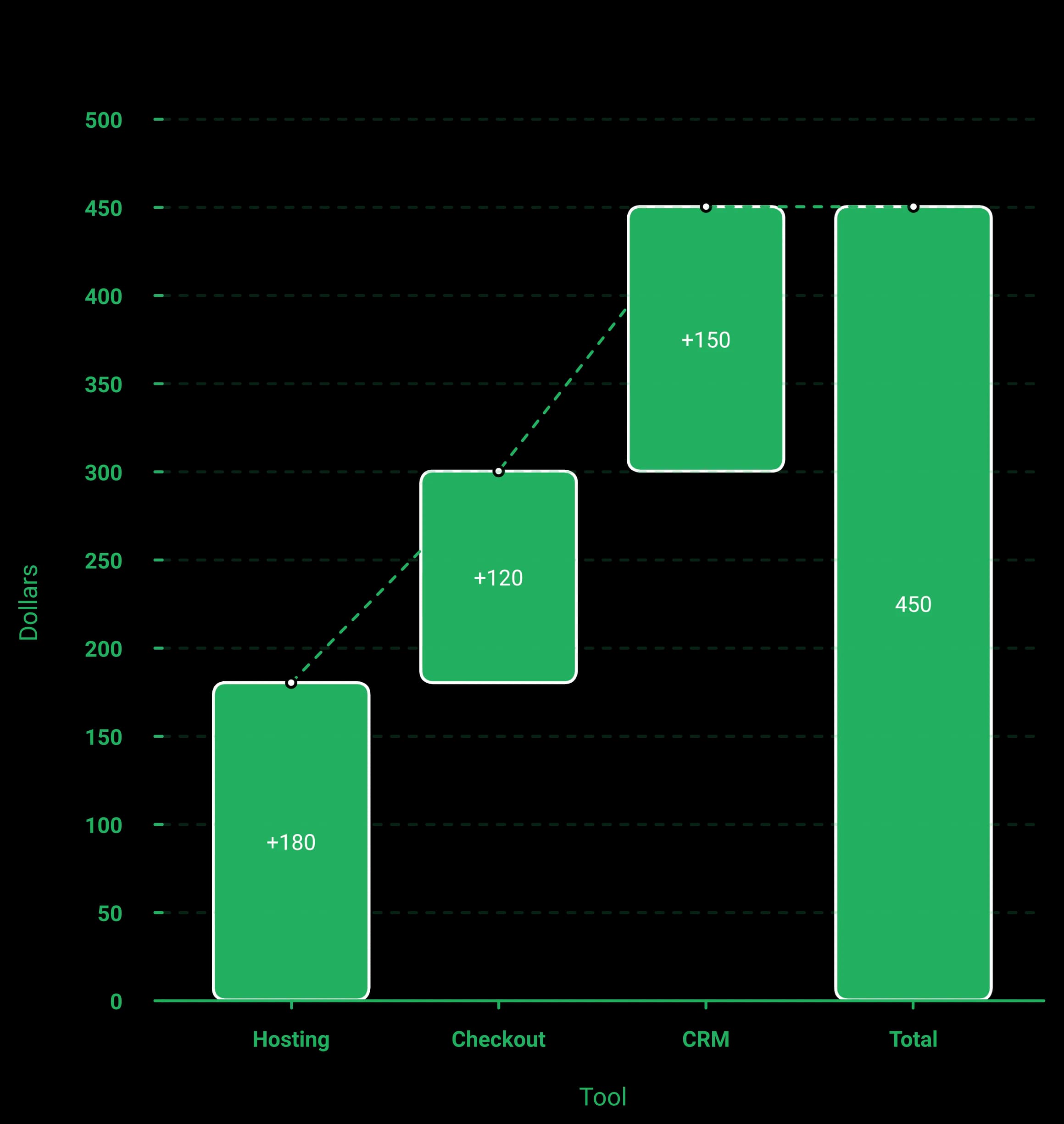
The stack you are replacing. Hosting and evergreen delivery, a checkout tool, and a sales CRM with calling add up to roughly $450 a month before the webinar platform itself.
The stack you are replacing
Look at the component tools instead of the platform. An evergreen tool plus video hosting runs $100 to $180 a month, a checkout tool with Zapier $50 to $120, and a sales CRM with calling $80 to $150. Add those three lines and you clear $230 a month before the webinar tool itself. This is where most operators quietly lose their margin, and it is the same math behind how to make money with webinars.
💸 The seam that nearly cost us a launch
Our Zapier account hit its Zap ceiling during a launch. We caught it four hours before going live, and only because a couple of hundred opt-ins were missing from the CRM.
Nobody bills you for that failure. You pay for it in leads that never got a reminder email. Every integration seam is a cost line with a failure mode attached, which is why native integrations beat chained automations.
💶 The euro problem nobody prices
WebinarGeek bills flat rate in euros, so a US or APAC buyer carries currency drift on every renewal. Third-party trackers convert Basic and Premium to roughly $57 and $80 at recent rates.
That is small at one seat. It stops being small when finance asks why the same plan cost three different amounts last year.
✅ The three-line model to build Monday
Write down base plan, add-ons, and replaced tools. Multiply by twelve, then add a 5% buffer for FX if you are paying in euros.
EasyWebinar bills in USD and folds CRM, auto-dial and checkout into the plan, so the number on the pricing page stays close to the number on the invoice a year later.
Takeaway: At entry level WebinarGeek is cheaper. At the tier where both platforms run a complete funnel the difference is roughly $14 a month, and the add-on count is where WebinarGeek's total climbs.
Yes, but not on the entry plan. WebinarGeek's €49 Basic covers live and on-demand with a two-hour cap and one presenter. Automated webinars, custom branding and up to 100 presenters begin at €69 Premium, where the cap rises to eight hours. EasyWebinar includes automated, simulive, evergreen and just-in-time scheduling with attendee timezone detection from the Growth plan, with automated viewer allowances of 1,000 on Growth, 2,500 on Pro and 5,000 on Scale.
Four words vendors use interchangeably
Live means you are actually presenting, right now.
On demand means a recording someone watches whenever they click.
Simulive means a recording that plays on a schedule, with you in the chat.
Just-in-time (JIT) means the next session starts minutes after someone registers — the core mechanic behind any automated webinar.
| Format | EasyWebinar | Webinargeek |
|---|---|---|
| Live | All plans; 2h cap on Launch, 4h from Growth | Basic, 2h cap, 1 presenter |
| On demand | All plans | Basic |
| Automated | From Growth | Premium, 8h cap |
| Simulive | From Growth | Premium tooling |
| Just-in-time | Included, attendee timezone detected | Published 5, 10 or 15-minute intervals |
| Automated viewer allowance | 1,000 Growth · 2,500 Pro · 5,000 Scale | Automated sessions draw on the viewer tier you bought |
| RTMP studio | Supported from Growth | Enterprise, €349 |
Why just-in-time is the whole ballgame
JIT is not a marketing word. It is a toggle that sets the next session to start minutes after someone lands on the page. Compare that to "next Tuesday at 7pm Eastern." One captures intent while it is hot. The other asks a stranger to remember you for six days.
EasyWebinar ships just-in-time scheduling with attendee timezone detection, so a Sydney registrant sees a session starting soon on her own clock, not yours.
⭐ Credit where it is due
WebinarGeek publishes explicit just-in-time intervals of 5, 10 or 15 minutes and describes a session that starts every few minutes depending on your wishes. That precision is a real strength and we will concede it rather than pretend otherwise.
⚠️ The wall a coach hits first
Here is the sequence we watch play out. A coach buys Basic at €49, runs three live sessions, then decides to automate the winner.
The automation toggle is not there. The upgrade to Premium is only €20 more, so it feels minor — until custom branding and multi-presenter also sit behind the same gate.
WebinarGeek-style automated setups with some live interaction layered in are probably the sweet spot. I have experience with both fully…
✅ The question to ask a sales rep
Ask this exact sentence: "On the plan you just quoted me, can I run an automated webinar, brand it as mine, and start a session within fifteen minutes of registration?"
If any part of the answer is "on the next tier up," you have your real price.
An evergreen funnel is only as good as the live version you cloned it from, so nail it live first, then automate — see how the scheduling modes differ.
Takeaway: Both platforms automate, and both gate it behind their second tier. EasyWebinar counts automated viewers separately at five times the live limit; WebinarGeek's automated sessions draw on the viewer tier you already bought.
Both platforms ship polls, quizzes, chat and call-to-action buttons. The difference is intent. WebinarGeek's interaction set is broader and engagement-first — quizzes with scored answers, assessments, evaluation forms, Interactive Sessions, question upvotes and simulated chat — though attendees can chat but never speak. EasyWebinar wires timed CTAs and offers to a checkout and a CRM record, so a click becomes a tracked buying signal instead of a dashboard number.
A room full of poll answers and zero sales
We have sat with operators reading a beautiful engagement report. Ninety-two percent poll participation, forty minutes average watch time, two sales. Engagement is not cash. The only interaction that matters is the one that sits next to an ask.
| Tool | Engagement job | Revenue job |
|---|---|---|
| Polls | Warm the room | Qualify buyers by answer |
| Quizzes | Hold attention | Segment for follow-up |
| Chat | Build presence | Capture objections to close on |
| CTA button | Look interactive | Open checkout mid-session |
| Countdown | Create pace | Time the offer window |
Where WebinarGeek is genuinely deeper
Saying this before the halfway point is what makes the rest of the comparison credible. WebinarGeek's published toolkit goes further than ours on teaching: quizzes with scored answers, assessments and evaluation forms, information boxes, question upvotes and private chat, discount codes, simulated chat and polls that replay live messages into a recorded session, up to 100 presenters on stage against our host plus up to 4 presenters, and an AI assistant that answers live chat questions at €20/mo.
EasyWebinar's published engagement set is narrower — chat, polls, question and answer, timed offers and handouts — with each one wired to a CRM record. If the quiz, the assessment and the certificate are the product, buy WebinarGeek. We are not an LMS and will not pretend to be one.
I love that we can have a poll, offer and countdown right in the event! That's going to be so great for sales and interactions.
What stands out immediately is the ease of use, from setting up your webinar to analyzing results afterward, everything is clear and intuitive.
The quality when using multiple presenters. If you have more presenters on different location the quality of the webinar will go down a lot.
The friction pattern in aggregated reviews
G2's aggregated dislikes for WebinarGeek are specific, not vague: eighteen reviewers cite a steep learning curve, fifteen cite CRM integration problems, and twelve cite limited registration page and analytics customisation.
EasyWebinar carries its own honest gripe. Setting up an automated webinar expects the presentation uploaded before you can build the funnel, which frustrates operators promoting far in advance — though the AI Funnel Builder shortens the rest of the build.
✅ Three placements to test on your next run
First, ask permission before the close — something like "I have a paid offer that goes deeper, is it okay if I walk you through it? Drop a one in the chat."
Second, promise a bonus for people still there at pitch time. Third, keep the CTA button live through the entire Q&A, not just the offer slide.
It's easy to get someone to sign up. The main issue I have with webinars is less than 15% of people that register show up.
Engagement design only matters after show rate is fixed. EasyWebinar attaches every in-webinar CTA and timed offer to EasyCRM, so the person who clicked at minute 47 lands in a follow-up sequence instead of a spreadsheet.
Takeaway: WebinarGeek wins on the depth of interaction. EasyWebinar wins on what happens to the interaction afterwards, because every CTA and timed offer lands in EasyCRM instead of a spreadsheet.
WebinarGeek charges at registration through Stripe or Mollie, then hands follow-up to your email tool, with HubSpot available as a €49/mo add-on and included on the €349 Enterprise plan. Fifteen G2 reviewers report CRM integration friction. EasyWebinar sells inside the session with in-webinar checkout, shipped in March 2026, then routes buyers and no-shows through EasyCRM with lead scoring and auto-dial.
The 90 minutes that decide your revenue
Most operators think the webinar ends when they stop talking. It does not. The next 90 minutes carry most of the money — that window is when a buyer is still warm, still in the tab, still holding a credit card. Whatever your platform can do inside those 90 minutes is your real conversion tooling.
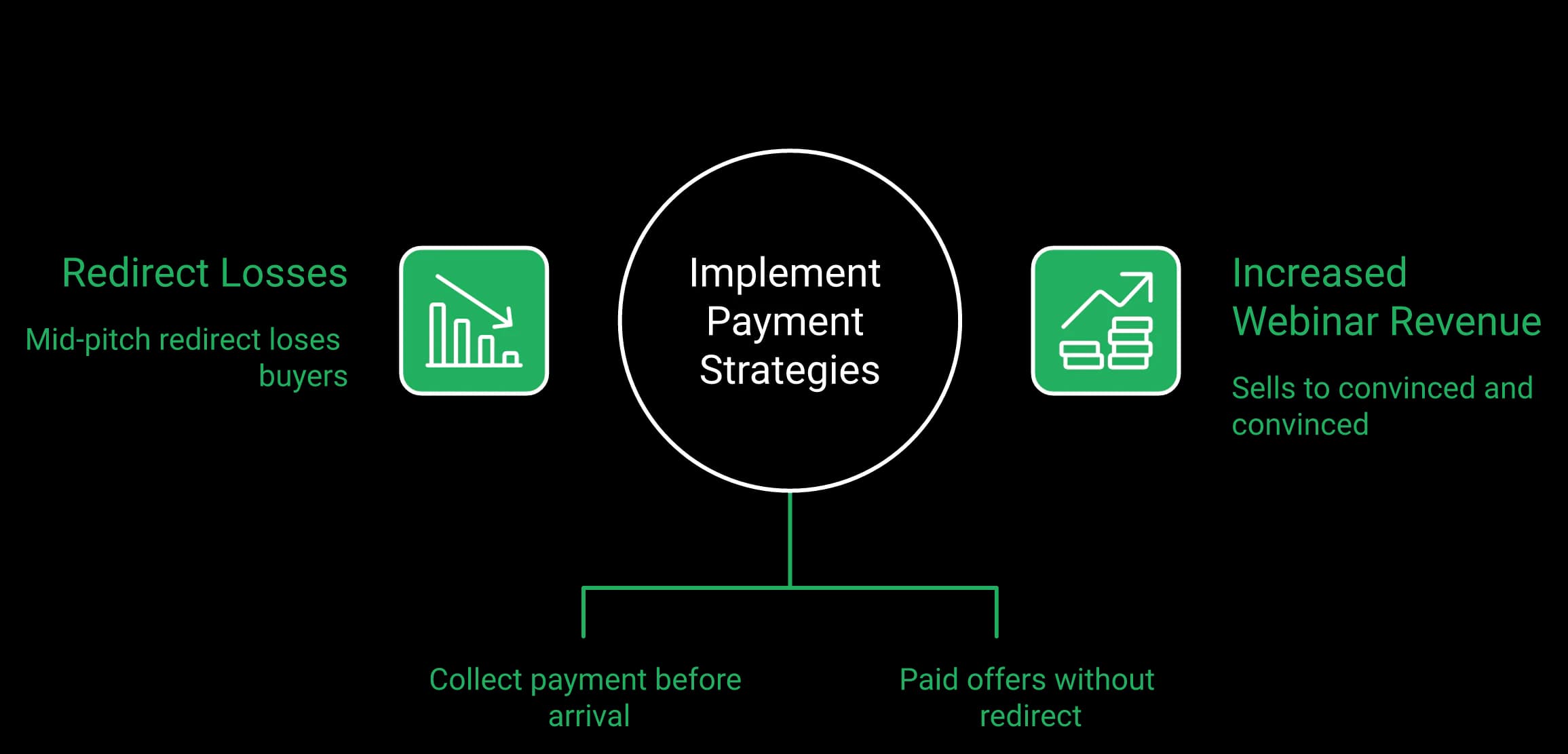
Where the money leaks. Payment collected before arrival sells to people who already decided; an in-room offer without a redirect sells to the people you convinced during the session.
Where the handoff usually breaks
Payment at registration is a different product than payment during the pitch. One filters for people who already decided. The other closes people you just convinced. WebinarGeek connects Stripe or Mollie so attendees pay while they register, then follow-up moves to your email platform and deeper CRM sync waits for the Enterprise tier.
| Capability | EasyWebinar | Webinargeek |
|---|---|---|
| Payment timing | In-webinar checkout, and paid registration via Stripe, PayPal and PayU | At registration, via Stripe or Mollie |
| Native CRM | EasyCRM from Growth | None |
| Lead scoring on webinar behavior | Native, in EasyCRM | Handled in the CRM you connect |
| Auto-dial follow-up | Included | Not offered |
| HubSpot / Salesforce Pardot | Native sync from Pro | €49/mo add-on; included on Enterprise at €349 |
| Reported integration friction | Bugs noted, fixed fast | 15 G2 reviewers cite CRM issues |
It also seamlessly integrated with our CRM. Also want to give a shout out to Rakesh who has been extremely helpful customer support rep.
I do use other email systems to send post-webinar email sequences because I can't track open and click rates on EasyWebinar.
With WebinarGeek, you can connect payment providers like Stripe or Mollie to let people pay during registration.
🤝 Why we built the CRM, and one caution
EasyWebinar built a sales CRM into the platform because leads were dying in the gap between tools, so we made it project-manage, qualify and auto-dial them. This is the single biggest functional difference between the two options here.
Be skeptical of any tool claiming to be more all-in-one than that, though. When a platform promises to also be your community, your course host and your ad manager, quality usually drops.
✅ The five-step follow-up to run Monday
- Tag buyers and no-shows separately before you leave the room.
- Send the replay to no-shows within two hours.
- Call anyone who clicked the offer but did not buy.
- Send one objection-specific email, not a generic nudge.
- Close the sequence with a real deadline you honor.
That sequence is the backbone of any working webinar funnel, and it does not care which platform you bought. On our side the pitch, the payment and the callback live in one system — see how in-room monetisation works.
Takeaway: Only one of these platforms takes payment inside the room. If your offer is made at minute 47, that distinction is small on a feature chart and large on a revenue report.
WebinarGeek rates 4.5 out of 5 across 529 G2 reviews and 4.6 out of 5 across 217 Capterra reviews, with customer service at 4.8, its strongest sub-score. EasyWebinar sits at 4.5 out of 5 across 104 G2 reviews. Read the dislikes on both, because that is where the buying decision actually hides.
The scorecard, with counts attached
A rating without a review count is decoration. Here is the same data both directory pages publish, with the volumes visible.
| Metric | EasyWebinar | Webinargeek |
|---|---|---|
| G2 rating | 4.5/5 | 4.5/5 |
| G2 review count | 104 | 529 |
| Capterra | Listed on profile | 4.6/5 across 217 reviews |
| Support sub-score | Praised for live Zoom help | 4.8/5 |
| Support geography | US timezone team | Europe-based |
The WebinarGeek complaint taxonomy
G2's aggregated dislikes are unusually specific. Eighteen reviewers cite a steep learning curve, fifteen cite CRM integration problems, thirteen cite thin onboarding guidance and twelve cite limited registration page and analytics customisation. There is no mobile or desktop app either, and Capterra reviewers add that attendees can chat but never speak in the room.
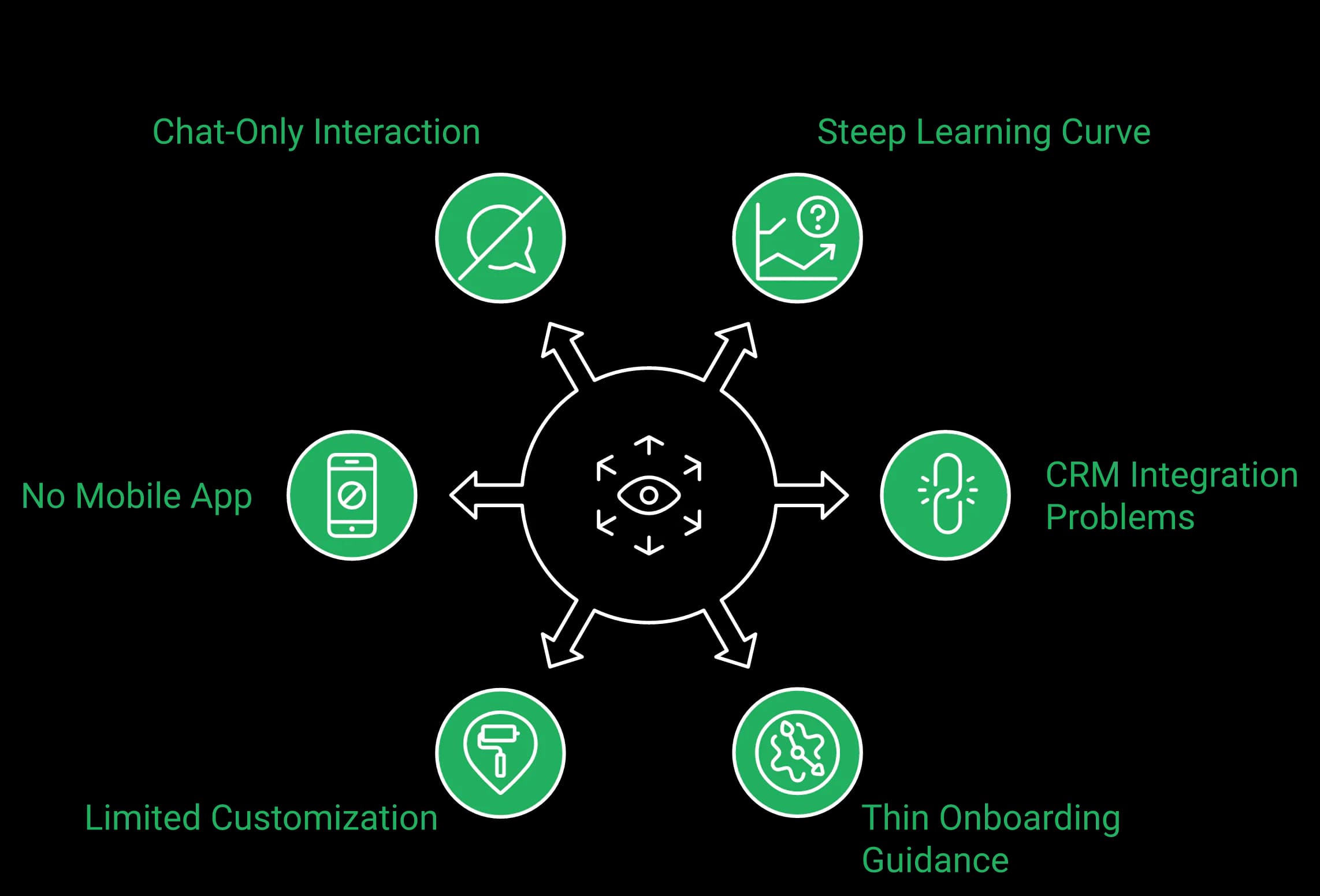
The complaint taxonomy. Counted from G2's aggregated dislikes — the six patterns reviewers raise most often about WebinarGeek.
EasyWebinar's honest weak spots
We are not going to pretend our reviews are spotless. The most repeated complaint is that automated webinars want the presentation uploaded before you can build the funnel. The second is that in-platform email open and click tracking is thinner than a dedicated ESP.
The biggest challenge is around setting up automated webinars, and needing the presentation uploaded first in order to set it up. Would love to be able to add the video later!
I would love to have more screen display options, like where I place my screen compared to my slides.
The competitor complaint worth reading twice
Design polish is the complaint we care least about. Simple scales, and fancy fails. Ugly pages have sold plenty, because the presentation carries the sale — a small host-to-viewer delay with weak conversion, as that reviewer described, is a more serious signal than an unfashionable registration page.
⚠️ What support hours feel like at 2am
WebinarGeek earns a 4.8 service score, delivered on European hours. That is excellent if you are in Amsterdam and awkward if your webinar starts at 8pm Pacific.
Also watch the volume gap. A 529-review base and a 104-review base are not comparable evidence, and several directory pages still quote stale counts.
Takeaway: Identical star ratings, very different review volumes and complaint patterns. Their friction is learning curve and CRM integration; ours is the build order on automated funnels.
These two platforms solve different compliance problems, so match the platform to the clause your contract actually contains. WebinarGeek positions as the European alternative, with attendee data in EU data centres and unusually granular privacy tooling. EasyWebinar answers procurement with SOC 2 Type II, GDPR-aligned data practices with a published Data Processing Agreement, SSO and SAML, and API access.
Two different questions, not one
Data residency asks where the records physically sit. Security attestation asks whether an auditor checked your controls. A GDPR claim does not produce a SOC 2 report, and a SOC 2 report does not move your servers to Frankfurt. Buyers who conflate the two waste weeks in review.
| Requirement | EasyWebinar | Webinargeek |
|---|---|---|
| GDPR | GDPR-aligned, with a published DPA and Model Clauses | Yes, with a DPA in-account |
| EU data residency | US-hosted, with Model Clauses covering EU-to-US transfer | EU data centres in Amsterdam and Frankfurt |
| SOC 2 Type II report | Yes | Not published |
| Granular privacy controls | Consent capture and per-attendee consent records | Deeper — registration anonymisation, IP and domain restriction, data lifecycle rules |
| SSO and SAML | Yes, on Scale and Enterprise | Not documented |
| Largest published room | Up to 100,000 live attendees on Enterprise | 5,000 viewers on Enterprise |
| Dedicated CSM and SLA | Enterprise plans | Enterprise, €349 |
🤝 What we do not hold, and where their DPA lands
We do not hold ISO 27001, PCI-DSS or HIPAA, and we will not imply otherwise. WebinarGeek's privacy controls are more granular than anything we publish, and procurement will find that out anyway.
One correction worth making in both directions: EU data centres are not the same as a guarantee. WebinarGeek's own DPA permits processing outside the EEA where sub-processors meet Chapter V safeguards, so ask for the sub-processor list rather than relying on the marketing line.
✅ Four questions for your security reviewer
- Where is attendee personal data stored, and can we name the region in a contract?
- Is a current SOC 2 Type II report available under NDA?
- Does the platform support SSO or SAML on the plan we are buying?
- What is the documented data deletion and export process at cancellation?
Question four is usually settled by the data processing addendum rather than a sales call.
⚠️ The tier trap in compliance shopping
Compliance features often live on the most expensive plan. WebinarGeek's Enterprise tier at €349/mo carries the custom domain, RTMP streaming, SLA and dedicated success manager.
Price your compliance requirements before you price your attendee count. Most buyers do this backwards and get surprised in month two.
Takeaway: If a German public sector buyer writes EU-only residency into the contract, WebinarGeek is the shorter path. If procurement wants an audited control environment, SSO and very large capacity, EasyWebinar is.
Both are browser-based and quick to a first live session, though 18 G2 reviewers describe WebinarGeek's learning curve as steep and 13 cite thin onboarding guidance. EasyWebinar assembles registration pages, reminder sequences and replay flows from one build, though automated setup expects your deck uploaded first. Budget one working day either way.
The honest time estimate
A first live session takes an afternoon on either platform. A complete evergreen funnel with reminders, replay and follow-up takes a day. Anyone promising fifteen minutes is describing a test room, not a funnel. The build time is not the platform — it is your offer copy.
✅ The day-one sequence
- Record or upload the presentation before touching the funnel.
- Build the registration page and set attendee timezone detection.
- Write three reminder emails, then one replay email.
- Place the offer CTA and the countdown inside the room.
- Run one internal rehearsal from a phone, not a laptop.
I love how easy to use EasyWebinar is. It didn't take long to get set-up. I'm going live with my first webinar in just a few hours.
The migration path, in order
Switching platforms is mostly a data and reminder problem. Export your registrant list first, because you own that asset and should never leave it stranded. Then rebuild one funnel, not five. Re-point your email automations, keep the old account live for one full cycle, and cancel only after a clean run.
Usually, I have to find outside help to implement any techy things. I found EasyWebinar all made sense and I could connect it to my other things and it all went smoothly.
⚠️ Check the tech, every single time
Test the registration button on a phone, not a desktop. We once found that sending a join link inside a text message hurt our booking rate badly, because phone attendees behaved differently.
What the switching debate sounds like
WebinarGeek-style automated setups with some live interaction layered in are probably the sweet spot. I have experience with both fully…
One more workflow note that saves hours: editing a recorded session by deleting words from a transcript is far faster than scrubbing a timeline, so record with a tool that transcribes.
Takeaway: One working day to a real funnel on either platform. EasyWebinar's AI Funnel Builder generates the registration page, reminder sequence and replay flow from one brief, which is the difference between a Monday launch and a Friday one.
Run live first. Operators split hard here — some build evergreen from day one because live show rates disappoint, while others insist on a sprint of five to ten live sessions until the offer clears a 10% attendee-to-buyer rate. EasyWebinar runs the live sprint and the evergreen version on one account, so proving an offer live does not mean buying a second platform later.
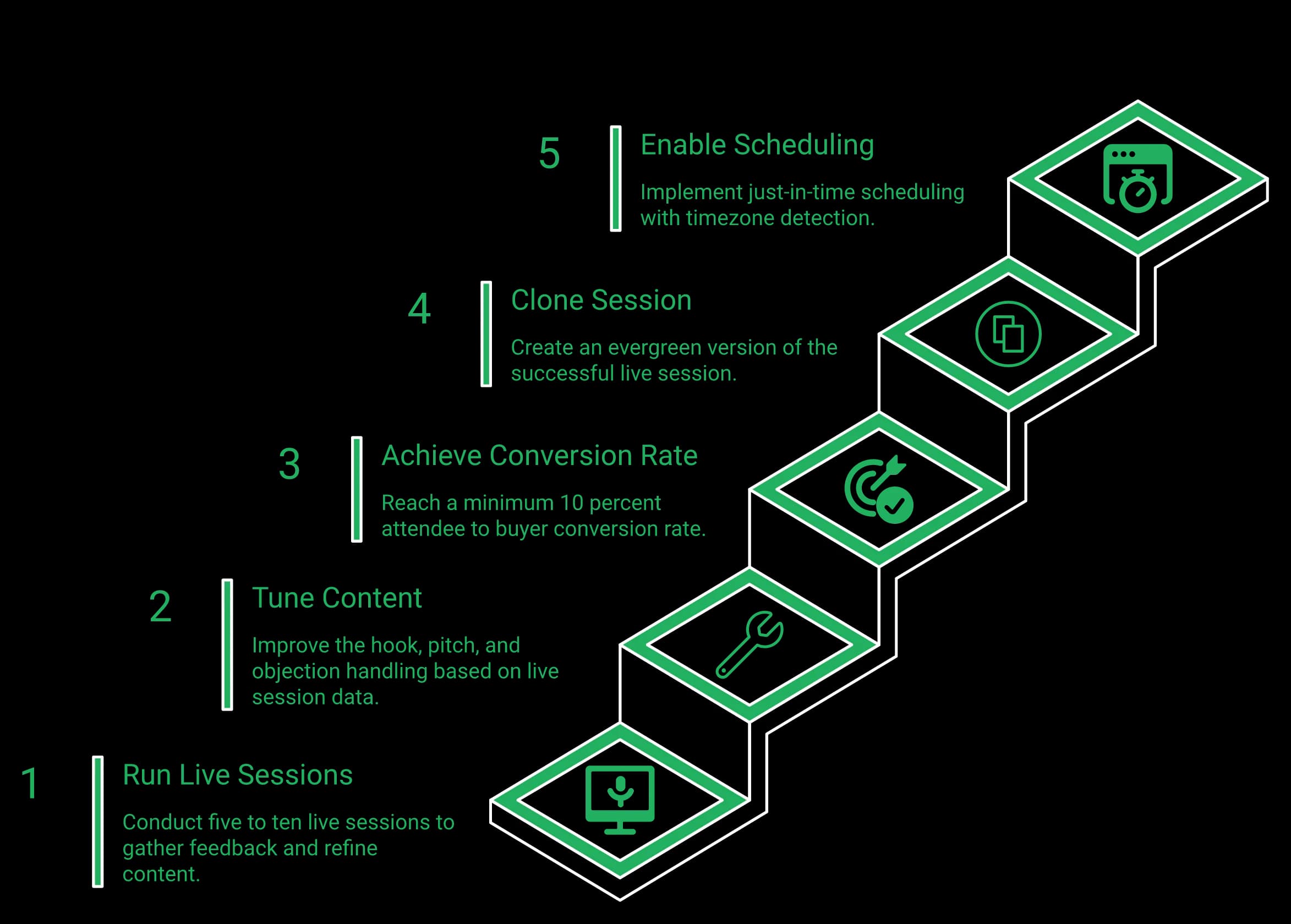
The order that works. Five to ten live sessions, tune the hook and the pitch, clear 10% attendee-to-buyer, then clone the winner into an evergreen funnel with just-in-time scheduling.
The advice you have already heard
The popular playbook says automate immediately. Record once, run it forever, stop showing up on Wednesday nights. We understand the appeal — and we have watched that advice quietly wreck a lot of good offers, including one of our own.
The counter view, stated fairly
There is a real camp that disagrees with us. Yuri Elkaim argues you do not need a live workshop every week, because show-up rates are poor and evergreen scales better. That camp is not wrong about show rates — fewer than 15% of registrants showing up is a normal complaint among operators. Our read is that this argues for better reminders, not for skipping the live phase.
✅ The gate we actually use
Run five to ten live sessions, fix the hook, the pitch and the objection handling, then automate the winner.
The number that matters is 10% attendee-to-buyer. Below that, automation just scales a broken offer to more people, faster.
In our work with K21 Academy, show-up climbed to 47% alongside 5× registrant growth — and that only happened because the live version was tuned first.
⚠️ The three-hour failure that taught us this
One webinar ran close to three hours. A presenter rebuilt the slide deck alone, the energy was off, and a sophisticated audience checked out. That session produced one sale.
Automating it would have produced one sale per month, on autopilot, forever. An automated webinar without traffic is also a billboard in the desert.
How this changes the plan you buy
This decision maps directly to money. If you run the live sprint on WebinarGeek Basic, you get a two-hour cap and one presenter for €49. Automation arrives at €69 Premium, where the cap rises to eight hours. So the honest sequence is either two upgrades, or one platform that carries both phases.
🤝 One rule we hold regardless of platform
Never tell an automated audience the session is live, and never insist it is not. Say "this session is starting now" and let the room behave normally. Trust survives a recording. It does not survive a lie in the chat.
Takeaway: Prove the offer live, then automate the winner. Buying a platform that only does one of those phases means paying for the migration later.
Course creator selling an evergreen offer: EasyWebinar. Enterprise training needing SSO and large audiences: EasyWebinar. B2B SaaS team needing HubSpot sync: EasyWebinar, or WebinarGeek Enterprise at €349. EU agency with data residency clauses in client contracts: WebinarGeek. Solo educator running live teaching sessions inside Europe: WebinarGeek Basic at €49.
How we weighted this
Three criteria carry most of the decision: where your data must live, whether automation is included at your price, and whether the platform can take money. Everything else is preference. Both tools stream video competently, and neither will embarrass you in front of an audience.
Five profiles, with a verdict each
- Course creator with a paid evergreen offer — EasyWebinar, because checkout and CRM ship with the plan.
- Enterprise training lead needing SSO, SAML and audit artifacts — EasyWebinar, on SOC 2 Type II.
- B2B SaaS demand gen team wanting HubSpot sync — EasyWebinar, or WebinarGeek Enterprise at €349.
- EU agency with data residency clauses — WebinarGeek, on EU data centres.
- Solo educator hosting live sessions in Europe — WebinarGeek Basic, at a two-hour cap.
| Operator profile | Recommended platform | Deciding factor |
|---|---|---|
| Course creator, paid evergreen offer | EasyWebinar | Checkout and CRM inside the plan |
| Enterprise training lead | EasyWebinar | SOC 2 Type II, SSO and SAML |
| B2B SaaS demand gen team | EasyWebinar, or WebinarGeek Enterprise | HubSpot sync — €349/mo on WebinarGeek |
| EU agency with residency clauses | WebinarGeek | EU data centres |
| Educator running scored assessments | WebinarGeek | Quizzes, assessments and evaluation forms |
| Solo educator, live sessions in Europe | WebinarGeek Basic | Two-hour cap at €49 |
❌ Do not buy EasyWebinar if
We would rather lose the sale than watch a refund request. Skip us for one-off internal team meetings, where a meeting tool is cheaper and simpler. Skip us for pure live-only events with no funnel intent.
Skip webinars entirely under a $200 price point, because the math rarely justifies the production work.
The integration with my email service provider was seamless, allowing me to automate a follow-up sales sequence once someone watches the webinar.
Rakesh was fantastic to work with, he helped set up everything from our email responses to our landing page seamlessly.
⚠️ The pricing lesson we paid for twice
We used to run a Sunday night strategy session at 7pm Eastern. It got draggy, and neither side wanted to be there. So we removed it and rebuilt it for people willing to pay more — and suddenly it was worth showing up for.
Price the model you can sustain, not the one that looks generous, and let paid webinars carry the filter for you.
Your next step
If your answer was EasyWebinar, the next question is which plan matches your attendee count, and the fastest way to know is to watch the evergreen funnel run once. You can check every tier and inclusion on the webinar pricing page, or keep shortlisting with EasyWebinar vs Demio.
One prediction going into 2027: as AI-built funnels get cheap, live workshops come back hard, because the scarcity of a real human moves offers. Tell us what you are seeing in your own show rates — that read could be early.
Takeaway: You have the comparison. Now price it against your own attendee count, and pick the platform whose included features match the job you are actually hiring it for.
Still deciding?
The side-by-side comparison above goes deeper than any single answer here — pricing, automation, CRM, checkout and security, row by row.
EasyWebinar vs WebinarGeek FAQ
WebinarGeek is cheaper at the advertised price and closer once you load the plan. Basic at €49/mo is the better buy for one presenter running live and on-demand sessions to a small room — but it excludes automated webinars, allows one account user, caps sessions at two hours, and shows a WebinarGeek badge on public pages. At the tier where both platforms do the same job, WebinarGeek Premium at €69 plus HubSpot €49, AI assistant €20, localisation €20 and one extra user €10 reaches €168/mo, roughly $184. EasyWebinar Pro is $198/mo month-to-month or $165 billed annually, with native HubSpot and Salesforce Pardot (Account Engagement) sync, EasyCRM, AI funnel builds and multi-language rooms included. Stop asking which plan is cheaper and ask what each plan costs once it does what you need.
Yes, but not on the entry plan. WebinarGeek's automated webinars, just-in-time scheduling, hybrid sessions and paid webinars all begin on Premium at €69/mo. Basic covers live and on-demand only, with a two-hour session limit and one presenter. Two words worth separating: a scheduled automated webinar is a recording that plays at set times you publish, while a just-in-time webinar starts minutes after someone registers so intent never cools. WebinarGeek publishes explicit just-in-time intervals of 5, 10 or 15 minutes, and that precision is a real strength we will concede. EasyWebinar runs live, automated, simulive, on-demand and just-in-time formats, with automation from the Growth tier at 1,000 automated viewers and Pro at 2,500, and session cloning so a proven live session becomes an evergreen one without rebuilding the funnel.
Only on EasyWebinar. WebinarGeek's paid webinars connect a Stripe or Mollie account so people pay during registration, which works well for ticketed workshops and paid training where the transaction happens before anyone shows up — it filters for people who already decided. EasyWebinar shipped paid registration through Stripe, PayPal and PayU, plus paid offers with checkout inside the live room, in March 2026, so the offer made at minute 47 right after you handle the third objection can be paid for without a redirect to another tab. The follow-up gap is the other half: WebinarGeek hands post-session work to your email tool and integrates with CRMs rather than shipping one, while EasyCRM ships natively from Growth with sequences and automated follow-up, and EasyWebinar scores leads on webinar behavior.
WebinarGeek does, and this is the dimension where we lose. Its published toolkit is deeper than ours: quizzes with scored answers, assessments and evaluation forms, information boxes, question upvotes and private chat, discount codes, simulated chat and polls that replay live messages into a recorded session, up to 100 presenters on stage against our host plus up to 4 presenters, and an AI assistant that answers live chat questions at €20/mo. EasyWebinar's published set is narrower — chat, polls, question and answer, timed offers and handouts — each wired to a CRM record so a click becomes a tracked buying signal. Use this as the scoring criterion: is your session a lesson or a pitch? If the quiz, the assessment and the certificate are the product, buy WebinarGeek. We are not an LMS and will not pretend to be one.
They answer different questions in a security review, so match the platform to the clause your contract actually contains. WebinarGeek is a Dutch vendor with unusually granular privacy tooling: consent fields, double opt-in, registration anonymisation, email blocklists, IP restriction, domain restriction, data lifecycle rules for automatic archive, anonymise or delete, and a custom Data Processing Agreement on Enterprise. For a European organisation with strict retention policies, those controls are more granular than anything we publish. EasyWebinar holds SOC 2 Type II and follows GDPR-aligned data practices, with a published Data Processing Agreement including Model Clauses, plus SSO/SAML and API access on Scale, and Enterprise events to 100,000 live attendees. We do not hold ISO 27001, PCI-DSS or HIPAA, and we will not imply otherwise. One caveat on the EU line: WebinarGeek's own DPA permits processing outside the EEA where sub-processors meet Chapter V safeguards, so ask for the sub-processor list rather than relying on the hosting claim alone.
WebinarGeek's trial is 14 days against EasyWebinar's 7, so on calendar time WebinarGeek wins. The more useful question is what each trial lets you validate. EasyWebinar's 7 days run at full plan access — evergreen and just-in-time funnels, AI campaign creation, paid webinars, in-room checkout, EasyCRM and lead scoring — so you can rehearse an entire revenue workflow before you pay. WebinarGeek's longer window suits evaluating the teaching experience and its assessment tools. Extra days cannot demonstrate tooling that is not in the product.
Yes, on Pro and above. Upload your context, such as PDFs and other files, and the AI Moderator answers attendee questions in the chat from that material during live, simulive and automated webinars. It is not included on Launch or Growth.