Webinar platform comparison
EasyWebinar vs Livestorm. Which webinar platform is right for you?
Both are polished, reliable webinar platforms. Livestorm leans into collaborative event operations; EasyWebinar combines reliable live delivery with deeper automation, conversion, CRM and revenue workflows.
 4.5/5 from 100+ EasyWebinar reviews
Choose EasyWebinar for conversion & growth.
Live + evergreen, Just-in-Time, AI funnel creation, EasyCRM, lead scoring, paid webinars, in-room checkout and multistreaming.
Choose Livestorm for event operations.
Strong multi-speaker rooms, unlimited team members on Pro, collaboration, localization and enterprise event controls.
Recognized and trusted
Independent reviews, audited security, and global privacy controls.




30-second comparison
EasyWebinar vs Livestorm at a glance
Short answer: choose Livestorm if the live event is the product, and EasyWebinar if the webinar has to generate revenue. Livestorm charges $3.00 per attendee, per session — replays included. EasyWebinar Growth is $116 a month flat for 200 live attendees plus 1,000 automated viewers, with evergreen and Just-in-Time scheduling, EasyCRM and in-room checkout included.
| What matters | Livestorm | |
|---|---|---|
| Best for | Lead generation, demos, sales, evergreen & revenue workflows | Collaborative events, panels, training & event programmes |
| Pricing model | One flat monthly price for the session size you need | – $2.75–$3.00 per person, per session, bought as a yearly credit pack |
| Live webinars | Yes | Yes |
| Automated / evergreen | Yes — automated viewers are already paid for in the plan | – Yes — but every replay or on-demand view spends a credit |
| Just-in-Time scheduling | Yes | – No direct equivalent found |
| Built-in CRM + lead scoring | EasyCRM from Growth | – No native CRM |
| Paid webinars / checkout | Native + in-room checkout | – External payment workflow |
| Multistreaming | Included from Growth | – Paid add-on |
| What a second viewing costs | Nothing extra — Growth includes 1,000 automated viewers per session | – One more credit, every time — live, replay or on-demand |
| Enterprise security highlight | SOC 2 Type II, GDPR, SSO/SAML on higher tiers | ISO 27001, SAML add-on, EU/USA video-hosting option |
Livestorm advantage
Choose Livestorm when the live event experience and event operations are the main job.
EasyWebinar advantage
Choose EasyWebinar when the webinar is part of your acquisition and revenue funnel.
Comparison facts checked August 28, 2026. Vendor pricing and features can change; verify before procurement.
7-day full access. Credit card required; no charge during the trial.
Pricing without guesswork
Two pricing models. One simple difference.
EasyWebinar charges for the room. Livestorm charges for every person who walks into it — including the ones who only watch the replay.
Growth starts at
$116/month, flat
200 live attendees · plus 1,000 automated viewers per session · $1,392 paid yearly
Pro credits at
$3.00/attendee credit
≈ $600/month for the same 200 attendees · one credit each, every time the session runs
Flat capacity
You pay for the room, not the head count.
Growth $116, Pro $198, Scale $349 a month. Double your registrations and the bill stays the same.
Where it flips
The crossover is near 460 attendees a year.
Under it, credits genuinely cost less and we say so. Over it, every viewing your funnel earns costs another $3.00.
USD prices verified August 28, 2026. High-volume Livestorm figures are estimated at its best published credit rate. No-shows never spend a credit, and team members are free on every Livestorm plan.
7-day full access. Credit card required; no charge during the trial.
Automation
Both can replay a webinar. Only one can run it as a funnel.
Livestorm does automate webinars — recurring sessions, on-demand replays and pre-loaded polls are all included on its paid plans. Two things are different: Livestorm charges a credit for every automated viewer, and it has no published way to start a session on the visitor's schedule instead of yours.
Automated funnel
The automated room keeps selling and following up
- Automated, simulive and evergreen sessions, plus on-demand and Just-in-Time in the visitor's own time zone.
- 1,000 automated viewers per session on Growth, 2,500 on Pro, 5,000 on Scale — already paid for.
- Timed offers and checkout inside the room; live chat handoff plus behavior-based EasyCRM follow-up.
- AI Funnel Builder generates the pages, emails, polls and offer as one set.
- AI Moderator, from Pro: upload PDFs and other files, and it answers attendee questions in the chat from them during live, simulive and automated webinars.
Livestorm
Automated playback
A scheduled or on-demand replay, priced per viewer
- Automated and recurring events plus on-demand replays, included on paid plans.
- One credit per person, per session — replay and on-demand viewings included.
- Polls and CTAs can be pre-loaded; payment happens outside the room.
- Automated sessions are passive; follow-up is manual or via an external CRM.
| The plain question | Livestorm | |
|---|---|---|
| Can you schedule a pre-recorded session to run like a live one? | Yes — automated, simulive and evergreen | Yes — automated and recurring events |
| Can people watch whenever they land on the page? | Yes — on demand and Just-in-Time, in the visitor's own time zone | – On demand yes; no published Just-in-Time / next-available start |
| Does each automated viewer cost extra? | No — 1,000 automated viewers per session on Growth, 2,500 on Pro, 5,000 on Scale | – Yes — one credit per person, per session, replay included |
| Can the automated room still sell? | Timed offers and checkout inside the room | – Polls and CTAs can be pre-loaded; payment happens outside |
| Who answers a question asked at 2am? | Live chat handoff plus behavior-based EasyCRM follow-up | – Automated sessions are passive; follow-up is manual or via an external CRM |
| Who builds the pages, emails, polls and offer? | AI Funnel Builder generates the whole set | – Built by hand; Livestorm's AI is aimed at post-event repurposing |
The simple version
On Livestorm, an evergreen webinar that works costs more every month it works.
EasyWebinar advantage
On EasyWebinar, the viewers it brings in are already paid for.
Conversion & revenue
Where EasyWebinar's total value becomes clearer
Both platforms register attendees and run engagement in the room. The difference is how much of the revenue workflow — payment, CRM, scoring, follow-up — is native to the platform.
| Revenue workflow | Livestorm | |
|---|---|---|
| Registration pages | Built in | Built in |
| Timed CTAs / offers | Built in | CTAs / engagement available |
| Paid registration | Native workflow | – External payment + Zapier workflow |
| Checkout inside the webinar | Yes | – No native in-room checkout found |
| CRM included | EasyCRM from Growth | – No native CRM |
| Lead scoring + behavior follow-up | Native | – Through external CRM / integrations |
| Native Salesforce Pardot | Pro | – Enterprise paid add-on |
Events vs funnels
Livestorm is the better event room. EasyWebinar is the better funnel.
Everything in this comparison reduces to that sentence. Both run a reliable live session — the difference is what happens around it, and whether the session keeps working after the calendar invite expires.
The funnel around the room
One session becomes an asset that keeps selling
- Sub-second latency on Dolby OptiView, with polls, timed offers and CTAs inside the session.
- The same recording runs live, simulive, evergreen, on-demand or just-in-time from one funnel.
- Payment happens where the decision happens — in-room checkout and paid registration.
- Every attendee is scored and followed up in EasyCRM, in the same system.
Livestorm
The room itself
The better buy when the event is the product
- Multi-speaker panels, moderator controls, upvotes and reactions are deeper than ours.
- Team seats are unlimited and free, which is a real cost advantage for large teams.
- Broad language coverage, including right-to-left, for global event programmes.
- Best fit for internal all-hands, training days and multi-session conferences — not acquisition.
We will not overstate this one: for panels, internal events and conference programmes, Livestorm is the stronger choice and we say so. What it does not do is turn that session into a funnel that runs, sells and follows up without you.
Distribution
EasyWebinar bundles multistreaming earlier.
If the webinar also has to reach LinkedIn, YouTube or X on the day it runs, check which plan the capability lives in before comparing headline prices.
| Distribution | Livestorm | |
|---|---|---|
| Multistreaming | Included from Growth | – Restreaming add-on |
| Destinations | 3 on Growth, 10+ on Pro/Scale | LinkedIn, YouTube, X and more through Restreaming |
| RTMP input | Supported | – Add-on |
Security & enterprise
Choose based on the control your procurement team actually requires.
Neither platform wins this outright. The right answer depends on the exact certification and data-protection clauses in your policy.
| Requirement | Livestorm | |
|---|---|---|
| Security certification | SOC 2 Type II | ISO 27001 |
| GDPR | Yes + DPA | Yes |
| SAML SSO | Scale / Enterprise | – Add-on |
| Large live capacity | Enterprise up to 100,000 live attendees | Enterprise / custom credit package |
Try before you decide
Two different ways to evaluate the product.
One offer tests the room. The other tests the revenue workflow: seven days of full access, including evergreen scheduling, in-room checkout and EasyCRM.
| Trial | Livestorm | |
|---|---|---|
| Entry | 7-day full-access trial | – Free plan capped at 20 minutes and 30 attendees |
| Credit card | Required; no charge during trial | No credit card |
| What you can test | The full conversion workflow: live, automation, CRM, checkout, follow-up | – The room only — no evergreen scheduling, checkout or CRM to test |
Which should you choose?
Choose around the job the webinar has to do.
Both are credible platforms. The decision is not which has more features — it is whether the webinar is an event you run or a funnel you operate.
Choose the revenue system
Choose EasyWebinar if…
- ✓Webinars need to generate leads, demos, customers or revenue.
- ✓You want live sessions to become evergreen or Just-in-Time funnels.
- ✓You want CRM, lead scoring, checkout and follow-up tied to webinar behavior.
- ✓You run webinars frequently and prefer predictable capacity pricing.
- ✓You want one platform for hosting + funnel + follow-up + monetization.
Livestorm
Choose event operations
Choose Livestorm if…
- ✓The live event experience is the main product.
- ✓You run large multi-speaker panels, training or internal programmes.
- ✓Unlimited team members on Pro matters to your operating model.
- ✓You need ISO 27001 or Livestorm's published hosting-region option.
- ✓Your event volume is low enough that attendee-credit pricing fits well.
Your CRM or ours. Already run HubSpot, Salesforce Pardot, ActiveCampaign, Kit or GoHighLevel? Keep it. EasyWebinar runs the webinars and the checkout and connects to the CRM you already use — or start with EasyCRM, built in from Growth.
Test the full conversion workflow: live, automation, CRM, checkout, follow-up.
7-day full access · SOC 2 Type II · GDPR + DPA
Complete buyer's guide
Continue with the full research behind the comparison.
Written by Pranav Sharma, Chief Business Officer at EasyWebinar, on August 27, 2026. Pricing, automation, security and review evidence were fact-checked against published vendor documentation.
In this guide
EasyWebinar vs Livestorm: Pricing, Automation & Attendee Experience Compared
Verified August 28, 2026
TL;DR
- Livestorm is the better built event product. EasyWebinar is the better built funnel product. The deciding question is whether webinars are scheduled occasions or an acquisition asset.
- Livestorm Pro charges $3.00 per attendee credit. EasyWebinar Growth is $116 per month flat for 200 live attendees plus 1,000 automated viewers.
- The cost crossover lands near 460 attendees a year. Below that, consumption pricing is genuinely cheaper, and we say so plainly.
- Livestorm publishes on demand events and event automation, but no scheduled evergreen funnel and no just in time scheduling.
- Livestorm wins the room with 25 simultaneous speakers, upvotes, and 24 languages. It also holds ISO 27001, which EasyWebinar does not.
- EasyWebinar shipped in room checkout and paid registration in March 2026, plus native EasyCRM from Growth and an AI funnel builder in January 2026.
Livestorm is the better built event product. EasyWebinar is the better built funnel product. If your constraint is the quality of each session, Livestorm wins, with 25 simultaneous speakers, question upvotes, and unlimited team seats. If your constraint is that every lead costs a live session someone has to run, EasyWebinar wins, because Livestorm publishes no scheduled evergreen funnel.
The moment this comparison usually starts
A marketing manager opens her webinar dashboard on a Wednesday. Registrations look fine. Attendance looks fine. Her VP asks which sessions produced pipeline, and the answer takes four spreadsheets.
That is the real question behind this search. It is not "which tool runs a nicer webinar." It is "why does a working webinar platform programme produce no revenue?"
⭐ Where Livestorm genuinely wins
I will concede this without hedging. Livestorm's in room toolkit is deeper than ours. It ships 25 simultaneous speakers, unlimited moderators, question upvotes, noise cancellation, and 24 languages with right to left support.
It also carries proof we cannot match yet. Capterra lists 398 reviews at 4.7, with 385 positive. Its customer list includes Equifax, Abbott, Zapier, and Intercom.
What I liked most about Livestorm was how easy it was to host webinars without requiring anyone to download software. Everything ran directly in the browser, the interface was clean, and attendees could join instantly.
💰 What polish does not do
Polish does not run the session at 2am while you sleep. Polish does not take the payment while the offer is still on screen.
Livestorm's own pricing FAQ explains the trade you accept in exchange. You spend one attendee credit each time a person actually attends, and Pro sits at $3.00 per attendee. Reach becomes a line item.
Price (odd pricing model based on contacts instead of registrants or attendees). Makes the platform crazy expensive for SMBs.
✅ The scoring question I would use
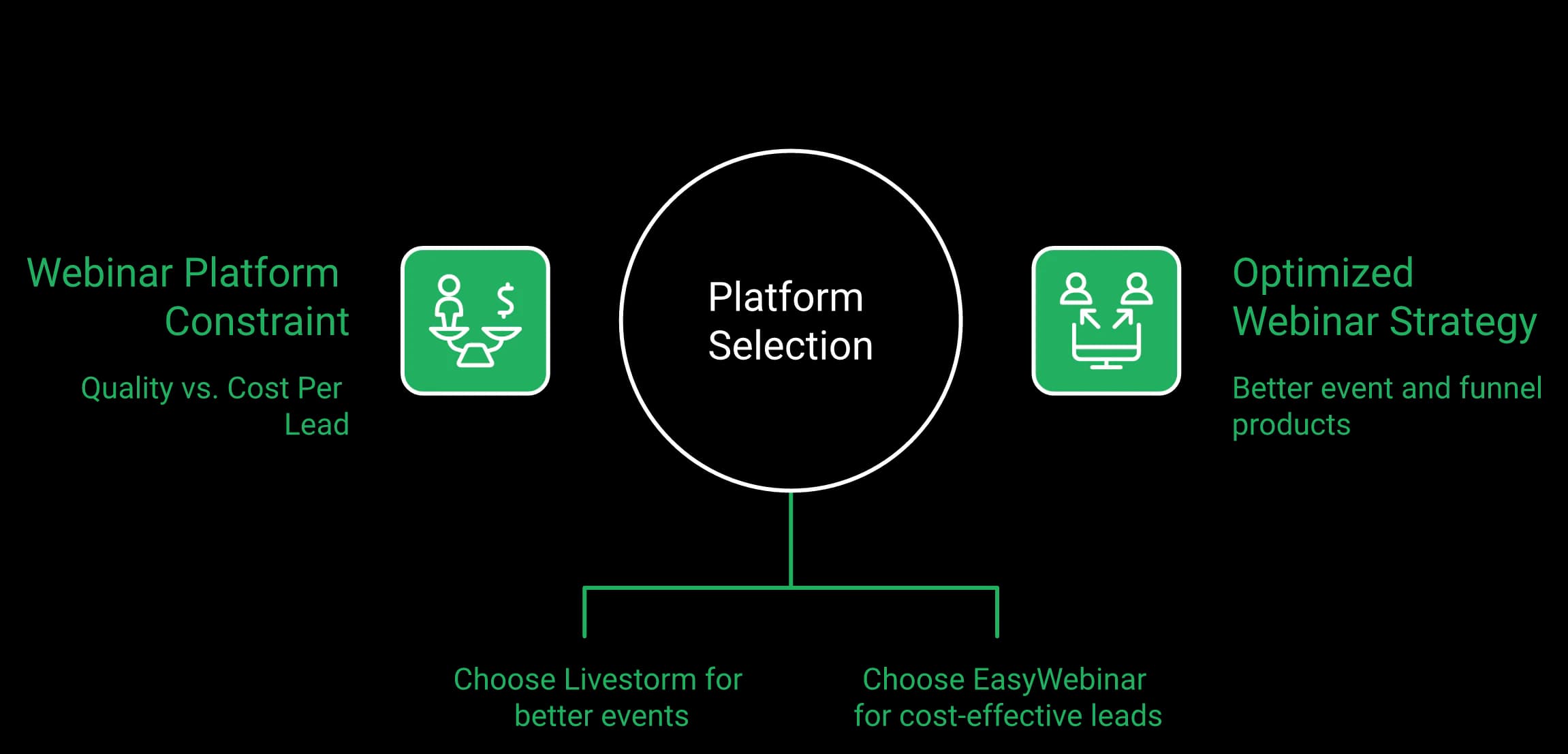
Ask yourself one thing before you compare webinar platforms. Is your constraint the quality of the event, or the number of events you can afford to run?
If it is quality, buy Livestorm and stop reading at Q4. If it is volume, keep going, because the arithmetic in Q2 decides this purchase.
The perspective I have earned the hard way
I did not arrive at webinars through strategy. I arrived through a bad year. My real estate income fell from mid six figures to $15,000, and I nearly lost my house.
Then I spent six months building a YouTube course that sold zero copies. A webinar was the only thing that ever sold it. That is why I read this category through revenue, not through interface design.
EasyWebinar's read is that the standard advice gets this backwards, though I might be pushing the point harder than the data supports. Engagement metrics feel like progress. They are not cash.
EasyWebinar is hands down THE webinar platform for evergreen webinars, no contest. While plenty of software can stream live webinars (and do), EasyWebinar is the only one on the market who makes a product built specifically to scale and 10X your efforts.
EasyWebinar is built so one recorded session keeps selling after the calendar invite expires. Live, simulive, evergreen, on demand, and just in time run from one funnel, with checkout inside the room. Growth is $116 per month for 200 live attendees plus 1,000 automated viewers.
These are different units. Livestorm Pro is $3.00 per attendee credit, spent once per unique participant per session across 12 months, counting live, replay, and on demand alike. EasyWebinar Growth is $116 per month flat for 200 live attendees plus 1,000 automated viewers. At 1,200 attendees a year, credits cost about $3,600 against $1,392.
State the units before you state the numbers
Any table that puts $3.00 next to $116 without explaining the units is misleading. One is a consumption charge. The other is a subscription.
So here is the fair version. Livestorm bills for outcomes you want more of, and EasyWebinar bills for capacity you may not use, which is why the webinar pricing page matters more than the feature grid.
⚖️ The parts of Livestorm's model that are genuinely fair
Livestorm does not charge for no shows. Its FAQ says people who register but never show up are not counted. Team members never consume credits either.
That matters more than it sounds. On a 40% show rate, you pay for the 40, not the 100. Livestorm measures the thing you actually received.
💸 The crossover table, with the assumption named
I am pricing one variable here, which is annual attendee volume. Everything else is held flat.
| Annual attendees | Livestorm Pro at $3.00 each | EasyWebinar Growth at $116/mo | Cheaper option |
|---|---|---|---|
| 300 | $900 | $1,392 | Livestorm |
| 700 | $2,100 | $1,392 | EasyWebinar |
| 1,200 | $3,600 | $1,392 | EasyWebinar |
| 3,000 | $9,000 | $1,392 (within automated cap) | EasyWebinar |
Crossover lands near 460 attendees a year. Below that, consumption pricing is honestly cheaper, and I would say so to a prospect on a sales call.
⏰ Turning registrations into credits
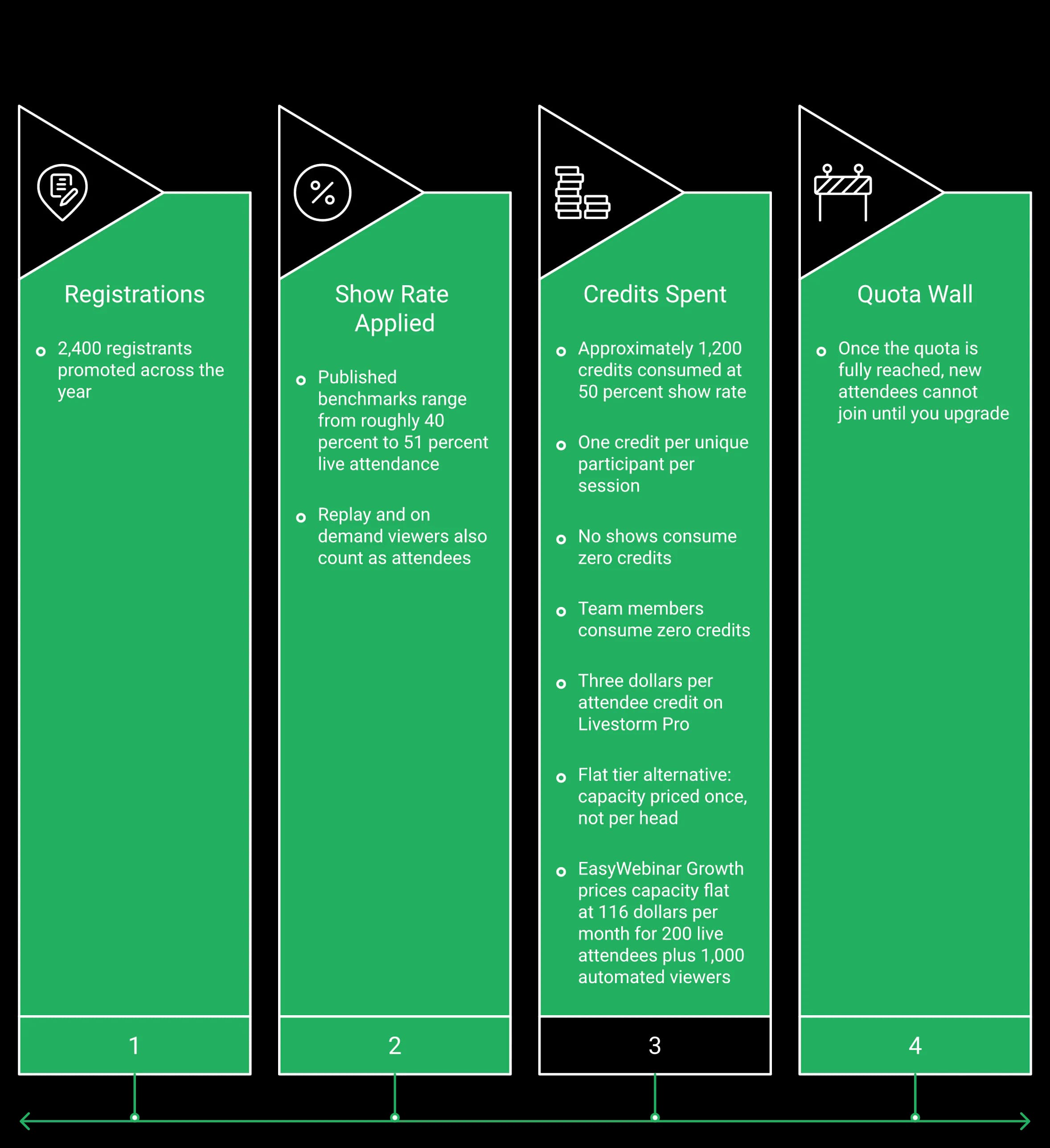
Most operators model registrants, not attendees, and that is the error. Livestorm's 2026 report of 850 go to market leaders puts the average show up rate at 51.3%, with 83 average live attendees.
Goldcast's 2026 study of 26,190 events puts attendance at 40.1%. Univid records 49% live, rising to 57% once replays count. Under Livestorm's rules, those replay viewers each spend a credit.
So 2,400 registrants at a 50% show rate is roughly 1,200 credits. That is your bill, before anyone watches the recording, and it is why webinar analytics should sit next to your invoice.
⚠️ The structural point, and Livestorm's own warning
Consumption pricing means success raises the bill. An evergreen funnel is designed to raise attendance indefinitely, which is the exact behaviour the model taxes.
Livestorm also publishes the hard stop. "If you fully reach your quota, new attendees will not be able to join sessions until you upgrade".
It is extremely EXPENSIVE, has no cost flexibility. If you need only one month webinar with more than 250 subscribers you have to pay for the whole year.
What I dislike about Livestorm is that its pricing can feel a bit high compared to some competitors, especially for smaller teams.
What I model first, every time
I have run thousands of split tests across eight figures of webinar sales. I model the worst case before the best case, because ad spend does not wait.
My rule is blunt. Quantity matters in this game, and it matters a lot. Thirty percent of a big number is a business, and 30% of zero is nothing.
It seems such a reasonable price for all the features you receive.
EasyWebinar prices the room, not the headcount. Growth at $116 per month covers 200 live attendees plus 1,000 automated viewers, so a funnel that doubles its reach does not double the invoice.
No. Livestorm ships on demand events and event automation, described in its own words as "automate the start and end, or automatically play a video for an experience that's just like live". That is session level automation. It publishes no scheduled evergreen funnel, and no just in time session that starts minutes after a visitor lands.
The narrow claim, said precisely
"Livestorm has no automation" is too strong, and I will not use it. It automates the start, the end, and the playback of a video inside a session.
What it does not publish is funnel level automation. That distinction is the whole article.
📘 The two terms, defined once
An evergreen webinar is a recorded session that runs on a published schedule, over and over, without a presenter. Registration, reminders, chat, offers, and follow up all fire automatically.
A just in time webinar is stricter. The next session starts between roughly one and fifteen minutes after the visitor hits the page. Nobody waits three days for Thursday at 11am, so intent does not cool.
🪜 The ladder, rung by rung
Recorded sessions can run in six modes. Live, simulive, scheduled evergreen, on demand, just in time, and instant replay.
| Mode | Livestorm | EasyWebinar |
|---|---|---|
| Live | Yes | Yes |
| Auto play inside a session | Yes | Yes |
| On demand | Yes | Yes |
| Scheduled evergreen funnel | Not published | Yes |
| Just in time | Not published | Yes |
| Timezone adjusted delivery | Not published | Yes |
EasyWebinar runs all six from one funnel, and Growth includes 1,000 automated viewers plus five AI built funnels. The mechanics of each mode sit on the automated webinar page.
💰 What the missing rungs cost you
Every missing rung converts into calendar time. On a platform with no evergreen mode, each new lead needs a live session, a presenter, and a slot.
Ten sessions a month is a part time job. Ask EasyWebinar to clone your best session instead, then let scheduling do the work you were doing manually, the way a simulated live webinar handles a fixed start time.
⚠️ Do not automate too early
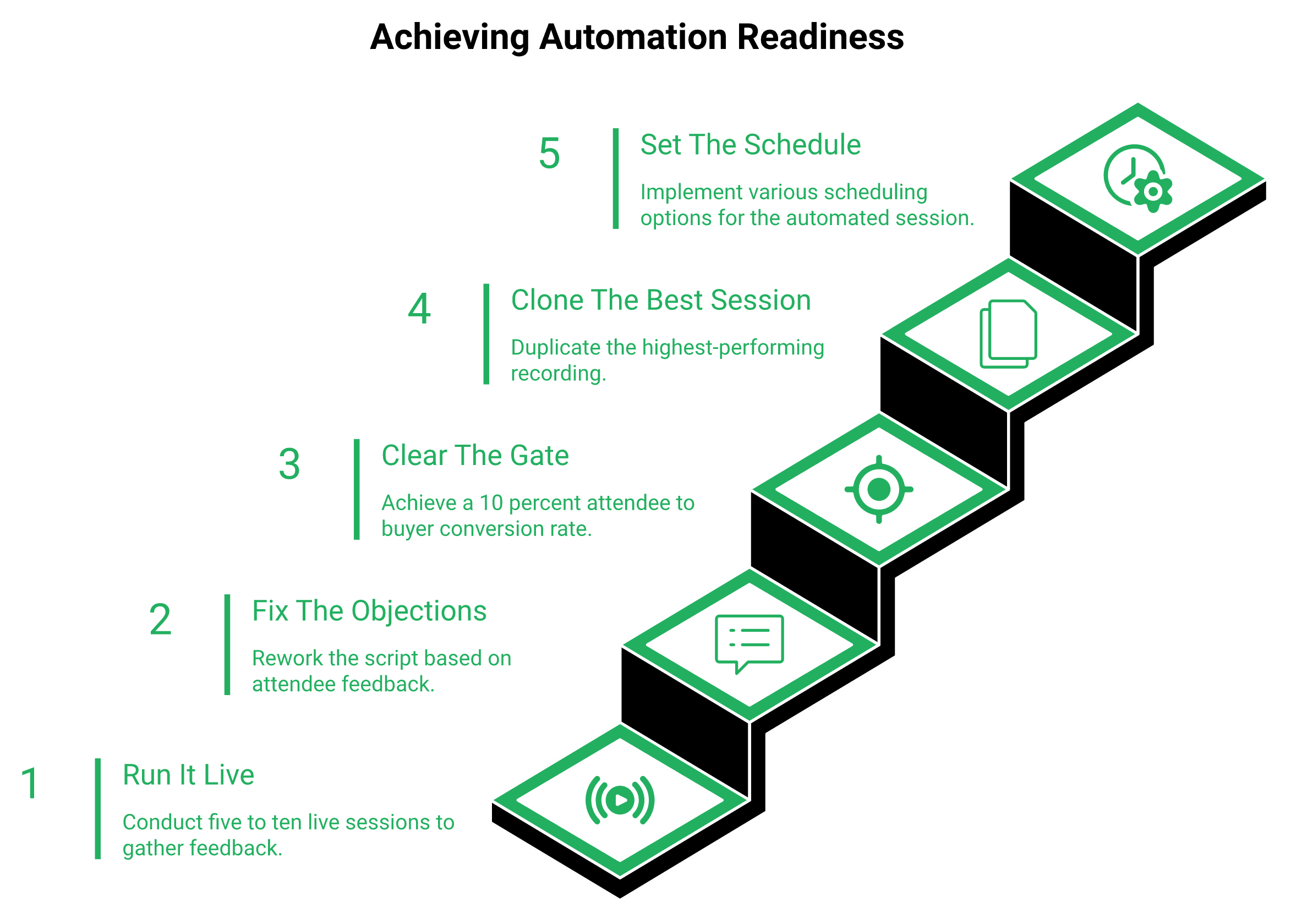
Here is where I break from the automation pitch. Run five to ten live sessions first. Hit at least a 10% attendee to buyer rate before you clone anything.
Automation copies whatever you feed it. A weak session at ten times the volume is just a louder weak session.
I have watched automated versions underperform their live originals badly, even when the original converted well. My read is that operators clone the average session instead of the single best one, a trade I unpack in live vs automated webinars.
🧭 The honest disagreement
Not everyone agrees with me, and you should know that. Yuri Elkaim argues for evergreen from day one, because live show up rates are punishing.
Jeremy Haynes and I sit on the other side. Prove it live, then let the machine repeat it. I could be reading my own data too strongly here, though the 10% gate has held up across the funnels EasyWebinar sees.
✅ Your Monday action
Pull the recording of your best converting session. Check its attendee to buyer rate against 10%.
If it clears, it is ready to run as an evergreen sales funnel this week. If it does not, the platform is not your problem yet.
EasyWebinar runs the same recording as simulive, evergreen, on demand, or just in time from one funnel. A session that converted live on Tuesday keeps converting at 2am on Sunday.
Livestorm's. It ships 25 simultaneous speakers, unlimited moderators, question upvotes, raise hand, emoji reactions, automatic picture in picture, noise cancellation, virtual backgrounds, live captions, and certificate delivery, across 24 languages with right to left support. EasyWebinar documents a host plus up to 4 presenters with TrueVoice audio, and 11 in room languages. If in room depth is your constraint, Livestorm is the honest answer.
The concession, made properly
This is the dimension we lose, and pretending otherwise would cost me your trust. Livestorm's reputation for polish is earned, not marketed.
Its browser first join flow is the clearest example. Nobody downloads anything, which removes the most common reason people quit before a session starts.
⭐ What reviewers actually praise
The engagement tools like chat, polls, and Q&A worked smoothly, which made our sessions more interactive and professional.
Capterra rates its ease of use 4.7 across 398 reviews. That is a strong signal and I will not argue with it.
❌ Where the polish thins out
Reviewers are consistent about the limits. G2 clusters 21 reviews asking for more email and form customisation, and 13 flagging limited layout and design control.
Getting a webinar started is not super intuitive.
Customisation of interface is a bit basic with too many restrictions on layout.
🤔 The reframe I would apply
Ask what in room depth actually moves. Reactions and upvotes change how a session feels, and I like that they exist.
They do not obviously move show up rate or booking rate. Those are decided before the room opens and after it closes, which is the argument behind most webinar engagement tools.
⚠️ The risk that really breaks attendee experience
The failure I see most often is mechanical, not aesthetic. A button that does not work on mobile quietly eats registrations while you sleep.
We once tested putting the join link directly in the SMS sequence. Show rate rose, and booking rate collapsed, because people joined from phones they could not act on.
Check the tech before you check the theme. That habit has saved more sessions than any reaction emoji ever will.
✅ What EasyWebinar does ship in the room
EasyWebinar streams on the Dolby OptiView (formerly Millicast) WebRTC stack with sub-second latency, and puts polls, timed offers, and CTAs inside the session. That is a different kind of attendee experience, aimed at the buying decision rather than the vibe, and the full set sits under live webinar software.
Our own reviewers are not uncritical, and I would rather you read them straight.
I would love to have more screen display options, like where I place my screen compared to my slides. The video quality came and went when I switched from the slides as the main screen back to me.
I love that we can have a poll, offer and countdown right in the event. That's going to be so great for sales and interactions.
EasyWebinar does not win the polish comparison, and buyers who need panel depth or right to left language coverage should choose Livestorm here. What EasyWebinar wins is the moment after the value section, when the offer, the countdown, and the checkout appear without moving anyone to a new tab, which is how paid webinars are built.
EasyWebinar shipped paid registration through Stripe, PayPal, and PayU plus in room checkout in March 2026, and includes EasyCRM natively from Growth at $116 per month. Livestorm's published feature set shows no payment capability at any tier, and Pro connects only to HubSpot and Zapier. Salesforce, Marketo, Pardot, and Microsoft Dynamics sit on Enterprise.
The question that exposes the gap
Your VP asks which sessions produced pipeline. On Livestorm Pro, the CRM that holds that answer is Salesforce, and Salesforce sync is Enterprise only.
So the reporting you need arrives after a sales call and a contract change. That is a procurement problem disguised as an analytics problem.
📊 The integration tiers, side by side
I checked both vendor pages on 17 August 2026. Nothing here is inferred.
| Capability | Livestorm Pro | Livestorm Enterprise | EasyWebinar Growth and Pro |
|---|---|---|---|
| Native CRM included | No | No | Yes, EasyCRM from Growth |
| HubSpot sync | Yes | Yes | Yes |
| Salesforce sync | No | Yes | Salesforce Pardot (Account Engagement), on Pro |
| Marketo, Pardot, Dynamics | No | Yes | Pardot on Pro; others not published |
| In room checkout | Not published | Not published | Yes, since March 2026 |
| Paid registration | Not published | Not published | Stripe, PayPal, PayU |
One caveat, stated plainly. Livestorm's feature comparison shows no payment tooling, and I have not found a help centre page contradicting that. If you want the full list of what connects where, the integrations page carries it.
💰 A worked example from a ticketed workshop
Take a $49 paid workshop with 300 registrations. That is $14,700 collected before anyone shows up.
EasyWebinar collects that at registration through Stripe, PayPal, or PayU, so the ad spend is funded before the session runs. On a platform without paid registration, that same cash arrives weeks later, if at all.
⏰ Why the checkout belongs inside the room
The close is the highest leverage 90 seconds in any webinar. My transition is simple, and I ask for permission first.
I say I have a paid offer that helps, then ask people to drop a one in the chat if it is fine to explain it. Sending them to a new tab at that exact moment breaks the moment you just built.
If the offer converts in the room, the checkout should open in the room.
Sell inside the session
Take the payment before the objection returns
Paid registration through Stripe, PayPal or PayU, plus timed offers with checkout inside the live room.
✅ The follow up that actually earns money
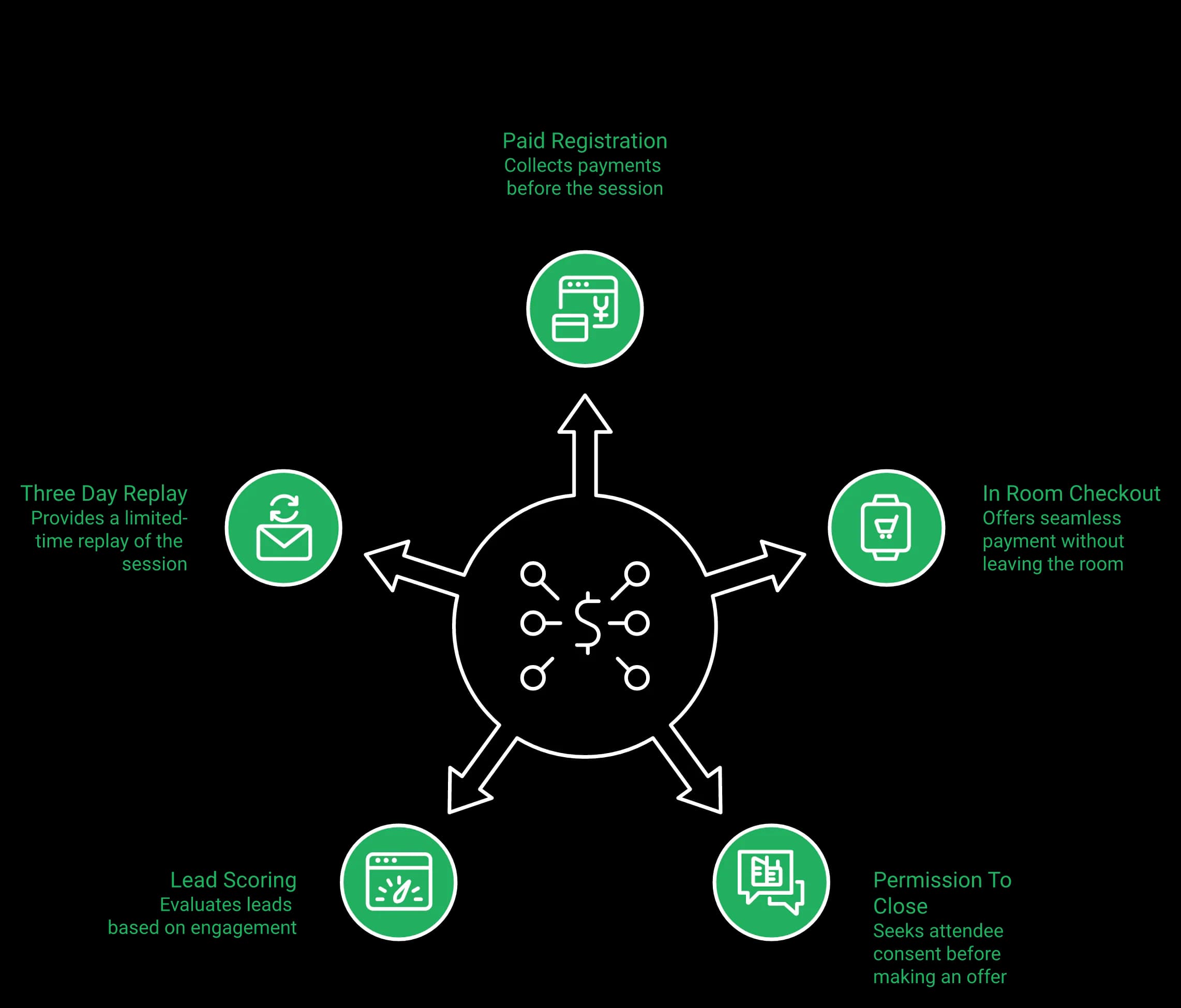
Most revenue lands after the session ends. My replay sequence runs three days and stays boring on purpose.
Day one says the replay is available and comes down tomorrow. Day three says final chance, it comes down in a few hours. EasyWebinar runs that sequence with lead scoring inside EasyCRM, and analytics is labelled Beta as of March 2026.
⚠️ Where I refuse the all in one pitch
I am wary of any tool claiming to be your CRM, your community, and your email service provider at once. GoHighLevel is the obvious example, and those products usually end up thin everywhere.
We once built a branching email machine we nicknamed the monster funnel. It took months, and it did not work. EasyCRM stays deliberately narrow, covering webinar behaviour, scoring, sequences, and revenue reporting on Pro, which is the same scope I describe in webinar marketing automation.
🧭 Your Monday action
Map the path from attendee to opportunity in your current stack. Count every manual handoff, including exports and spreadsheet joins.
Three or more handoffs means the platform is not the bottleneck. The seams between platforms are, which is the argument behind running a webinar CRM in the same place the session runs.
EasyWebinar takes the payment where the decision happens and scores the lead in the same system. In room checkout plus sales CRM ships from Growth, and native HubSpot and Salesforce Pardot (Account Engagement) sync arrives on Pro at $198 per month.
EasyWebinar shipped an AI webinar funnel builder in January 2026, producing the script, pages, emails, and polls from one prompt in 10 to 15 minutes. EasyCast multistreaming reaches 3 destinations on Growth and 10 or more on Pro. Livestorm's AI is post event, covering AI Studio clip generation, currently waitlisted, plus content repurposing, and its Restreaming is a paid add on.
Build side AI versus post event AI
This is the cleanest difference in the whole comparison. One vendor points AI at the build. The other points it at the recording.
Both are useful. Only one shortens the gap between an idea and a live registration page.
⏰ Where the months actually go
Operators tell me the same thing in different words. It takes months and months to launch one webinar funnel.
The time never sits in the video. It sits in the script, the registration page, the reminder emails, the poll timing, and the follow up copy, which is exactly the sequence mapped out in this webinar funnel breakdown.
🧩 The five steps, in order
Here is the sequence I would run this week.
- Write one prompt describing the offer, the audience, and the promise.
- Ask EasyWebinar to generate the funnel, which returns script, pages, emails, and polls in 10 to 15 minutes.
- Edit the script only, because that is where conversion lives.
- Run it live, twice, and watch where people drop.
- Automate the version that converted, not the average of both.
Livestorm's path is different by design. You build the event, run it, then use AI Studio to cut clips afterwards, once you are off the waitlist.
📡 How far one session travels
Reach is the second half of speed. Streaming the same session to YouTube, LinkedIn, and Facebook multiplies the audience without multiplying the work.
| Distribution | Livestorm | EasyWebinar |
|---|---|---|
| Multistream to social platforms | Restreaming, paid add on | EasyCast, included |
| Destinations | LinkedIn, YouTube, X | 3 on Growth, 10 or more on Pro |
| RTMP input | Paid add on | Supported |
| Add on pricing published | No | Not applicable |
Livestorm's Restreaming price is not published on its pricing page, which makes budgeting awkward. Every destination included with EasyCast multistreaming is listed on its own page instead.
🪑 The Ikea framing I keep coming back to
Writing a webinar sounds creative. In practice it is assembly, closer to building Ikea furniture than composing music.
The hook, the pain, the shift, the proof, the offer, and the close are known parts. EasyWebinar's builder was trained on years of webinar funnel data, so it hands you the parts pre cut.
⚠️ Speed is not permission to skip the sprint
I want to be careful here, because fast build times invite a bad habit. A funnel generated in 15 minutes is a draft, not a proven asset.
EasyWebinar's own data points toward the live sprint first, though I may be reading my sample harder than it deserves. Run it live, fix the objections you hear, then automate.
✅ Your Monday action
Pick your best performing offer. Write a single prompt describing it, and generate one funnel.
Book two live sessions this month, not four. Two sessions give you enough objection data to fix the script.
EasyWebinar's AI funnel builder produces the script, registration pages, reminder emails, and polls from a single prompt in 10 to 15 minutes, which is where the months usually go. Growth includes five AI built funnels, and Pro includes ten.
Livestorm publishes unlimited team members and moderators at no extra charge, 3,000 live attendees per event, 4 hour events on Pro, and 12 hours on Enterprise. Enterprise adds VIP support, an SLA, a dedicated customer success manager, live event shadowing, and up to four business reviews a year. EasyWebinar's seat model and session length limits are not published, so treat that comparison as open.
The limits table, with the gaps shown as gaps
Unpublished is not the same as unlimited. I will not claim a win where we have not published a number.
| Operational limit | Livestorm | EasyWebinar |
|---|---|---|
| Team seats | Unlimited, no extra charge | Not published |
| Moderators | Unlimited | Not published |
| Live attendees per event | 3,000 | 200 on Growth, 500 on Pro |
| Event duration | 4 hours Pro, 12 hours Enterprise | No published cap |
| Large scale capacity | 3,000 | Enterprise by enquiry |
| Support tiers | Standard, then VIP with SLA | Chat, email, and human onboarding |
Attendee capacity above 3,000 needs an Enterprise conversation on both sides. Anyone quoting six figure capacity as a standard feature is overselling, and the honest ceiling for each tier sits on the webinar pricing page.
⏰ What these caps mean in real work
A 4 hour cap is irrelevant for a 60 minute demo. It matters for training days and multi session events.
Seats matter differently. If eight people touch a webinar, unlimited seats is a genuine cost advantage for Livestorm.
⚠️ The failure that actually costs money
Support quality decides whether you catch problems in time. My worst near miss had nothing to do with attendee caps.
Our Zapier account hit its plan limit for the number of automations that could fire. We caught it four hours before the session and found a few hundred opt ins missing from the CRM.
Check the tech before every launch. Reconcile registrations in your CRM against the platform count, every single time, the way this host preparation guide lays out.
⭐ What operators say about support
It isn't delightful because Livestorm's support team doesn't always answer my questions or takes days to respond.
I love EasyWebinar's support team; they're responsive and helpful, providing peace of mind when I encounter problems. I do use other email systems to send post-webinar email sequences because I can't track open and click rates on EasyWebinar.
Rakesh was fantastic to work with, he helped set up everything from our email responses to our landing page seamlessly.
❌ When Livestorm is the right buy
I will say this plainly, because it saves you time. Livestorm is the better choice for internal all hands, multi speaker panels, and multi session conferences.
Those events need seats, moderators, and duration, not funnel automation. GetApp also lists mobile apps and 24/7 phone support against EasyWebinar's profile, which matters for distributed teams.
EasyWebinar publishes no session length cap and offers Enterprise capacity by enquiry, which is an unpublished limit rather than an unlimited one. Support runs through chat, email, and human onboarding sessions, and reviewers name individual team members by hand in our customer reviews.
Livestorm. It is ISO 27001 certified, offers EU or USA video hosting region selection, and supports SAML single sign on plus security review paperwork. EasyWebinar holds SOC 2 Type II with GDPR-aligned data practices and a published data processing agreement, and does not hold ISO 27001. With an ISO mandate or a strict EU residency requirement, Livestorm is the safer answer.
The concession, made without conditions
This is a straight loss, so I will not dress it up. ISO 27001 is an internationally recognised certification for information security management, audited by an external body.
Livestorm holds it. EasyWebinar does not. If your policy names ISO 27001, the decision is already made.
🔐 What each vendor publishes
| Requirement | Livestorm | EasyWebinar |
|---|---|---|
| ISO 27001 certified | Yes | No |
| SOC 2 Type II | Not published | Yes |
| GDPR | Yes | GDPR-aligned, with published DPA |
| Data residency choice | EU or USA video hosting, add on | Not published |
| SAML SSO | Add on | Available on higher tiers |
| Security review support | Yes, with MSA support | DPA on request |
SOC 2 Type II and ISO 27001 are not interchangeable. SOC 2 Type II is an attestation report against the AICPA Trust Services Criteria, tested over a period of time.
ISO 27001 certifies a management system against a standard. Many European procurement teams accept either. Some accept only one, and our GDPR page states which documents we can produce.
⚠️ Where the residency question really bites
Data residency means the country where recordings and personal data physically sit. For an EU buyer with a strict mandate, that is not negotiable.
Livestorm sells region selection as a paid add on, which is honest and specific. EasyWebinar publishes no equivalent region control, so I would flag that early rather than let procurement discover it in week six.
📋 The four questions to ask before you sign
Send these to both vendors in one email. Written answers protect you later.
- Which certifications do you currently hold, and what is the report date?
- Where are recordings and attendee personal data stored?
- Is a data processing agreement available without a legal escalation?
- Is single sign on included, or priced as an add on?
EasyWebinar answers the second question with SOC 2 Type II controls and a GDPR aligned DPA, and we will not claim more than that. The signable version sits at our data processing addendum.
✅ What EasyWebinar does clear
Most B2B security reviews ask for SOC 2 Type II, a DPA, single sign on, and access controls. EasyWebinar clears that set, and its Enterprise tier handles larger capacity by enquiry rather than as a published number.
What it does not clear is an ISO 27001 line item, or a contractual EU only hosting clause. My honest read is that this costs us European enterprise deals, and it should until the certification exists.
I would rather lose a deal than have a legal reviewer catch a claim we cannot support. That habit is also why I trust the pricing and automation arguments in this article.
EasyWebinar holds SOC 2 Type II with GDPR-aligned data practices and a published data processing agreement, which clears most B2B security reviews. It does not hold ISO 27001, and buyers with that requirement or a strict EU residency clause should choose Livestorm, a trade worth weighing beside every option on our all features list.
Livestorm carries roughly 1,700 G2 reviews at 4.4, plus 398 Capterra and GetApp reviews at 4.7 with 385 positive. Its customer list names Equifax, Abbott, Zapier, Intercom, Chargebee, and ElevenLabs. One independent tester sample of 15 reviews averages 2.7, with 27% recommending. EasyWebinar has no reconciled public rating to publish against that.
Start with the number that goes against me
Livestorm wins this section, and by a wide margin. Nearly 1,700 G2 reviews is a decade of accumulated trust.
EasyWebinar's review base is a fraction of that size, and our internal count is not reconciled across platforms. So I will not quote a star rating I cannot stand behind, which is also why our customer reviews page names individual operators instead of leading with a badge.
⭐ What reviewers consistently praise
Three themes repeat across Livestorm's reviews. Browser based joining, ease of setup for standard events, and clean analytics.
The engagement tools like chat, polls, and Q&A worked smoothly, which made our sessions more interactive and professional.
Capterra rates its ease of use 4.7 across 398 reviews. That score is not marketing. It is thousands of hours of other people's events.
❌ What reviewers consistently complain about
The complaints cluster just as tightly. G2 groups 21 reviews asking for better email and form customisation, and 13 citing limited design control.
Price (odd pricing model based on contacts instead of registrants or attendees). Makes the platform crazy expensive for SMBs.
Value for money scores 4.4 on Capterra, notably below its 4.7 overall. That gap is the credit model showing up in sentiment, and it is the same tension I unpack across affordable webinar platforms.
📉 The sentiment spread nobody publishes
Aggregate ratings hide variance. A 4.4 average and a 2.7 sample can both be true, because they measure different populations.
The 4.4 reflects a broad base of event organisers. The 2.7 sample of 15 reviews skews toward people who hit pricing walls or reliability trouble. Read both, then decide which group you resemble.
⚠️ Why review scores mislead in this specific comparison
Here is the trap. Most Livestorm reviews rate an event product, and you are buying a funnel.
A five star review from a company running quarterly customer webinars tells you almost nothing about evergreen conversion. Ease of use and revenue per registrant are unrelated measurements, which is why I read webinar platform reviews by workflow rather than by score.
✅ How I would read reviews for your own case
Filter by workflow, not by rating. Search reviews for the words "automated," "evergreen," "checkout," and "renewal."
Those four words surface the operators whose job resembles yours. EasyWebinar reviewers use that vocabulary often, which is a signal in itself.
I've been using EasyWebinar to automate my webinars and drive course sales. The integration with my email service provider was seamless, allowing me to automate a follow-up sales sequence once someone watches the webinar.
The biggest challenge is around setting up automated webinars, and needing the presentation uploaded first in order to set it up. Would love to be able to add the video later.
The rule I apply to my own numbers
The easiest money I ever make comes from adding results to a webinar that already works. A hundred small documented wins beats two spectacular ones, every time.
I apply the same rule to ratings. Volume of specific, boring, workflow level detail beats one glowing headline.
EasyWebinar publishes no reconciled aggregate rating yet, so judge it on the trial rather than the badge. Seven days of full access runs one real funnel end to end, which tells you more than any star count, and you can start that from sign up free.
Stay on Livestorm for multi speaker panels, internal all hands, multi session conferences, an ISO 27001 requirement, EU data residency, or a programme reaching a few hundred attendees a year. Choose EasyWebinar Growth at $116 per month if your webinars must generate pipeline continuously, take payment in the room, and keep converting without a presenter. Pro at $198 adds native Salesforce Pardot (Account Engagement) sync.
The fork, stated once
Livestorm is the better event product. EasyWebinar is the better funnel product.
Everything in this comparison reduces to that sentence. The rest is arithmetic and paperwork, and the same fork shows up when you compare webinar platforms across the rest of the category.
🧾 Who should buy Livestorm, with no hedging
I will name the buyer clearly, because vague comparisons waste your afternoon.
- You run panels bigger than a host plus 4 presenters, since Livestorm supports 25 speakers.
- Your policy requires ISO 27001 certification.
- You need EU or US hosting region selection for data residency.
- Your webinars are scheduled occasions, not an acquisition channel.
- Your programme reaches under roughly 460 attendees a year, where credits cost less.
- Eight or more colleagues need seats, which Livestorm includes free.
If three of those apply, buy Livestorm and stop shopping.
💰 Free plan versus full access trial
These two offers test different things. Livestorm's free plan caps sessions at 20 minutes and 30 attendees, which is enough to test the room.
EasyWebinar's 7 day trial gives full access instead, including evergreen scheduling and in room checkout. One tests the experience. The other tests the revenue path.
| Entry option | Livestorm | EasyWebinar |
|---|---|---|
| Free tier | Yes, 30 attendees, 20 minutes | No |
| Trial | Free plan acts as trial | 7 days, full access |
| Recommended paid entry | Pro, $3.00 per attendee | Growth, $116 per month |
| Tier for CRM sync buyers | Enterprise, custom | Pro, $198 per month |
Every inclusion and cap behind those two columns sits on the webinar pricing page, so check the tier before you commit a quarter of budget.
⏰ The Monday action that settles this
You already have the recording. The only open question is whether it can run without you.
Take your best converting session from the last quarter. Check its attendee to buyer rate, then rebuild it as an automated webinar, where a recorded session runs on a published schedule with no presenter.
Test it, don't buy it
Turn one recording into a funnel this week
Seven days of full access. Evergreen and just-in-time scheduling, EasyCRM and in-room checkout included.
⚠️ One mistake I see almost weekly
Operators wait for a bigger list before automating anything. That order is backwards.
An automated funnel with no traffic is a billboard in the desert. Webinars grow the audience, so waiting is the actual mistake, and the fixes that move attendance sit in how to drive webinar attendance.
🔮 What I think changes by 2027
My prediction is that AI built funnels stop being the differentiator within 18 months. Everyone will generate pages and emails from a prompt.
What will separate operators is the source session, the offer, and the honesty of the delivery. EasyWebinar's data already points that way, though I could be over reading one quarter of funnel results.
So here is the question I am sitting with. If the build cost drops to nearly zero, does the winning operator run more webinars, or fewer and better ones?
I genuinely do not know yet. Tell me which side you are testing, and what your numbers say, or bring the numbers to a request demo conversation and we will read them together.
EasyWebinar gives you seven days of full access to run one recorded session as an evergreen funnel, with checkout inside the room. That is enough to answer the only question that matters here, which is whether your webinars can sell while you sleep, and the all features list shows what runs during those seven days.
EasyWebinar vs Livestorm FAQ
No. Livestorm publishes on demand events and event automation, described in its own wording as automating the start and end, or automatically playing a video. That is session level automation, not funnel level automation. What its published feature set does not include: • A scheduled evergreen funnel that runs a recorded session repeatedly with no presenter. • Just in time scheduling, where the next session begins roughly one to fifteen minutes after a visitor lands on the page. • Timezone adjusted delivery for global audiences. EasyWebinar runs the same recording as live, simulive, scheduled evergreen, on demand, or just in time from a single funnel, and Growth includes 1,000 automated viewers. We built it that way because every missing scheduling mode converts into calendar time, and each new lead ends up costing a live session someone has to run. One caution we hold firmly. Automation copies whatever you feed it, so run five to ten live sessions and clear a 10% attendee to buyer rate before cloning anything. Then set the schedule on an automated webinar and let it repeat the session that already converted.
They are different units, so comparing the headline numbers without translating them is misleading. Livestorm Pro charges $3.00 per attendee credit, spent once per unique participant per session, counting live, replay, and on demand viewers alike. EasyWebinar Growth is $116 per month flat for 200 live attendees plus 1,000 automated viewers. What that means at real volumes: • 300 attendees a year: roughly $900 in credits against $1,392 flat. Livestorm is cheaper. • 700 attendees a year: roughly $2,100 against $1,392. EasyWebinar is cheaper. • 1,200 attendees a year: roughly $3,600 against $1,392. The crossover sits near 460 attendees a year, and we will happily concede everything below that line. Livestorm's model is also fair in ways worth naming, since no shows cost nothing and team members never consume credits. The structural catch is that consumption pricing means success raises the bill, and an evergreen funnel is designed to raise attendance indefinitely. Livestorm also warns that once your quota is exhausted, new attendees cannot join until you upgrade. Every tier and inclusion behind our side of the maths sits on our webinar pricing page.
Only on one of them, based on what each vendor publishes. EasyWebinar shipped paid registration through Stripe, PayPal, and PayU plus checkout inside the live room in March 2026. Livestorm's published feature comparison shows no payment capability at any tier. Why the placement of the checkout matters: • Registration revenue on a ticketed workshop can fund ad spend before the session runs. A $49 workshop with 300 registrations collects $14,700 up front. • The close is the highest leverage ninety seconds in any webinar, and sending people to a new tab there costs conversions. • Paid registration filters the audience, so the people in the room have already committed something. Our own transition is deliberately simple. We ask permission before moving to the offer, then invite people to drop a one in the chat if it is fine to explain it. The offer, the countdown, and the payment then appear without anyone leaving the session. If you sell during sessions rather than after them, the mechanics behind paid webinars are the part of this comparison worth testing first.
Livestorm does, and we will not argue the point. Its published in room toolkit is deeper than ours. What Livestorm ships that we do not match: • 25 simultaneous speakers and unlimited moderators, against a host plus up to 4 presenters with TrueVoice audio on our side. • Question upvotes, raise hand, emoji reactions, automatic picture in picture, and noise cancellation. • 24 languages with right to left support, against our 11 in room languages. • Browser based joining with no download, which reviewers praise consistently. Where we would push back is on what polish actually moves. Reactions and upvotes change how a session feels, but show up rate and booking rate are decided before the room opens and after it closes. The failure we see most often is mechanical, not aesthetic, and it is usually a registration button that quietly breaks on mobile. EasyWebinar streams on the Dolby OptiView (formerly Millicast) WebRTC stack with sub-second latency and puts polls, timed offers, and CTAs inside the session. That is a different kind of attendee experience, aimed at the buying decision, and you can see the full set under our live webinar software.
Livestorm, and this is a straight loss we would rather state than let procurement discover in week six. What each vendor publishes: • Livestorm is ISO 27001 certified, offers EU or USA video hosting region selection as an add on, and supports SAML single sign on plus security review paperwork. • EasyWebinar holds SOC 2 Type II with GDPR-aligned data practices and a published data processing agreement, and does not hold ISO 27001. The two credentials are not interchangeable. SOC 2 Type II is an attestation report tested over a period of time against the AICPA Trust Services Criteria. ISO 27001 certifies an information security management system against an international standard. Many European procurement teams accept either, and some accept only one. Four questions we would send both vendors in a single email: which certifications do you hold and on what report date, where do recordings and attendee data physically sit, is a data processing agreement available without legal escalation, and is single sign on included or priced separately. Our answers to the second and third live on the GDPR page, and buyers with a hard ISO mandate should choose Livestorm.
Yes, on Pro and above. Upload your context, such as PDFs and other files, and the AI Moderator answers attendee questions in the chat from that material during live, simulive and automated webinars. It is not included on Launch or Growth.