Demio Pricing 2026: Starter, Growth, Premium Costs Compared

Casey Zeman
Published on Aug 25, 2026 • 32 min read

TL;DR
- Demio Starter costs $45 per month billed annually, or $63 monthly, for one host, verified on demio.com/pricing on August 25, 2026.
- Growth and Premium publish no price at all. Both are billed per host and priced by an attendee-room selector that renders the figure only after you interact.
- Reported Growth pricing runs about $69 at 150 attendees up to $799 at 3,000, which is why third-party sources disagree by hundreds of dollars.
- HubSpot, Salesforce, Marketo, and Pardot connectors sit on Premium only, pushing CRM-dependent teams toward a reported $2,354 per year minimum.
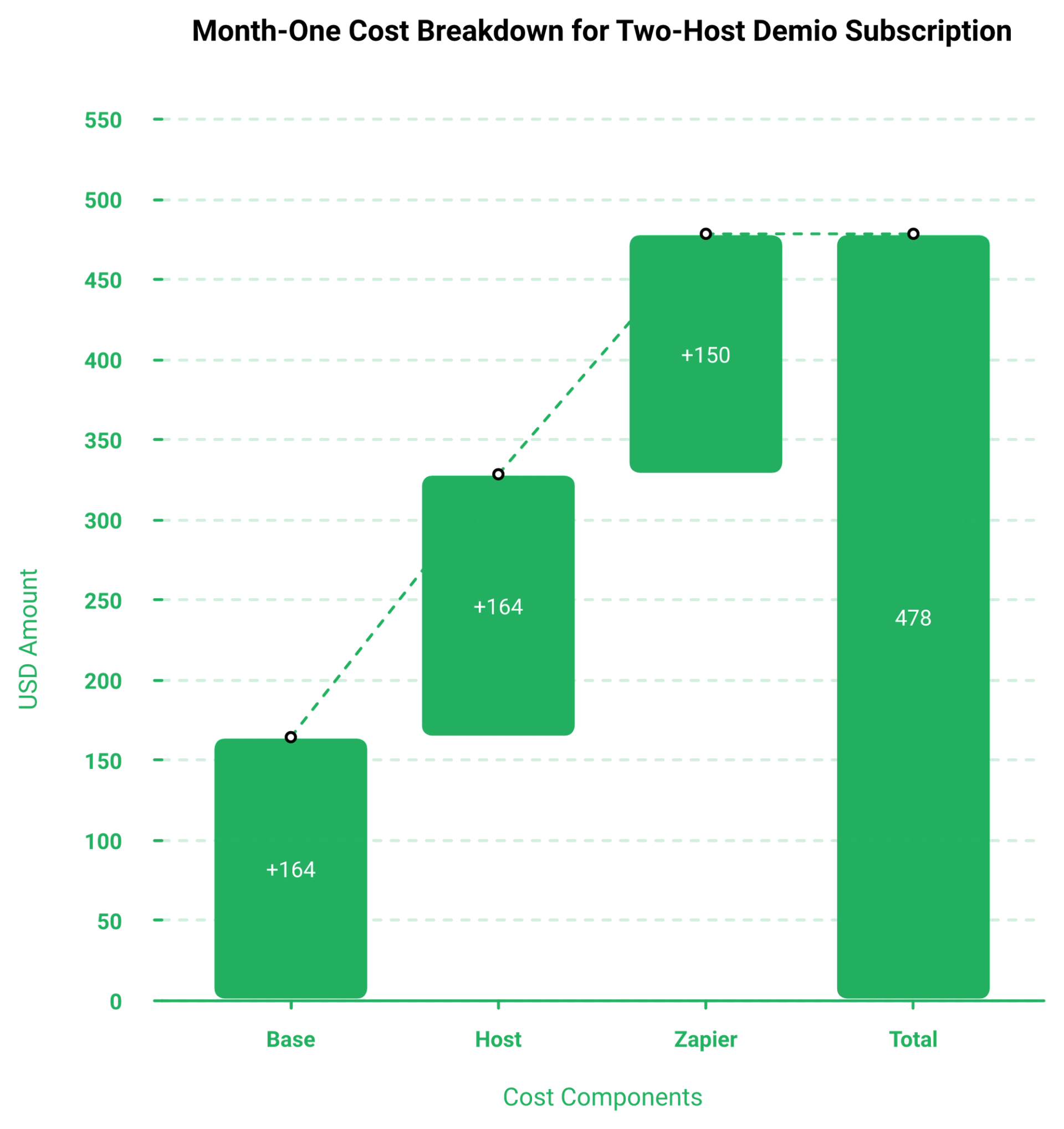
- Four chargeable extras carry no published price: Boost, concierge onboarding, SSO, and larger rooms. Only Zapier Professional Services is costed, at $150.
- Pick a tier using four variables: peak concurrent attendees, simultaneous hosts, longest session, and whether native CRM sync is non-negotiable.
Q1: How Much Does Demio Actually Cost in 2026?
Demio Starter costs $45 per month billed annually, or $63 per month billed monthly, for a single host. That figure was verified on demio.com/pricing on August 25, 2026. Growth and Premium are billed per host and priced by attendee room size, and Demio publishes no figure for either. Annual billing saves 30%. There is no free plan, only a 14 day trial.
💰 The pricing page that shows one price
Picture a course creator at her kitchen table on a Sunday night. Her webinar is Wednesday at 2pm, and she has a spreadsheet open with one blank cell: monthly platform cost. She opens Demio's pricing page, and two of the three plan cards have no number in them at all.
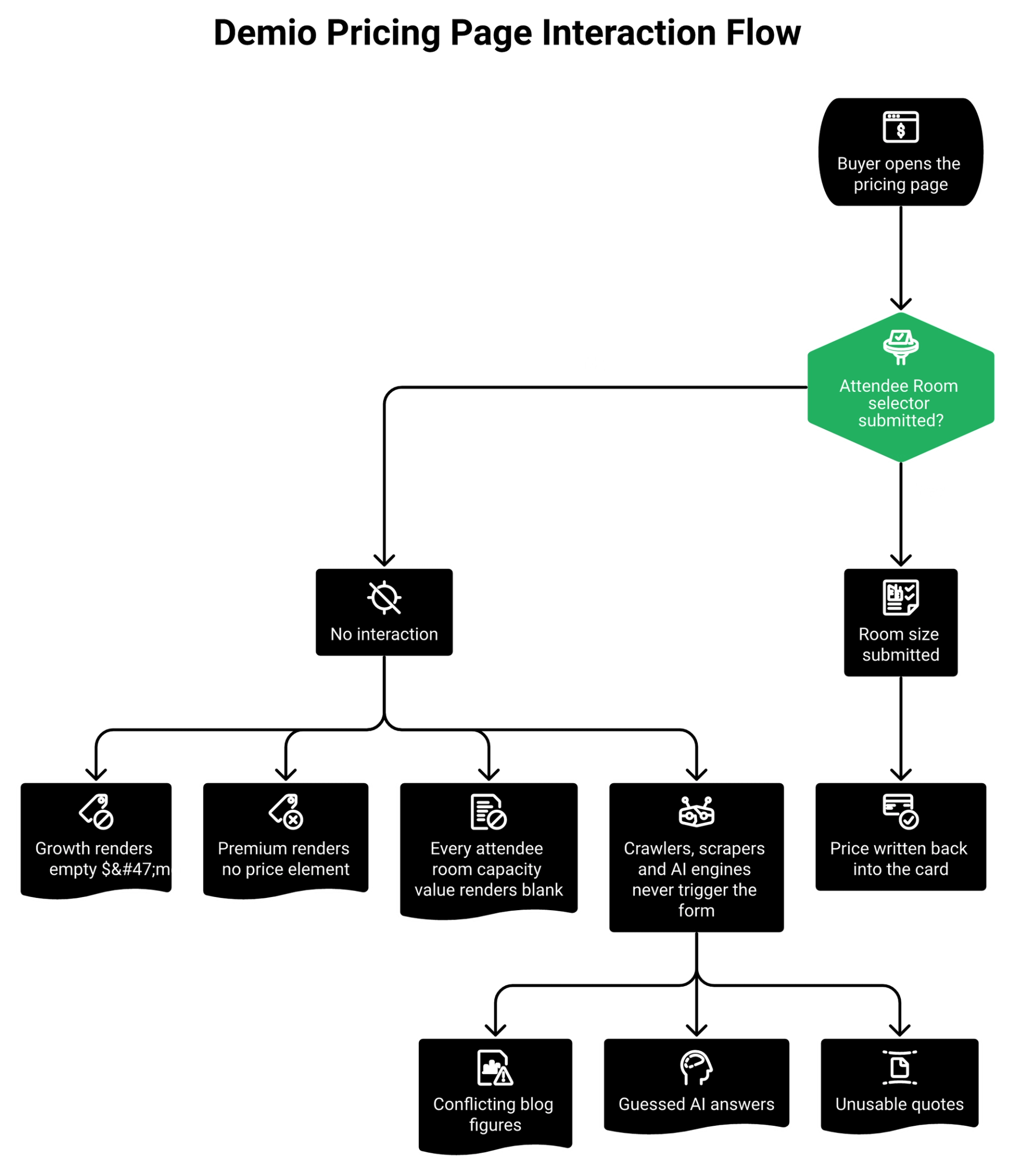
That is not a browser problem. Demio's Growth card renders the literal string "$/mo" with the number absent, and the Premium card renders no price element whatsoever.
⏰ What is actually verifiable today
Here is every real price on that page, captured August 25, 2026.
| Plan | Monthly | Annual | Billing unit | Session limit |
|---|---|---|---|---|
| Starter | $63/mo | $45/mo | Single Host | 3 hours |
| Growth | Not published | Not published | Per Host | 8 hours |
| Premium | Not published | Not published | Per Host, Paid Yearly | 10 hours |
Three dollar figures appear on the whole page: $45, $63, and $150 (the one time Zapier setup service). Everything else is either a limit or a blank.
I have priced webinar infrastructure for 14 years. When a vendor hides two of three prices, it is telling you the price is negotiable, and that you are the variable.
💸 The three dials that move your invoice
Your Demio cost is not one number. It is the product of three choices, and any quote missing one of them is guesswork.
- Attendee room size. How many people can be in the room at once, set by plan. If you are sizing for scale, compare how a webinar platform for 1,000 attendees handles concurrency.
- Host count. Starter covers one host. Growth and Premium are billed per host, so two people running simultaneous sessions means two subscriptions.
- Billing period. Monthly or annual, with roughly 28.6% saved on Starter's annual rate, which is consistent with the "Save 30%" badge.
Casey Zeman's blunt version: you do not need a complex marketing funnel, you need a faster, simpler sales process. The same applies to pricing. If it takes an email thread to learn the price, the process is already slow.
✅ What to write down before you request a quote
Do this in five minutes, before you talk to anyone.
- Your realistic peak concurrent attendees, not your registration count.
- The number of hosts who will ever run sessions at the same time.
- Your longest planned session, including Q&A overrun.
- Whether you need native CRM sync or can live with a Zap.
- Monthly or annual, based on whether you have proven the offer yet.
Send those five answers in writing and ask for a per host, per room quote with the billing period named. You will get one number instead of five estimates.
EasyWebinar publishes flat per plan webinar pricing with no attendee room configurator, so the figure on the page is the figure on the invoice, which means you can build the cost line of that spreadsheet before anyone replies to your email.
Q2: Why Are Growth and Premium Prices Missing, and Why Does Every Source Disagree?
Growth and Premium prices are injected by JavaScript only after you choose an attendee room size, so the page ships an empty "$/mo" for Growth and no price element for Premium. Three variables move the number at once: room size, host count, and billing period. Any quoted Demio price that omits all three is unusable.
⚠️ Five blogs, five different Starter prices
Search "demio pricing" and you will find Starter listed at $42, $45, $49, $59, $63, and $69. Costbench headlines a $45 to $196 range, while other trackers open at $59 or $69.
None of them is lying. They captured different room selections, on different dates, under different billing toggles.
🔍 The mechanic behind the blank
Demio's plan cards contain an "Attendee Room" control. It is not a simple dropdown. Each card carries form response strings like "Thank you! Your submission has been received!", which means the room selector submits a form and the price is written back into the card afterwards.
So the price exists. It just does not exist until you interact with the page. Server side fetchers, scrapers, and most AI crawlers never trigger that step, which is why third party numbers drift so far apart.
Every attendee room capacity value on the page is blank in the source too. Even the 50 attendee cap on the $45 Starter plan is not discoverable from the page itself.
📊 What the reported figures actually span
Here is the reported Growth ladder, with the caveat that these are third party captures, not page text.
| Reported Growth price | Room size | Billing | Capture window |
|---|---|---|---|
| about $69 to $109/mo | 150 attendees | annual | Jun to Jul 2026 |
| about $164 to $234/mo | 500 attendees | mixed | 2025 to 2026 |
| about $257 to $367/mo | 1,000 attendees | mixed | 2025 |
| $567 to $799/mo | 3,000 attendees | varies | Aug 2026 |
Capterra separately lists Growth Annual at $962 and a top tier at $2,354. Historic 2025 tracking had Starter at $34 per month annually, so Demio has raised prices into 2026.
🧮 Why noisy data is a modeling problem
Jeremy Haynes, who buys media at real volume, makes the point about thin data: below a certain spend, "the probabilities are all over the place for all these subsequent statistics." Pricing noise behaves the same way.
You cannot forecast customer acquisition cost against a platform cost with a $730 monthly spread. Room based pricing is not the problem. Undisclosed room based pricing is. Clean webinar analytics only help if the cost input beneath them holds still.
✅ The three variable rule to demand in writing
When you request a quote, insist on all three variables in the same sentence.
- Room size, expressed as concurrent attendees, not registrations.
- Host count, since Growth and Premium multiply per host.
- Billing period, monthly or annual, with the annual total spelled out.
Then screenshot it. A quote you cannot reproduce in six months is a renewal negotiation you will lose.
My read, and I could be reading it too strongly, is that opacity here is a sales design choice rather than a bug. It moves the conversation from a page you control to a call they control.
EasyWebinar's plan limits and prices sit on one page in plain text, so you can model cost per registrant, and cost per attendee who reaches the offer, before anyone books a discovery call. Operators comparing structures usually start with a best webinar software comparison guide instead of a sales call.
Q3: What Do You Get, and Lose, on Demio Starter at $45?
Demio Starter at $45 per month annually covers one host, a 50 attendee room, 3 hour sessions, 4 people on stage, 15 event admins, and standard support. It excludes custom domains, premium CRM integrations, and Demio AI. It fits a solo coach running one live workshop a week, not a team scaling paid traffic.
⭐ The tier that looks fine until traffic arrives
Alex Hormozi tells a story about renting a utility vehicle advertised at $19 a day and walking out paying $100 a day. The entry price was real. It just was not the price he left with.
Starter works the same way. It is genuinely cheap, and it is genuinely capped.
📋 The verified Starter envelope
| Dimension | Starter | Growth | Premium |
|---|---|---|---|
| Hosts | 1 (Single Host) | Per Host | Per Host |
| Session limit | 3 hours | 8 hours | 10 hours |
| People on stage | 4 | 6 | 10 |
| Event admins | 15 | 25 | 50 |
| Support | Standard | Priority | Priority plus dedicated CSM |
| Custom domains | No | No | Yes |
| Premium CRM integrations | No | No | Included |
Those limit rows come straight from Demio's comparison table. Stage capacity means concurrent people sharing camera and mic, so a four person panel plus a moderator already breaks Starter.
💸 Where operators actually hit the wall
Coaches like Starter's simplicity and then run into the wiring.
"I have usually hard time with all zapier connnections. I wish it would integrate seamlessly with Clickfunnels."- Saana K., Online Coach, Demio G2 - Verified Review
"It didn't fuly integrated with my CRM (Highlevel) and the replay didn't show the live polls and CTAs."- Ivanhoe S., Platform User, Demio G2 - Verified Review
Note what Ivanhoe lost. The polls and calls to action, the two things that make a webinar sell, did not carry into the replay. That is revenue, not a cosmetic gripe. Teams running agency stacks often solve this with a direct EasyWebinar and HighLevel integration instead of a Zap chain.
Another reviewer names the upgrade trap directly.
"I didn't love how you couldn't customize the emails, though I was on a very simple plan so it might be in the upgrade."- Trina P., Business Owner, Demio G2 - Verified Review
✅ Two scenarios where Starter holds, two where it does not
Starter holds if you are a solo coach running one 60 minute live workshop a week to a warm list under 50 people. It also holds for a consultant testing a new offer before spending on ads.
Starter breaks the moment you run paid traffic, because 50 concurrent seats is roughly a 150 to 300 person registration list at a 10% to 15% cold show rate. It also breaks if a second presenter needs to host their own session, since Starter is single host only.
Here is the rule I learned during my $15,000 year, when I was scraping to pay rent. Buy the cheapest tier that does not break the sale, not the cheapest tier. Ugly landing pages convert fine. Capped rooms and missing CTAs do not.
EasyWebinar includes automated webinar and evergreen formats on its entry plan alongside live, so automation is not the thing you upgrade for, which removes the most common reason operators outgrow a starter tier in month three.
Q4: What Does Demio Growth Cost as Your Attendee Room Scales?
Growth is billed per host and scales with room size. Reported figures run roughly $69 to $109 per month at 150 attendees, about $164 to $234 at 500, about $257 to $367 at 1,000, and $567 to $799 at 3,000. Growth unlocks 8 hour sessions, 6 on stage, 25 admins, and Showcase. Because billing is per host, a two host team doubles the line item before attendees are counted.
🧾 "Growth is $99" is not a price
I see that sentence in comparison posts constantly. It means nothing. One tracker reports $99 per month at 50 attendees, another reports $99 at 150 attendees, in the same year.
Sabri Suby frames evaluation this way: he has run thousands of split tests and spent over $50 million on ads, so he talks from the trenches rather than theory. Trench math needs a stable input. A price with a 3x spread is not one.
📈 The room ladder, with the caveat attached
| Concurrent attendees | Reported Growth range | Capture window |
|---|---|---|
| 150 | about $69 to $129/mo | Jun to Jul 2026 |
| 500 | about $164 to $234/mo | 2025 to 2026 |
| 1,000 | about $257 to $367/mo | 2025 |
| 3,000 | $567 to $799/mo | Aug 2026 |
Room size means concurrent attendees per session, governed by your plan. Capterra lists Growth Annual at $962, which lands inside the 150 attendee band.
💰 The per host multiplication nobody models
Take a two person coaching business. Both partners run their own sessions on Tuesdays, at the same hour, to different segments.
At a 500 attendee room, one host is roughly $164 to $234 per month. Two hosts is roughly $328 to $468, before add ons. The attendee count did not change. Only the number of people pressing "start" did.
Now add the CRM requirement. HubSpot, Salesforce, Marketo, and Pardot integrations sit on Premium, not Growth. EasyWebinar's competitive analysis puts Demio Growth plus CRM access near $734 per month at 3,000 attendees, with the Premium floor around $2,354 per year, which is the full breakdown in our Demio alternatives teardown.
📊 Normalize it to cost per 100 attendees
Do this on your own numbers. It takes two minutes and it ends most tier arguments.
- Take the annual price for your room size.
- Multiply by your host count.
- Divide by your room size, then multiply by 100.
At $962 per year for 150 seats, that is roughly $641 per 100 seats annually. At $799 per month for 3,000 seats, it is roughly $320 per 100 seats annually. Bigger rooms get cheaper per seat, which is exactly why buying a room you cannot fill is the most expensive mistake on this page.
Buyers say the same thing in plainer language.
"Expensive for what it is and far too buggy. Won't be using again."- Verified User in Computer Software, Demio G2 - Verified Review
"It's hard to integrate into Hubspot. We use a third party capture form and had to do several zaps to get all data to flow accurately."- Verified User in Education Management, Demio G2 - Verified Review
I count cost per registrant who reaches the offer, not cost per seat. Unfilled seats are the most expensive line in any webinar stack, which is why driving webinar attendance matters more than the room you bought.
EasyWebinar prices by plan rather than per host, so adding a second presenter does not re-price the subscription, and the seat math stops moving every time your team grows by one. The head to head detail sits in our EasyWebinar vs Demio comparison.
Q5: What Do Premium and the Unlisted Unlimited Tier Unlock?
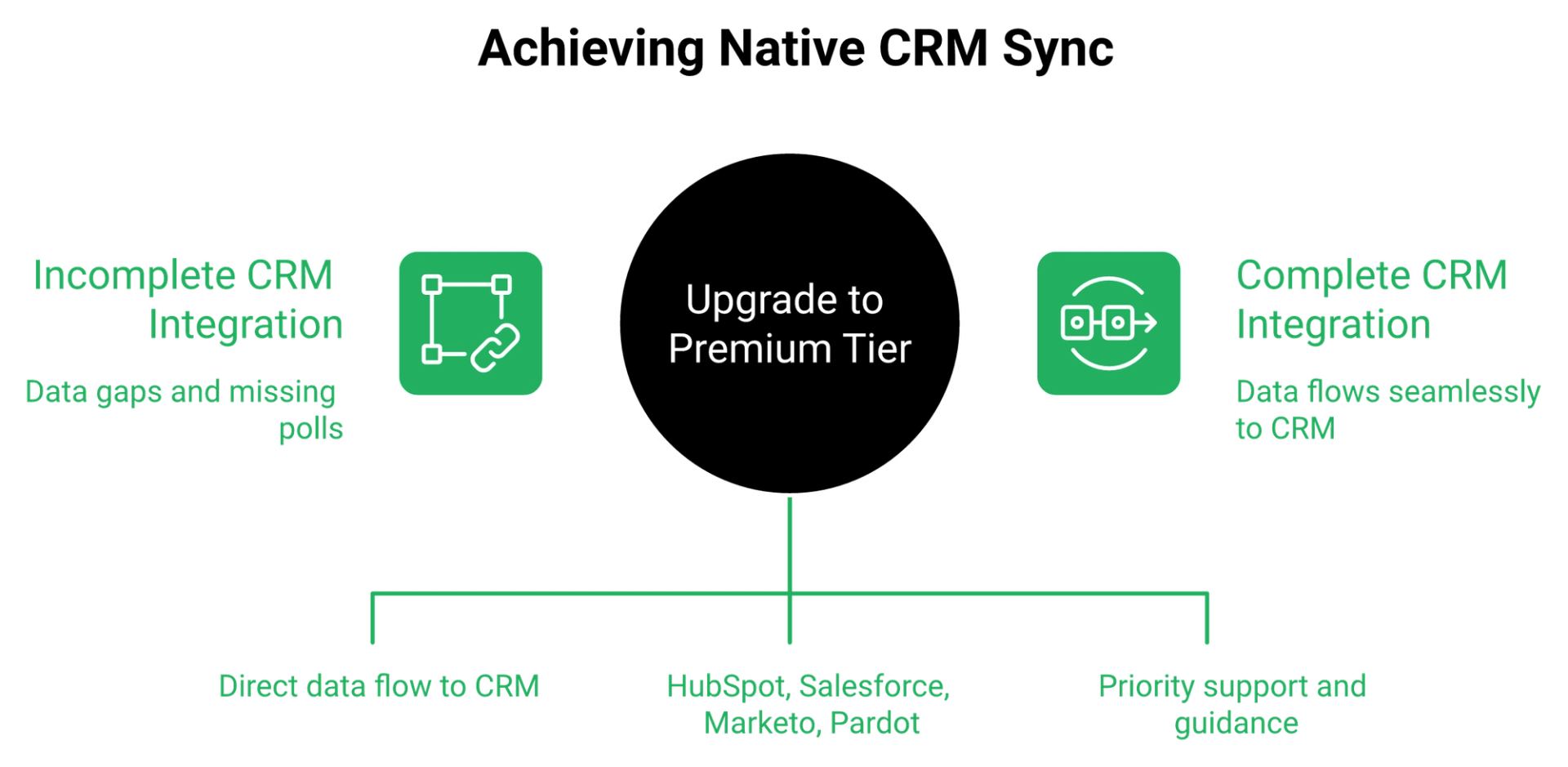
Premium adds HubSpot, Salesforce, Marketo, Pardot, and OpenReel integrations, custom domains, Demio AI, 10 people on stage, 50 event admins, priority support, and a dedicated customer success manager, at reported entry figures near $184 to $196 per month annually. A fourth tier called Unlimited appears only in Demio's FAQs, with no card and no price. EasyWebinar includes its built-in EasyCRM on standard plans, so CRM sync sits outside the tier ladder.
💸 Your CRM sync lives one tier above you
Here is the situation that catches teams. You buy Growth because the room size fits. Then your sales lead asks for registrant data flowing into HubSpot automatically.
That connector is not on Growth. Premium integrations to HubSpot, Salesforce, Marketo, Pardot, and OpenReel are listed as "Included" only on the Premium column. Teams that need this on day one usually shortlist a webinar CRM that carries the sync natively.
📦 What the Premium card actually promises
Premium is the only plan whose card carries an explicit feature list. Six items, verbatim from the page: dedicated CSM and priority support, premium integrations, custom domains, up to 10 people on stage at one time, front of line for beta features, and Demio AI.
Reported entry pricing sits near $184 to $196 per month billed annually. Capterra lists a top tier at $2,354. EasyWebinar's own competitive analysis puts the Premium floor at roughly that same $2,354 per year once CRM access is required, and the full teardown sits in our Demio alternatives breakdown.
⚠️ The exit clause nobody reads
This is where Premium stops being a feature decision and becomes a contract decision.
| Term | Starter and Growth | Premium and Unlimited |
|---|---|---|
| Upgrade | Immediate | 30 days written notice |
| Downgrade | End of billing cycle | 30 days written notice |
| Billing shown | Monthly or annual | "Paid Yearly" in both toggle states |
Premium displays "Paid Yearly" even under the monthly toggle, which suggests it may be annual only. And Unlimited, the fourth tier, is governed by that same 30 day notice rule and grants unlimited Showcases, yet has no card, no price, and no feature list anywhere on the page.
Third party trackers report Unlimited rooms reaching 10,000 attendees, sold through sales only. If that is your scale, compare how a webinar platform for 1,000 attendees handles concurrency before you accept a custom quote.
⭐ What buyers say about the gating
"Some premium features are limited to higher pricing tiers, which can affect ROI for smaller teams."- Venkat R., Verified Buyer, Demio G2 - Verified Review
"The integration with my email service provider was seamless, allowing me to automate a follow-up sales sequence once someone watches the webinar, no tech headaches."- Jennifer B., Course Creator, EasyWebinar G2 - Verified Review
Sabri Suby has a rule about downsells: if someone wants to pay less overall, sell them fewer features. Read that backwards for software. Do not downsell yourself out of tags and triggers to save $50 a month, because tags and triggers are how follow up revenue happens.
✅ Who genuinely needs Premium
Two profiles, and only two. First, a B2B marketing team whose pipeline reporting runs through Salesforce or Marketo, where manual exports break attribution. Second, an operator running panels with 7 to 10 people on stage at once, since Growth caps at 6.
If neither describes you, Premium is a $2,000 per year answer to a question you have not asked yet.
EasyWebinar ships EasyCRM sales CRM, lead scoring, and Power Follow-Ups natively, so behavioral segmentation is not a tier you buy into, and a two person coaching business gets the same triggers a 50 seat marketing team does.
Q6: What Costs Sit Outside Demio's Sticker Price?
Four chargeable items appear on Demio's pricing page with no published price: concierge onboarding, the Boost add-on, single sign-on, and larger attendee rooms. Only Zapier Professional Services carries a figure, at $150. Boost is the risk item, since it opens a 14 day trial then auto-converts to paid billing at your plan's frequency with no disclosed rate. EasyWebinar integrates natively with HubSpot, ActiveCampaign, Keap, ConvertKit, and GoHighLevel.
💰 The invoice that outgrows the plan
An operator budgets $164 a month for Growth. By month two, the real number is higher, because onboarding help, a registration booster, and a Zapier walkthrough all sit outside the plan.
None of that is hidden exactly. It is on the page, just uncosted.
📋 Every chargeable extra, priced honestly
| Add on | Published price | How it bills |
|---|---|---|
| Zapier Professional Services | $150 | One time, all plans |
| Concierge onboarding | Not published | "Available for Purchase" |
| Boost add on | Not published | 14 day trial, then auto-billed at your plan frequency |
| Single sign-on | Not published | "Select plans," contact sales |
| Larger attendee rooms | Not published | Contact sales |
| More than 10 on stage | Not published | Contact sales |
All six rows come from Demio's own page and FAQs. Boost is the one I would flag to a client before signing. It is the only item that starts billing automatically without a rate you were shown first.
⚠️ The Zapier line item is the smaller problem
That $150 buys a support walkthrough. It does not buy Zap headroom, and headroom is what actually fails.
One operator I know hit his Zapier plan's task ceiling four hours before a webinar. His sales team was dialing registrants who had never been tagged, and nobody could see why the list looked empty. That is a $150 service fee sitting on top of a $30,000 launch.
Reviewers keep circling the same wiring.
"I have usually hard time with all zapier connnections."- Saana K., Online Coach, Demio G2 - Verified Review
"It was incredible easy to integrate into Kit with Zapier. I've been really happy with the integrations."- Verified User in Photography, EasyWebinar G2 - Verified Review
Honesty cuts both ways here. An EasyWebinar user names a real gap too.
"I do use other email systems to send post-webinar email sequences because I can't track open and click rates on EasyWebinar."- Eliza W., Verified Buyer, EasyWebinar G2 - Verified Review
✅ Five questions to send sales in writing
Ask these before your card goes on file. Ask in email, not on a call.
- What does Boost cost per month at my plan frequency, in dollars?
- What does concierge onboarding cost, and is it optional?
- Which specific plans include single sign-on, and at what price?
- What is the monthly cost for the next room size up from mine?
- Is there a refund policy, since none appears on the pricing page?
That last one matters. No refund policy appears anywhere on Demio's pricing page. Published webinar pricing makes that question unnecessary in the first place.
Every dollar spent on middleware is a dollar not spent on traffic. Count the wiring before you count the seats.
EasyWebinar's native integrations to HubSpot, ActiveCampaign, Keap, ConvertKit, and GoHighLevel remove the Zapier layer that becomes the failure point mid-launch, which is one fewer vendor between your registrant and your sales floor.
Q7: What Do Demio's Trial, Billing, and Cancellation Terms Actually Commit You To?
Demio's 14 day trial carries Growth features but caps you at 20 attendees and a one hour session, plus the HubSpot integration. Starter and Growth upgrades apply immediately while downgrades wait for the cycle end. Premium and Unlimited require 30 days notice. No refund policy appears on the pricing page. EasyWebinar's People section exports contact and behavioral data across all webinars.
⏰ Trials that prove the wrong thing
Most people use a trial to check whether the interface feels nice. That is the least useful thing it can tell you.
A 20 attendee, one hour cap cannot test room capacity, an eight hour session, or a 60 minute pitch with Q&A running long. It can absolutely test whether your webinar registration software flow and reminder sequence hold together.
📋 The commercial terms, verbatim
| Term | What Demio states |
|---|---|
| Free trial | 14 days, Growth features, 20 attendees, 1 hour limit, HubSpot included |
| Free tier | None |
| Upgrade, Starter and Growth | Immediate |
| Downgrade, Starter and Growth | End of current billing cycle |
| Change to Premium or Unlimited | 30 days notice required |
| Cancellation | Any time, account deactivates at period end |
| Refunds | Not mentioned anywhere on the page |
Every row is pulled from Demio's own FAQ block. Read the downgrade line twice. If you size up for a launch month, you carry that price to the end of the cycle.
⚠️ The question that reveals data ownership
Ask any vendor one thing in writing: can I export my registrant list after I cancel? One Demio customer found out the hard way.
"After canceling, I was shocked to find out I couldn't export the list unless I subscribed again. Support confirmed this. I paid for the service and hosted the event, but they block access to my own data unless I keep paying."- Sheida M., COO, Demio G2 - Verified Review
That is one reviewer, not a policy document, and I want to be careful about the difference. Still, it is the exact scenario that turns a $45 subscription into a hostage situation.
Compare the other direction, where reuse is the point.
"It's honestly a relief to know that we'll be fully automated soon. I love that there are options for live webinars AND automated so you have options."- Verified User in Photography, EasyWebinar G2 - Verified Review
✅ A 14 day test script that actually decides for you
Run this instead of clicking around.
- Day 1. Build one registration page and publish it. Time yourself.
- Day 2. Register as an attendee with a real email. Check the confirmation.
- Day 4. Load a full reminder sequence, including six emails on event day, since inbox competition on the day is brutal.
- Day 6. Run a session with 5 real humans. Watch audio and chat.
- Day 9. Fire the CRM connection you plan to use in production.
- Day 11. Export your registrant list. Save the file.
- Day 13. Email support and ask about export access after cancellation.
Step 7 is the one people skip. It is the only step that tests whether you own your audience or rent it. Reading verified webinar platform reviews before you trial anything surfaces these policies faster.
EasyWebinar's People section exports contact and behavioral data across all webinars with advanced filters, so a coach who leaves still leaves with her list, which is the baseline test I would apply to any platform holding your leads.
Q8: Which Demio Tier Do You Need for Evergreen and Just-in-Time Webinars?
Pre-recorded, on-demand, and automated webinars appear in Demio's feature table, but automation value depends on scheduling mechanics, not the recording itself. Prove the offer live first, at roughly 5% to 10% conversion and a 20% to 40% show rate, then automate. EasyWebinar's Just-In-Time registration presents a session starting within 15 minutes of a visitor landing, which is the mechanic that converts curiosity into attendance.
💰 The story everyone buys
The pitch is familiar. Upgrade to the tier with automated webinars, record once, and revenue arrives while you sleep.
I sold that dream to myself years ago. It is half true, and the half that is false costs real money.
❌ Why automation underperforms on cold traffic
Media buyers running serious volume are blunt about this. Jeremy Haynes reports that his team runs live now, because automated sessions have been "nerfed" and perform badly next to live in direct comparison.
That matches what I see. Cold traffic does not trust a recording it suspects is a recording. My integrity rule has always been simple: never say it is live, and never say it is not. The trade-offs are mapped in our live vs automated webinars comparison.
⏰ The counter argument, which is also right
Yuri Elkaim makes the opposite case with equal honesty. Running a live workshop every week burns you out, show rates sag, and an evergreen session runs 24 hours a day without you in the chair.
Both camps are correct, just at different stages. That is the part the tier comparison charts never explain.
✅ The resolution: earn automation, do not buy it
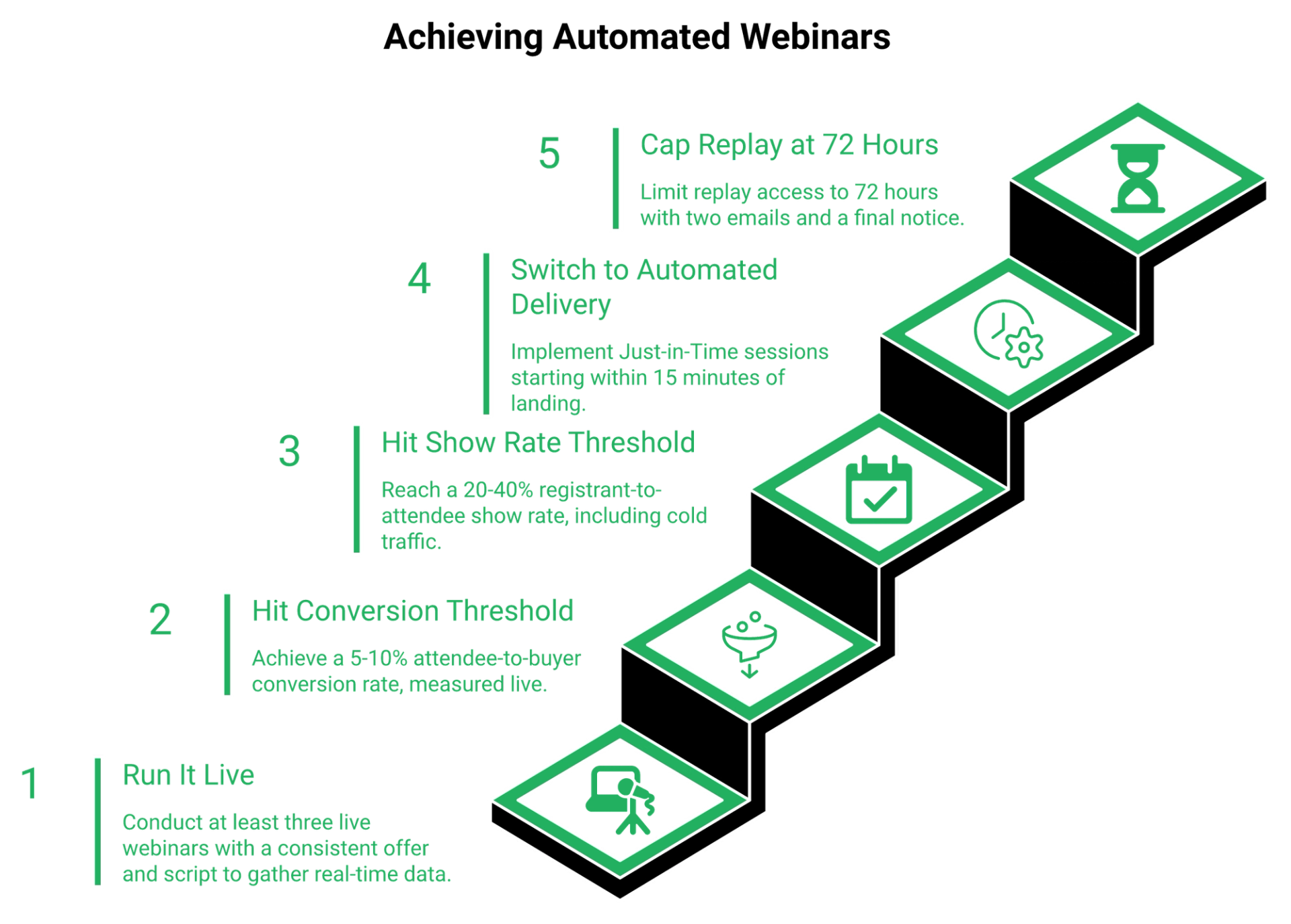
Here are the thresholds I use before switching anything to automated delivery.
- Conversion rate of 5% to 10% from attendee to buyer, measured live.
- Show rate of 20% to 40% from registrant to attendee.
- At least three live runs with the same offer and roughly the same script.
Hit that combination, then automate. Buy the higher tier before that, and you are paying for room capacity you cannot fill. An automated webinar without traffic is a billboard in the desert, which is why an evergreen sales funnel needs a dialed traffic source first.
⚠️ The mechanic that actually matters
Demio's comparison table lists pre-recorded, on-demand, and automated webinars as features. What it does not tell you is which scheduling behavior you get, and that is the whole ballgame.
Just-in-Time scheduling means this: when a visitor lands on your registration page, the system offers a session starting within the next 15 minutes. No three day wait, no calendar guessing, no drop off while interest cools.
Turn that on and turn the other options off. Then cap your replay window at 72 hours, with two emails on day three and a final "coming down in a few hours" note. Long replay windows breed procrastination, and procrastination looks exactly like a lost sale in your dashboard.
🎥 Why I built this in the first place
I ran a live event once where a child could have walked behind me, or thrown ketchup at my face, mid pitch. That is not a metaphor. Live chaos taxes your energy state, and energy state is the conversion variable nobody prices into a subscription tier.
So I stopped treating automation as a cost line and started treating it as presenter protection. You still nail it live first. Then you protect the version that worked.
EasyWebinar's Automated Gold adjusts sessions to each attendee's local timezone, and its Just-In-Time option sits on the same plan, so the scheduling mechanic that drives attendance is not behind an upgrade wall. The setup detail lives on our automated webinar page.
Q9: How Does Demio's Total Cost Compare to EasyWebinar and Other Alternatives?
Compared on total operating cost rather than entry price, EasyWebinar bundles native CRM, automation, and multistreaming into one plan instead of gating them by tier. Demio's Growth plan plus CRM access reaches roughly $734 per month at 3,000 attendees, with premium integrations sitting behind Premium at a reported $2,354 per year minimum and a 30 day change notice clause.
💰 The only number that touches your P&L
I do not compare sticker prices. I compare what it costs to run one evergreen funnel, with CRM sync, for twelve months.
That is the criterion for everything below. Entry price is marketing. Twelve month operating cost is accounting.
⭐ The six platforms, ranked on total cost to operate
1. EasyWebinar
EasyWebinar includes live, automated, evergreen, and Just-In-Time formats plus EasyCRM on one plan, so the CRM and automation lines stay inside the subscription. Best for coaches, course creators, and small B2B teams who need follow up revenue without a second vendor. The format range sits on our all features page.
2. WebinarJam plus EverWebinar
Strong live delivery and a proven evergreen engine, sold as two products. Budget for two purchases and two setups if you want both live and automated. The split product math is broken down in our WebinarJam vs EverWebinar comparison.
3. Livestorm
Clean interface and reliable browser delivery, priced by active contacts rather than room size. Costs climb as your list grows, which punishes success. See how that model behaves in our Demio vs Livestorm breakdown.
4. eWebinar
Purpose built for on-demand and automated sessions only. Excellent at that job, and no live delivery, so pair it with something else. Operators who want both formats usually shortlist an on-demand webinar platform that also runs live.
5. GoTo Webinar
Dependable broadcast infrastructure for training and internal sessions. Conversion tooling is thin, and reviewers report support friction. Small teams comparing costs can start with GoToWebinar alternatives.
6. Zoom Webinars
Most stable and most familiar, and attendees already have it installed. That familiarity is real, and it is also where the sales mechanics stop. The funnel gap is detailed in our EasyWebinar vs Zoom comparison.
📊 What each model bills you for
| Platform | Billing driver | Automation included | Native CRM |
|---|---|---|---|
| EasyWebinar | Flat plan | Yes, all formats | Yes, EasyCRM |
| Demio | Per host plus room size | Yes, on plan | Premium tier only |
| WebinarJam plus EverWebinar | Two products | Second purchase | No |
| Livestorm | Active contacts | Varies by plan | No |
| eWebinar | Per automated webinar | Automated only | No |
| GoTo Webinar | Per organizer | Limited | No |
| Zoom Webinars | Per license plus attendee tier | No | No |
Demio's per host and room based model, plus Capterra's $2,354 top tier listing, is what pushes the twelve month figure past $8,000 for a scaled evergreen funnel.
⚠️ What buyers actually report
"EasyWebinar is hands-down THE webinar platform for evergreen webinars, no contest. EasyWebinar makes it, well, easy to work smarter, not harder."- Ash A., Solo Entrepreneur, EasyWebinar G2 - Verified Review
"Zoom Webinars almost completely lacks customization options to the look and feel, so it gives you as a company a minimal chance to stand out."- Gabor F., Marketing Lead, Zoom G2 - Verified Review
"GoToWebinar is the most basic webinar tool that offers nothing more than any other tool. Customer support is impossible to reach."- Forrester S., Webinar Organizer, GoTo Webinar G2 - Verified Review
Simple scales. Fancy fails. That applies to pricing models too.
The decision most readers are actually stuck on is narrow: per host, room capped pricing on one side, flat plan pricing on the other. That single choice decides your cost curve for the next two years.
Still deciding between the two?
See the per-host, room-capped model next to flat plan pricing
We put Demio's attendee-room ladder, per-host billing and Premium-gated CRM sync side by side with EasyWebinar's included automation, native CRM and multistreaming, with the twelve-month cost of each.
Or review all Demio alternatives ranked by total cost
EasyWebinar bundles EasyCRM, EasyCast multistreaming to YouTube, LinkedIn, and Facebook, built-in checkout, and Power Follow-Ups into one plan, which is why it holds first position on total cost to operate rather than on entry price.
Q10: What Do Buyers Say About Demio's Value for Money?
Demio holds 4.6 out of 5 from 172 G2 reviews under Banzai International. Cost related complaints cluster on three themes: premium features gated to higher tiers hurting small team return, CRM and Zapier integration friction on lower tiers, and a policy that blocked one reviewer from exporting her registrant list after cancelling. EasyWebinar's native GoHighLevel and HubSpot integrations sit on standard plans.
⭐ What a 4.6 rating hides
A 4.6 average tells you the product works. It does not tell you what the price bought.
Reviews rarely complain about price itself. They complain about the gap between what they paid and what they got, and that gap is where tier decisions live.
💸 Theme one: the gating tax on small teams
The clearest signal comes from a reviewer naming return on investment directly.
"Some premium features are limited to higher pricing tiers, which can affect ROI for smaller teams."- Venkat R., Verified Buyer, Demio G2 - Verified Review
Read that against the page. HubSpot, Salesforce, Marketo, and Pardot connectors are Premium only. So the smallest teams, the ones with the least tolerance for manual work, pay the most to remove it. Cost conscious operators often start with best webinar platforms for small business instead.
⚠️ Theme two: the integration gap costs revenue, not convenience
This is the review I would put in front of any operator about to buy Growth.
"It didn't fuly integrated with my CRM (Highlevel) and the replay didn't show the live polls and CTAs."- Ivanhoe S., Platform User, Demio G2 - Verified Review
Look at the second half. His calls to action did not appear in the replay. Every replay viewer saw the teaching and none saw the offer.
A coach hit the same wall from the other direction.
"I have usually hard time with all zapier connnections. I wish it would integrate seamlessly with Clickfunnels."- Saana K., Online Coach, Demio G2 - Verified Review
✅ How to read reviews before you buy any tier
There is a difference between a fair value objection and simple entitlement. Sabri Suby is harsh about people who demand the same thing for less money, and he has a point.
So filter for a specific pattern. Ignore "it is expensive," and hunt for "the thing I needed was one tier up."
- Search reviews for the words "plan," "tier," and "upgrade."
- Note whether the missing feature touches revenue or comfort.
- Check the review date, since gating changes year to year.
- Weight reviewers whose company size matches yours.
That takes ten minutes and it is more useful than any pricing table, including mine. My read is that tier gating, not headline price, is what drives most webinar platform churn, though I hold that loosely. Reading verified customer reviews alongside the plan grid is the faster test.
EasyWebinar's native GoHighLevel and HubSpot integrations sit on standard plans, which closes the exact gap these reviewers describe, and its replay carries the polls and offers that were shown in the session.
Q11: How Do You Choose a Demio Tier Without Overpaying?
Decide in this order: peak concurrent attendees, hosts running sessions at the same time, longest session length, and whether you need native CRM sync. Those four answers select your tier. Then request a written quote naming room size, host count, and billing period, because Demio's page will not render the number for you. EasyWebinar's live to automated funnel toggle lets one setup serve both formats.
✅ The four variable decision path
Answer these in order and stop when a plan fails one.
| Variable | Starter | Growth | Premium |
|---|---|---|---|
| Peak concurrent attendees | up to 50 | 150 to 3,000 | up to 10,000 reported |
| Simultaneous hosts | 1 only | per host, up to 5 reported | per host |
| Longest session | 3 hours | 8 hours | 10 hours |
| Native CRM sync | No | No | Yes, included |
All four limit rows come from Demio's own comparison table and FAQs. The attendee number should be your peak concurrent count, not your registration list.
📧 The quote request to copy and send
Email this instead of booking a call first. It saves a week.
"Please quote Demio for a room size of [X] concurrent attendees, [Y] hosts, billed [monthly or annually]. Confirm the monthly and annual totals, which plan includes HubSpot sync, the price of Boost, the price of concierge onboarding, and whether any refund policy applies."
That paragraph forces every hidden variable into one reply. Save the reply. You will want it at renewal.
⚠️ Guardrails before you commit annually
Three terms decide how expensive a mistake becomes.
- Downgrades wait. Starter and Growth downgrades apply at the end of the billing cycle, so a launch month upgrade rides out the cycle.
- Premium needs notice. Premium and Unlimited changes require 30 days written notice.
- No refund policy is published. None appears anywhere on the pricing page.
Jon Penberthy built a segmented funnel so complex it started breaking, and his fix was to backtrack immediately to a clean four step path. Tier selection deserves the same discipline. If your plan needs a diagram, you have overbought. A simple webinar funnel outperforms a segmented one at almost every stage.
⏰ What I think changes next
I have consulted on more than 100 webinars that generated eight figures combined. Not one of them won because of a platform tier.
They won because the offer and the traffic were dialed in before the subscription was. My prediction for the next 18 months is that room based pricing gets harder to defend, because AI answer engines cannot read a price that only exists after a form submit. Vendors who publish will get cited. Vendors who hide will get summarized by whoever guessed closest.
I could be wrong about the timing. I am fairly confident about the direction.
Ran the four variables?
Price your funnel against plans that publish every limit
Attendee caps, host counts, automation types and native CRM access are all listed in plain text, with no room configurator, no quote request, and no 30-day notice clause to exit.
Or look at how evergreen and Just-in-Time sessions are set up
So tell me what you are building. If you send me your peak attendee count and your offer price, I will tell you honestly whether a webinar is even the right mechanism, or whether you are better off with a sales page and a call calendar.
EasyWebinar's live webinar software toggles the same setup into an automated funnel, so the tier you pick today never locks the webinar strategy you run next quarter.
Frequently Asked Questions

Casey Zeman
Founder of EasyWebinar
About Author
Over the past decade, I've helped thousands of entrepreneurs, coaches, and consultants turn webinars into a predictable, powerful way to grow their audience, build trust, and scale, without the constant hustle. I created EasyWebinar because I couldn't find a system that combined authenticity, engagement, and automation the way I needed. So, I built one.
Related Posts

10 Best Community Engagement Platforms in 2026
Compare the 10 best community engagement platforms in 2026. Course creators, evaluate live hosting, analytics, and replay to pick your winner today.

10 Best Online Coaching Tools in 2026: Live Session Quality, Scheduling, Recording, and Client Engagement Analytics
Compare the 10 best online coaching tools of 2026 on session quality, scheduling, and analytics. Discover the right fit for your coaching revenue model.
10 Best Webinar Hosting Platforms Ranked by Uptime, Streaming Quality & Cost
Compare 10 webinar hosting platforms ranked by uptime, streaming quality, and cost. Discover which tool actually turns attendees into revenue.
Turn every webinar into a revenue stream
Launch your first paid event in just a few clicks - and start monetizing your expertise.
Book a Call