Zoom Alternative Webinar Platform: 8 Picks That Actually Drive Revenue

Casey Zeman
Published on May 4, 2026 • 52 min read

TL;DR
- Zoom Webinars is a paid add-on: $89 monthly or $66.67 annually in October 2026, plus Zoom Workplace Pro, and its prices have shifted several times since July 2025.
- We ranked 8 alternatives on revenue workflow, formats, attendee experience, reviews, and pricing: EasyWebinar, Demio, Contrast, GoTo Webinar, WebinarJam, Webex, Teams, and EverWebinar.
- EasyWebinar ranks first because it runs live and automated webinars, in-room checkout, and behavior-based follow-up on one subscription, with your CRM or ours.
- Prove a webinar live first: run 5 to 10 sessions, reach roughly 10% attendee-to-buyer conversion, then automate that exact session.
- Browser join, real-time delivery, and a simple stack decide show-up and revenue more than long feature lists do.
- Stay on Zoom for internal meetings, all-hands, and classes, and choose Teams or Webex where IT has already standardized on them.
Q1. What are the 8 Best Zoom Webinar Alternatives in 2026?
The 8 best Zoom webinar alternatives in 2026 are EasyWebinar, Demio, Contrast, GoTo Webinar, WebinarJam, Webex Webinars, Microsoft Teams Webinars, and EverWebinar. Zoom Webinars is a paid add-on that requires a Zoom Workplace Pro subscription as a prerequisite. EasyWebinar runs live, simulive, automated, and evergreen webinars on one subscription. From its Growth plan, it adds browser join, built-in checkout, and EasyCRM. Each platform below is ranked against eight criteria, using dated G2 reviews and each vendor's own pricing page.
- EasyWebinar
- Demio
- Contrast
- GoTo Webinar
- WebinarJam
- Webex Webinars
- Microsoft Teams Webinars
- EverWebinar
🎯 Why this decision carries real cost
A marketing director opens last month's Zoom report on a Monday morning. It shows 380 registrants and 95 attendees, but no record of who clicked the offer or who left before the pitch. That gap is why the platform choice matters: it decides what you can sell, measure, and follow up on.
This guide evaluates 8 vendors against defined criteria. It is written for the operator who runs webinars every week. It also covers the questions a CFO, an IT director, and a RevOps lead will raise during a shortlist or RFP review.
Our Evaluation Criteria
Webinar format coverage 🎥
Whether the platform supports live, simulive (a recording played at a scheduled time), automated, evergreen, and on-demand webinars, and on which plan each starts.
Time to launch ⏰
How fast an operator moves from sign-up to a working registration page, reminder emails, and a room. This includes templates and AI-assisted setup.
Engagement depth 💬
The interaction tools available in the room: chat, polls, Q&A, handouts, timed offers, and calls to action.
Funnel and conversion workflow 🧭
Whether registration, thank-you, and replay pages, offers, and follow-up paths live inside the platform or must be bolted on.
CRM and follow-up readiness 📇
Native CRM (customer relationship management) features, lead scoring, attendee tagging, and the depth of each CRM and email integration.
Monetization support 💰
Paid webinars, in-room checkout, and the payment gateways connected to the room.
Analytics and attribution 📊
Visibility into attendance, watch time, engagement, offer clicks, and purchases at the attendee level.
Reliability, support, and scale ✅
Stream stability, attendee capacity, security posture, and how quickly support resolves a problem during a live session.
Who This Guide Is For
- Coaches and course creators who want an educational webinar to become a repeatable sales funnel.
- Marketing teams using webinars for lead generation, nurturing, and pipeline.
- Revenue operators checking whether webinar data can reach their CRM, lead scoring, and follow-up workflows.
- Founders and consultants replacing separate tools for hosting, landing pages, email, checkout, and follow-up.
- Buying-committee readers: CFOs validating stack consolidation, IT leaders checking reliability and security, and marketing heads judging funnel performance.
Zoom Webinar Alternatives at a Glance
| Provider | Best For | Standout Strength | Known Limitation | Webinar Formats Covered | Support Model | Pricing Model |
|---|---|---|---|---|---|---|
| EasyWebinar ⭐⭐⭐⭐⭐ | Creators, coaches, and marketing teams whose webinars must sell and keep working after the live hour | Turns a proven live session into an automated webinar on the same subscription | Automated setup needs the video uploaded before registrations open | Live, simulive, automated, evergreen, just-in-time, on-demand (automation from Growth) | Chat, email, and onboarding calls; dedicated account manager on Pro; Slack support on Scale | Flat monthly per plan; overage billed past the limit |
| Demio ⭐⭐⭐⭐ | Marketers running occasional live marketing webinars | No-download browser joining with engagement analytics on every plan | One reviewer could not export registrants after cancelling ( G2, May 2025 ) | Live and series; automated and on-demand from Growth | Standard support; priority support and dedicated CSM on Premium | Per host; room size sets price |
| Contrast ⭐⭐⭐⭐ | B2B marketing teams producing brand-led live webinars | Speakers join without needing instructions | HubSpot integration described as a work in progress, and no survey feature ( G2, Apr 2025 ) | Live, plus on-demand replays | Chat and email; reviewers describe support as easy to reach | Free, Pro, and Premium tiers, priced by unique monthly registrants and features |
| GoTo Webinar ⭐⭐⭐⭐ | Organizations running formal corporate training and compliance sessions | Simple organizer back end and report pulling | Speaker audio and screen-share failures, plus slow support escalation ( G2, Oct 2025 ) | Live, simulive, recordings | Ticket-based; reviewer reports slow escalation | Per organizer per month |
| WebinarJam ⭐⭐⭐ | Creators running one-off live launches | Launch-style live rooms built for urgency | Inconsistent Mailchimp sync and unreliable email sends ( G2, Jun 2023 ) | Live; automation runs in EverWebinar, a separate product included on Basic and above | Ticket and email | Monthly or annual billing, across Starter, Basic, Professional, and Enterprise |
| Webex Webinars ⭐⭐⭐ | Enterprises whose IT has standardized on Cisco | Calendar and email integration, plus breakout rooms | Lag, slow joins, and freezes during screen share ( G2, Jun 2025 ) | Live, recordings | Cisco support channels | Per license per month |
| Microsoft Teams Webinars ⭐⭐⭐ | Organizations already standardized on Microsoft 365 | Registration, reminders, and attendee reporting inside Microsoft 365 | Limited branding, and some external attendees must sign in or download Teams ( G2, Dec 2025 ) | Live, recordings | Microsoft 365 admin support | Per user, inside Microsoft 365 subscriptions |
| EverWebinar ⭐⭐⭐ | Sellers running fully pre-recorded sessions where live is never needed | Pure automated replay engine for a webinar that already converts | Setup complexity and email-only support on event day ( G2, Jan 2018 ) | Automated, evergreen; no live hosting | Email support (per G2 review) | Annual, with a three-payment installment option |
1.1 EasyWebinar
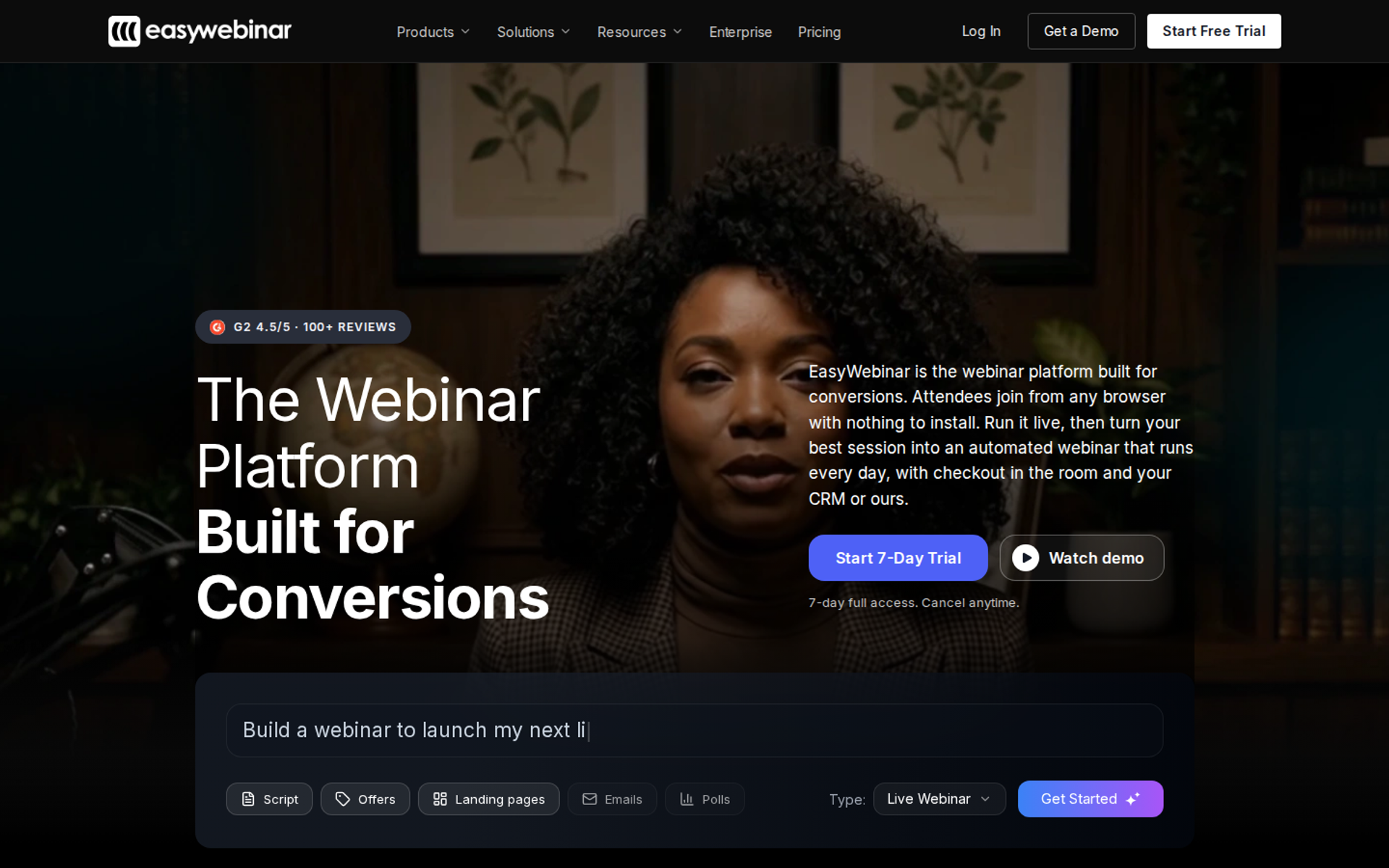
EasyWebinar is best for coaches, course creators, consultants, and marketing teams that need webinars to sell and keep producing leads after the live hour. It runs live and automated webinars, in-room checkout, and behavior-based follow-up on one subscription. It may not fit buyers who need lessons and certificates, or a tool for internal all-hands meetings.
| Quick fit | Details |
|---|---|
| Best for | Creators, coaches, and marketing teams turning a webinar into a revenue or pipeline channel |
| Skip if | You need an LMS with lessons and certificates, or a tool for internal team meetings |
| Strongest edge | Run a webinar live, then switch that exact session to automated delivery on the same plan |
| Biggest trade-off | Automation, checkout, and EasyCRM start at Growth, not the entry plan |
| Pricing snapshot | Launch $44, Growth $116, Pro $198, and Scale $349 per month billed monthly, with two months free on annual billing |
💸 What the plans include
EasyWebinar's Launch plan covers live webinars for up to 50 attendees, with replays for up to 250 viewers. Automated, simulive, and evergreen webinars, built-in checkout, and EasyCRM begin at Growth. Pricing is flat monthly with no per-attendee fees within the plan. Attendees beyond the limit are billed as overage, and the session does not stop.
EasyWebinar has no free plan. Every plan starts with a 7-day full-access trial, and a card is required to begin it.
Why EasyWebinar ranks #1
EasyWebinar scores highest on the two criteria Zoom leaves open: format coverage and the revenue workflow. A buyer leaving Zoom usually wants three things: attendees who join without friction, a way to sell inside the room, and follow-up that reacts to what each person did. EasyWebinar covers all three on one subscription, so the operator is not stitching a webinar room to a page builder, a CRM, and a checkout tool.
🔁 The live-to-automated workflow
EasyWebinar was built around a problem I hit as a course seller. I could run a live webinar on GoToWebinar, but I couldn't turn that session into an automated one. In my first year of live webinars, I built a 14,000-person email list and sold $245,000 of my online course. Doing that live every week was the part that didn't scale.
EasyWebinar's answer is a sequence, not a shortcut. Prove the presentation live first. Then switch that exact session to Just-in-Time delivery, where a session starts minutes after someone registers, in their own time zone. Automating a webinar that never converted live just automates the failure.
What EasyWebinar does well
- Live and automated on one plan. EasyWebinar supports live, simulive, evergreen, just-in-time, and on-demand delivery, so a proven session keeps selling without being rebuilt.
- Browser join, real-time delivery. Attendees join from any browser on desktop or mobile with nothing to install. Polls and offers land in real time on Dolby OptiView WebRTC at sub-500ms latency, backed by a 99.9% uptime guarantee.
- Checkout inside the room. From Growth, buyers pay inside the webinar without a redirect, through Stripe, PayPal, or PayU, so the sale and the attendee data stay together.
- Your CRM or ours. EasyCRM adds lead scoring, sequences, and an auto-dialer. Pro adds native HubSpot and Salesforce Pardot (Account Engagement) sync. ActiveCampaign, Kit (formerly ConvertKit), and Zapier integrations connect on lower plans.
- AI Webinar Builder. The builder writes the script, registration page, thank-you page, email sequence, poll questions, and a timed call to action. That shortens the first launch and makes it practical to test several offers.
- EasyCast multistreaming. Growth streams to three destinations at once, and Pro raises that to ten or more, so viewers on YouTube or LinkedIn can see the offer too.
Where EasyWebinar falls short
- Video before registration. EasyWebinar's automated setup needs the presentation uploaded first. A G2 reviewer who promotes events far in advance flagged this as a real constraint.
- Email metrics stay outside. EasyWebinar's built-in emails don't show open or click rates. One reviewer runs post-webinar sequences in a separate email tool for that reason.
- Automation costs more than the entry plan. Launch is live-only with 50 attendees. A G2 reviewer noted that the Just-in-Time feature cost about double the basic plan, though she judged it worth the upgrade.
- Not an LMS. EasyWebinar has no lessons, progress tracking, or certificates. Course creators pair it with Kajabi, Teachable, or Thinkific.
Decision scorecard
| Evaluation criterion | EasyWebinar fit | Why it matters |
|---|---|---|
| Live webinars | Strong | Every plan includes live webinars with browser join. |
| Simulive or automated webinars | Strong (Growth+) | A proven session runs on a schedule without the host present. |
| Evergreen automation | Strong (Growth+) | Just-in-Time and recurring schedules catch registrants while intent is high. |
| Funnel pages | Strong | Registration, thank-you, and replay pages are built in, so no separate page builder is needed. |
| Engagement | Strong | Chat, polls, Q&A, countdowns, and timed offers run in the room. |
| CRM and follow-up | Strong | EasyCRM, or native HubSpot and Salesforce Pardot sync on Pro. |
| Monetization | Strong (Growth+) | In-room checkout keeps the sale at the peak of the pitch. |
| Analytics | Strong | Attendee-level watch time, offer clicks, and purchases show what made money. |
| Integrations | Strong | Stripe, PayPal, ActiveCampaign, Kit, Zapier, and more. |
| Pricing fit | Partial | Flat monthly pricing, but automation starts at Growth. |
| Best-fit buyer | Creators, coaches, marketing teams | Webinars that must produce revenue or pipeline. |
Best for / skip if
Choose EasyWebinar if your webinar has to sell, book calls, or feed your CRM, and you want to automate the version that already works. Skip it if you need a course platform with certificates, or a tool for internal meetings.
Reviews
- A course creator went from 10 to 12 course sales per live class to 25 sales within three weeks of switching to an evergreen webinar ( EasyWebinar G2 - Verified Review, 5/5, Jan 2025).
- A monthly host praised the reusable setup and analytics, but sends post-webinar emails from another tool because open and click rates aren't tracked ( EasyWebinar G2 - Verified Review, 4.5/5, Feb 2026).
EasyWebinar is the step up from Zoom for webinars that have to sell. Zoom runs the meeting. EasyWebinar runs the session that converts, then turns that exact session into an automated webinar with checkout in the room and your CRM or ours. Carla Beisinger generated $5M from one evergreen EasyWebinar funnel after scaling from small live events.
1.2 Demio
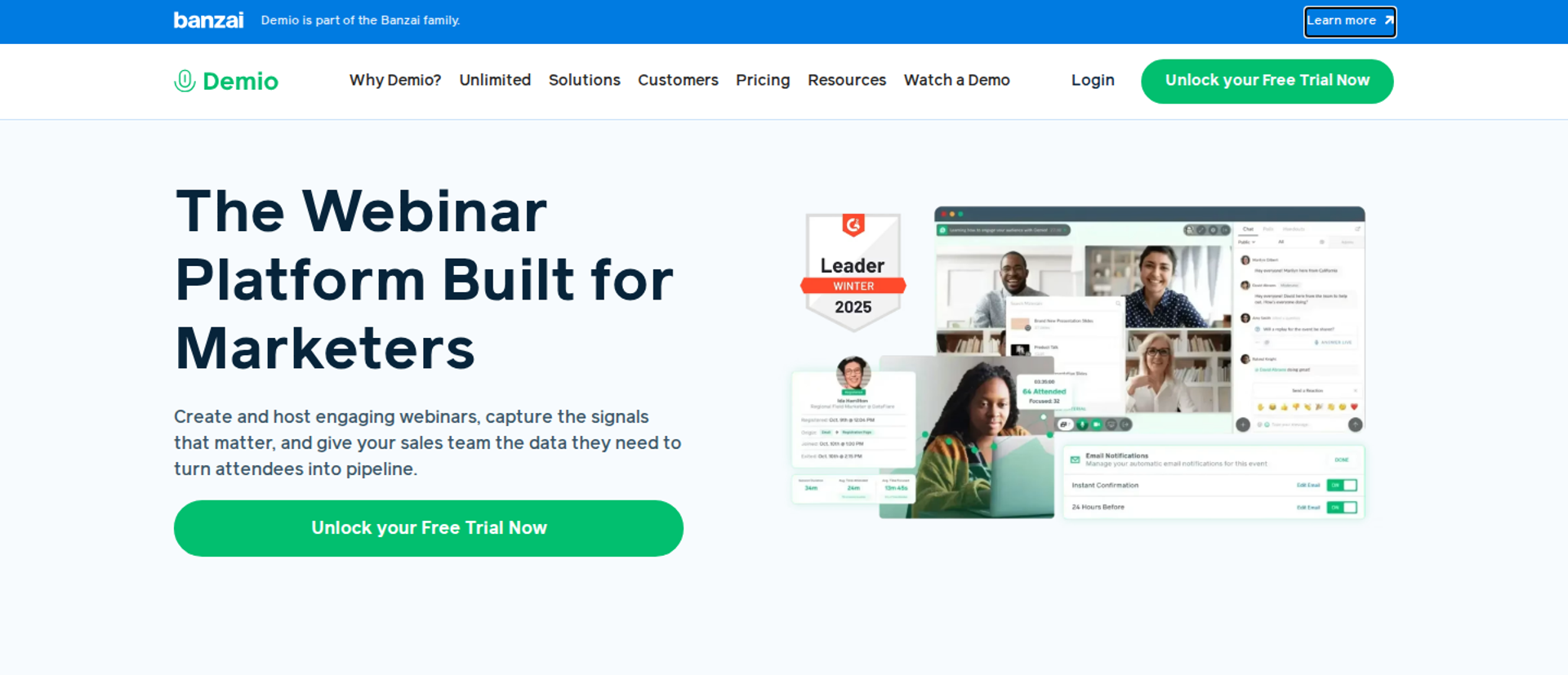
Demio is best for marketing teams running occasional live marketing webinars that need a clean, no-download attendee experience and engagement analytics. It may not fit buyers who need in-room checkout, a built-in CRM, or automation on the entry plan.
| Quick fit | Details |
|---|---|
| Best for | Marketers running live marketing webinars a few times a month |
| Skip if | You want to sell inside the room, or need several hosts on a small budget |
| Strongest edge | Browser-based joining with no download, plus engagement analytics on every plan |
| Biggest trade-off | Per-host pricing, with automation and premium CRM integrations gated to higher tiers |
| Pricing snapshot | Starter costs $45/mo for a single host billed yearly, or $63/mo billed monthly, with a 50-attendee room. Premium costs $196/mo per host billed yearly. |
💸 How Demio prices hosts and rooms
Demio prices by host and room size. Each host can start and stop events, and running sessions at the same time requires more than one host. The Growth plan's per-host price is not shown on the pricing page until you select a room size between 150 and 3,000 attendees.
The 14-day free trial includes Growth features but is capped at 20 attendees and one-hour sessions. For comparison, EasyWebinar's pricing is flat per plan rather than per host.
Why Demio ranks #2
Demio scores well on attendee experience, engagement, and analytics, which are the criteria most Zoom users feel first. It loses ground on monetization and native CRM depth. Buyers who sell inside the webinar or want CRM data without middleware will need extra tools.
👥 Where Demio beats a Zoom meeting
Demio fixes the "Hollywood Squares" problem of a Zoom meeting, where every attendee's camera fills the screen. One G2 reviewer chose Demio over Zoom because attendees stay anonymous and cannot see each other. That matters for coaches and marketers who want a stage, not a group call.
What Demio does well
- No-download joining. Demio markets a webinar experience that attendees join without downloading anything, which removes a common show-up barrier.
- Engagement on every plan. Chats, polls, featured actions, handouts, and engagement analytics are included from Starter.
- Automated and on-demand on Growth. Pre-recorded on-demand and automated webinars, custom branding, and registration source tracking start at Growth.
- Showcase embeds. Showcase lets teams embed a branded collection of upcoming events on their website, which helps recurring programs.
- Enterprise CRM connectors. Premium includes integrations with HubSpot, Salesforce, Marketo, and Pardot, plus a dedicated CSM.
Where Demio falls short
- Per-host pricing adds up. Starter is limited to one host, so teams running parallel sessions pay for multiple seats.
- Key features sit on Premium. 1080p streaming, restreaming, live captions, custom domains, and Demio AI are Premium-only.
- No native checkout. Demio's plan comparison lists no built-in checkout. EasyWebinar, by contrast, includes in-room checkout from Growth.
- Data access and contract terms. One reviewer could not export registrants after cancelling. Premium subscriptions also require 30 days' notice for plan changes.
Decision scorecard
| Evaluation criterion | Demio fit | Why it matters |
|---|---|---|
| Live webinars | Strong | Browser joining and a clean stage suit live marketing sessions. |
| Simulive or automated webinars | Partial | Available from Growth, not on Starter. |
| Evergreen automation | Partial | Automated sessions exist, but scheduling depth is narrower than dedicated evergreen tools. |
| Funnel pages | Partial | Registration pages and Showcase embeds exist; there are no offer or checkout pages. |
| Engagement | Strong | Polls, handouts, and featured actions run on every plan. |
| CRM and follow-up | Partial | Premium integrations are gated, and there is no built-in CRM. |
| Monetization | Weak | No built-in checkout is listed on the plan comparison. |
| Analytics | Strong | Engagement analytics are included on all plans. |
| Integrations | Partial | Zapier on lower tiers; HubSpot and Salesforce on Premium. |
| Pricing fit | Partial | Per-host pricing raises cost for multi-presenter teams. |
| Best-fit buyer | Live marketing teams | Occasional live webinars with no in-room selling. |
Best for / skip if
Choose Demio if you run live marketing webinars a few times a month and your CRM workflow already lives elsewhere. Skip it if you need to take payment in the room, or want automation and CRM sync without moving to higher tiers.
Reviews
- A 4-star reviewer liked the simple interface, polls, and handouts, but found Zapier connections difficult to manage ( Demio - G2 Verified Review, Aug 2024).
- A paid user could not export their registrant list after cancelling unless they subscribed again ( Demio - G2 Verified Review, May 2025).
1.3 Contrast
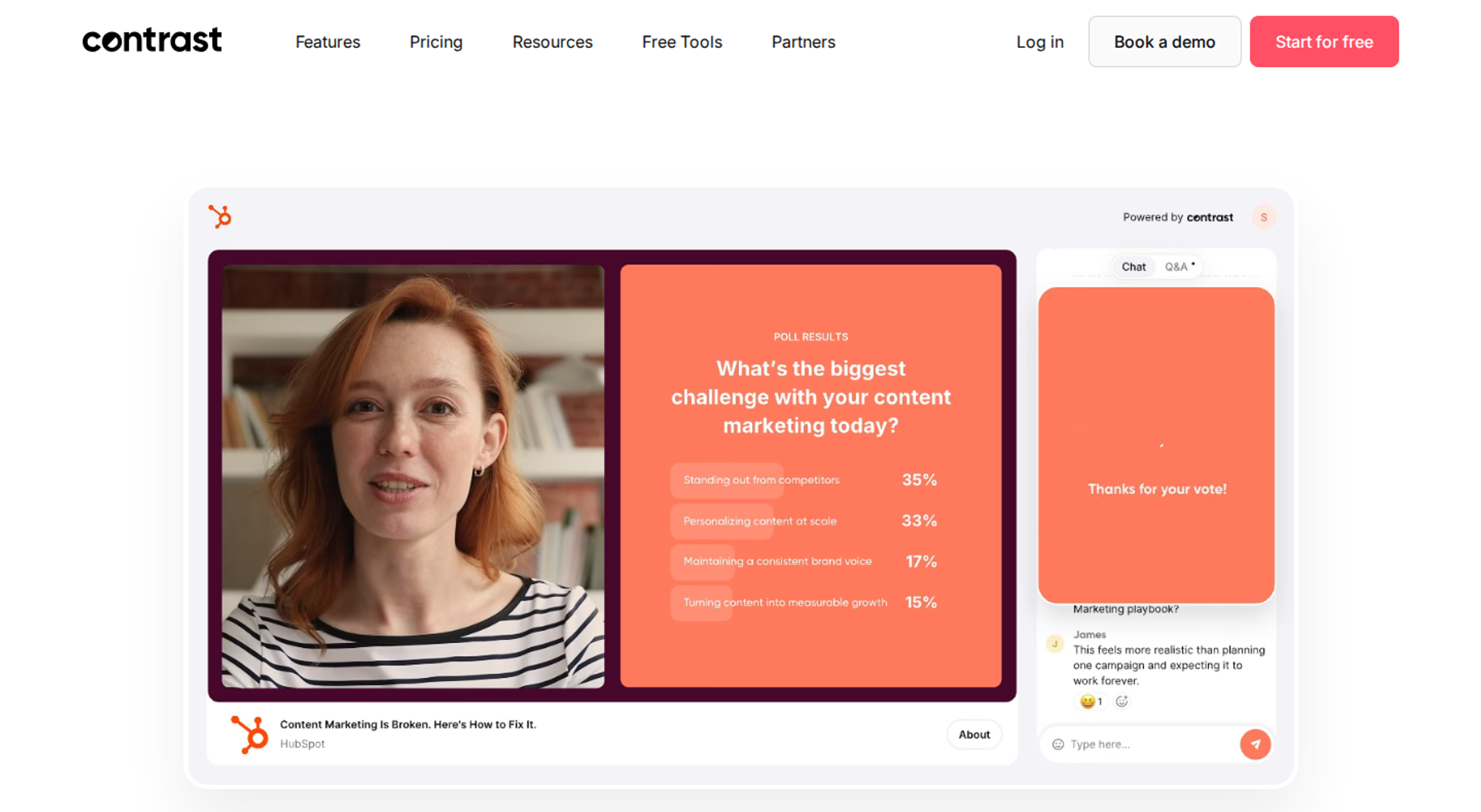
Contrast is best for B2B marketing teams that need polished, brand-led live webinars with low speaker friction. It offers a clean studio where invited speakers join without instructions. It may not fit buyers who need in-room checkout, evergreen scheduling, or pricing set per event rather than per monthly contact.
| Quick fit | Details |
|---|---|
| Best for | B2B marketing teams running branded live webinar series |
| Skip if | You sell inside the webinar or need automated, evergreen delivery |
| Strongest edge | A clean studio and speaker experience that needs almost no presenter training |
| Biggest trade-off | Pricing scales with monthly active contacts, so a big registration month raises your tier |
| Pricing snapshot | Free is $0 for up to 50 active contacts a month. Pro is $150/month for up to 250 active contacts. Premium covers unlimited contacts. Yearly billing saves 20%. |
💸 How Contrast counts usage
Contrast counts an active contact as anyone who registers for or watches one of your webinars in a given month. That differs from EasyWebinar's model, which caps live attendees per session on flat monthly plans. On Contrast, a busy month and a quiet month can land on different invoices.
Contrast says it won't block registrants when a paid account's webinar draws more sign-ups than expected. Every plan includes unlimited seats, and Pro adds integrations and room for 150 stored videos, according to the Contrast pricing page.
Why Contrast ranks #3
Contrast scores well on attendee experience, speaker experience, and design, which matter most to brand-conscious B2B teams. It ranks below EasyWebinar and Demio because it is weaker on the revenue criteria. Its public plans don't show in-room checkout or evergreen scheduling.
🎙️ Where Contrast earns its place
Contrast suits teams that treat webinars as branded content programs. A G2 reviewer credits it with letting them scale registrations without worrying about the stream failing. EasyWebinar's approach differs: it treats the webinar as a conversion asset, not a content channel.
What Contrast does well
- Speaker onboarding. Reviewers say invited speakers need no explanation to join, which cuts prep time before each session.
- Clean interface. G2 reviewers repeatedly praise the UI, which helps first-time hosts run a professional room.
- Automatic reminder emails. One reviewer relies on its email sequences to remind attendees and send recording links.
- Unlimited seats. Every plan allows unlimited team seats, so marketing, product, and sales can share one account.
- HubSpot connection. A 2025 reviewer titled their review around smooth HubSpot sync. An earlier reviewer called the integration a work in progress.
Where Contrast falls short
- Contact-based billing. One G2 reviewer found it hard to predict cost, because limits count participants per month rather than per event.
- Missing broadcast inputs. A reviewer flagged the lack of RTMP input (a way to send your own custom video stream into the room).
- Engagement gaps. Reviewers note no survey feature and no anonymous Q&A box, though polls and chat work well.
- Revenue tooling. EasyWebinar includes in-room checkout and EasyCRM from Growth. Contrast's public plans list neither.
Decision scorecard
| Evaluation criterion | Contrast fit | Why it matters |
|---|---|---|
| Live webinars | Strong | The studio and speaker flow are its core strength. |
| Simulated live or automated webinars | Verify | The public plans don't describe automated scheduling. |
| Evergreen automation | Weak | There is no just-in-time or recurring evergreen engine on the plans. |
| Funnel pages | Partial | Registration and replay pages exist; there are no offer or checkout pages. |
| Engagement | Partial | Polls and chat work well; surveys and anonymous Q&A are missing. |
| CRM and follow-up | Partial | HubSpot sync and reminder emails, with no built-in CRM. |
| Monetization | Weak | No in-room checkout is listed. |
| Analytics | Partial | Registration and attendance data flow to the CRM. |
| Integrations | Partial | HubSpot is the primary integration. |
| Pricing fit | Partial | The free tier helps, but cost rises with monthly contacts. |
| Best-fit buyer | B2B content marketers | Branded live programs, not in-room selling. |
Best for / skip if
Choose Contrast if your team runs branded live webinar series and HubSpot is your system of record. Skip it if your webinar has to take payment in the room or run on an automated schedule.
Reviews
- An IT services reviewer praised the speaker experience and support, but noted HubSpot sync was still maturing and surveys were missing ( Contrast - G2 Verified Review, 5/5, Apr 2025).
- A marketing reviewer reported zero bugs across events, but missed RTMP input for custom video streams ( Contrast - G2 Verified Review, 5/5, May 2025).
1.4 GoTo Webinar
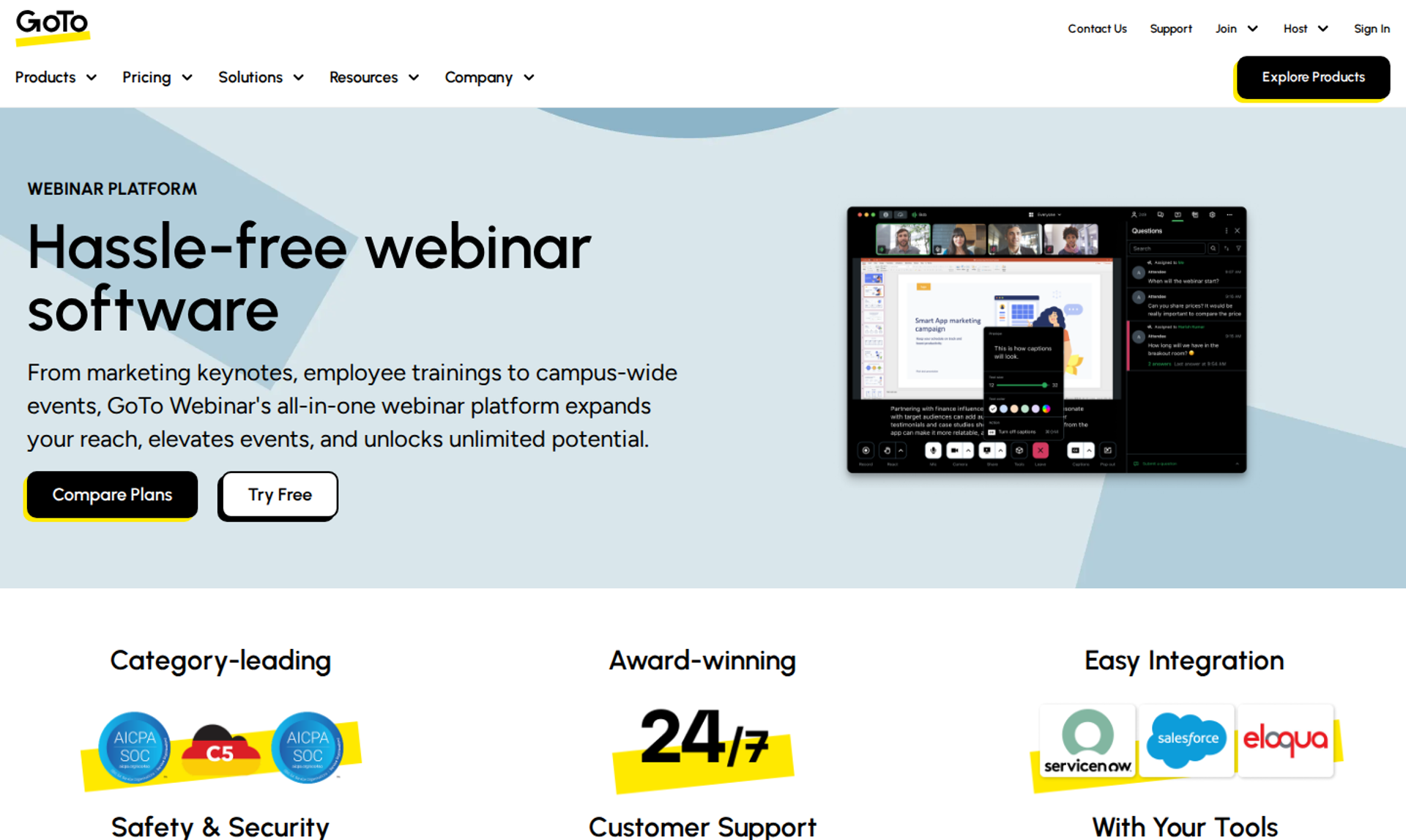
GoTo Webinar is best for organizations running formal corporate training and compliance sessions that need predictable large-audience hosting. It offers simulive events, automated emails, and reporting on every tier. It may not fit buyers who want in-room payments without a custom contract, or who need a native CRM.
| Quick fit | Details |
|---|---|
| Best for | Training, HR, and corporate communications teams running scheduled sessions |
| Skip if | You sell during webinars on a self-serve plan, or want evergreen funnels |
| Strongest edge | Mature hosting with reporting, reminders, and simulive on every plan |
| Biggest trade-off | Payments, source tracking, and certificates sit on the quote-only Complete tier |
| Pricing snapshot | Reach costs $69/month and Elevate $129/month, or $59 and $103 when billed annually. Complete is quote-only ( GoTo pricing page , captured August 2026). |
💸 What each GoTo tier unlocks
Reach includes one organizer seat, up to 500 participants, reporting, automated reminder and follow-up emails, polls, live Q&A, and mobile hosting. Elevate raises capacity to 1,000 and adds branded webinars, custom URLs, cloud recordings, AI summaries, transcripts, and breakout rooms, per the GoTo Webinar plan page.
Complete adds custom organizer seats, up to 3,000 participants, paid events, certified training, registration source tracking, and a GoTo Meeting license. GoTo's free trial requires no credit card and no commitment. For occasional hosts, the Flex plan costs $228 a year, then $149 per event for up to 500 attendees, as broken down in our GoTo Webinar pricing guide.
Why GoTo Webinar ranks #4
GoTo Webinar scores well on reliability at scale, reporting, and simulive coverage, which is why training teams keep it. It ranks below the top three because selling and source tracking are gated to Complete. It also has no native CRM, so funnel work happens in other tools.
🏢 Where GoTo Webinar fits a buying committee
IT and procurement teams often favor GoTo Webinar for its long track record and predictable per-organizer billing. EasyWebinar takes a different shape: checkout starts at Growth, a self-serve plan, rather than requiring a custom contract.
What GoTo Webinar does well
- Simulive on every tier. GoTo's plan comparison shows simulive events across all three tiers, so a recorded session can run at a scheduled time.
- Reporting and reminders. Every plan includes reporting, analytics, and automated emails, which cuts manual work for recurring training.
- Large-session comfort. A TrustRadius reviewer called it their go-to option for webinars above 200 attendees.
- Visual overlays. The same reviewer values overlaying names, titles, and branding on the video feed during sessions.
- AI summaries on Elevate. Transcripts and AI summaries help training teams send recap material quickly.
Where GoTo Webinar falls short
- Monetization is gated. Paid events and source tracking need Complete, which requires a sales conversation.
- Support friction. A 2025 G2 reviewer described outsourced support and repeated escalations to fix a speaker webcam setting.
- Audio and page limits. A TrustRadius reviewer reported audio cut-offs and limited registration page customization.
- No native CRM. Follow-up depends on integrations. EasyWebinar includes EasyCRM with lead scoring from Growth.
Decision scorecard
| Evaluation criterion | GoTo Webinar fit | Why it matters |
|---|---|---|
| Live webinars | Strong | Mature hosting with up to 3,000 participants on Complete. |
| Simulated live or automated webinars | Partial | Simulive is available, but there is no evergreen scheduling engine. |
| Evergreen automation | Weak | There are no just-in-time or on-demand funnel schedules. |
| Funnel pages | Partial | Registration pages exist, but reviewers report limited customization. |
| Engagement | Partial | Polls, Q&A, and handouts; no timed offers. |
| CRM and follow-up | Partial | Automated emails plus integrations; no built-in CRM. |
| Monetization | Weak | Payments require the quote-only Complete tier. |
| Analytics | Strong | Reporting and analytics on every plan. |
| Integrations | Partial | Integrations are available, and a reviewer found the API documentation hard to use. |
| Pricing fit | Partial | Per-organizer billing adds up for multi-host teams. |
| Best-fit buyer | Corporate training teams | Scheduled sessions with no in-room selling. |
Best for / skip if
Choose GoTo Webinar if you run formal training or compliance sessions and value reporting over funnel tools. Skip it if you need self-serve in-room payments or evergreen sales webinars.
Reviews
- A marketing team lead reported recurring speaker audio and screen-share problems and slow support escalations ( GoTo Webinar - G2 Verified Review, 0/5, Oct 2025).
- A software company reviewer uses it as the default for sessions above 200 attendees, while calling it costly ( GoTo Webinar - TrustRadius Verified Review, 6/10, Jun 2024).
1.5 WebinarJam
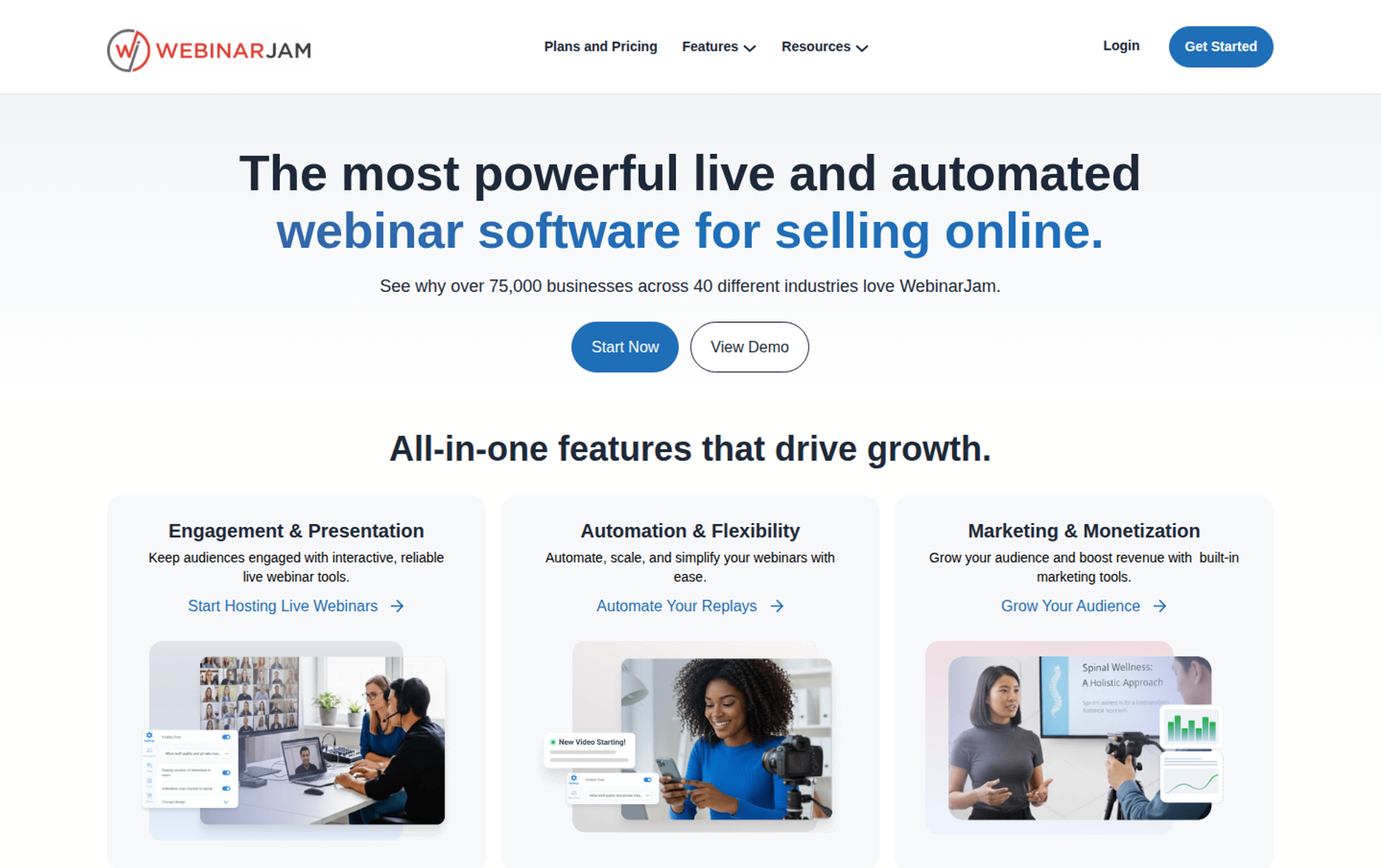
WebinarJam is best for creators running one-off live launches that need urgency tools in the room. It offers live offer displays, a panic button, and email and SMS reminders on every plan. It may not fit buyers who want live and automated webinars inside one product, because automation runs in its sister platform, EverWebinar.
| Quick fit | Details |
|---|---|
| Best for | Creators and info-product sellers running launch-style live events |
| Skip if | You want one interface for live and automated sessions, or webinars longer than your tier's cap |
| Strongest edge | Launch-room tools: live offers, A/B split testing, and a panic button |
| Biggest trade-off | Session length caps run from 1 to 4 hours, and automation lives in a second product |
| Pricing snapshot | Starter $49/mo monthly or $39 annually (100 attendees). Basic $99 or $79 (500). Professional $299 or $229 (2,000). Enterprise $499 or $379 (5,000). |
💸 What the WebinarJam plans include
The 14-day trial costs $1 and runs on Basic with 500 attendees. WebinarJam also offers a 30-day money-back guarantee. Session limits rise by tier: Starter allows 1 host and 1-hour sessions, while Enterprise allows 6 hosts and 4-hour sessions, per the WebinarJam pricing page.
WebinarJam includes EverWebinar at no extra cost on Basic, Professional, and Enterprise. That closes much of the cost gap with EasyWebinar's single-subscription model. The setup gap remains, because the automated version is built in a different product.
Why WebinarJam ranks #5
WebinarJam scores well on live engagement, page building, and price per attendee. It ranks below GoTo Webinar because reviewers report integration and email delivery problems. Those failures hit the follow-up criteria hardest, where revenue gets recovered.
⚠️ EasyWebinar's read on the two-product setup
EasyWebinar was built because I wanted a single switch from a live session to an automated one. At the time, GoToWebinar couldn't do it. WebinarJam's own FAQ tells users to host live in WebinarJam, then convert the recording into an automated session in EverWebinar. That works, but it means two dashboards to keep in sync.
What WebinarJam does well
- Launch-room urgency. Every plan lists live offer displays, polls and surveys, an always-on live room, and a panic button. These support a high-energy launch pitch.
- Built-in email and SMS. Reminder messaging is included, which reduces the need for a separate SMS tool.
- Page split testing. A point-and-click page builder lets you split-test two registration designs and track which converts better.
- Social broadcasting. Sessions can broadcast to Facebook and YouTube, which extends reach beyond registrants.
- Wide email integrations. Connections include ActiveCampaign, AWeber, Keap, Mailchimp, Ontraport, ConvertKit, Twilio, and Zapier.
Where WebinarJam falls short
- Hard session caps. WebinarJam suggests scheduling a second session for anything longer than your plan allows. That interrupts long workshops.
- Integration reliability. A G2 reviewer reported inconsistent Mailchimp syncing and emails that didn't reach registrants.
- Equipment demands. WebinarJam recommends a wired ethernet connection and at least 5 Mbps of sustained upload speed. EasyWebinar attendees, by contrast, join from any browser with nothing to install.
- No built-in CRM. Lead follow-up depends on the connected email tool.
Decision scorecard
| Evaluation criterion | WebinarJam fit | Why it matters |
|---|---|---|
| Live webinars | Strong | Launch-room tools are its core strength. |
| Simulated live or automated webinars | Partial | Video injections run inside a live session; full automation sits in EverWebinar. |
| Evergreen automation | Partial | Included through EverWebinar on Basic and above, configured separately. |
| Funnel pages | Strong | Templates and A/B split testing for registration pages. |
| Engagement | Strong | Offers, polls, whiteboard, and attendee spotlight. |
| CRM and follow-up | Partial | Email and SMS built in; no native CRM. |
| Monetization | Partial | Live offer displays push buyers to an external checkout. |
| Analytics | Partial | Registration split-test data; reviewers report email reporting gaps. |
| Integrations | Partial | A wide list, with reported sync issues. |
| Pricing fit | Strong | Low cost per attendee, especially billed annually. |
| Best-fit buyer | Launch-driven creators | High-urgency live events. |
Best for / skip if
Choose WebinarJam if you run launch-style live events and want low cost per attendee. Skip it if you want live and automated sessions managed in one product, or run sessions longer than your tier allows.
Reviews
- A course seller liked replaying sessions through EverWebinar, but reported inconsistent Mailchimp syncing and unreliable email sends ( WebinarJam - G2 Verified Review, 0/5, Jun 2023).
- An investment firm user found upselling easy inside the room, but hit presenter control and file size limits ( WebinarJam - G2 Verified Review, 0/5, Aug 2020).
1.6 Webex Webinars
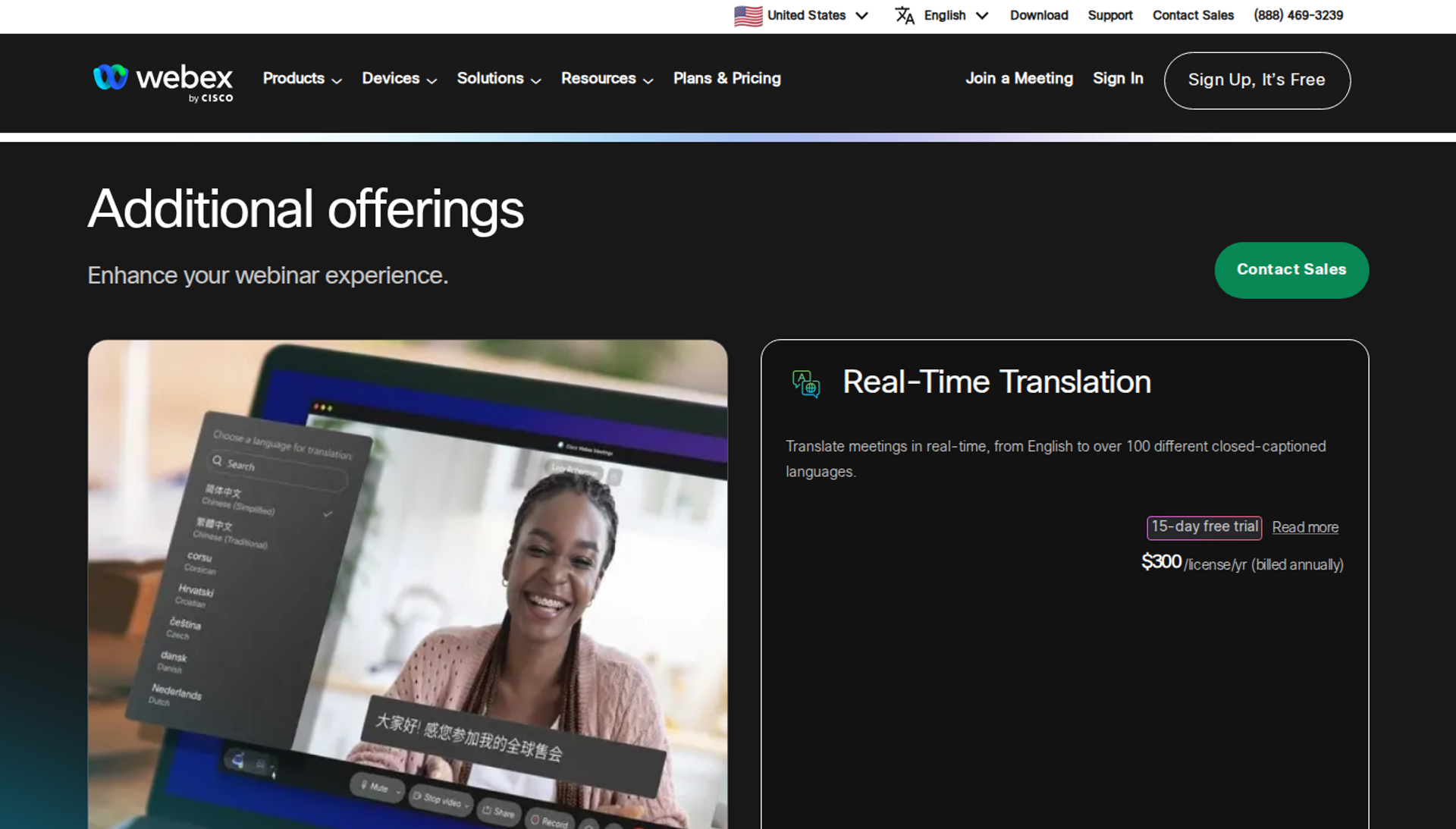
Webex Webinars is best for enterprises whose IT team has standardized on Cisco and needs large, multilingual broadcasts. It offers browser joining, simultaneous interpretation, and webcast capacity up to 100,000 attendees. It may not fit buyers who need evergreen funnels, in-room checkout, or self-serve pricing.
| Quick fit | Details |
|---|---|
| Best for | Enterprise communications teams already running Cisco Webex |
| Skip if | You run sales webinars or want evergreen automation |
| Strongest edge | Large-scale, multilingual broadcasting inside an IT-approved stack |
| Biggest trade-off | No revenue tooling, and reviewers report lag and slow joins |
| Pricing snapshot | The 1,000-attendee license lists at $2,700 per license per year, recently discounted 75% to $675, with a Webex Meet plan added at checkout ( Webex pricing , captured August 2026). |
💸 How Webex licenses webinars
Webex bills per host license, and attendees join without needing a license. Webex's pricing page now shows the Webinars plan for up to 1,000 attendees as "Let's talk," next to Webex Events at $300 per license per year.
Any Webex user can try the free version, which supports up to 100 attendees. For comparison, EasyWebinar publishes four flat monthly plans with no sales call needed below Enterprise.
Why Webex Webinars ranks #6
Webex Webinars scores well on capacity, security, and multilingual features, which matter to enterprise IT. It ranks low for this article's buyer because it offers no evergreen engine, no checkout, and no native CRM. Reviewers also report performance issues that hurt live conversion.
🌐 Where Webex earns a shortlist spot
Global companies running all-hands-style external briefings get real value from interpretation channels. Attendees can pick their preferred language channel before or during a webinar, according to Webex. EasyWebinar concedes these large multi-region broadcasts to event platforms.
What Webex Webinars does well
- Scale. Webex Webinars supports up to 5,000 attendees, and webcast view supports up to 100,000.
- Browser joining. Attendees can join through a browser, and the platform supports single sign-on for attendees, per the Webex feature list.
- Language access. Real-time translated captions and simultaneous interpretation are built in.
- Polling options. Native multiple-choice polls run alongside Slido as an integrated app.
- Responsive chat support. A 2025 G2 reviewer praised step-by-step chat support over long email threads.
Where Webex Webinars falls short
- Performance complaints. A 2025 G2 reviewer reported lag, slow joins, and freezing during screen share, even on stable internet.
- Interactivity. A 2022 reviewer said its webinar interaction tools trailed other systems.
- No revenue workflow. There is no checkout, evergreen schedule, or built-in CRM. EasyWebinar includes all three from Growth.
- Opaque pricing. The public page now routes webinar buyers to a sales conversation.
Decision scorecard
| Evaluation criterion | Webex Webinars fit | Why it matters |
|---|---|---|
| Live webinars | Partial | Strong capacity, but reviewers report lag. |
| Simulated live or automated webinars | Weak | It is not built around automated delivery. |
| Evergreen automation | Weak | There is no evergreen scheduling engine. |
| Funnel pages | Partial | Registration sites exist; there are no offer pages. |
| Engagement | Partial | Polls and Slido; reviewers want more interactivity. |
| CRM and follow-up | Weak | No native CRM or behavior-based follow-up. |
| Monetization | Weak | No in-room checkout. |
| Analytics | Partial | Pre-event data collection is praised by reviewers. |
| Integrations | Partial | Strongest inside the Cisco stack. |
| Pricing fit | Weak | Quote-led pricing for webinar licenses. |
| Best-fit buyer | Cisco enterprises | Large multilingual broadcasts. |
Best for / skip if
Choose Webex Webinars if your IT team mandates Cisco and you broadcast to large multilingual audiences. Skip it if your webinars need to sell, follow up, or run on autopilot.
Reviews
- An IT services reviewer valued responsive chat support, but wanted a full view of the event agenda while building it ( Webex Webinars - G2 Verified Review, 4.5/5, Apr 2025).
- Another IT services reviewer reported constant lag, slow joins, and freezing during screen share ( Webex Webinars - G2 Verified Review, 0/5, Jun 2025).
1.7 Microsoft Teams Webinars
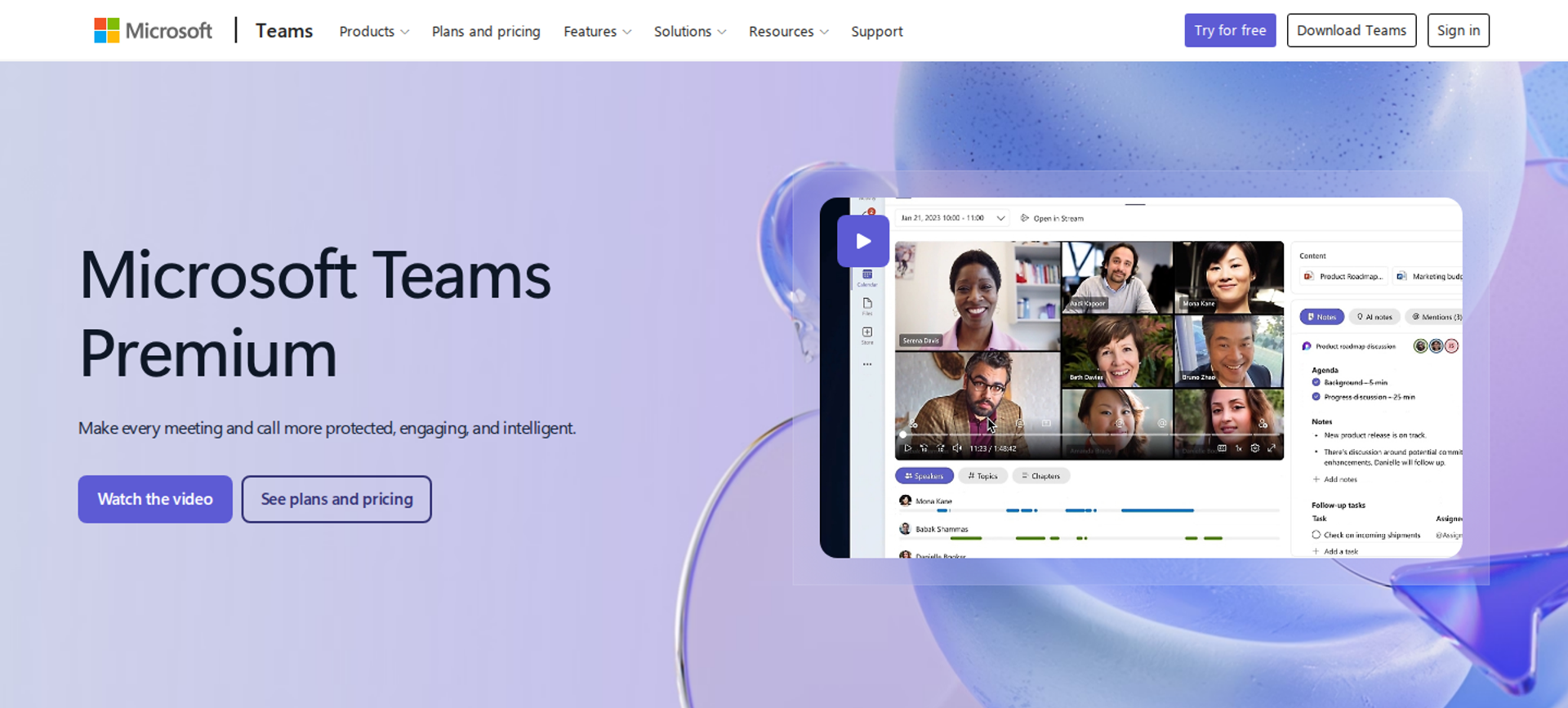
Microsoft Teams Webinars is best for organizations already standardized on Microsoft 365 that run partner, customer, or internal-facing webinars. It offers registration, reminders, and attendee reports inside the Teams license they already pay for. It may not fit buyers who need branded funnels, behavior-based follow-up, or in-room selling.
| Quick fit | Details |
|---|---|
| Best for | Microsoft 365 organizations running customer and partner education sessions |
| Skip if | Your webinar is a sales funnel or needs custom branding |
| Strongest edge | Webinar registration and reporting inside an existing Microsoft license |
| Biggest trade-off | Basic branding and shallow behavioral analytics |
| Pricing snapshot | Included in Teams Enterprise licensing; Teams Premium is an add-on at $10 per user per month, paid annually . |
💸 What changed in Microsoft licensing
On April 1, 2026, Microsoft moved a long list of Teams Premium features into the base Teams Enterprise license. Basic webinar functionality, event themes, and registration customization for webinars and town halls moved to standard Teams Enterprise.
Only the organizer needs a Premium license to enable branded meetings and advanced webinars. For a Microsoft 365 shop, the marginal cost of a webinar can be close to zero. EasyWebinar's cost case rests on the revenue tools that come with its subscription instead.
Why Microsoft Teams Webinars ranks #7
Teams Webinars scores well on pricing fit and ease of setup for Microsoft 365 customers. It ranks low because it has no evergreen delivery, no checkout, and limited branding. Reviewers also call its engagement analytics basic.
🏢 Where Teams Webinars belongs
Teams earns its slot for internal training and partner updates, which EasyWebinar does not chase. It does not belong at the center of a sales funnel. A G2 reviewer noted that its registration pages look like a standard Microsoft form.
What Microsoft Teams Webinars does well
- No new vendor. Webinars run inside the Microsoft 365 license, which simplifies procurement and IT review.
- Built-in registration and reminders. Reviewers say registration pages, reminders, and attendee reporting reduce the need for third-party tools.
- Presenter controls. A G2 reviewer highlights strong presenter controls, polls, Q&A, and live captions.
- Outlook integration. Scheduling flows through Outlook calendars that staff already use.
Where Microsoft Teams Webinars falls short
- Limited branding. Reviewers say registration pages and emails can't be customized enough for marketing campaigns.
- Join friction for outsiders. A December 2025 reviewer said some external attendees must sign in or download Teams.
- Shallow analytics. Polling, Q&A moderation, and reporting lack deeper behavioral insight. EasyWebinar tracks watch time, offer clicks, and purchases per attendee.
- No monetization. There is no in-room checkout or offer tooling.
Decision scorecard
| Evaluation criterion | Teams Webinars fit | Why it matters |
|---|---|---|
| Live webinars | Partial | Reliable for Microsoft users; external joins can stall. |
| Simulated live or automated webinars | Weak | It is built around live sessions. |
| Evergreen automation | Weak | There is no evergreen scheduling. |
| Funnel pages | Weak | Registration pages offer limited branding. |
| Engagement | Partial | Polls and Q&A are basic, according to reviewers. |
| CRM and follow-up | Weak | No native CRM or behavior-based sequences. |
| Monetization | Weak | No checkout or offers. |
| Analytics | Partial | Attendance reports, but no behavioral insight. |
| Integrations | Strong | Deep Microsoft 365 integration. |
| Pricing fit | Strong | Included in existing Teams Enterprise licensing. |
| Best-fit buyer | Microsoft 365 organizations | Education and partner sessions. |
Best for / skip if
Choose Microsoft Teams Webinars if your organization runs on Microsoft 365 and your sessions inform rather than sell. Skip it if your webinar must convert, follow up by behavior, or carry your brand.
Reviews
- A reviewer praised built-in registration, attendee tracking, and presenter controls, but noted limited branding and sign-in friction for external attendees ( Microsoft Teams Webinars - G2 Verified Review, 4.5/5, Dec 2025).
- Another reviewer valued the reminders and reporting, but found polling, Q&A, and reporting too basic for behavioral insight ( Microsoft Teams Webinars - G2 Verified Review, 5/5, Dec 2025).
1.8 EverWebinar
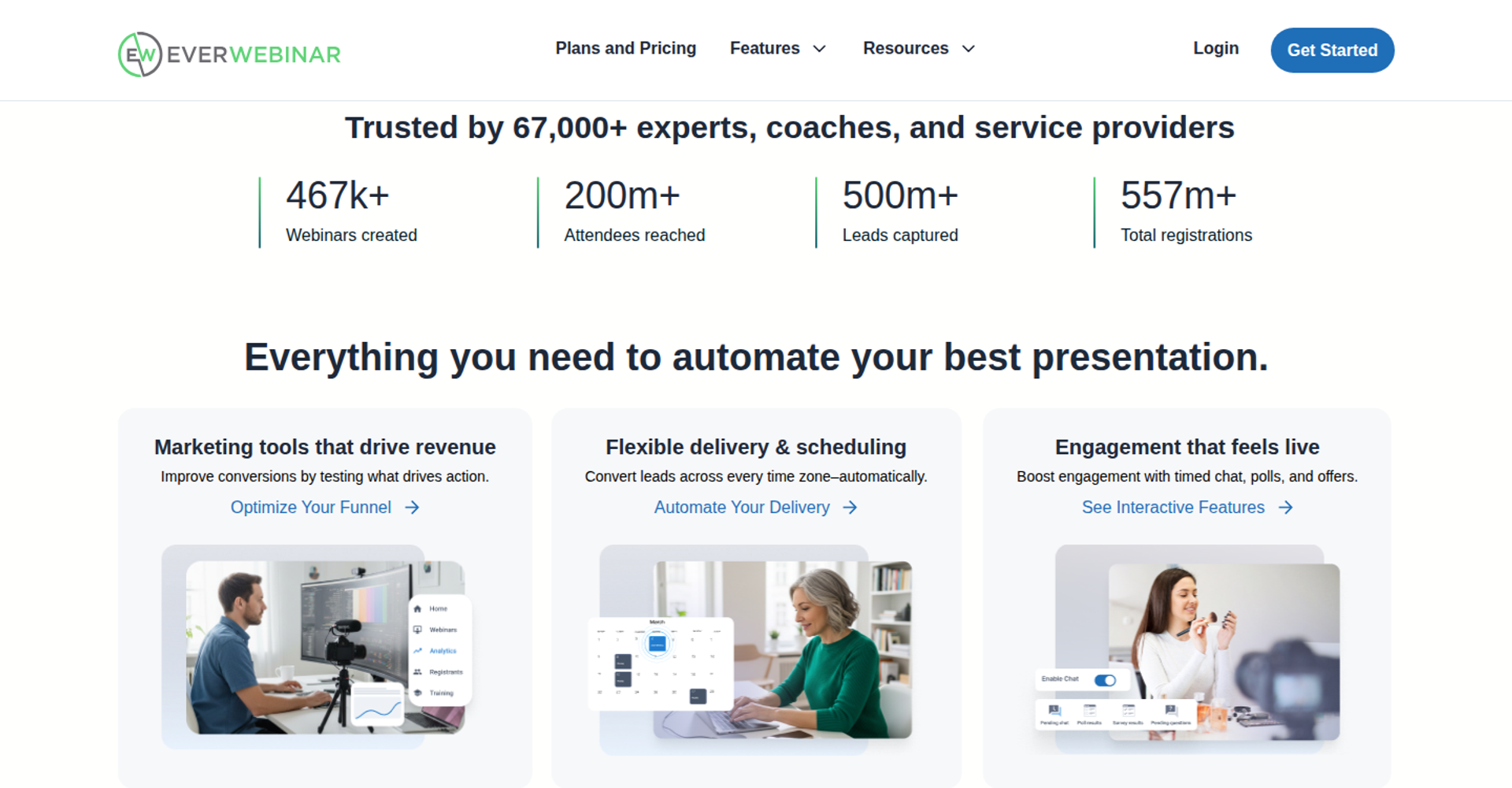
EverWebinar is best for sellers who already have a proven webinar recording and never plan to present live. It replays a recorded session on a schedule. It may not fit buyers who also host live webinars, because it cannot run live sessions without WebinarJam.
| Quick fit | Details |
|---|---|
| Best for | Sellers with a webinar that already converts and needs scheduled replays |
| Skip if | You want to host live, then automate, in one product |
| Strongest edge | A dedicated engine for scheduled replays of a recorded webinar |
| Biggest trade-off | No live hosting, and reviewers report setup and support issues |
| Pricing snapshot | $199 billed monthly, $99/mo on an annual plan, or $79/mo on a two-year plan, with a $1 trial (live page verified August 25, 2026, as documented in our EverWebinar pricing breakdown ). |
💸 How EverWebinar charges
The annual and two-year plans charge $1,188 or $1,896 in a single payment on day one. The pricing page doesn't state attendee caps, host seats, SMS fees, or the renewal rate.
WebinarJam's Basic, Professional, and Enterprise plans include EverWebinar at no extra cost, per the WebinarJam pricing page. For buyers who also host live, that bundle is usually cheaper than EverWebinar alone. EasyWebinar runs both formats from one dashboard instead.
Why EverWebinar ranks #8
EverWebinar scores on automation depth for a single job: replaying a recorded webinar on a schedule. It ranks last because it covers one format, and its G2 reviews describe setup and support problems. Most of those reviews are older, so recent buyers may see a different product.
⏰ EasyWebinar's rule before you automate
EasyWebinar's guidance is to automate only a session that has already converted live. Automating an unproven webinar just automates the failure. EverWebinar fits that rule only if your live proof happened somewhere else.
What EverWebinar does well
- Single-purpose automation. It focuses on scheduled replays, which keeps setup narrow for one proven webinar.
- Converts WebinarJam sessions. WebinarJam users can convert a live recording into an automated EverWebinar session.
- Bundled value. WebinarJam buyers on Basic or above get it at no extra cost.
- Active community. A G2 reviewer noted an active Facebook community that responds quickly.
Where EverWebinar falls short
- No live hosting. Testing a new offer live means paying for, or switching to, a second product.
- Upfront billing. The annual and two-year plans are charged in one payment.
- Reported reliability issues. A 2021 reviewer reported duplicate chat messages and unsent emails after cloning webinars.
- Support access. A 2018 reviewer said email was the only way to reach support during a live event day.
Decision scorecard
| Evaluation criterion | EverWebinar fit | Why it matters |
|---|---|---|
| Live webinars | Weak | It cannot host live sessions. |
| Simulated live or automated webinars | Strong | Automated replay is its whole purpose. |
| Evergreen automation | Strong | Scheduled replays of one recording. |
| Funnel pages | Partial | Registration pages come with the replay flow. |
| Engagement | Partial | Scripted interactions only; there is no live presenter. |
| CRM and follow-up | Partial | Relies on connected email tools. |
| Monetization | Partial | Offers point to an external checkout. |
| Analytics | Verify | Reporting depth isn't stated on the pricing page. |
| Integrations | Partial | Shares WebinarJam's connector approach. |
| Pricing fit | Partial | Strong inside the WebinarJam bundle, costly alone. |
| Best-fit buyer | Proven-webinar sellers | Automation without live sessions. |
Best for / skip if
Choose EverWebinar if you already own WebinarJam Basic or above and have a proven recording to automate. Skip it if you want to validate offers live and automate them inside one product.
Reviews
- A team cloned webinars and then hit duplicate chat messages, unsent registrant emails, and slow support ( EverWebinar - G2 Verified Review, 0/5, Aug 2021).
- A market research user liked the active community, but struggled with setup and email-only support on event day ( EverWebinar - G2 Verified Review, 1/5, Jan 2018).
EasyWebinar finishes first in this guide because it runs both halves of the job on one subscription: run a webinar live, find the version that converts, then turn that exact session into an automated webinar. Attendees join from any browser. Checkout runs inside the room, and follow-up reacts to each attendee's behavior through your CRM or EasyCRM. G2 reviewer Laura C. went from 10 to 12 course sales live to 25 sales within three weeks of evergreen.
Q2. How Did We Choose and Score These Zoom Alternatives?
Each platform in this guide was scored out of 100 on five weighted criteria. Revenue and conversion workflow carries 25%. Format coverage across live, automated, and on-demand delivery carries 20%. Attendee experience and reliability carries 20%, verified user reviews carry 20%, and pricing predictability carries 15%. Scores of 0 to 20 earn one star, and 21 to 40 earn two. Each further 20 points adds a star, up to five at 81 to 100.
The Five Weighted Criteria
| Criterion | Weight | What was checked |
|---|---|---|
| Revenue and conversion workflow 💰 | 25% | In-room offers, checkout, follow-up by attendee behavior, and CRM (customer relationship management) depth |
| Format coverage ⏰ | 20% | Live, simulive (a recording played at a set time), automated, evergreen, and on-demand support |
| Attendee experience and reliability ✅ | 20% | Browser join, stream stability, and uptime terms |
| Verified user reviews ⭐ | 20% | Dated G2 and TrustRadius reviews |
| Pricing predictability 💸 | 15% | Published prices, per-host or per-contact billing, and overage terms |
⚠️ Why revenue workflow carries the most weight
Readers of this guide are leaving Zoom because a webinar has to produce something afterward. So the heaviest weight goes to what happens after the live hour: the offer, the follow-up, and the CRM record. A platform can stream perfectly and still score low here.
EasyWebinar's own history shaped the second criterion. I ran live webinars for years before I could automate one, and that gap cost me sleep. Format coverage is the criterion buyers check last, but it decides whether a proven session can keep working.
The Scores
| Platform | Revenue (25) | Formats (20) | Experience (20) | Reviews (20) | Pricing (15) | Total | Stars |
|---|---|---|---|---|---|---|---|
| EasyWebinar | 24 | 20 | 17 | 18 | 13 | 92 | ⭐⭐⭐⭐⭐ |
| Demio | 15 | 14 | 18 | 15 | 12 | 74 | ⭐⭐⭐⭐ |
| Contrast | 12 | 10 | 19 | 17 | 14 | 72 | ⭐⭐⭐⭐ |
| GoTo Webinar | 11 | 13 | 15 | 12 | 12 | 63 | ⭐⭐⭐⭐ |
| WebinarJam | 15 | 14 | 12 | 7 | 12 | 60 | ⭐⭐⭐ |
| Webex Webinars | 8 | 9 | 16 | 13 | 12 | 58 | ⭐⭐⭐ |
| Microsoft Teams Webinars | 6 | 8 | 14 | 15 | 12 | 55 | ⭐⭐⭐ |
| EverWebinar | 12 | 13 | 12 | 5 | 10 | 52 | ⭐⭐⭐ |
✅ How the numbers were built
Each criterion score comes from three inputs. The first is each vendor's own pricing and feature pages, as of October 2026 or the latest capture. The second is dated reviews from G2 and TrustRadius. The third is a check of every claim against the plan that actually includes it, not the top tier.
Contrast outscores EasyWebinar on attendee experience, and that is deliberate. G2 reviewers consistently praise its interface and speaker flow. EasyWebinar loses points on pricing because automation starts at Growth rather than the entry plan.
❌ What this method does not measure
These scores don't test stream quality in a lab. They also don't cover internal meetings, accredited courses, or 5,000-person multi-track summits. Teams buying for those jobs should weight the criteria differently, and Teams Webinars or Webex may rank higher for them.
Review scores reflect the reviews in this guide's review files, and some vendors have older review sets. EverWebinar's lowest scores come from reviews dated 2018 to 2021, so recent buyers may see a different product.
EasyWebinar scores highest on revenue workflow and format coverage because it runs live, simulive, automated, and evergreen webinars on one subscription. Checkout, behavior-based follow-up, and EasyCRM sit beside the room. It doesn't top every row, and the attendee experience and pricing scores show where other platforms lead.
Q3. When Does Zoom Stop Being Enough, and What Does It Really Cost in 2026?
Zoom stops being enough when a webinar has to produce revenue. Zoom Webinars is an add-on to a paid Zoom Workplace plan. On October 15, 2026, Zoom listed its standard Webinars plan at $89 billed monthly or $66.67 a month billed annually. In-room offers, behavior-based follow-up, and a built-in CRM sit outside Zoom. EasyWebinar is the step up from Zoom, with flat monthly pricing and no per-attendee fees.
⏰ The launch that sold nothing
EasyWebinar started with a failed launch. I spent six months building a YouTube course, and nobody bought it. A webinar was the only thing that changed my sales.
In my first year of live webinars, I built a 14,000-person email list and sold $245,000 of that course. EasyWebinar exists because that webinar needed more than a video room.
The Old Way: Meetings, Then an Add-On
Most teams start in a regular Zoom meeting. Attendees join with cameras and mics on, so hosts face a grid of faces and interruptions. Zoom tech coach Betsy Sabatini calls this the "Hollywood Squares" problem.
The usual fix is the Webinars add-on, which puts attendees in view-only mode. Sabatini priced a one-month add-on at about $89, versus about $67 a month on an annual plan. Zoom's current pricing page still shows those two numbers today.
💸 What Zoom covers, and what it leaves out
The standard plan includes chat, polls, Q&A, practice sessions, and CRM connectors such as HubSpot and Salesforce. Pre-recorded sessions, backstage, and advanced analytics only start on Webinars Plus, per Zoom's plan comparison.
The gap is what happens after the pitch. Zoom has no offer button timed to the pitch, no sequences by watch time, and no CRM of its own. Teams bolt on page builders, email tools, Zapier, and a CRM.
What Changed: Price Became a Moving Target
Zoom's webinar pricing has moved several times in 15 months:
| Date | Change |
|---|---|
| July 2025 | Prices rose 45% |
| February 2026 | Prices fell 37%, while the top tier rose 84.8% to $415.83 a month |
| July 2026 | One plan was removed from the lineup |
| October 2026 | Webinars $89, Webinars Plus $99, and Events $149, billed monthly |
On top of that, every webinar plan requires Zoom Workplace Pro at $15.99 per user per month. EasyWebinar's pricing page estimates a typical eight-tool webinar stack at $495 to $1,550 a month.
⚠️ Why the stack costs more than the license
Every extra tool adds a login, a bill, and a webhook (an automated link between two apps) that can fail. In EasyWebinar's experience, those failures cluster right before showtime.
EasyWebinar's Answer: One Bill, Built for the Webinar That Sells
EasyWebinar uses flat monthly pricing with no per-attendee fees within your plan, and your webinar never stops at the limit. Buyers pay through checkout inside the room. No-shows, early leavers, and offer-clickers each get their own follow-up. Data flows into HubSpot, Salesforce Pardot (Account Engagement), or EasyCRM.
✅ The proof
Carla Beisinger generated $5M from one evergreen EasyWebinar funnel after scaling up from small live events.
"It was easy to implement, integrates with our systems well and is always coming out with new features." - Rob K., 4/5, Zoom - G2 Verified Review
"Zoom Webinars almost completely lacks customization options to the look&feel." - Gabor F., 2/5, Zoom - G2 Verified Review
EasyWebinar is the step up from Zoom. Zoom runs the meeting, while EasyWebinar runs the webinar that has to sell, on one flat monthly subscription.
Q4. Live or Automated: Which Alternative Lets You Run Both, and Which Converts Better?
Zoom's standard Webinars plan doesn't include pre-recorded sessions, and no Zoom plan lists just-in-time or evergreen scheduling. WebinarJam runs automated webinars through EverWebinar, a separate product. From its Growth plan, EasyWebinar runs live, simulive, automated, evergreen, just-in-time, and on-demand webinars on one subscription. Live often converts better on cold traffic, so Casey Zeman's Webinar Sprint Method runs 5 to 10 live sessions, then automates the winner.
⏰ The cost of being live every time
EasyWebinar was built for a problem every live presenter knows. Live webinars create urgency, so people show up with intent. But you have to show up too, fight the tech, and repeat the same talk.
I used to joke that your kid could throw ketchup at your face mid-pitch. Live works, but it doesn't scale with one human.
The Old Way: Two Products or a Rebuild
EasyWebinar's live-to-automated switch exists because of a gap I hit. GoToWebinar could run my live session but couldn't turn it into an automated one, so automating meant rebuilding elsewhere.
The split still shows up today. WebinarJam's own FAQ says to host live in WebinarJam, then convert the recording into an automated session in EverWebinar. EverWebinar is now included free on Basic and higher plans, but it remains a second product to set up. On Zoom, pre-recorded sessions start at Webinars Plus.
What Changed: Viewers Moved to Their Own Schedule
ON24's 2026 benchmark reports 60% registration-to-attendee conversion, with 52% of attendees watching on demand. Half the audience now arrives on its own schedule, and a live-only room misses them.
⚠️ The live versus evergreen debate
| Position | Who argues it | The claim |
|---|---|---|
| Live wins on cold traffic | Jeremy Haynes, paid ads strategist | Automated webinars perform far worse on cold paid traffic, and many high-ticket buyers watch 2 to 3 live webinars first |
| Evergreen wins on leverage | Yuri Elkaim, health coach and marketer | Weekly live webinars are a time trap, and one evergreen recording reached seven figures in seven weeks |
EasyWebinar's read is that both are right, in sequence. And an automated webinar without traffic is like a billboard in the desert.
EasyWebinar's Answer: The Webinar Sprint Method
EasyWebinar runs both halves on one platform, in this order:
- Run 5 to 10 live sessions to test the offer.
- Track attendee-to-buyer conversion until it reaches roughly 10%.
- Record the winning version.
- Switch that exact session to automated delivery, with no rebuild.
- Add live Q&A on top for a human touch.
✅ What the automated formats do
From Growth, EasyWebinar adds automated, simulive, and evergreen webinars. Just-in-Time starts a session minutes after someone registers, in their own time zone. Simulive plays a recording at a set time, and On-Demand starts instantly. EasyWebinar never presents an automated session as live.
"With my live class I used to sell 10-12 courses. With EasyWebinar I sold 25 courses within 3 weeks of my evergreen 'launch'." - Laura C., Founder, 5/5, EasyWebinar G2 - Verified Review
"The biggest challenge is around setting up automated webinars, and needing the presentation uploaded first in order to set it up." - Ash A., Owner, 5/5, EasyWebinar G2 - Verified Review
EasyWebinar lets you run it live and find the version that converts. Then that exact session becomes an automated webinar that runs every day, on one subscription.
Q5. Do Attendees Need to Download Anything, and Will the Stream Hold Up?
EasyWebinar attendees don't need to download anything. They join from any browser on desktop or mobile, with no app, plugin, or account. Polls and offers reach them in real time on Dolby OptiView WebRTC at sub-500ms latency (the delay between the host speaking and the viewer hearing). EasyWebinar backs the live session with a 99.9% uptime guarantee. Every step between the reminder email and the room costs show-ups, and a stream that drops mid-pitch costs the sale.
⏰ The join-link moment
Picture a coach at 1:58 p.m. on a Wednesday, two minutes before launch. Her inbox fills with "the link isn't working" replies. Half of those people are stuck on an install screen, and some will never come back.
EasyWebinar was built around that two-minute window. In my experience, a webinar is won or lost before the first slide, at the click from the reminder email to the room.
The Old Way: Installs, Plugins, and Lag
For years, joining a webinar often meant downloading an app first. Each extra step between the email and the room drops a slice of registrants. Lag hurts too, because a poll that arrives late lands after the moment has passed.
Reviewers still report both problems. One GoTo Webinar user said registrants refused to attend until the company changed platforms. A Webex reviewer described slow joins and freezing during screen share, even on a stable connection.
⚠️ Why friction shows up in the revenue report
Livestorm's 2026 benchmark reports a 47.7% live show-up rate. On cold ad traffic, show-up can fall to 10 to 15%. When half your registrants never arrive, every join step you remove matters.
What Changed: Show-Up Became a Friction Metric
Buyers now judge a platform by how many registrants actually reach the room. Show-up rate is less about promotion and more about friction. Speed matters too, because offers and polls only work while the audience is still paying attention.
EasyWebinar's read on mobile has one nuance I didn't expect. An operator who removed join links from SMS reminders booked more calls, because viewers moved to desktop.
EasyWebinar's Answer: One Click In, Real Time Once There
Every EasyWebinar plan includes live webinars that attendees join from any browser. Here is what that means in the room:
- Nothing to install: no app, plugin, or account on desktop or mobile.
- Real-time delivery: Dolby OptiView WebRTC at sub-500ms, with Dolby Voice spatial audio.
- Reliability terms: a 99.9% uptime guarantee.
- No hard cutoff: the webinar keeps running past the plan limit, with overage billed under the terms.
✅ What users report
EasyWebinar reviewers call the platform reliable, and one 4.5-star reviewer flagged a real limit. Sharing another browser tab caused loading loops on the attendee side, and switching to PDF slides fixed it.
"The app is user-friendly and reliable, making it easy for us to host webinars and automate our processes." - Jo K., 5/5, EasyWebinar G2 - Verified Review
"On the attendee view, it was continue to cycle and load. But I switched to .pdf files and it worked" - Verified User in Photography, 4.5/5, EasyWebinar G2 - Verified Review
"I have had several registrants tell me they will not attend a webinar of ours until we switch our platform." - Forrester S., 0/5, GoTo Webinar - G2 Verified Review
EasyWebinar treats reliability as a conversion feature. Attendees join in one click from any browser, the stream runs on Dolby OptiView WebRTC, and a 99.9% uptime guarantee covers the live pitch.
Q6. How Do You Sell, Follow Up and Trace Revenue Without a 'Spaghetti Funnel'?
A typical Zoom webinar stack chains a page builder, Zapier, an email tool, and a CRM, and each connection can fail. EasyWebinar keeps the sale in the room with built-in checkout through Stripe, PayPal, or PayU. EasyWebinar sends no-shows, early leavers, and offer-clickers their own follow-up sequences. It records what each attendee watched, clicked, and bought, then syncs that data to HubSpot, Salesforce Pardot (Account Engagement), Kit (formerly ConvertKit), or EasyCRM.
⚠️ Four hours before showtime
One operator caught it four hours before a live broadcast. A Zapier task cap had silently stopped syncing leads. About 200 registrants on the landing page never reached the CRM's dialer list.
EasyWebinar hears versions of this story every launch season. The webinar itself was fine. The wiring around it was not.
The Old Way: The Tube Map
Most webinar funnels grow one tool at a time: a landing page, an email tool, a Zapier zap between them, and a CRM at the end. Marketer Jon Penberthy put it bluntly: "you don't want your sales funnels to look like the tube map."
EasyWebinar customers often arrive after months of building branching email paths on a whiteboard. Every branch is another place for a link or trigger to break. In my experience, wiring each stage together takes six months to a year to get right.
💸 What the wiring costs
EasyWebinar's pricing page estimates a typical eight-tool webinar stack at $495 to $1,550 a month. The bigger cost is lost data. When checkout sits on another site, the webinar can't see who bought.
What Changed: Simple Scales, Fancy Fails
Operators learned that simple, linear follow-up beats clever branching. A strict 72-hour replay window works well: one email on day one, one on day two, and two on day three. The deadline does the work.
Coach Bri Leever warns that tools promising to be everything usually do each job poorly. EasyWebinar's answer is to take a narrower position: keep your CRM, or use ours.
EasyWebinar's Answer: Sell, Follow Up, and Trace in One Place
From the Growth plan up, EasyWebinar includes built-in checkout, paid webinars, and EasyCRM with lead scoring and sequences.
- Sell in the room: timed offers appear at the peak of the pitch, with no redirect.
- Follow up by behavior: no-shows, early leavers, offer-clickers, and replay viewers each get their own sequence.
- Trace revenue: a drop-off heatmap shows the minute attendees leave, and lead scores sort contacts into Hot, Warm, or Nurture.
- Your CRM or ours: EasyCRM includes an auto-dialer, and Pro adds native HubSpot and Salesforce Pardot sync.
✅ What users report
EasyWebinar users praise the follow-up automation. One reviewer honestly notes that the built-in email tool doesn't track open and click rates.
"The integration with my email service provider was seamless, allowing me to automate a follow-up sales sequence once someone watches the webinar." - Jennifer B., 5/5, EasyWebinar G2 - Verified Review
"I can't track open and click rates on EasyWebinar." - Eliza W., 4.5/5, EasyWebinar G2 - Verified Review
"The integrations with 3rd party software such as mailchimp is inconsistent" - Tara G., 0/5, WebinarJam - G2 Verified Review
EasyWebinar keeps the money moment inside the webinar. Buyers pay without leaving the room, and every attendee signal flows into your CRM or EasyCRM.
Q7. Which Zoom Alternative Fits Your Situation, and When Should You Stay on Zoom?
Match the platform to the job. Choose EasyWebinar when the webinar must sell or keep producing pipeline after the live hour. Choose GoTo Webinar for formal training and compliance sessions, and Demio for occasional live marketing webinars. Choose Contrast for brand-led B2B live sessions. Choose Webex or Microsoft Teams where IT has standardized on them, and EverWebinar for fully pre-recorded sessions. Stay on Zoom for internal meetings, all-hands, and classes.
The Decision Matrix
| If your situation is... | Shortlist | Skip it if |
|---|---|---|
| Selling a course, program, or offer from a webinar | EasyWebinar | You need lessons, progress tracking, and certificates |
| Turning a proven live session into a daily automated webinar | EasyWebinar | You never plan to present live |
| Running live marketing webinars a few times a month | Demio | You want to take payment inside the room |
| Producing branded B2B live webinar series | Contrast | You need evergreen scheduling |
| Formal training and compliance sessions | GoTo Webinar | You sell on a self-serve plan |
| One-off, launch-style live events | WebinarJam | You want live and automated in one product |
| Large multilingual broadcasts inside a Cisco stack | Webex Webinars | You need a sales funnel |
| Partner or customer education inside Microsoft 365 | Microsoft Teams Webinars | You need custom branding |
| Automating a recording you already proved elsewhere | EverWebinar | You also host live sessions |
💰 How to read the matrix
Start with the job, not the feature list. A webinar that sells needs checkout, follow-up, and attribution. A webinar that informs mostly needs reliable streaming.
EasyWebinar sits in two rows because its anchor job has two halves. Run the webinar live, find the version that converts, then automate that exact session.
When You Should Stay on Zoom
Zoom is still the right call for many jobs. Attendees don't need a Zoom account to join a Zoom webinar. Zoom's Large Meetings let up to 1,000 participants interact with audio, video, and screen sharing, according to Zoom's webinar FAQ.
Stay on Zoom if:
- Your webinars are internal team meetings or all-hands.
- You run interactive classes where everyone speaks.
- Your organization has standardized on Zoom, and no webinar needs to sell.
⚠️ The honest test
Ask one question: does anything need to happen after the live hour? If the answer is no, Zoom is probably enough. If a sale, a booked call, or a CRM record has to follow, a webinar-first platform earns its cost.
Who EasyWebinar Is Not For
EasyWebinar is not the right fit for these jobs:
- Free hosting: EasyWebinar has no free plan, and every plan starts with a trial.
- Accredited courses: EasyWebinar is not an LMS (learning management system), so certificates stay in your course platform.
- Internal all-hands: Microsoft Teams or Zoom handle internal communication better.
- Investor-relations calls: regulated IR webcasting needs compliance tools EasyWebinar does not claim.
- Cohort classes and podcast studios: these are classroom and recording products.
✅ Where the shortlist lands
Most shortlists come down to three tools. Coaches usually compare EasyWebinar, WebinarJam, and Demio. B2B teams compare EasyWebinar, Contrast, and Demio, while training teams compare GoTo Webinar, Webex, and Teams.
EasyWebinar's 7-day trial gives full access to the plan you choose, so run one real webinar before deciding.
EasyWebinar is built for webinars that have to keep working: browser join, automated sessions built from proven live ones, checkout in the room, and your CRM or ours. For internal communication or accreditation, another tool fits better.
Frequently Asked Questions

Casey Zeman
Founder of EasyWebinar
About Author
Over the past decade, I've helped thousands of entrepreneurs, coaches, and consultants turn webinars into a predictable, powerful way to grow their audience, build trust, and scale, without the constant hustle. I created EasyWebinar because I couldn't find a system that combined authenticity, engagement, and automation the way I needed. So, I built one.
Related Posts

10 Best Community Engagement Platforms in 2026
Compare the 10 best community engagement platforms in 2026. Course creators, evaluate live hosting, analytics, and replay to pick your winner today.

10 Best Online Coaching Tools in 2026: Live Session Quality, Scheduling, Recording, and Client Engagement Analytics
Compare the 10 best online coaching tools of 2026 on session quality, scheduling, and analytics. Discover the right fit for your coaching revenue model.
10 Best Webinar Hosting Platforms Ranked by Uptime, Streaming Quality & Cost
Compare 10 webinar hosting platforms ranked by uptime, streaming quality, and cost. Discover which tool actually turns attendees into revenue.
Turn every webinar into a revenue stream
Launch your first paid event in just a few clicks - and start monetizing your expertise.
Book a Call