GoTo Webinar Pricing 2026 Breakdown: Plans, Tiers, and Hidden Costs

Casey Zeman
Published on Aug 8, 2026 • 25 min read

TL;DR
- GoTo Webinar now sells Reach at 69 dollars monthly and Elevate at 129 dollars monthly, falling to 59 and 103 dollars when billed annually. Complete is quote-only.
- Reach includes 1 organizer seat and 500 participants. Elevate bundles 3 seats and 1,000 participants. Complete covers up to 3,000 with unlimited live streaming.
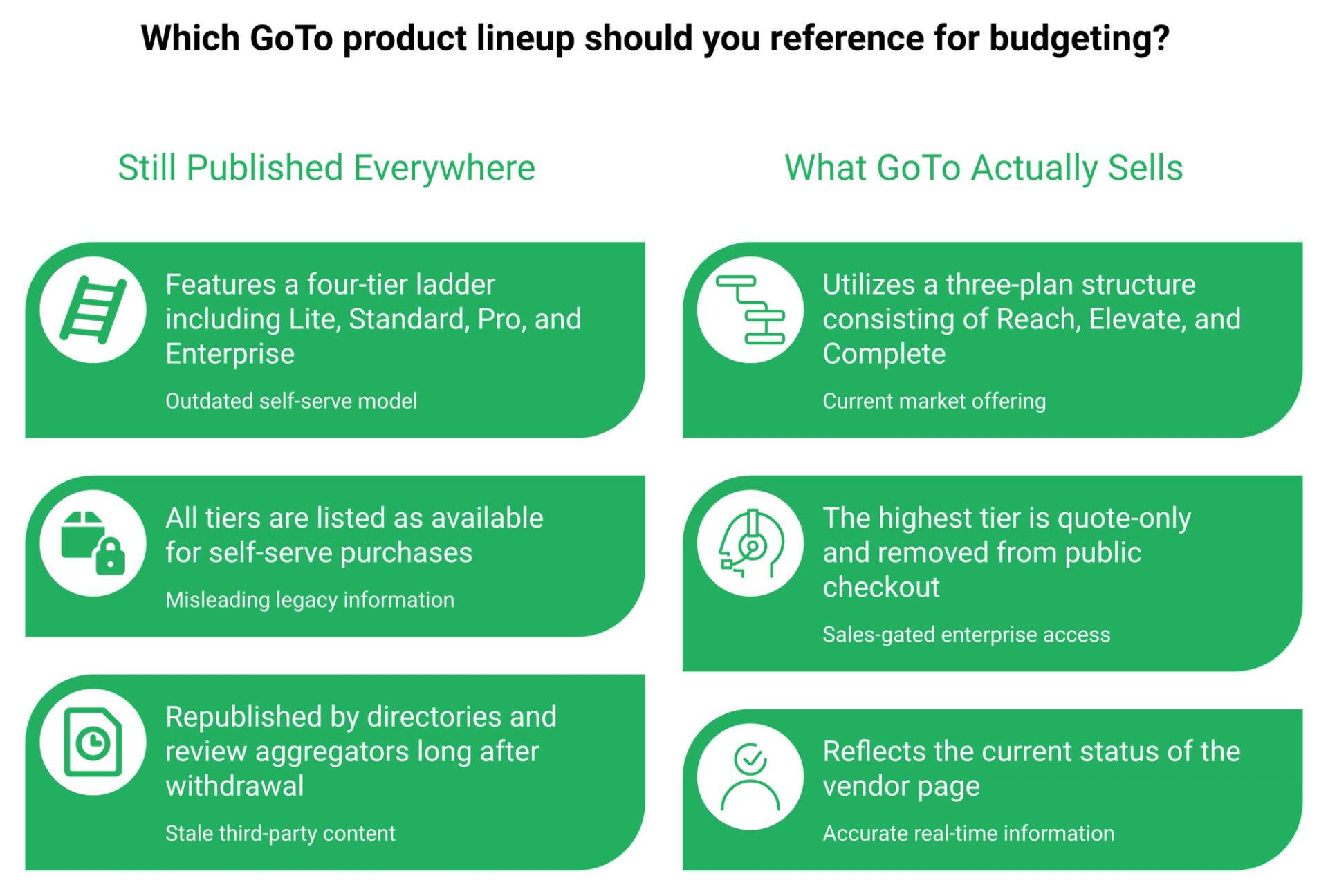
- Most ranking pages still quote retired Lite, Standard, Pro, and Enterprise tiers at 49 to 399 dollars, which is why buyers build budgets on stale numbers.
- Flex costs 228 dollars annually plus 149, 299, or 499 dollars per live event. It stops being cheaper at roughly three events a year, not five.
- There is no free plan, only a 30-day trial with no credit card. Paid plans auto-renew, so cancel before the renewal date or you own another full period.
- Licence cost is modest. The parity stack of pages, CRM, email, checkout, multistream, and middleware is where a realistic three-year total reaches 25,000 to 45,000 dollars.
Q1. How much does GoTo Webinar cost in 2026?
GoTo Webinar costs $69 per month for Reach and $129 per month for Elevate, dropping to $59 and $103 per month when billed annually. Complete is quote-only. Reach includes 1 organizer seat and up to 500 participants. Elevate includes 3 seats and 1,000 participants. Complete covers up to 3,000 participants.
Last month a course creator sent me a screenshot of a blog post quoting GoTo at $49 a month. She had built her whole launch budget on that number. It was wrong by roughly 40%, because GoTo quietly renamed and repriced its entire lineup.
💰 What GoTo Webinar actually charges right now
| Plan | Monthly | Billed annually | Organizer seats | Participants |
|---|---|---|---|---|
| Reach | $69 | $59/mo | 1 | Up to 500 |
| Elevate | $129 | $103/mo | 3 | Up to 1,000 |
| Complete | Quote only | Quote only | Custom | Up to 3,000 |
Source: GoTo pricing page, captured August 2026.
Annual billing saves about 14% on Reach and about 20% on Elevate. That is real money, but it locks you into twelve months. I have watched more operators regret the lock-in than the extra 20%.
⚠️ Why $49 to $399 still shows up everywhere
Third-party directories have not caught up. Forbes Advisor still lists Lite, Standard, Pro, and Enterprise at $49 to $399 annually. Capterra and other aggregators repeat the same four-tier structure.
Those pages are not lying. They are stale. Check the currency selector and plan names on GoTo's own page before you budget anything, and cross-check any figure you find in a GoToWebinar alternatives roundup.
✅ You are buying room size, not capability
Notice what separates the tiers. It is participant count first, then features second. Reach at 500 seats, Elevate at 1,000, and Complete at 3,000.
That is a broadcast pricing model. It assumes your constraint is how many people fit in the room. EasyWebinar prices around webinar formats instead, bundling live, simulive, automated, evergreen, just-in-time, and on-demand into one plan line rather than splitting them by audience size.
⏰ The sticker is the floor, not the ceiling
I never ask what a platform costs per month. I ask what it costs per closed sale. Fourteen years, 100 plus webinars, eight figures in combined sales, and the invoice was never the number that decided anything.
Reach at $59 looks cheap. Then you add seats, the registration stack, and the follow-up tooling. We will do that arithmetic properly later in this piece.
EasyWebinar publishes its plans and attendee capacity on one page, with live and automated formats in the same tier, so the annual-versus-monthly comparison takes a minute instead of a support ticket.
Q2. What does each GoTo Webinar tier actually include?
All three GoTo Webinar tiers include reporting, automated emails, polls, Q&A, handouts, integrations, and simulive events. Cloud recordings, custom branding, transcripts, AI summaries, breakout rooms, and unlimited cloud storage start at Elevate. Accepting payments, source tracking, certificates, live streaming, and a bundled GoTo Meeting license require Complete.
⭐ The gating matrix nobody publishes
| Capability | Reach | Elevate | Complete |
|---|---|---|---|
| Polls, handouts, Q&A | ✅ | ✅ | ✅ |
| Simulive events | ✅ | ✅ | ✅ |
| Cloud recordings | ❌ | ✅ | ✅ |
| Custom branding and custom URL | ❌ | ✅ | ✅ |
| Transcripts and AI summary | ❌ | ✅ | ✅ |
| Accept payments | ❌ | ❌ | ✅ |
| Source tracking | ❌ | ❌ | ✅ |
| Certificates | ❌ | ❌ | ✅ |
Source: GoTo plan comparison table, captured August 2026.
Read that payments row again. If you want to sell a ticketed workshop, you need the quote-only tier. Same for knowing which ad source produced which registrant.
❌ Three assumptions that cost people money
Buyers assume cloud recording is standard. It is not, on Reach. Buyers assume they can track registration sources. They cannot, below Complete.
Buyers assume paid events are a checkbox. On GoTo they sit behind a sales conversation. That discovery usually lands two weeks before launch, which is the most expensive moment possible.
⚠️ What operators report after the upgrade
GoToWebinar is the most basic webinar tool that offers nothing more than any other tool. Customer support is impossible to reach and is completely outsourced.- Forrester S., 0/5, 23 Oct 2025, GoTo Webinar G2 - Verified Review
Registration form options are limited. Post-event emails are wonky. Very little ability to customize.- Verified reviewer, Media Production Company, 5/10, 6 Dec 2023, GoTo Webinar TrustRadius - Verified Review
Now the honest counterweight, because tier premiums exist on our side too.
The only downside is that to have the "just in time" feature you have to pay a premium that is about double the price of the basic subscription. However, it has been worth it for me.- Laura C., 5/5, 28 Jan 2025, EasyWebinar G2 - Verified Review
✅ Score cost per capability, not cost per seat
Volume is not value. An effective offer is usually much smaller than we think, and the same holds for feature lists.
Write down the four things your funnel genuinely needs. Then find the cheapest tier that ships all four. EasyWebinar keeps timed offers, countdown timers, polls, behavioral follow-up, and attendee-level analytics inside the core product rather than behind a tier gate, which is why our conversion mechanics do not move when you change plans.
EasyWebinar treats in-webinar offer overlays and countdown timers as core conversion tooling, not upsells, because those are the blocks that decide whether a webinar earns its subscription back.
Q3. Is the GoTo Webinar Flex plan cheaper than a subscription?
GoTo Webinar Flex costs $228 annually or $29 monthly, then bills per live event: $149 for up to 500 attendees, $299 for up to 1,000, and $499 for up to 3,000. GoTo positions it for hosts running five or fewer live sessions per year. Any live event lasting 15 minutes or more with five or more participants triggers the fee.
💸 The fee ladder, exactly as GoTo documents it
Flex has two parts. A low base subscription covers on-demand features and GoTo Stage simulive events. Live events are charged separately.
- Base: $29 monthly or $228 annually
- Up to 500 attendees: $149 per event
- Up to 1,000 attendees: $299 per event
- Up to 3,000 attendees: $499 per event
One note on accuracy. TrustRadius lists the Flex base at $19 per month billed annually. GoTo's own support documentation says $228 annually, which works out to $19 monthly. Both are right, described differently.
⏰ Where Flex stops being cheaper
Compare Flex against Reach at $59 per month billed annually, which is $708 for the year.
| Live events per year (500 attendees) | Flex total | Reach total | Cheaper |
|---|---|---|---|
| 1 | $377 | $708 | Flex |
| 2 | $526 | $708 | Flex |
| 3 | $675 | $708 | Flex, barely |
| 4 | $824 | $708 | Reach |
At 1,000-attendee events the crossover arrives faster. Three events on Flex costs $1,125 against Elevate at $1,236, and four costs $1,424. So the honest break-even sits at roughly three events a year, not five.
⚠️ The clause that catches light users
The trigger is 15 minutes and five participants, and the organizer and panelists count toward that five. A rehearsal with two panelists and two colleagues can bill you.
I have seen a coach get charged for what she thought was a tech check. Read that clause before you run any dry run.
✅ Why per-event billing fights your learning curve
Simple scales. Fancy fails. Flex is fancy billing, and it taxes the exact behavior that makes webinars profitable.
Webinar revenue comes from iteration. You run the thing, watch where people leave, fix that segment, and run it again. Charging $149 per attempt makes that loop expensive, so operators run fewer tests and learn slower.
Automating webinars that we used to have to run live every week and over time also saving us money, being more efficient.- Darrin B., 5/5, 29 Apr 2025, EasyWebinar G2 - Verified Review
EasyWebinar bills by plan rather than by event, and a winning live session clones into an automated webinar in a single switch, so running four tests in a month costs the same as running one.
Q4. Is there a free version, and how do cancellation and renewal work?
No. GoTo Webinar has no permanent free plan. It offers a free trial with no commitment and no credit card required, and a trial subscription cancels itself automatically when it expires. Paid monthly and annual subscriptions auto-renew, so the billing contact must cancel before the renewal date to avoid the next full billing period.
✅ What the trial actually gives you
GoTo's pricing page states the trial includes the features and tools with no commitment and no credit card. Support confirms you will not be charged when a trial lapses on its own.
You do not need to cancel a trial. It expires quietly. That removes the most common billing anxiety around testing this platform.
⏰ The renewal mechanic that costs people a year
This is the part worth writing on a calendar. Your subscription renews automatically at the end of the monthly or annual period.
To stop it, the billing contact signs in at billing.goto.com, opens the Subscriptions tab, selects the product, and chooses Cancel Subscription. The plan then shows Pending Cancellation and runs until the period ends.
⚠️ Annual plans and the downgrade trap
Annual billing saves about 14 to 20% depending on tier. It also means a mid-year change of mind costs you the remaining months.
If you are unsure about event volume, start monthly. Move to annual once you know your real cadence. The 20% discount is not worth a wasted eleven months. If you are still weighing options, a direct EasyWebinar vs GoToWebinar comparison is a faster way to test the assumption.
💰 How to spend the trial so it teaches you something
An automated webinar without traffic is like a billboard in the desert. A trial with no traffic tests nothing except the interface.
Do not test features. Run one complete webinar funnel end to end with real traffic. Registration page, reminder sequence, live session, offer, and follow-up email.
Then read three numbers only. Registration rate from your traffic source, show-up rate against registrants, and clicks on your offer. Anything else is decoration during a 30-day window.
⭐ The question to answer before day 30
Ask whether the platform produced a sale, not whether you enjoyed the dashboard. I have watched operators fall in love with an interface and miss that nobody bought.
Book your real webinar inside the trial window. Deadlines force clarity in a way exploration never does.
EasyWebinar offers a free signup path so you can build and publish a complete funnel, including registration pages and follow-up emails, before any budget is committed.
Q5. What does GoTo Webinar cost once you add seats and annualize it?
GoTo Webinar licences are sold per organizer seat. Reach includes 1 seat at $59 per month billed annually, which is $708 a year. Elevate includes 3 seats at $103 per month billed annually, which is $1,236 a year, or about $412 per seat. Seats beyond the Elevate bundle are quoted by sales on the Complete plan.
💰 The annualized grid by team size
Most people compare monthly stickers. Budgets are approved annually. Here is the same lineup converted into yearly spend.
| Seats needed | Cheapest documented route | Annual cost | Cost per seat |
|---|---|---|---|
| 1 | Reach | $708 | $708 |
| 3 | Elevate (3 seats included) | $1,236 | $412 |
| 5 | Elevate x2 (6 seats) | $2,472 | $412 |
| 10 | Elevate x4 (12 seats) or Complete | $4,944 or quote | $412 or quote |
Source: GoTo pricing page, captured August 2026.
Notice the jump from one seat to three. A single Reach seat costs more per person than a three-seat Elevate plan. That is unusual, and it works in your favor if you have a small team.
⚠️ Who hits the seat wall first
Agencies hit it fastest. Each client account wants its own scheduler, and Reach gives you exactly one. Agency teams running multiple client funnels usually feel this within the first quarter, which is why agency-focused webinar workflows get built around shared access instead.
Enterprise training teams hit it second. Three trainers running parallel cohorts consume the Elevate bundle immediately. Then you are in a sales conversation, not a checkout flow.
Multi-presenter marketing teams hit it third. The trigger is always the same moment. Someone needs to schedule a session without waiting for the person who owns the login.
❌ Where the older figures came from
Directories still describe additional organizers as full-price licences under the old Lite through Enterprise structure. Under the current lineup, Elevate bundles three seats instead.
I am flagging this because the two models produce very different budgets. Verify seat counts against GoTo's own page before you present numbers to finance, then check them against current webinar pricing elsewhere in the category.
✅ Downsell your own requirements before you negotiate
Here is a rule I use as a buyer, borrowed from how I price my own offers. People who demand to pay less for the same thing are not negotiating, they are stalling.
So do not chase a discount. Cut requirements instead. Ask which presenters genuinely need independent scheduling authority, and which just need to appear on camera.
That single question usually removes two seats from the order. EasyWebinar handles that split differently, allowing co-presenters and moderators inside a webinar without a separately paid organizer licence for each person on screen.
⏰ The five-minute audit before you buy
Count three numbers, in this order. How many people must schedule independently. How many only present. How many only moderate chat.
Only the first number needs a paid seat on most platforms. I have watched teams cut a proposed six-seat order to two by asking that in a meeting.
EasyWebinar includes co-presenter and moderator roles in the live webinar software setup itself, so a four-person panel does not become a four-licence line item.
Q6. Where do the hidden costs actually show up?
Four cost leaks sit outside GoTo Webinar's price list: the funnel stack it does not include (registration funnels, CRM, email and SMS sequencing, checkout, and multistream), the automation middleware that silently hits quota, the support burden reviewers describe as outsourced and slow, and the labour of maintaining every join between those tools. EasyWebinar consolidates that same stitched layer into one platform.
💸 The four leaks nobody prices
Leak one is the stack gap. Leak two is middleware quota. Leak three is support time. Leak four is the human hours spent holding it together.
None of these show up in a plan comparison. All four show up in your calendar.
⚠️ The Friday I nearly lost a launch
Our Zapier account hit its task limit four hours before a webinar. Zapier is the middleware that passes registrants from one tool to another, and it bills by task volume.
Salespeople were dialing leads that had already been called. Nobody knew why. We were staring at dashboards asking what on earth was happening.
We caught it with four hours to spare. That is luck, not process, and I do not want you relying on luck.
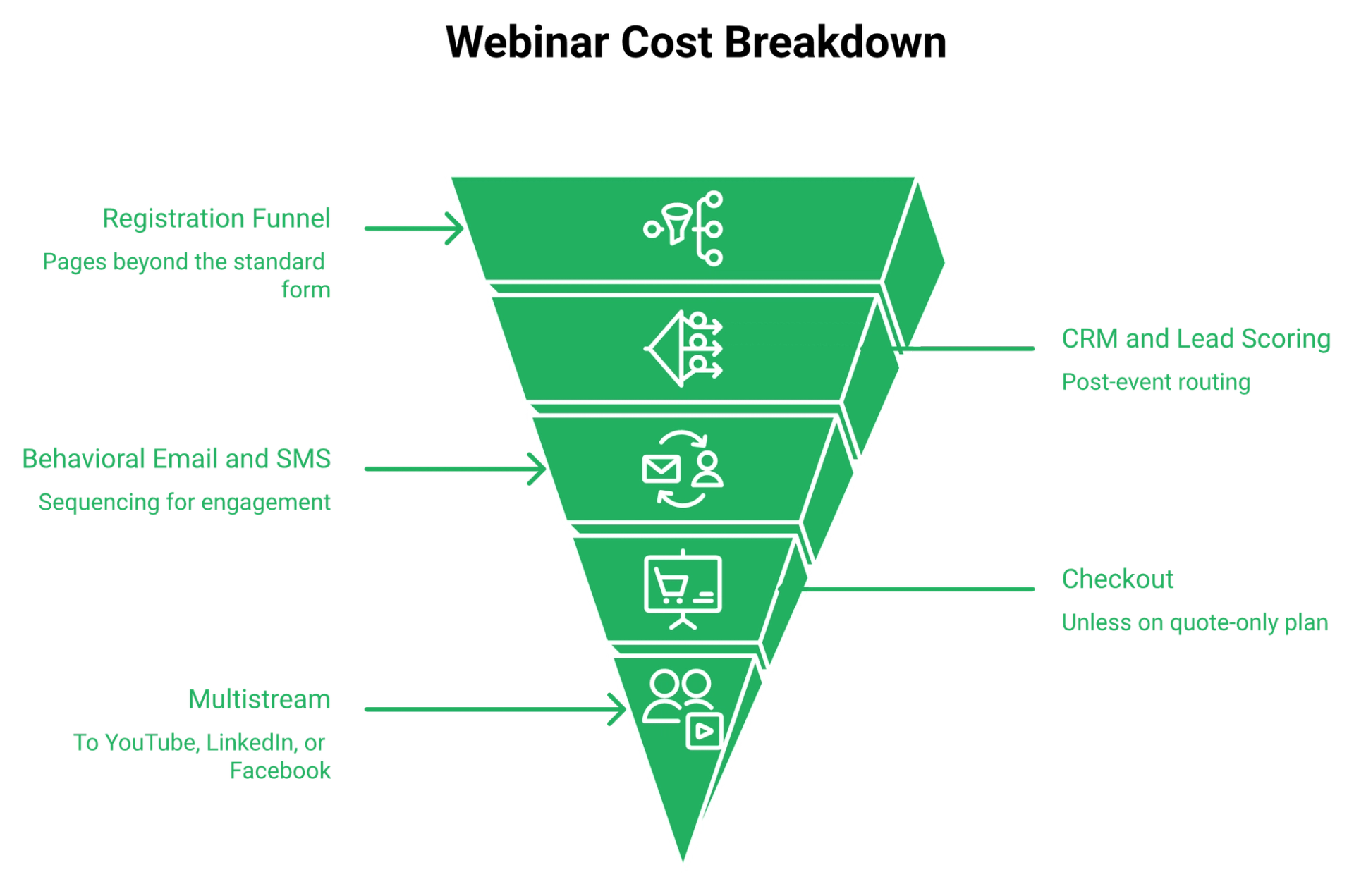
❌ What GoTo Webinar leaves you to buy
GoTo handles the room well. It does not handle the funnel around the room.
- Registration funnel pages beyond the standard form
- CRM and lead scoring for post-event routing
- Behavioral email and SMS sequencing
- Checkout, unless you are on the quote-only Complete plan
- Multistream to YouTube, LinkedIn, or Facebook
- The middleware that connects all of the above
Every item on that list is a subscription. Every join between two items is a place the funnel can break. A single multistreaming line item alone can cost more than the webinar licence it supports.
⭐ What operators report about the invisible costs
Some users say pricing is steep, especially for small businesses, with less value compared to lower-cost alternatives.- Capterra review sentiment summary, 50% negative across 151 reviews, GoTo Webinar Capterra - Verified Reviews
As an administrator, the launcher caused problems for not only myself but also our attendees. One day the launcher would work, and the next day it wouldn't. This decreased our attendance significantly.- Verified User in Education Management, 0/5, 20 Feb 2018, GoTo Webinar G2 - Verified Review
An honest one from our own side, because consolidation is not total.
I do use other email systems to send post-webinar email sequences because I can't track open and click rates on EasyWebinar.- Eliza W., 4.5/5, 11 Feb 2026, EasyWebinar G2 - Verified Review
✅ Your Monday morning quota audit
Open every connected tool and write down two things. Your current usage, and your plan ceiling.
Do this for middleware tasks, email sends, and storage. Set a calendar alert at 70% of each ceiling, and review your integrations list at the same time.
I have seen this fifteen-minute exercise save a launch twice. A complex funnel with hidden ceilings is a tube map, and tube maps break at the transfers.
EasyWebinar replaces that stitched layer, covering pages, email and SMS, sales CRM, checkout, storage, and multistream inside one platform, which removes middleware quota as a failure point entirely.
Q7. What is the true three-year cost of running GoTo Webinar?
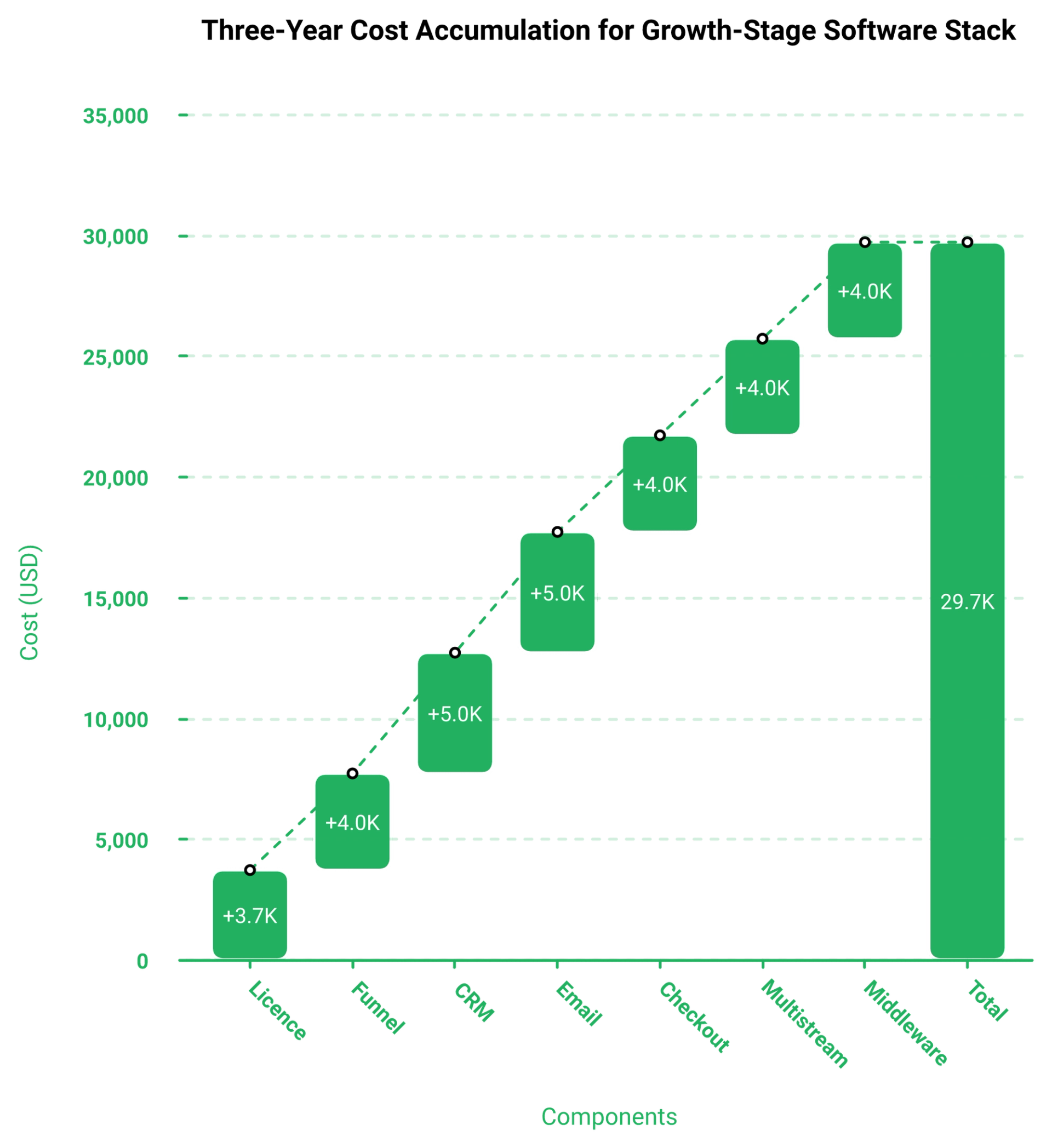
GoTo Webinar licences run $708 to $1,236 per year for one to three seats on documented plans. Reaching functional parity with a full webinar funnel adds an estimated $600 to $1,000 monthly in separate tooling, pushing a realistic three-year total into roughly $25,000 to $45,000 for a small team. EasyWebinar published that parity estimate, and it should be read as a competitor's model.
⭐ Method, stated openly
Three inputs drive this model. Licence cost, parity stack cost, and time horizon of 36 months.
Licence figures come from GoTo's live pricing page. Parity stack figures come from EasyWebinar's own GoToWebinar alternatives analysis, which is vendor-adjacent by definition. I am telling you that so you can discount it accordingly.
Two things I cannot model honestly. Complete plan pricing, because it is quote-only, and your negotiated discount, because those are private.
💰 Licence line items over 36 months
| Route | Year 1 | 36 months |
|---|---|---|
| Reach, 1 seat | $708 | $2,124 |
| Elevate, 3 seats | $1,236 | $3,708 |
| Elevate x2, 6 seats | $2,472 | $7,416 |
Source: GoTo pricing page, captured August 2026, annual billing. Assumes no price increases, which is optimistic over three years.
At the licence layer alone, GoTo is not expensive. That is the honest read, and most competitor blogs get this part wrong.
💸 The parity stack, component by component
Here is where the total moves. Each row replaces something a unified platform includes.
- Funnel and landing page builder
- CRM with lead scoring
- Email and SMS sequencing tool
- Checkout and payment layer, if you are not on Complete
- Multistream service
- Automation middleware
EasyWebinar's analysis estimates that bundle at $600 to $1,000 monthly for a growth-stage team. Over 36 months, that is $21,600 to $36,000, which dwarfs the licence.
⚠️ What I am still unsure about
My read is that the parity range skews high for solo operators. A coach running one evergreen sales funnel might spend $250 monthly, not $900.
Contrast's annualized comparison puts webinar licence spend alone between $588 and $4,788 yearly across the category, which supports the wide band. I could be reading the stack estimate too aggressively for the smallest teams.
✅ Swap your own inputs
Risk comes from not knowing what you are doing. A published model converts an unknown into a range you can defend in a budget meeting.
Take the three inputs above and replace them with your actual invoices. Then compare that total against any single-platform quote, or against a broader webinar platform comparison.
EasyWebinar was built to collapse that parity stack into one bill, and that consolidation is where most of the three-year difference originates rather than in the licence line.
Q8. How many attendees do you get per tier, and why do sources disagree?
GoTo Webinar's current plans support up to 500 participants on Reach, 1,000 on Elevate, and 3,000 on Complete, with unlimited live streaming on Complete. Third-party directories still publish the older 250, 500, 1,000, and 3,000 structure, and TrustRadius lists Lite at 100 and Pro at 500. Verify against goto.com before budgeting.
⚠️ The discrepancy audit
Four sources, four different answers. This is worth showing plainly.
| Source | Entry-tier cap | Mid-tier cap | Date |
|---|---|---|---|
| GoTo pricing page | 500 (Reach) | 1,000 (Elevate) | Aug 2026 |
| Capterra | 250 (Lite) | 1,000 (Pro) | 2026 |
| Forbes Advisor | 250 (Lite) | 1,000 (Pro) | Oct 2024 |
| TrustRadius | 100 (Lite) | 500 (Pro) | 2026 |
The directories are not fabricating. They are describing a lineup GoTo retired. Anyone quoting caps without a capture date is quoting fiction.
❌ The belief that costs the most money
Everyone assumes a bigger cap means more revenue. Run the arithmetic and that collapses.
For a cold audience, 10 to 15% show-up is the realistic floor. Registration-to-signup around 30% on cold paid traffic counts as a good benchmark.
So filling a 3,000-seat room needs enormous registration volume. Most operators buy the room and never fill it, when the cheaper fix is usually improving webinar attendance on the seats they already have.
⭐ Small rooms with high intent
Jason Fladlien has said his first webinar had 17 people show up, and it changed his life. I believe that completely, because my own numbers looked the same at the start.
Capacity is vanity. Retention is revenue. What matters is the percentage still watching when the offer appears.
I would rather sit with 60 people who chose to be there than 600 who clicked a link. EasyWebinar measures this through attendee-level analytics, tracking watch time, poll responses, offer views, and drop-off points per person rather than headcount alone.
✅ How to right-size your tier
Do this in three steps, using numbers you already have.
- Take your realistic registration count for one event.
- Multiply by 15% for a cold audience, or 35% for a warm list.
- Add 30% headroom, then buy for that number.
A coach expecting 400 registrants from a warm list needs roughly 180 seats, not 1,000. That is Reach territory, not Complete.
💰 Spend the difference where it converts
Whatever you save on capacity, put into follow-up. Reminder sequences and behavioral emails move revenue more than an unused seat ceiling ever will.
One traffic spike should not force a permanent tier upgrade either. EasyWebinar supports streaming live events to YouTube Live for unlimited overflow attendees, so a single unusually large session does not lock you into a large-attendee webinar plan forever.
Q9. What do verified reviewers say the price actually buys?
Verified reviewers credit GoTo Webinar for stability at scale, strong reporting, and simple organizer admin. They consistently criticise cost against alternatives, outsourced support, limited registration-page customization, and unreliable post-event emails. Capterra logs high subscription cost concerns across half of its 151 negative reviews. EasyWebinar runs reminders, SMS, and behavior-based follow-up through its own native engine, which is the layer reviewers most often report as broken elsewhere.
⭐ What reviewers genuinely rate
Give GoTo its due. The reporting is good, and large rooms hold up.
GoToWebinar is an intuitive, easy-to-use platform for hosting webinars on a large scale. The post-webinar analytics feature is great.- Khyati Doshi, Senior Marketing Manager, Wiley University Services, 6/10, 6 Dec 2023, GoTo Webinar TrustRadius - Verified Review
That is a marketing manager with nine years of experience giving it a six out of ten. Competent, not loved.
💸 The complaint that repeats for a decade
Cost against value is the pattern. It shows up in 2018 reviews and 2025 reviews alike.
We use it for regular external and internal webinars to present the products to our customers.- Verified reviewer, Computer Software Company, 501 to 1000 employees, 6/10, review titled "Good part of Martech but costly," 1 Jun 2024, GoTo Webinar TrustRadius - Verified Review
In a large group setting it has reliability issues that I feel have been left unaddressed. The last time we tried it for a large group meeting people were continually dropped.- Richard Hazel, Senior Business Application Analyst, FedEx Customer Technologies, 3/10, 5 Feb 2020, GoTo Webinar TrustRadius - Verified Review
✅ Read the pattern, not the star average
Three complaints repeat: cost, support reach, and customization limits. That is not noise. That is a roadmap. Reading a full set of webinar platform reviews by date is faster than reading any vendor comparison page.
I sort reviews by date and look for what keeps appearing across years. A one-off bug is a bad week. A decade of the same note is a product decision.
EasyWebinar gets its own version of this treatment, with reviewers regularly flagging landing page design flexibility as the recurring limitation across our customer reviews and G2 profile.
❌ Ugly pages are survivable, broken emails are not
Here is where I break with most reviewers. Limited registration page design barely matters.
I still have a client, Jay Boyer, who uses default registration pages. They are plain. He has made millions from webinars running on them.
What is not survivable is email automation that misfires. Registrants who never get the join link do not attend, and non-attendance is the only metric that always costs money. That is a webinar attendance problem, not a design problem.
⏰ What this means for a high-ticket seller
If your product sells for $2,000 or more, follow-up is the revenue engine. The webinar opens the conversation and the sequence closes it.
So weigh the complaints by which layer they hit. Ugly page, ignore it. Wonky post-event email, treat that as a dealbreaker.
EasyWebinar sends reminders and SMS through its native webinar marketing automation engine, with follow-up sequences triggered by what each attendee did, including leaving early or viewing the offer without clicking.
Q10. Which platform should you buy instead, and how do you decide?
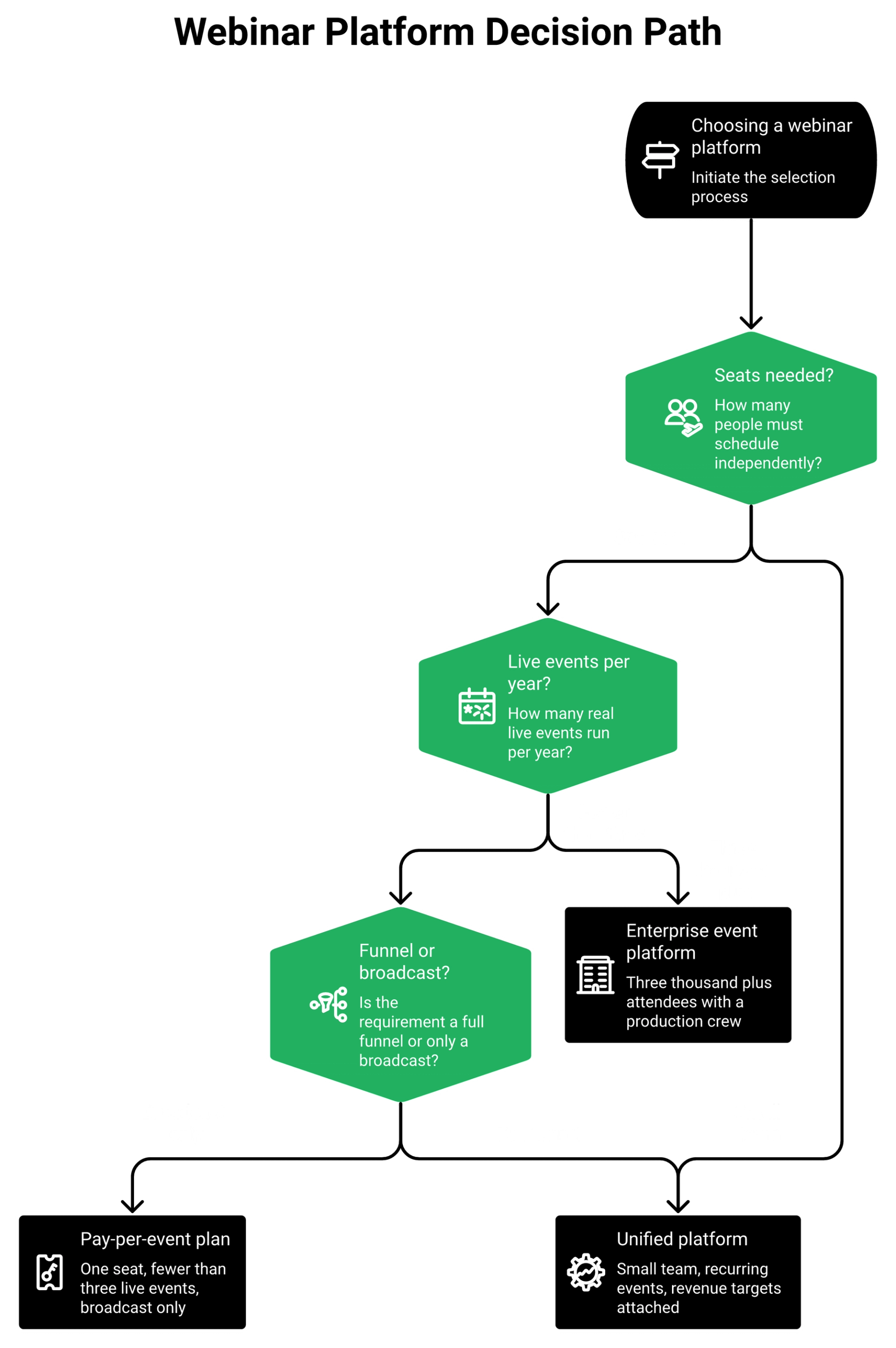
Decide on three inputs: seats needed, real events per year, and whether you need a funnel or only a broadcast. Ranked on revenue capability per dollar, EasyWebinar leads for combining live, simulive, automated, and evergreen formats with in-webinar payments, a native CRM, and multistreaming in one subscription. Then Demio, Livestorm, WebinarJam with EverWebinar, Zoom Webinars, and BigMarker.
⚠️ My conflict, stated up front
I founded EasyWebinar. So do not take the ranking on faith.
Here is the rubric instead: formats included per bill, whether payments and CRM are native, and cost per closed sale rather than cost per seat. Check my maths against your own numbers, and against any independent webinar software comparison you trust.
1. EasyWebinar
Strength: EasyWebinar ships live, simulive, automated, evergreen, just-in-time, and on-demand formats in one platform, alongside in-webinar checkout, EasyCRM, and EasyCast multistreaming.
Known limitation: landing page design flexibility, flagged repeatedly by reviewers.
Best for: coaches, course creators, and B2B teams selling something at $500 or more.
Not for: one-off internal team meetings, or products under $200 where the webinar maths does not work.
EasyWebinar is hands-down THE webinar platform for evergreen webinars, no contest. This is especially important for solo entrepreneurs wearing 800 different hats.- Ash A., 5/5, 13 Mar 2026, EasyWebinar G2 - Verified Review
2. Demio
Demio strength: clean live experience and fast setup. Known limitation: data portability after cancellation.
After canceling, I was shocked to find out I couldn't export the list unless I subscribed again. Support confirmed this.- Sheida M., 0/5, 12 May 2025, Demio G2 - Verified Review
If that policy is a blocker for you, the shortlist of Demio alternatives is worth reading before you commit a list to it.
3. Livestorm
Livestorm strength: browser-native, no download friction. Best for European B2B teams running frequent shorter sessions. Not for operators needing evergreen sales funnels with checkout.
4. WebinarJam with EverWebinar
WebinarJam strength: proven evergreen funnel mechanics. Known limitation: it is two products, so you buy and manage both. The split-product trade-off is laid out in this WebinarJam vs EverWebinar breakdown.
5. Zoom Webinars
Zoom's real advantage is familiarity, and I will not pretend otherwise. Your audience already has it installed, and that lifts show-up.
Zoom is missing a lot of core webinar features that should be table stakes today. There's no pre-webinar waiting room or post-webinar exit page.- Casey S., 1.5/5, 16 Mar 2021, Zoom Events and Webinars G2 - Verified Review
6. BigMarker
BigMarker strength: enterprise scale and virtual event production. Best for large summits with production teams. Not for solo operators, on price or complexity.
One caution that applies to my own category too. Be skeptical of any tool claiming to be more all-in-one than conversation, content, and events combined. Breadth bought at the cost of depth produces a mediocre product everywhere.
⏰ The three-input decision rule
- One seat, under three live events a year, broadcast only: GoTo Flex works.
- Small team, recurring events, revenue targets: a unified platform wins on 36-month cost.
- 3,000 plus attendees with a production crew: enterprise event platforms.
EasyWebinar sits squarely in the second case, which is where licence plus stack arithmetic stops favouring separate tools. If you are still mapping requirements, the full feature list is the fastest way to check what a single bill covers.
Ran the 36-month maths and didn't like the total?
See what GoTo Webinar's licence plus stack looks like next to one platform
We put both side by side on formats, in-webinar payments, native CRM, multistreaming and total tooling required, so you can check our numbers against your own seat count and event volume.
Compare EasyWebinar vs GoTo Webinar
Or look at the plans and tell us how many events you actually run a year, and we'll tell you which tier is honest for that.
Here is what I am sitting with going into 2027. Broadcast pricing by room size feels like a model built for a different decade, when audience size was the scarce thing. Attention is the scarce thing now. So tell me how many events you actually run in a year, and I will tell you whether any of this pricing makes sense for you.
Frequently Asked Questions

Casey Zeman
Founder of EasyWebinar
About Author
Over the past decade, I've helped thousands of entrepreneurs, coaches, and consultants turn webinars into a predictable, powerful way to grow their audience, build trust, and scale, without the constant hustle. I created EasyWebinar because I couldn't find a system that combined authenticity, engagement, and automation the way I needed. So, I built one.
Related Posts

10 Best Community Engagement Platforms in 2026
Compare the 10 best community engagement platforms in 2026. Course creators, evaluate live hosting, analytics, and replay to pick your winner today.
10 Best Online Coaching Tools in 2026: Live Session Quality, Scheduling, Recording, and Client Engagement Analytics
Compare the 10 best online coaching tools of 2026 on session quality, scheduling, and analytics. Discover the right fit for your coaching revenue model.
10 Best Webinar Hosting Platforms Ranked by Uptime, Streaming Quality & Cost
Compare 10 webinar hosting platforms ranked by uptime, streaming quality, and cost. Discover which tool actually turns attendees into revenue.
Turn every webinar into a revenue stream
Launch your first paid event in just a few clicks - and start monetizing your expertise.
Book a Call