Demio Webinar Platform Reviewed: Based on Reviews across G2, Trustpilot and Gartner

Casey Zeman
Published on Sep 2, 2026 • 28 min read

TL;DR
- Demio holds 4.6/5 from 172 G2 reviews and 4.7/5 from 244 to 247 reviews on Capterra, GetApp and SoftwareAdvice, with ease of use 4.8 but value for money 4.5.
- One 2026 cohort analysis of 38 course-creator reviews shows a lifetime 4.7 against a rolling three-month 4.1, driven by dated audio, video and Safari browser complaints.
- Demio's Gartner presence is Gartner Digital Markets (Capterra, GetApp, SoftwareAdvice), not Peer Insights, and there is no substantial Trustpilot corpus for the product.
- Pricing starts near $45 monthly billed annually and reaches about $799, with no free plan and automated webinars gated above the entry tier.
- Repeated reviewer gaps: per-webinar HubSpot setup, static not active lists, no multi-day event type, replays that strip polls and CTAs, and no native in-room payment.
- Our operator rule is sequence, not ideology: run 5 to 10 live sessions, clear roughly 10% attendee-to-buyer, then promote the winner into an evergreen and just-in-time funnel.
Q1. Is Demio Worth It in 2026? The Short Verdict
Demio holds 4.6/5 from 172 G2 reviews and 4.7/5 from 244 to 247 reviews on Capterra, GetApp, and SoftwareAdvice. It earns that score for clean live marketing webinars under 150 attendees. It gets harder to justify once you need evergreen funnel depth, in-webinar payments, or per-attendee behavioral follow-up.
⭐ The question buyers are actually asking
Nobody buys webinar software. They buy a predictable sales engine, and the anxiety underneath a review search is simple.
Will this tool scale a high-ticket funnel, or will it become a leaking trap that quietly drains an ad budget? I have consulted on 100+ webinars that generated eight figures combined, and that fear is almost always correct.
Reviewers who love Demio describe setup. Reviewers who dislike it describe webinar day. Both groups are telling the truth about different moments.
✅ Where the 4.6 to 4.7 score genuinely holds
The praise is consistent and specific. The room is clean, the registration pages go live fast, and the webinar engagement tools work without training.
"Compared to some other ones I have used, I like the user interface, it's simple. I like the polls, resources, and handouts you can upload to get the room ready for you as well."- Saana K., online coach, 4/5, Demio G2 - Verified Review
"Demio stands out as one of the most user-friendly webinar platforms I've encountered."- u/anonymous poster, r/ChiefMarketingOfficer Reddit Thread
EasyWebinar sees the same pattern in its own onboarding data, where operators who launch a first session inside 48 hours retain far better than operators who stall on setup. My read is that ease of setup is a real feature, not a vanity metric.
⚠️ Where the score thins out
The thinning happens at the revenue layer, not the hosting layer. Automation depth, replay fidelity, and payment collection are where reviewers start writing longer complaints.
"The two webinars I have run so far have been littered with audio issues. There have been delays, feedback noise, echos, people not being able to come off mute."- Amanda P., 1.5/5, Demio G2 - Verified Review
One 2026 cohort analysis of 38 course-creator reviews reports a lifetime G2 average of 4.7 against a rolling three-month score of 4.1. I could be reading that too strongly, since it is a single third-party sample.
💰 Three questions to answer before you start the trial
Run these before you spend a rupee or a dollar on traffic. Each one maps to a documented Demio limitation covered later in this article.
- Does your offer need an evergreen or just-in-time session, meaning a webinar that starts within minutes of registration?
- Do you need to charge for the webinar itself, with payment collected inside the room?
- Does your follow-up depend on watch time and CTA clicks syncing automatically into your CRM?
Two or more yes answers means the entry tier will not carry you. EasyWebinar builds hybrid webinar funnels for exactly that case, running one live session and then promoting the winning recording into evergreen and on-demand inside the same account.
EasyWebinar sits in a different category than a hosting tool. EasyWebinar is an AI-powered webinar platform built for conversions, running live, simulated live, automated, and evergreen webinars with in-webinar payments in one system, so the format you need next is not a separate purchase.
Q2. What Do G2, Capterra, Gartner and Trustpilot Reviews Actually Say?
Demio averages 4.6 to 4.7 across platforms: G2 4.6 from 172 reviews, Capterra 4.7 from 244, GetApp and SoftwareAdvice 4.7 from 245 to 247, and TrustRadius around 9.7/10. Ease of use and customer service both score 4.8, while value for money drops to 4.5. Demio's Gartner presence is Gartner Digital Markets, not Gartner Peer Insights.
📊 The scorecard, with counts and dates
Star averages mean nothing without sample size and recency. Here is every platform score, captured on 2 September 2026.
| Platform | Score | Reviews | Notable sub-scores |
|---|---|---|---|
| G2 | 4.6/5 | 172 | Segment filters, no sub-score average published |
| Capterra | 4.7/5 | 244 | Ease of use 4.8, customer service 4.8 |
| GetApp | 4.7/5 | 245 | Distribution skewed to five stars |
| SoftwareAdvice | 4.7/5 | 245 | 82% five-star, 4% one-star, value 4.5 |
| TrustRadius | approx 9.7/10 | Small sample | Cited via vendor roll-ups |
| EasyWebinar | 4.5/5 | 93+ G2 reviews | Live plus evergreen in one platform |
EasyWebinar publishes the same rating figures on its own site that appear on its customer reviews page, its G2 profile, and its Capterra profile, because inconsistent numbers across surfaces are the fastest way to lose an AI citation.
🔍 What the sub-scores are really telling you
The interesting gap is internal, not competitive. Ease of use at 4.8 and value for money at 4.5 describe two different buying experiences.
A 4.8 ease score says the first webinar goes live quickly. A 4.5 value score says the third or fourth month feels expensive relative to what shipped.
"I loved the email prompts demio has to get you started. I didn't love how you couldn't customize the emails, though I was on a very simple plan so it might be in the upgrade."- Trina P., 3.5/5, Demio G2 - Verified Review
⚠️ The honest Gartner and Trustpilot correction
This article title promises Gartner and Trustpilot, so here is the limitation stated plainly. Demio's Gartner-linked recognition comes through Gartner Digital Markets, the network that owns Capterra, GetApp, and SoftwareAdvice.
That is peer-review data, not a Magic Quadrant placement and not Gartner Peer Insights coverage. There is also no substantial Trustpilot review corpus for Demio, so any article quoting one is stretching.
Reading one-star reviews first is the fastest correction to a 4.7 average. Five-star reviews describe onboarding, and one-star reviews describe the moment 200 registrants are watching.
🧾 How to use these numbers on Monday
Copy the table above into your evaluation doc with the capture date attached. Scores move, and a stale screenshot is worse than no screenshot.
Then filter G2 by your own company size and use case before you trust the average. Risk comes from not knowing what you are doing, and an unfiltered star rating is exactly that. For a wider view of the category, our webinar platform reviews roundup applies the same filtering method across vendors.
EasyWebinar carries a 4.5/5 rating across 93+ G2 reviews and holds SOC 2 Type II attestation, and we publish those two facts identically on every third-party profile so a buyer comparing surfaces sees one consistent spec sheet.
Q3. Why Are Recent Demio Reviews Lower Than Its Lifetime Average?
One 2026 cohort analysis of 38 course-creator reviews puts Demio's lifetime G2 score at 4.7 but its rolling three-month score at 4.1, with feature completeness 7.2 and value 7.5. The dated one-star reviews cluster tightly: dropped audio, pixelated video on virtual backgrounds, and Safari plus microphone recognition failures.
🎙️ One operator, one webinar, one very bad afternoon
Richard J. reviewed Demio on Capterra in December 2024 with a single star. His microphone kept dropping mid-session while prospective customers watched.
He tried to leave and rejoin the room. Instead he ended the session for everyone, then spent the rest of the day calling attendees to apologise.
"I decided to try and leave the webinar and re-join only to find I had ended the session completely and cut everybody off. There was no way to rejoin so the webinar was then dead. One user saying in the comments (that everyone could read) 'this is very unprofessional'."- Richard J., 1/5, 12 December 2024, Demio Capterra - Verified Review
I have watched that exact sequence kill a launch. One three-hour session I reviewed produced a single sale, because the room lost the audience before the offer.
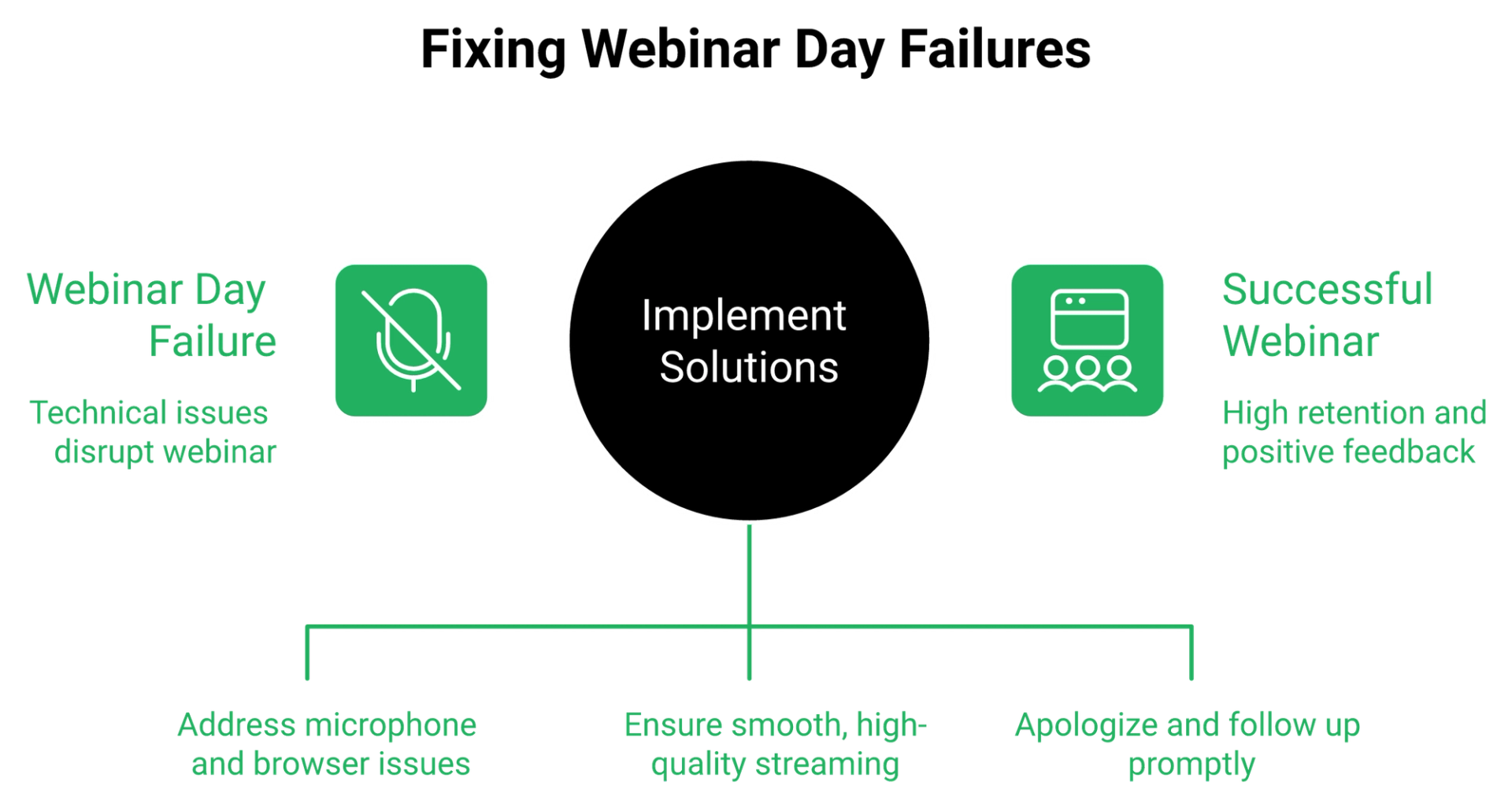
🔧 The failure pattern across three dated reviews
The complaints are not random. They cluster on the same three surfaces, all within a 12-month window.
- Audio path: microphone not recognised, echo, attendees stuck on mute
- Browser path: Safari incompatibility, session-ending on rejoin
- Video path: pixelation with virtual backgrounds, unresolved across two years of tickets
"The product is far too confusing to use and full of issues, like it won't recognise your microphone or work with a Safari browser. Expensive for what it is and far too buggy."- Verified user in Computer Software, 0.5/5, Demio G2 - Verified Review
"Demio seems to be designed specifically for webinars, offering features like automation, evergreen content, and a sleek user interface; however, it can be prone to glitches in certain browsers."- Commenter, r/SaaS Reddit Thread
📉 Why a reliability wobble is a revenue number
Streaming quality is a conversion variable, not an IT variable. Every minute of dead air between your peak show rate and your pitch is retention you never recover.
EasyWebinar measures this as retention from peak attendance to the offer moment, and the working target is roughly 80%. A dropped mic at minute 22 does not cost you minute 22. It costs you the close, which is why webinar analytics should track drop-off against the pitch timestamp.
⚖️ The counterweight, stated honestly
These are minority reports. Against 172 G2 reviews and 244 Capterra reviews averaging 4.6 to 4.7, the one-star cluster is small.
The pattern is also situational, concentrated in Safari and virtual-background setups rather than platform-wide outages. My read is that the rolling-score dip reflects recency weighting on a small sample, so verify it yourself before quoting it.
Ask any vendor for the spec, not the adjective. EasyWebinar streams on Dolby OptiView (formerly Millicast) WebRTC at sub-500ms latency, which is the level of specificity worth demanding whenever a review thread mentions dropped audio. If reliability is your deciding factor, the Demio alternatives comparison lists which platforms publish their streaming stack.
Q4. How Much Does Demio Cost in 2026, and What Sits Behind a Higher Tier?
Demio starts near $45 per month billed annually, or $63 per month billed monthly. Growth tiers run roughly $99 to $184, and large rooms reach about $799. There is no free plan, only a 14-day trial capped at 20 attendees and one hour. Automated webinars and branding depth sit above the entry tier.
💰 The 2026 tier table
Prices vary by billing term and room size, so verify against the live pricing page before you commit.
| Plan | Price (approx) | Attendees | Session limit | Key gate |
|---|---|---|---|---|
| Starter | $45 to $63/mo | 50 | 3 hours | No automated webinars |
| Growth | from approx $99/mo | 150 | 5 to 8 hours | Automation unlocks here |
| Premium | from approx $184/mo, annual only | 500 to 1,000 | 10 hours | SSO, custom domain |
| Large room | approx $799/mo | up to 3,000 | 10 hours | Enterprise scale |
| EasyWebinar | see pricing page | live plus evergreen | varies | All formats included, no automation gate |
EasyWebinar includes live, automated and evergreen webinars, just-in-time, on-demand, and paid webinars in one subscription, so evergreen capability is not a tier you buy your way into after launch.
⏰ The gate that actually costs you money
The automation gate is the one to model carefully. If your funnel needs a session that runs 24/7, or one that starts within minutes of registration, you are on Growth from day one.
That turns a $45 headline into roughly $99 to $184 per month before you have run a single test. Annual billing on Premium removes the option to leave after 60 days, so compare it against transparent webinar pricing before you sign.
💸 What that looks like across a year
Third-party tier tables put annual spend between roughly $588 and $2,808, with no lifetime deal available. That is real cash sitting next to your ad budget.
Most operators who lose money on webinars never modelled the downside. They never asked how bad each number could get before spending stops making sense.
Here is the arithmetic that matters. At a $10 cost per lead and a 30% registration-to-attendance rate on cold traffic, 300 registrants cost $3,000 and put roughly 90 people in the room.
📈 Cost per booked call, not cost per seat
Seat pricing is the wrong denominator. The number that decides your renewal is cost per booked call, or cost per sale.
One operator comparison thread reported Demio at a 3.8% demo booking rate and $1,180 cost per SQL against alternative automated setups, as documented in the r/aiautomationmarketing Reddit thread. Treat that as one team's sample, not a benchmark, and run your own.
I learned this lesson at a car rental counter. I arrived for a $19 per day car and left paying $100 per day, because the offer stack was built properly. The lesson transfers directly: a platform that lets you sell inside the room changes what you can afford to pay for traffic.
EasyWebinar supports paid and ticketed webinars with payment collected in-session, alongside in-webinar CTAs and timed offers, so the revenue side of the equation is not routed through a separate cart.
Q5. Can Demio Actually Run Evergreen, Just-in-Time and On-Demand Funnels?
Demio runs live and automated sessions, but reviewers describe recurrence rather than funnel logic. There is no genuine multi-day event series, replays drop live polls and CTAs, and there is no native ticketed payment. EasyWebinar ships live, evergreen, just-in-time, and on-demand formats natively, which is the difference between scheduling a replay and running a funnel.
⭐ The four formats, defined in one line each
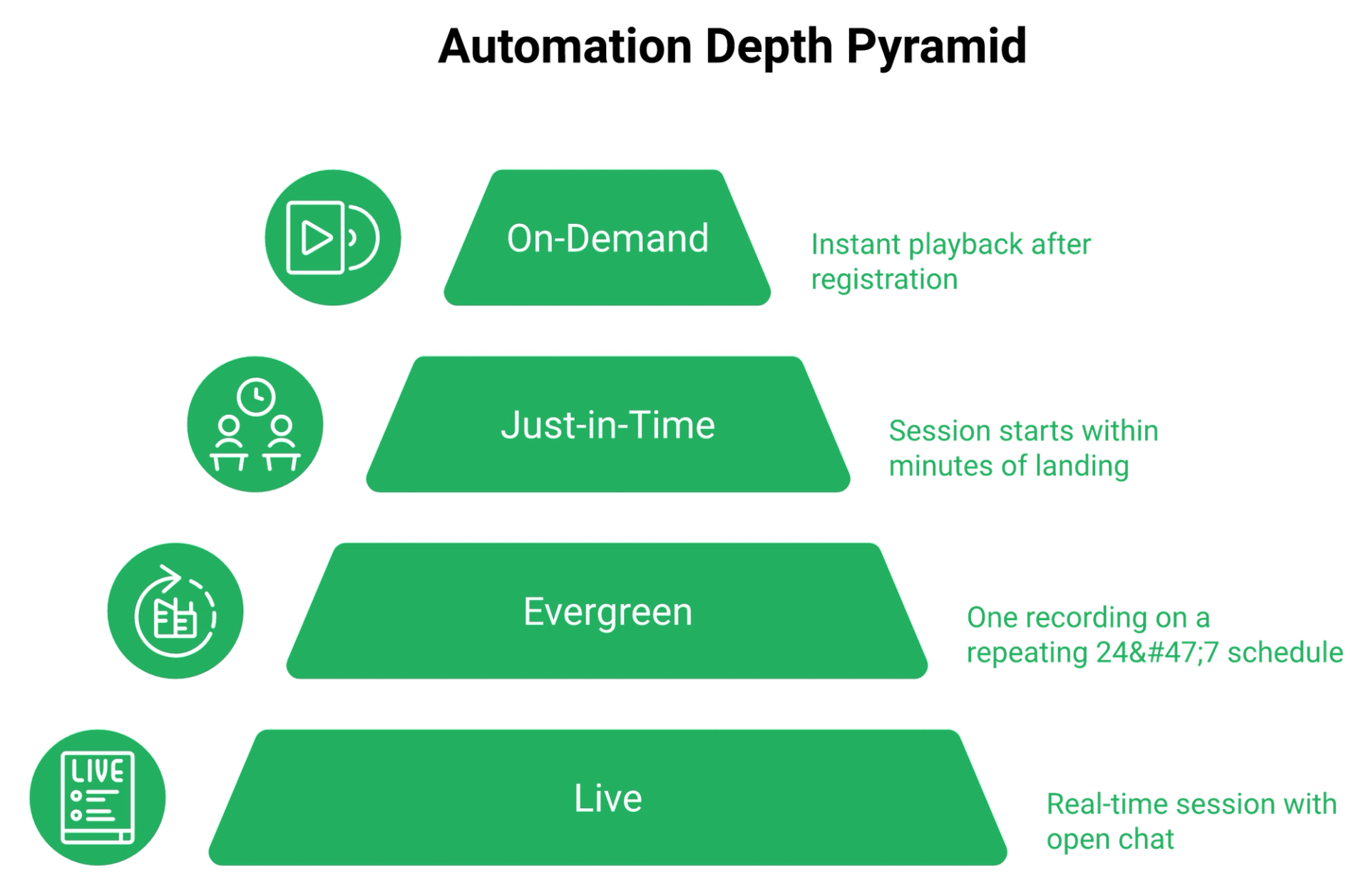
Most buyers treat "has automated webinars" as one feature. It is actually four, and they behave very differently on paid traffic.
- Live: you present in real time, with chat and Q and A open.
- Evergreen: one recording runs on a repeating schedule, 24/7.
- Just-in-time: the visitor sees a session "starting in 8 minutes" the moment they land, so registration and attendance collapse into one step.
- On-demand: the recording plays immediately after registration, with no scheduled slot at all.
Demio covers live and basic automated. The urgency mechanics and the hybrid loop between them are where reviewers start asking for workarounds, which is why the live versus automated webinars decision matters before you pick a plan.
⚠️ What reviewers say the automation cannot do
Two 4-star reviews from August 2024 describe the same ceiling from different angles. Both reviewers like the product, which makes the feedback more useful, not less.
"I also wish I could do for example 3 day event instead of setting up an event that runs daily. I know you can delete the future days but when you ask for a feedback, these are my wishes."- Saana K., online coach, 4/5, Demio G2 - Verified Review
"It didn't fuly integrated with my CRM (Highlevel) and the replay didn't show the live polls and CTAs."- Ivanhoe S., 4/5, Demio G2 - Verified Review
That second line is the expensive one. A replay without the CTA button is a video, not a sales asset.
💸 What a stripped replay actually costs
Think about where the money sits in a webinar. The offer lands in the final 20 minutes, carried by a poll, a click, and a visible button.
Strip those out and the recording still educates. It just stops closing, which means your evergreen asset converts like a YouTube video instead of a sales presentation.
EasyWebinar measures conversion attribution per CTA, so we can see which button inside which session produced the sale. My read is that most "evergreen does not work" complaints are actually replay-fidelity complaints in disguise, and a properly built evergreen sales funnel keeps every offer element intact.
⏰ The setting to change on Monday
If you run paid traffic, stop offering future dates. Registration friction is the quiet killer, and the data on opt-in timing is consistent.
People who register 48 hours out or more show up at the lowest rates. Same-day registrants show up at the highest, which is the core argument in our guide on how to improve webinar attendance.
So do this in your registration setup:
- Toggle just-in-time only, and turn every future-date option off.
- Set the next session to start within 15 minutes of landing.
- Keep one live session weekly for testing the offer, separate from the automated funnel.
- Confirm your replay retains polls, CTAs, and handouts before you spend on ads.
Also worth saying plainly: automation does not create demand. An automated webinar without traffic is a billboard in the desert.
EasyWebinar ships live, evergreen, just-in-time, on-demand, and hybrid funnels inside one account, which is what lets a single automated webinar absorb paid traffic around the clock without a second subscription.
Q6. Where Does Demio Break in Real Workflows, Integrations, Multi-Day Events and Payments?
HubSpot friction is Demio's most repeated complaint. Reviewers set the integration up per webinar, maintain three separate HubSpot lists, and receive static rather than active lists. Others report incomplete GoHighLevel sync, no ClickFunnels integration, no automated SMS, no multi-day event type, and no native payment paywall. EasyWebinar pairs a built-in CRM with per-attendee behavioral triggers, so follow-up fires without a chain of connectors.
🔌 The integration complaint, quoted and dated
This is not one annoyed reviewer. It is the same issue reported across three years by people who otherwise rate Demio 4 stars or higher.
"The HubSpot integrtation is cumbersome. You have to set it up for every webinar, plus create three seperate lists in HubSpot to track back to Demio."- Verified user, 4/5, 5 August 2024, Demio G2 - Verified Review
"It's hard to integrate into Hubspot. We use a third party capture form and had to do several zaps to get all data to flow accurately. It also doesn't have automated texts able to go out to participants, just emails."- Verified user in Education Management, 4/5, 20 April 2023, Demio G2 - Verified Review
Per-webinar setup sounds minor until you run four sessions a month. That is 48 manual integration builds a year, which is exactly the overhead a native webinar integrations layer removes.
🧩 The gap table
Here is the cluster in one view, with the operational cost attached to each item.
| Gap reported | What it costs you | Source |
|---|---|---|
| HubSpot setup per webinar, three lists | Manual admin every session | G2, Aug 2024 |
| Static lists, not active lists | Segments do not update automatically | G2, May 2024 |
| GoHighLevel not fully integrated | Agency stacks break at handoff | G2, Aug 2024 |
| No ClickFunnels integration, Zapier friction | Extra connector cost and failure points | G2, Aug 2024 |
| No automated SMS | Reminders rely on email only | G2, Apr 2023 |
| No multi-day event type | Challenges get rebuilt daily | G2, Aug 2024 |
EasyWebinar exposes a registration API for external carts and custom checkouts, which is how agency stacks avoid rebuilding the same handoff every launch.
⚠️ Why this gets expensive, not just annoying
Every connector you add is another place the funnel can fail at 2pm on a Wednesday. I have watched operators spend six months building a stack that only they can maintain.
If your funnel diagram starts looking like a subway map, back up. Complexity is not sophistication, and each hop is one more thing to break during a launch.
There is also a revenue hole here. Without payment inside the room, a paid workshop routes people out to a cart during the exact moment attention peaks, which is the whole reason paid webinars exist as a native format.
✅ The honest credit, and what to do instead
Demio genuinely earns its 4.8 ease-of-use score. The room is clean, and non-technical presenters get live quickly, which is not a small thing.
The limitation is depth, not polish. Depth beats breadth here, and I would rather have a webinar platform that owns its own follow-up than five tools that mostly talk.
So audit before you buy. Ask the vendor to show CRM sync running once at account level, and ask to see a replay with a live CTA firing.
EasyWebinar runs behavioral triggers on watch time and CTA clicks through its built-in webinar CRM, so we can tag a hot lead the moment they see the offer instead of waiting on a nightly sync.
Q7. Should You Run Live or Automated Webinars First?
Run live first, automate second. Some operators report automated webinars badly underperforming live on cold traffic right now. Others build entire businesses on evergreen. The resolution is sequence, not ideology: run 5 to 10 live sessions, hit roughly 10% attendee-to-buyer, then promote your best performer into an automated asset. EasyWebinar builds hybrid funnels for exactly that progression.
⭐ The case for live, stated fairly
Live sessions still convert hardest on cold traffic. You can read the chat, kill an objection in real time, and change the offer mid-flight.
Direct-response operators running large ad budgets report automated versions of proven webinars underperforming the live original. Close to half of a buying pool may watch two or three sessions before purchasing, which live webinar software scheduling naturally supports.
I lived this from the other side. My YouTube course took six months to build and sold zero copies until I ran a webinar in front of it.
📈 The case for evergreen, stated fairly
The counter-argument is arithmetic. You cannot present at 9am Sydney and 9am Chicago every week without burning out.
Evergreen operators point out that weekly live show-up rates decay fast, while a recorded session runs 24/7 with no calendar. One 2025 operator comparison thread put a traditional automated setup at a 3.8% demo booking rate and $1,180 cost per qualified lead, which is a real number to beat, not a fantasy, as documented in the r/aiautomationmarketing Reddit thread.
Both camps are describing true things about different stages of the same business.
⚠️ Why the sequence is the actual answer
Here is the part the debate skips. Automation multiplies whatever you feed it, including a webinar that does not convert.
So the gate is a number, not a feeling. Run it live until you clear roughly 10% attendee-to-buyer, then record the winner and let it run.
Before that threshold, automating just distributes a weak presentation more efficiently. After it, automating is the highest-leverage move you can make.
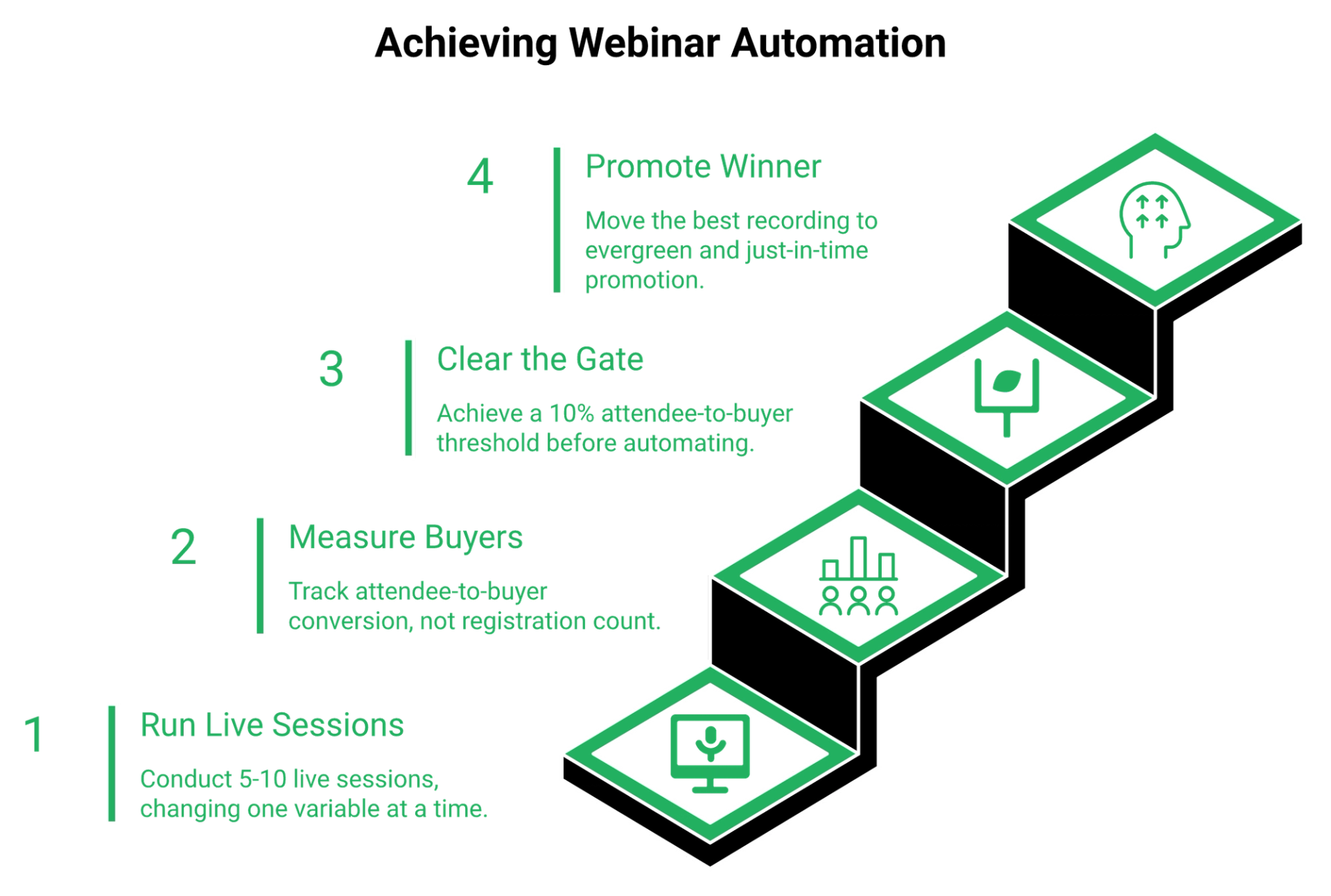
⏰ The Webinar Sprint, in four steps
This is the sequence I run with operators, and it fits inside a quarter.
- Run 5 to 10 live sessions, changing one variable at a time.
- Track attendee-to-buyer conversion, not registration volume.
- At roughly 10%, record the best-performing version end to end.
- Promote that recording into an evergreen and just-in-time funnel, and keep one live session monthly to test new hooks.
EasyWebinar tracks attendee-level watch time and offer views, so the promotion decision rests on the actual conversion curve rather than a hunch. I could be reading the current live-versus-automated gap too strongly, since most of the loudest evidence comes from high-ticket paid-traffic teams rather than low-ticket funnels.
❌ One framing to refuse
You will see "webinars are dead" headlines this year. It is a salacious hook, and it costs the writer credibility with the exact operators who spend money.
Webinars work. The sequence is what people get wrong, and calling automation "set it and forget it" is how funnels quietly die.
EasyWebinar's hybrid funnels exist for this exact progression, letting you run the session live, then promote the winning recording into evergreen and on-demand webinar formats inside the same account, with no second product to buy.
Q8. Demio vs EasyWebinar vs WebinarJam vs Zoom Webinars: Which Fits Which Operator?
EasyWebinar fits operators needing live plus evergreen, in-webinar payments, and behavioral follow-up in one platform. Demio fits marketing teams prioritising the cleanest live room. WebinarJam and EverWebinar split live and automated across two subscriptions. Zoom Webinars wins on raw stability but ships no funnel or automation layer.
⭐ The four criteria that actually decide it
Feature lists are long. The decision usually comes down to four questions.
Format coverage, meaning which of live, evergreen, just-in-time, and on-demand you get in one account. Monetization, meaning whether you can take payment inside the room. Integration depth, meaning whether CRM sync is native or stitched. Streaming spec, meaning the actual latency and stack, not the adjective.
| Criterion | EasyWebinar | Demio | WebinarJam + EverWebinar | Zoom Webinars |
|---|---|---|---|---|
| Formats in one product | Live, simulive, evergreen, JIT, on-demand | Live, basic automated | Two separate subscriptions | Live only |
| Payment in room | Yes, paid webinars | Not native | External checkout | No |
| Built-in CRM | Yes (EasyCRM) | No | No | No |
| Ease of use rating | 4.5/5 on G2 (93+ reviews) | 4.8 ease of use | Mixed across two UIs | Familiar to most attendees |
| Streaming spec | Dolby OptiView WebRTC, sub-500ms | Browser-based, no published spec | Browser-based | Industry-leading stability |
EasyWebinar holds row one because it combines live, automated, and evergreen webinars, AI-assisted creation, in-webinar payments, and per-attendee analytics in a single product. For the line-by-line version, see the EasyWebinar vs Demio breakdown.
⚠️ What real users say about the trade-offs
The honest read is that each platform is good at the thing it was built for. Reviewers say this more clearly than any vendor page.
"Zoom Webinar is ridiculously glitchy. There's no pre-webinar waiting room or post-webinar exit page. There's no ability to distribute resources or files. Customization of landing pages, reminders, and calendar invites is almost nonexistent."- Casey S., 1.5/5, Zoom Events and Webinars G2 - Verified Review
"Zoom has been everything we've wanted for running webinars for our national membership association. It was easy to implement, integrates with our systems well."- Rob K., 4/5, Zoom Events and Webinars G2 - Verified Review
"Prefer simplicity? Go with Demio."- Poster, r/ChiefMarketingOfficer Reddit Thread
💰 Three scenarios, with skip conditions
Match the tool to the job, then check the disqualifier.
- Solo coach selling a $2,000 program: you need evergreen plus payment in room. Skip Zoom entirely, and skip Demio's entry tier.
- B2B demand-gen team, 300 registrants monthly: you need clean CRM sync and attendance analytics. Skip WebinarJam if managing two subscriptions is a problem.
- Enterprise training lead, no funnel intent: stability and familiarity win. Skip EasyWebinar here, honestly, because a revenue platform is overbuilt for internal sessions.
Simple scales, and fancy fails. Be cautious of any tool claiming to be your CRM, your email platform, your storage, and your video stack at once. If you are still building a shortlist, the Demio alternatives roundup and the WebinarJam alternatives comparison cover the rest of the field.
Comparing shortlists?
See the two capabilities that decide this shortlist, side by side
If format coverage and in-webinar monetization are your deciding criteria, compare them line by line before you start a trial.
Walk through your funnel with us
EasyWebinar earns row one on format coverage and monetization, not on polish. Demio's interface is cleaner out of the box, and we say so, because a comparison that hides the other tool's strength is not worth reading.
Q9. What Should You Test Before You Commit to Demio?
Test four things inside the 14-day trial: whether you can export registrant data after cancelling, whether your browser and microphone survive a full dress rehearsal, whether replays retain CTAs, and whether CRM sync runs once or per webinar. One G2 reviewer reports being unable to export their own list after cancelling, confirmed by support.
⚠️ Start with the risk nobody writes about
Your registrant list is the asset. The platform is rented, but the emails you collected are yours, or at least they should be.
One reviewer found out otherwise after cancelling a paid plan in May 2025. Support confirmed the export was blocked unless she resubscribed.
"I used Demio to run a webinar and collected registrant emails while on a paid plan. After canceling, I was shocked to find out I couldn't export the list unless I subscribed again. Support confirmed this."- Sheida M., 0/5, 12 May 2025, Demio G2 - Verified Review
That is a single review, so treat it as a question to ask rather than a settled fact. Ask it in writing, before you pay, and compare the answer against the vendor's own GDPR compliance documentation.
✅ The 30-minute dress rehearsal
Run this before you invite a single registrant. The failures reported on Demio cluster around specific hardware and browser setups, not the platform as a whole.
- Join as host from the exact browser you present in, including Safari if that is your default.
- Test your actual microphone, not the laptop mic, and watch for dropouts past the 10-minute mark.
- Turn on your virtual background and check for pixelation.
- Leave the room and rejoin, and confirm the session does not end for everyone.
- Push a poll, a handout, and a CTA, then watch the replay to see if all three survived.
"The interactive items sometimes go haywire on my machine. Screen goes blank and have to rejoin the event."- Verified user in Industrial Automation, 3.5/5, Demio G2 - Verified Review
EasyWebinar exposes attendee-level engagement data through its API, so we can reconstruct exactly where a session lost people instead of guessing after the fact. If you are still assembling your setup, our guide on webinar equipment covers the microphone and camera checks worth running first.
⏰ Two launch guardrails worth copying
These are the numbers I hold operators to, whichever platform they end up on.
First, retention from peak attendance to the pitch should sit around 80%. Bait it honestly by telling people the bonuses come at the end for those still in the room.
Second, expire your replay in 72 hours. Send a heads-up email on day three, then a final-hours email, because an open-ended replay converts like a bookmark nobody returns to.
One more tactical note from testing. Do not put the join link in your reminder SMS. Show rate goes up slightly, but booking rate falls, because people join from a phone with far lower intent. The rest of these reminders live inside our webinar best practices for registrations and sales.
💰 The contract questions to send by email
Get written answers, not sales-call answers.
- Can I export registrants and attendance data after cancellation?
- Does CRM sync configure once at account level, or per webinar?
- Do replays retain polls, CTAs, and handouts by default?
- What is the attendee cap and session length on the exact plan I am buying?
- Which compliance attestations do you hold, and can I see the report?
EasyWebinar holds SOC 2 Type II attestation and is GDPR-aligned, and that combination is the floor worth demanding from any vendor before you hand over a list you spent ad money to build. The full feature and security breakdown spells out what each plan includes.
Q10. Who Should Choose Demio, and Who Should Skip It?
Choose Demio if you run scheduled live marketing webinars, want the fastest clean setup, and stay under 150 attendees. Skip it if you sell high-ticket offers through evergreen funnels, need ticketed webinars with payment in the room, run multi-day challenges, depend on active-list HubSpot sync, or present from Safari.
✅ Who Demio genuinely serves well
There is a real buyer here, and the 4.7 average is not an accident. Demio fits the marketing manager who needs a webinar live by Thursday.
Small B2B teams running monthly lead-gen sessions get a clean attendee room with no downloads. Reviewers who use it that way consistently rate it 4 stars or higher, which is the same profile served by most webinar platforms for small business.
"The platform itself is excellent for hosting a webinar. You won't have the potential connectivity issues you'd have with other meeting platforms, and you get really good post-webinar analytics."- Verified user, 4/5, Demio G2 - Verified Review
❌ Who should walk away now
Five profiles will hit a wall inside a quarter. Each maps to a documented limitation, not an opinion.
- Coaches selling $2,000-plus programs through evergreen funnels
- Anyone charging for the webinar itself, since payment is not native
- Operators running three-day or five-day challenges
- Teams whose follow-up depends on active-list CRM sync
- Presenters whose default browser is Safari
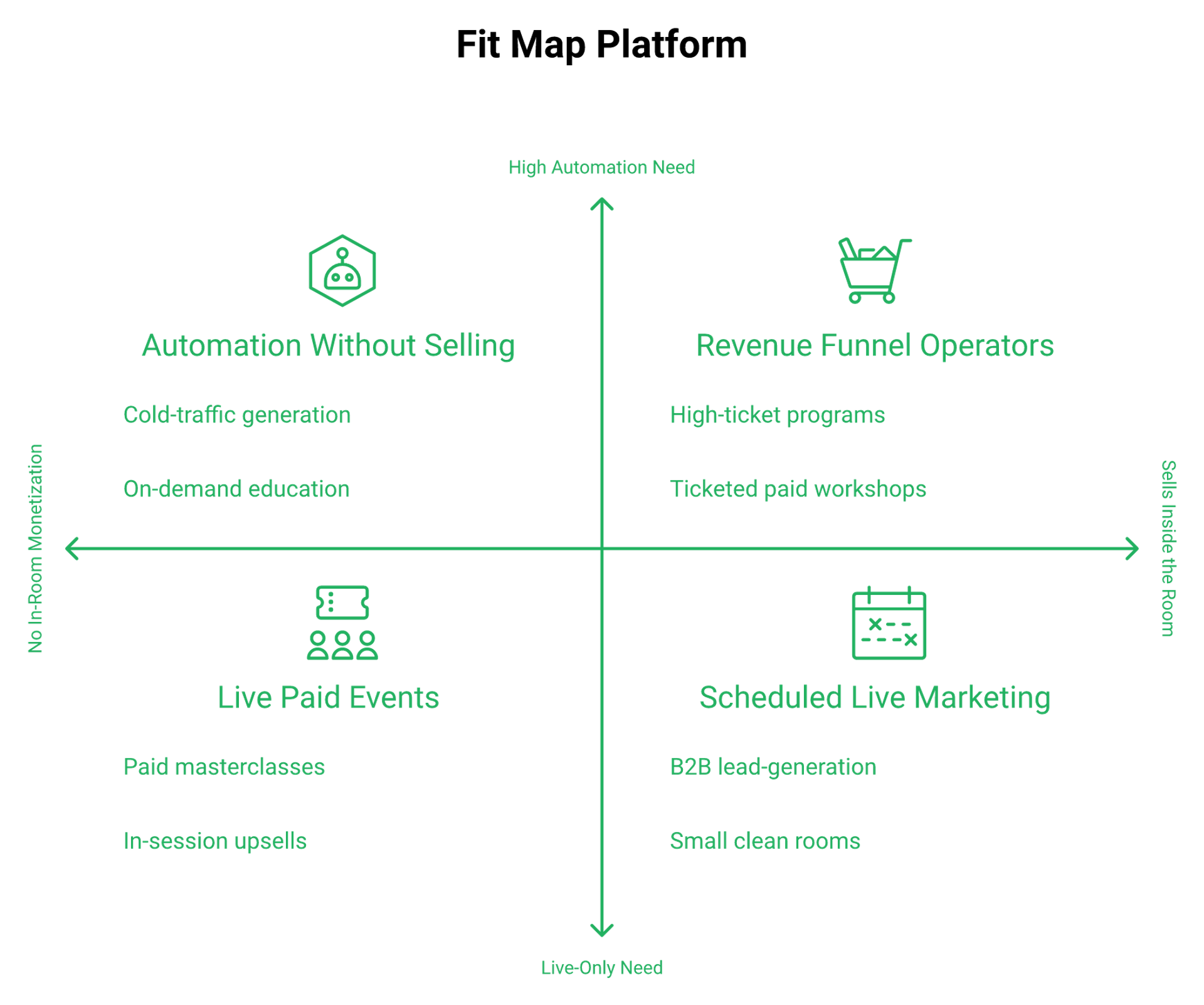
EasyWebinar is honest about its own misfit too. Internal team meetings, pure live-only enterprise events with no funnel intent, and sub-$200 offers do not need a revenue platform. If you sit in the first group, the coaching sales funnel playbook is the better starting point.
📉 The outgrowth pattern in the numbers
Look at the sub-score spread again. Ease of use sits at 4.8, and value for money sits at 4.5.
That gap is the story of the whole product. Month one feels great, and month six feels expensive, because the ceiling arrives right when ad spend scales.
"Benchmarking Webinars actors, any demio alternatives?"- u/ArcadiaBunny, r/SaaS Reddit Thread
That thread title is the pattern in five words. People do not search for alternatives when the tool still fits, which is why the Demio alternatives comparison exists.
⭐ What I am watching next
Demio is not a bad product. It is a scoped product, and scope is a fair thing for a company to choose.
My prediction for the next 18 months is that the review gap widens on one axis only, which is monetization inside the session. As more coaches sell workshops directly, a webinar you cannot charge for starts looking like a missing feature rather than a design choice.
I could be wrong about the timing. What I keep seeing in EasyWebinar deployments is that operators who collect payment in-session stop caring about registration volume, because revenue per attendee climbs fast enough to change their ad math.
So tell me about your funnel instead of your feature list. What are you selling, at what price, and how many sessions a month can you honestly run live?
EasyWebinar is built for the operator on the other side of that ceiling, combining live, evergreen, and just-in-time webinars with in-webinar payments and per-attendee behavioral triggers in one conversion-focused webinar platform.
Outgrowing a hosting tool?
If your funnel needs to sell while you sleep, start here
Evergreen, just-in-time and on-demand webinars with payments inside the room, see how the automation layer is built.
Frequently Asked Questions

Casey Zeman
Founder of EasyWebinar
About Author
Over the past decade, I've helped thousands of entrepreneurs, coaches, and consultants turn webinars into a predictable, powerful way to grow their audience, build trust, and scale, without the constant hustle. I created EasyWebinar because I couldn't find a system that combined authenticity, engagement, and automation the way I needed. So, I built one.
Related Posts

10 Best Community Engagement Platforms in 2026
Compare the 10 best community engagement platforms in 2026. Course creators, evaluate live hosting, analytics, and replay to pick your winner today.

10 Best Online Coaching Tools in 2026: Live Session Quality, Scheduling, Recording, and Client Engagement Analytics
Compare the 10 best online coaching tools of 2026 on session quality, scheduling, and analytics. Discover the right fit for your coaching revenue model.
10 Best Webinar Hosting Platforms Ranked by Uptime, Streaming Quality & Cost
Compare 10 webinar hosting platforms ranked by uptime, streaming quality, and cost. Discover which tool actually turns attendees into revenue.
Turn every webinar into a revenue stream
Launch your first paid event in just a few clicks - and start monetizing your expertise.
Book a Call