10 Best Webinar Platforms for Influencers in 2026

Casey Zeman
Published on Sep 29, 2026 • 58 min read

TL;DR
- We ranked 10 platforms for influencer webinars in 2026: EasyWebinar, Stan Store, Circle, Riverside, Zoom Webinars Plus, Skool, Heartbeat, Meetn, Descript, and GoHighLevel.
- Scoring used five weighted criteria, with unified live plus automated architecture at 25% and follow-up automation at 20%, because integration breakage kills launches, not short feature lists.
- Warm creator and partner traffic delivers 30% to 40% show-up rates against 10% to 15% on cold paid ads, at $8 to $12 cost per lead.
- Run 5 to 10 live sessions and clear 10% attendee-to-buyer conversion before promoting a winner into Simulated Live or Evergreen delivery.
- Entry pricing spans $9 to $99 per month, but overage charges, gated automation, and transaction fees decide the real bill during a launch spike.
- EasyWebinar ranks first for warm audiences selling above $500, since live, automated tiers, checkout, and CRM follow-up run from one $44 to $349 subscription.
Q1. What are the 10 Best Webinar Platforms for Influencers in 2026?
The 10 best webinar platforms for influencers in 2026 are EasyWebinar, Stan Store, Circle, Riverside, Zoom Webinars Plus, Skool, Heartbeat, meetn, Descript, and GoHighLevel. Each was scored on five criteria: unified live and automated architecture, monetization, stream reliability at scale, repurposing, and pricing transparency. EasyWebinar ranks first because one system covers live, simulated live, and evergreen delivery, plus registration pages, in-webinar checkout, and EasyCRM follow-up with an auto-dialer. Plans run $44 to $349 per month, with custom enterprise capacity up to 100,000 live attendees.
The ranked list
- EasyWebinar
- Stan Store
- Circle
- Riverside
- Zoom Webinars Plus
- Skool
- Heartbeat
- meetn
- Descript
- GoHighLevel
🗂️ Why this decision is high-stakes
Picking a webinar stack is the one software choice that sits directly on top of revenue, because a crashed stream or a broken reminder email costs you the launch, not just the login. Ten vendors were evaluated against the eight criteria below. The daily operator is the creator or coach who builds the funnel, presses go live, and answers the chat. The shadow readers on the buying committee are the marketing lead checking funnel performance, the finance owner validating tool consolidation, and the technical helper who inherits the integrations when something breaks.
🎬 The Sunday night tab problem
I watched a coach do this last year. Nine tabs open on a Sunday night, a registration page in one tool, reminder emails in another, checkout in a third, and a recording she could not turn into an evergreen session without re-uploading it. She was not short on audience. She was short on one system that held the chain together.
Our Evaluation Criteria
Webinar format coverage 📺
Whether the platform runs live, simulated live, evergreen, just-in-time, replay, and on-demand sessions natively.
Time to launch ⏰
How long it takes to get a registration page, reminder emails, and a scheduled session live from a standing start.
Engagement depth 💬
Chat, polls, question handling, timed offers, and whether that layer survives into automated sessions.
Funnel and conversion workflow 🧩
Registration, thank-you, join, and replay pages, plus where the offer appears and where the buyer checks out.
CRM and follow-up readiness 📇
Native CRM, lead scoring on watch behavior, attendee tagging, segmented sequences, and outbound calling.
Monetization support 💰
Paid or ticketed access, in-room checkout, payment plans, and affiliate or partner payouts.
Analytics and attribution 📊
Registration, attendance, watch time, offer clicks, replay behavior, and revenue visibility per session.
Reliability, compliance, and scale ⚠️
Streaming stability under load, attendee ceilings, SOC 2 and GDPR posture, and the support model behind it.
Who This Guide Is For
- Coaches and course creators turning a teaching webinar into a repeatable sales funnel.
- Influencers and personal brands converting warm follower traffic into paid workshops or programs.
- Creators running paid communities who need recurring live events inside the membership.
- Marketing and revenue operators checking whether webinar behavior can flow into CRM and follow-up.
- Founders and consultants replacing separate tools for hosting, pages, email, checkout, and calling.
- Buying-committee readers validating consolidation cost, reliability, and data handling.
Platform comparison at a glance
| Provider | Best For | Standout Strength | Known Limitation | Webinar Formats and Attendee Cap | Support Model | Pricing Model |
|---|---|---|---|---|---|---|
| EasyWebinar ⭐⭐⭐⭐⭐ | Creators selling high-ticket offers to a warm list | Live, simulated live, and evergreen delivery with EasyCRM follow-up in one account | Reviewers call the page and email design options limited and the UX dated | Live, simulated live, evergreen, just-in-time, replay, on-demand; 50 to 1,000 live by plan, up to 100,000 on custom enterprise | Email, in-app, onboarding calls, dedicated account manager on Pro, Slack on Scale | Flat monthly $44 to $349, overage at $0.78 per extra live attendee |
| Stan Store ⭐⭐⭐⭐ | Creators selling low-ticket products from a link in bio | Mobile storefront with AutoDM checkout and 0% platform fee on sales | No native webinar room, and email flows sit behind the $99 tier | No hosted webinar room; sells access to sessions hosted elsewhere | Standard support, priority support on Creator Pro | Flat monthly $29 or $99, annual $300 or $948 |
| Circle ⭐⭐⭐⭐ | Creators running a paid community with recurring events | Conversation-first community with an event calendar and RSVP flow | Events are community-shaped, not funnel-shaped, with no evergreen webinar engine | Live community events only; Professional 100, Business 200, Scale 500 live stream attendees | Email and in-app support, priority support on higher tiers | Flat monthly, $89 Professional to $419 Scale on annual billing |
| Riverside ⭐⭐⭐⭐ | Creators who repurpose every session into clips | Local multi-track recording that survives internet dips, plus AI clip generation | Built for production quality, not registration funnels or offers | Live streaming and recording; Webinar plan caps at 100 registrants | Email and in-app support | Freemium, then annual billing from $288 per year |
| Zoom Webinars Plus ⭐⭐⭐ | One-off broadcasts to very large familiar audiences | Backstage production controls and attendee familiarity at scale | G2 reviewers report glitches, missing exit pages, and almost no page customization | Live and simulive; capacity-based licenses from 500 attendees upward | Ticket-based, enterprise admin gated per reviewer reports | Per-user annual licensing, $290.83 per user per month for 500 attendees |
| Skool ⭐⭐⭐ | Creators bundling community, course, and calendar in one flat fee | Single flat price with gamified community and an event calendar | Fixed layouts, and a separate account per community | Community calls only, no evergreen webinar engine | Email and in-app support | Flat monthly, $9 Hobby or $99 Pro, plus transaction fees |
| Heartbeat ⭐⭐⭐ | Event-driven communities and masterminds | Smooth live session flow with recordings auto-posted to the group | No thread topic organization, so channels stack up Slack style | Live community events only, voice and video rooms up to 256 attendees | Email and in-app support | Flat monthly, $49 Build to $849 Scale, plus transaction fees |
| meetn ⭐⭐⭐ | Budget-conscious creators who want a stable room | Admin mode lets a host enter without alerting attendees | Thin funnel, CRM, and monetization layer | Live webcasts, 100 attendees on Pro and up to 1,000 on the Ultimate room tier | Email and in-app support | Per-seat monthly from $19.95, plus per-room add-ons |
| Descript ⭐⭐⭐ | Creators post-producing the recording afterward | Text-based editing that cuts filler words from a transcript | Not a webinar delivery platform at all | Recording and editing only, room recording caps at 10 participants | Email support, SSO and SCIM on Enterprise | Freemium, then per-person monthly from $16 on annual billing |
| GoHighLevel ⭐⭐ | Agencies already running client funnels inside one CRM | Broad CRM, pages, and automation under one login | Video and webcast delivery is the weakest layer in the suite | No purpose-built webinar room; funnel and CRM layers only | Partner-delivered and ticket-based, premium support as a paid add-on | Per-account monthly, $97 Starter to $497 Agency Pro |
1. EasyWebinar
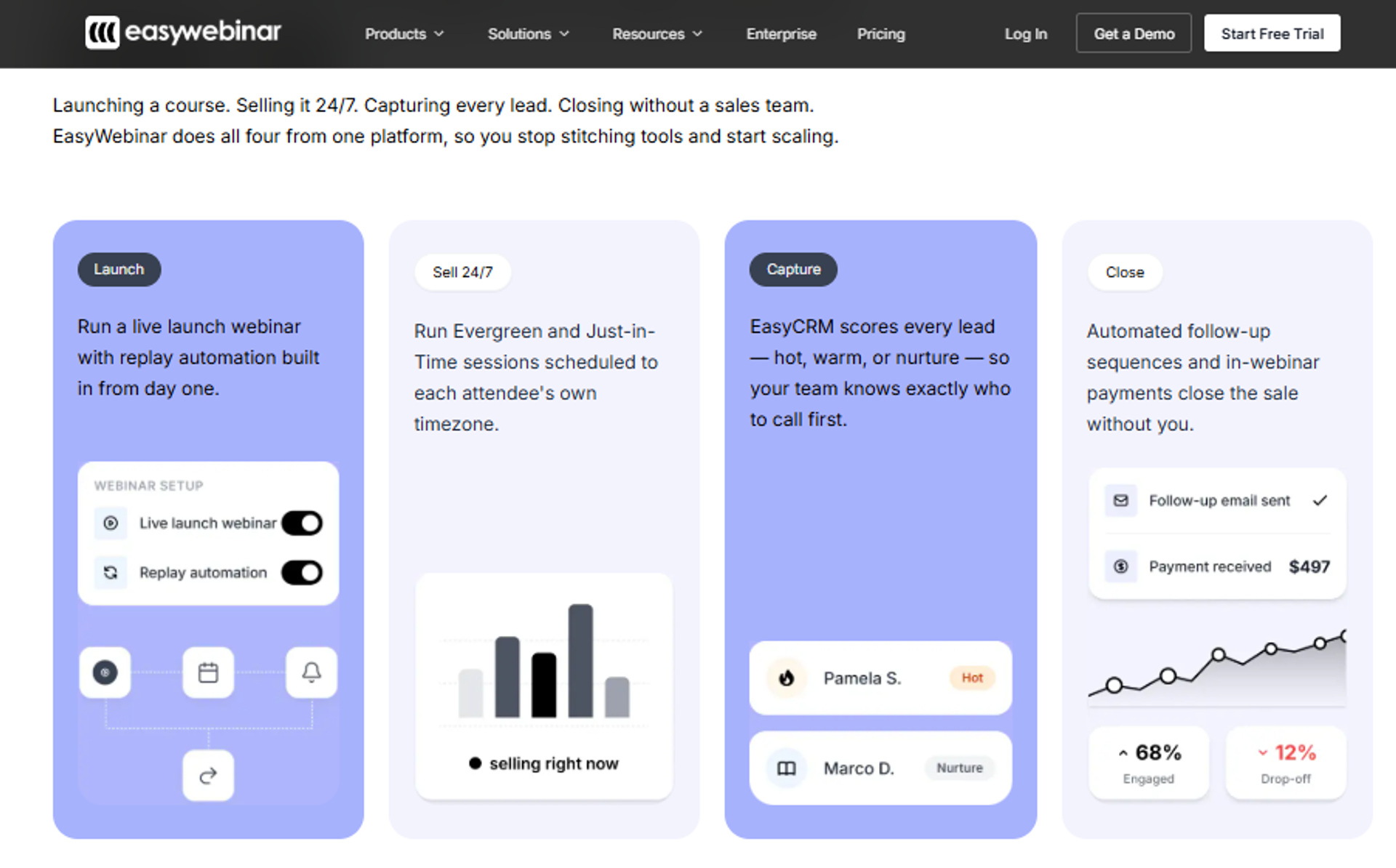
EasyWebinar is best for influencers, coaches, and course creators selling offers above roughly $500 to a warm audience, because live, simulated live, and evergreen sessions run from the same account with registration pages, in-room checkout, and EasyCRM follow-up attached. It may not fit creators who want a polished page design system, or anyone selling a sub-$200 product where a webinar is not mathematically required.
| Quick fit | Detail |
|---|---|
| Best for | Creators and coaches converting a warm list into high-ticket sales |
| Skip if | You need a design-led page builder, or a one-off internal team meeting |
| Strongest edge | One account covers live validation through evergreen automation, with CRM follow-up included |
| Biggest trade-off | Page and email customization is narrower than a dedicated page builder |
| Pricing snapshot | Launch $44, Growth $116, Pro $198, Scale $349 per month, custom enterprise above that |
Why EasyWebinar ranks #1
🏗️ Format coverage decides this category
EasyWebinar covers live, simulated live, evergreen, just-in-time, replay, and on-demand from one place, and the Growth plan at $116 per month is where automation unlocks, per its webinar pricing page. That matters because most platforms on this list treat automation as a separate product or skip it entirely. I have run this progression on my own launches for years. Validate live, hit your conversion number, then promote the winning session.
💰 The stack math is the real argument
EasyWebinar documents a typical stitched stack at roughly $1,063 to $1,500 per month across eight tools for hosting, pages, automation, storage, AI copy, email, CRM, and multistreaming, as itemized on its pricing page. Our read is that the standard advice gets this backwards. Operators shop for the cheapest room, then quietly pay four times more for the plumbing around it.
📇 Follow-up is where launches actually leak
EasyWebinar includes EasyCRM from Growth upward, with lead scoring on watch time, pipeline stages, behavior-triggered sequences, and an auto-dialer for hot leads. I care about this more than any streaming spec. The attendee who left at minute 38 is your best call of the week, and most stacks lose her.
What EasyWebinar does well
- Launches faster. The AI Webinar Builder generates a script, registration page, thank-you page, email sequence, polls, and a timed CTA from one prompt, with 200 to 2,000 credits by plan.
- Keeps engagement inside automation. Simulated live sessions hold real-time chat and polls, and EasyWebinar's simulated chat can carry prior session chats into new events.
- Sells in the room. Built-in checkout puts a timed offer button inside the session, and paid webinars gate access entirely, both from Growth, per the published plan comparison.
- Expands reach without OBS. EasyCast multistreaming sends one session to YouTube, LinkedIn, Facebook, and custom RTMP, with 3 destinations on Growth and 10 or more on Pro.
- Removes timezone friction. Evergreen scheduling handles just-in-time sessions, timezone-adjusted delivery, and instant replay, so a global follower base books a local time.
- Clears procurement. EasyWebinar holds SOC 2 Type II certification and GDPR compliance, with SSO, SAML, and API access on Scale.
Where EasyWebinar falls short
- Page and email design control is narrower than a dedicated builder. G2 flags limited customization on pages and emails in 5 reviews, and cost as prohibitive in 3, across its G2 review profile.
- The interface is functional rather than fashionable, and reviewers say so plainly.
- Automated webinar setup expects the presentation uploaded first, which blocks promoting a session before the video exists.
- Email open and click tracking inside the platform is thinner than a dedicated email tool, so some operators still send post-webinar sequences elsewhere.
- Live attendee overage is billed at $0.78 per extra live attendee, and $0.078 per extra automated viewer, so a spike has a price, per the overage schedule.
Decision scorecard
| Evaluation criterion | EasyWebinar fit | Why it matters |
|---|---|---|
| Live webinars | Strong | Dolby OptiView and WebRTC streaming keeps polls and offers in sync with the presentation. |
| Simulated live | Strong | Real-time chat and polls stay active on a scheduled pre-recorded session. |
| Evergreen automation | Strong | Just-in-time, timezone-adjusted, replay, and on-demand scheduling ship together. |
| Funnel pages | Partial | Registration, thank-you, join, and replay pages are included, but design control is limited. |
| Engagement | Strong | Chat, polls, handouts, and timed CTA overlays run live and in simulated live. |
| CRM and follow-up | Strong | EasyCRM adds lead scoring, sequences, pipeline stages, and an auto-dialer from Growth. |
| Monetization | Strong | In-room checkout and paid webinar gating are native from Growth. |
| Analytics | Partial | Attendance, watch time, and CTA clicks are tracked, though reviewers want deeper in-dashboard detail. |
| Integrations | Strong | 13 CRM and email integrations, with native HubSpot and Salesforce sync on Pro. |
| Pricing fit | Strong | Entry at $44, automation at $116, and no separate evergreen product to buy. |
| Best-fit buyer | Warm-audience creator selling a high-ticket offer | The whole chain sits in one login. |
Best for / skip if
Choose EasyWebinar if you already have audience attention and need one system that validates an offer live, then runs it evergreen with follow-up attached. Skip it if you need a design-led page builder, or if your product sits under $200 and a webinar is not required to sell it.
Reviews
EasyWebinar holds 4.5 out of 5 across 119 G2 reviews, with support and easy setup as the dominant praise themes, according to its G2 profile. Operators consistently name evergreen delivery as the reason they stay, and the interface as the reason they grumble, a pattern the customer reviews page echoes.
"EasyWebinar is hands-down THE webinar platform for evergreen webinars, no contest. The biggest challenge is around setting up automated webinars, and needing the presentation uploaded first in order to set it up."- Ash A., President, EasyWebinar G2 - Verified Review
"EasyWebinar is stable and feature-rich. I especially like the Evergreen simulated chat. The main drawback is the dated UX."- Peter Y., Investment Banking, EasyWebinar G2 - Verified Review
EasyWebinar is used by 25,000 plus businesses and creators, and Carla Biesinger generated $5M from a single evergreen webinar funnel on it after moving off small live events, as documented in her course creator case study. That is the pattern worth copying, not the software logo.
2. Stan Store
Stan Store is best for influencers selling low-ticket digital products, mini courses, and paid workshops straight from a link in bio, because checkout, course hosting, and Instagram or TikTok AutoDM triggers sit in one mobile-first storefront. It may not fit anyone who needs to host the webinar itself, since Stan sells access rather than running the room.
| Quick fit | Detail |
|---|---|
| Best for | Social-first creators monetizing DM and bio traffic |
| Skip if | You need to host live or evergreen webinars inside the platform |
| Strongest edge | Mobile checkout with AutoDM triggers and 0% platform fee on sales |
| Biggest trade-off | No webinar delivery layer, and email flows are locked to the $99 tier |
| Pricing snapshot | Creator $29 per month or $300 per year, Creator Pro $99 per month or $948 per year |
Why Stan Store ranks #2
📱 It wins the first 30 seconds of the funnel
Stan Store ranks second because it removes friction at the exact point most creator funnels lose people, which is the jump from a social post to a paid checkout on a phone. Creator costs $29 per month and Creator Pro costs $99, both with a 0% Stan transaction fee and a 14-day trial, per Stan's published pricing. It does not rank first because it is a storefront, not a webinar engine.
🔗 Pair it, do not replace with it
In EasyWebinar's client work, the cleanest version of this is a pair, not a swap. Stan handles the impulse purchase and the DM trigger. EasyWebinar handles the room, the timed offer, and the follow-up call to the attendee who left early, which is the creator monetization gap Stan leaves open. I could be reading the split too strongly, but the operators I see doing $40K months rarely force one tool to do both jobs.
What Stan Store does well
- Converts DM traffic. AutoDM triggers on Instagram and TikTok comments push buyers to checkout without leaving their phone.
- Keeps the full sale price. Stan charges 0% platform fee on both plans, so you only pay Stripe or PayPal processing, per its plan documentation.
- Hosts the offer next to the sale. Unlimited digital products, courses, bookings, and subscriptions live in the same storefront.
- Adds real checkout mechanics on Pro. Order bumps, one-click upsells, payment plans, discount codes, and affiliate management arrive at $99.
- Tracks paid traffic. Pixel tracking for Meta, TikTok, Google, and Pinterest is included on Creator Pro.
Where Stan Store falls short
- No webinar room, so live sessions, simulated live, and evergreen delivery all happen somewhere else.
- Email flows, broadcasts, and triggered sequences require the $99 Creator Pro tier, which surprises creators who bought at $29.
- No free plan, and the 14-day trial requires a card, so the $29 starts before your first sale does.
- Store layout control is deliberately narrow, which is the price of the mobile-first simplicity.
Decision scorecard
| Evaluation criterion | Stan Store fit | Why it matters |
|---|---|---|
| Live webinars | Weak | No hosted room, so delivery sits outside the platform. |
| Simulated live | Weak | Not supported. |
| Evergreen automation | Weak | No evergreen webinar scheduling or just-in-time sessions. |
| Funnel pages | Partial | A strong mobile storefront, but not a webinar registration and replay funnel. |
| Engagement | Weak | No chat, polls, or timed in-session offers. |
| CRM and follow-up | Partial | Email flows and broadcasts exist, on the $99 tier only. |
| Monetization | Strong | Checkout, upsells, payment plans, and affiliates with 0% platform fee. |
| Analytics | Partial | Pixel tracking and store analytics, with no webinar watch-time data. |
| Integrations | Partial | Strong social and payment coverage, lighter CRM depth. |
| Pricing fit | Strong | $29 entry is the lowest real floor on this list. |
| Best-fit buyer | Social-first creator selling low-ticket digital products | The checkout is the product. |
Best for / skip if
Choose Stan Store if most of your revenue comes from DMs, bio clicks, and products under a few hundred dollars. Skip it as your primary pick if the webinar itself is the sales mechanism, and instead run it alongside a platform that hosts the session.
Reviews
Stan holds 4.8 out of 5 on Trustpilot across roughly 1,900 reviews, with about 91% rated five stars, which is unusually high for a creator tool, per its Trustpilot profile. The recurring operator complaint is not reliability but tier gating, since creators expect the email automation that only appears at $99.
EasyWebinar sits beside Stan in plenty of real stacks rather than against it. Stan takes the impulse buy at $29 per month. EasyWebinar runs the live, simulated live, and evergreen sessions plus the EasyCRM follow-up that closes offers above $500, which is why operators weighing both tend to compare webinar platforms on follow-up rather than checkout. Two jobs, two tools, one clear division of labor.
3. Circle
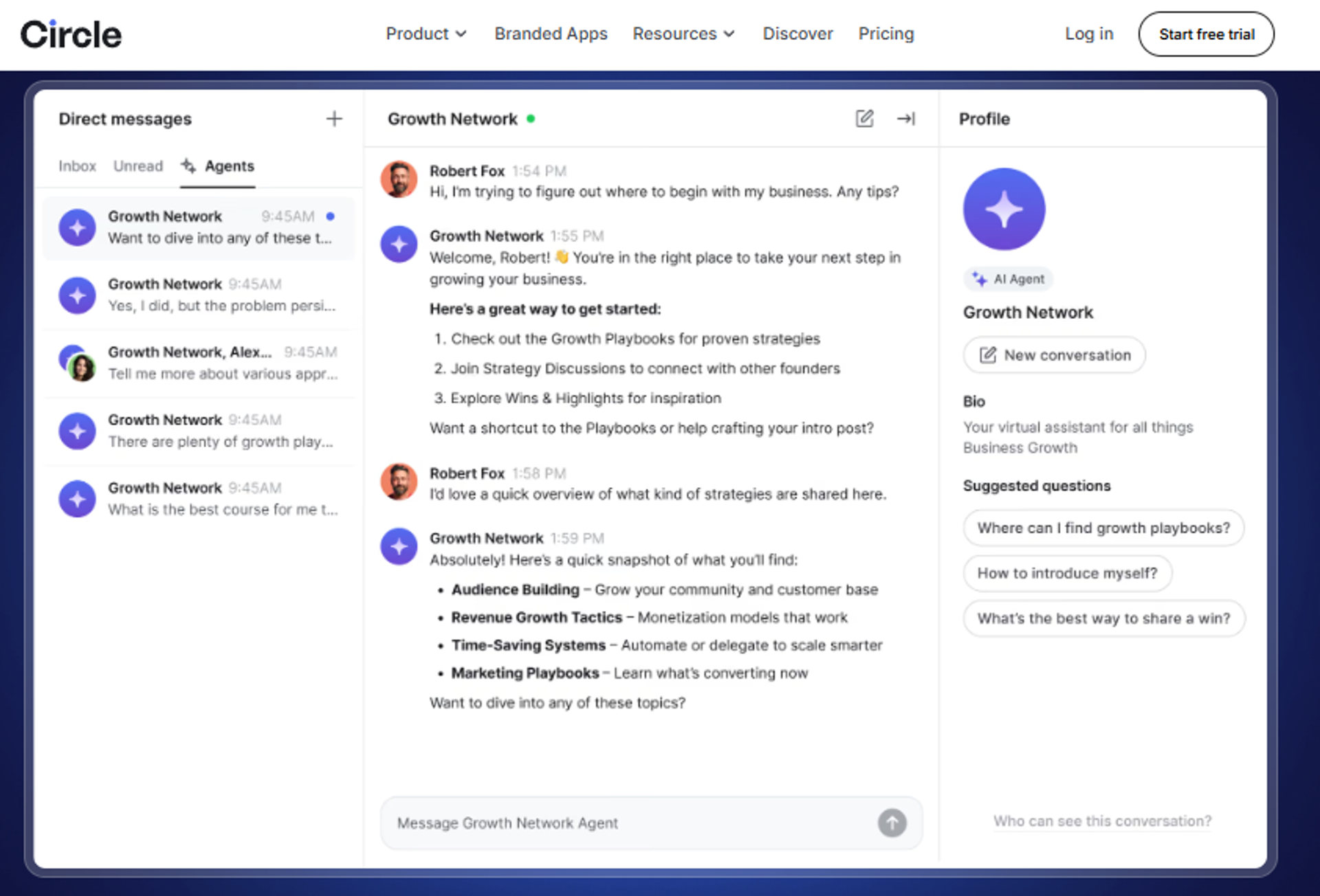
Circle is best for influencers who run a paid membership and want live events to sit inside the community, because discussions, courses, payments, and live streams share one login with 0% platform lock-in beyond its transaction fee. It may not fit creators who need a registration funnel, reminder sequences, and evergreen sessions, since Circle streams are community events rather than sales funnels.
| Quick fit | Detail |
|---|---|
| Best for | Creators monetizing a paid community with recurring live sessions |
| Skip if | Your webinar needs a registration page, reminders, and evergreen scheduling |
| Strongest edge | Community, courses, payments, and live streams in one member experience |
| Biggest trade-off | Live stream attendee caps are low, and hours are metered |
| Pricing snapshot | Professional $89, Business $199, Scale $419 per month on annual billing, plus custom Circle Plus |
Why Circle ranks #3
🏘️ It wins retention, not acquisition
Circle earns third place on community depth, not webinar depth. Live streams cap at 100 attendees on Professional, 200 on Business, and 500 on Scale, with 10 to 20 streaming hours included, per Circle's published pricing. Extra live attendees cost $20 per month per 100, and extra hours cost $50 per month per 10.
💸 The fee stack is the thing to model
Circle charges a 2% transaction fee on Professional, dropping to 0.5% on Circle Plus. The Email Hub that sends your broadcasts is a separate add-on, at $99 per month for 10,000 contacts, as listed on the same plan comparison. EasyWebinar's Growth plan at $116 per month includes evergreen scheduling and reminder email sequences without a separate messaging add-on, per its webinar pricing page. Different jobs, and worth modeling side by side.
What Circle does well
- Keeps members in one place. Discussions, courses, events, and payments live behind a single member login, which cuts churn from tool-hopping.
- Runs events natively. An events calendar with RSVP and live rooms makes recurring cohort calls simple to schedule.
- Automates member journeys. Workflows are unlimited from Business upward, so tagging and onboarding sequences run without Zapier.
- Scales into a branded app. Circle Plus adds custom iOS and Android apps with branded push notifications.
- Supports enterprise access control. Scale adds webhooks, custom SSO, and higher API limits.
Where Circle falls short
- Live stream ceilings are low for a launch. A 500 attendee cap requires the $419 Scale plan.
- Streaming hours are metered, so a heavy launch week can trigger add-on charges.
- No evergreen webinar engine, no just-in-time sessions, and no timed in-session offer overlays, which is the gap covered by a dedicated automated webinar engine.
- Email marketing sits outside the base price as the Email Hub add-on.
Decision scorecard
| Evaluation criterion | Circle fit | Why it matters |
|---|---|---|
| Live webinars | Partial | Live streams work, but attendee caps and metered hours limit launch use. |
| Simulated live | Weak | No scheduled pre-recorded session with live chat. |
| Evergreen automation | Weak | No always-on webinar scheduling. |
| Funnel pages | Partial | Strong member pages, no webinar registration funnel. |
| Engagement | Strong | Chat, comments, gamification, and live rooms are the core product. |
| CRM and follow-up | Partial | Workflows and activity scores exist, with email as a paid add-on. |
| Monetization | Strong | Native payments and paid memberships, with a 2% fee at entry. |
| Analytics | Partial | Community reporting and activity scores, not webinar watch-time data. |
| Integrations | Strong | Zapier, APIs, MCP, webhooks, and SSO options. |
| Pricing fit | Partial | $89 entry is fair, but add-ons accumulate quickly. |
| Best-fit buyer | Creator with a paid community | Events support the membership, not a sales funnel. |
Best for / skip if
Choose Circle if your revenue comes from recurring membership fees and live calls are a retention tool. Skip it if the webinar is your acquisition engine and you need registration, reminders, and evergreen delivery.
4. Riverside
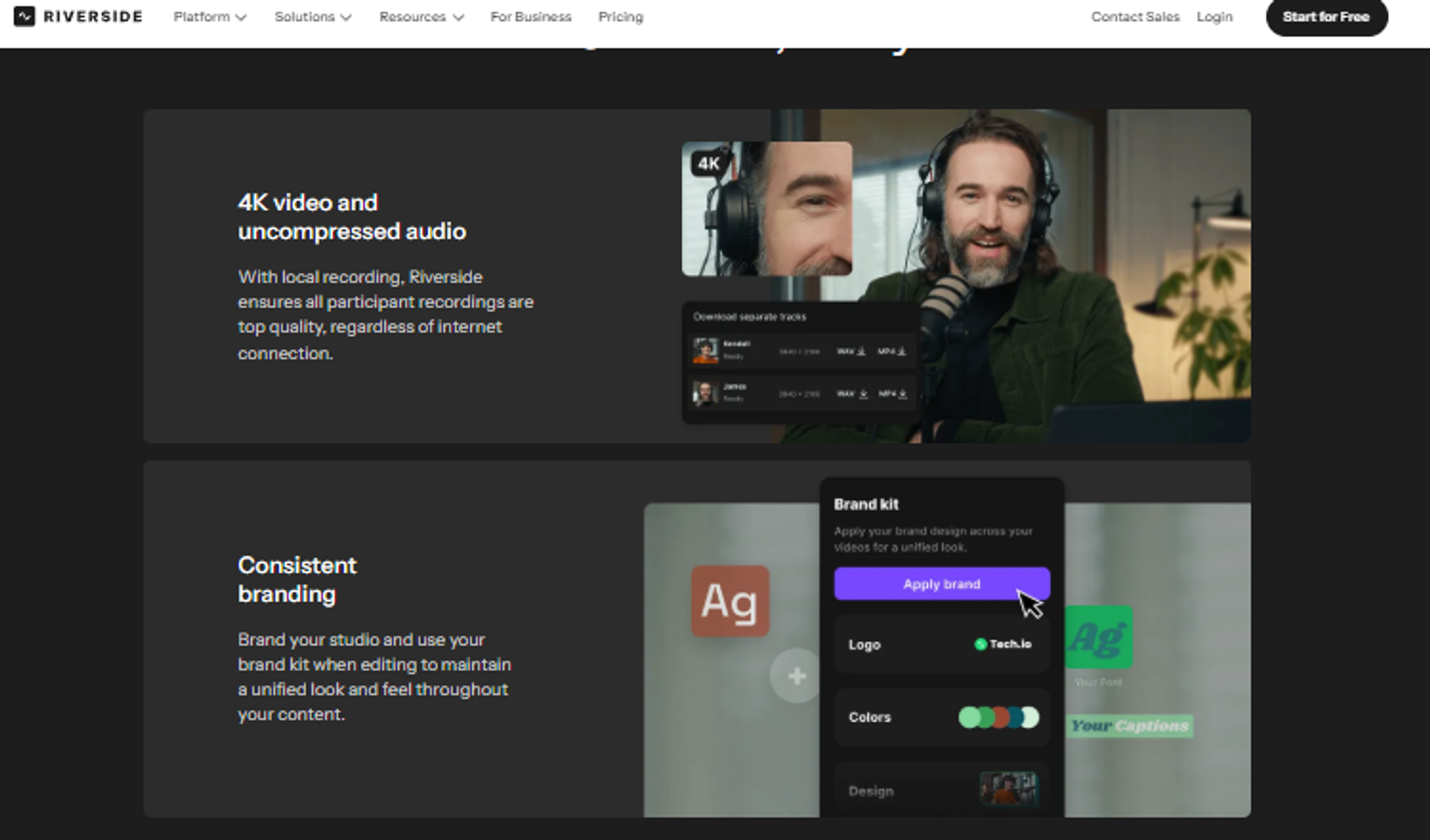
Riverside is best for influencers who turn every session into clips, because local multi-track recording captures separate 4K tracks per guest even when the internet dips, and its Webinar plan adds registration and pre-recorded streaming. It may not fit creators running a high-volume sales funnel, since webinars cap at 100 registrants on that plan.
| Quick fit | Detail |
|---|---|
| Best for | Creators who repurpose sessions into short-form content |
| Skip if | You need more than 100 registrants or an evergreen funnel |
| Strongest edge | Local multi-track recording that survives connection drops |
| Biggest trade-off | Webinar capacity and funnel depth are thin |
| Pricing snapshot | Free $0, Pro billed $288 annually, Grow billed $408 annually, Webinar plan billed $408 annually |
Why Riverside ranks #4
🎥 Recording quality is a real moat
Riverside ranks fourth because it solves a problem no funnel tool solves. Recording happens locally per participant, so a guest with bad Wi-Fi still produces a clean 4K track. The Webinar plan adds up to 100 registrants, pre-recorded streaming, recurring webinars, a branded registration form, lead capture, and HubSpot sync, per Riverside's plans and pricing page.
⏰ Where the funnel stops
I like Riverside for the asset, not the ascent. Its Grow plan multistreams 1080p to unlimited destinations, including custom RTMP, which is generous. EasyWebinar's read is that repurposing and revenue are separate jobs. EasyWebinar handles evergreen scheduling and sales CRM follow-up at $116 per month, and plenty of operators run both tools together.
What Riverside does well
- Protects the recording. Separate audio and video tracks per guest mean one bad connection does not ruin the session.
- Cuts editing time. AI clip generation, filler-word removal, and text-based editing turn one session into many posts.
- Streams everywhere. Grow multistreams to unlimited destinations plus custom RTMP, so partner audiences see it live, which is the same job EasyCast multistreaming performs inside a webinar funnel.
- Captures leads. The Webinar plan includes a branded registration form, lead capture, and branded email reminders.
- Feeds the CRM. Native HubSpot sync pushes webinar leads into an existing pipeline.
Where Riverside falls short
- The Webinar plan caps at 100 registrants, which a single partner email can exceed.
- No evergreen or just-in-time scheduling, so sessions stay tied to dates you pick.
- No in-session checkout or timed offer overlay, so selling happens off-platform, unlike a dedicated paid webinars setup.
- Separate track download hours are metered at 15 to 25 hours by plan.
Decision scorecard
| Evaluation criterion | Riverside fit | Why it matters |
|---|---|---|
| Live webinars | Strong | Studio-grade streaming with backstage speaker management on Grow. |
| Simulated live | Partial | Pre-record and stream as live is included on the Webinar plan. |
| Evergreen automation | Weak | No always-on or timezone-adjusted sessions. |
| Funnel pages | Partial | Branded registration form only, no thank-you or replay funnel. |
| Engagement | Strong | Q&A, live call-ins, polls, and reactions are native. |
| CRM and follow-up | Partial | HubSpot sync and branded reminders, no native CRM. |
| Monetization | Weak | No in-session checkout or paid gating. |
| Analytics | Partial | Webinar analytics exist, without offer-click attribution. |
| Integrations | Partial | Strong publishing destinations, lighter marketing stack coverage. |
| Pricing fit | Strong | Free tier plus $288 annual entry is accessible. |
| Best-fit buyer | Content-led creator building a clip library | The recording is the product. |
Best for / skip if
Choose Riverside if your webinar doubles as a content shoot and you care most about the footage. Skip it as your primary funnel tool if you expect more than 100 registrants or need evergreen delivery.
5. Zoom Webinars Plus
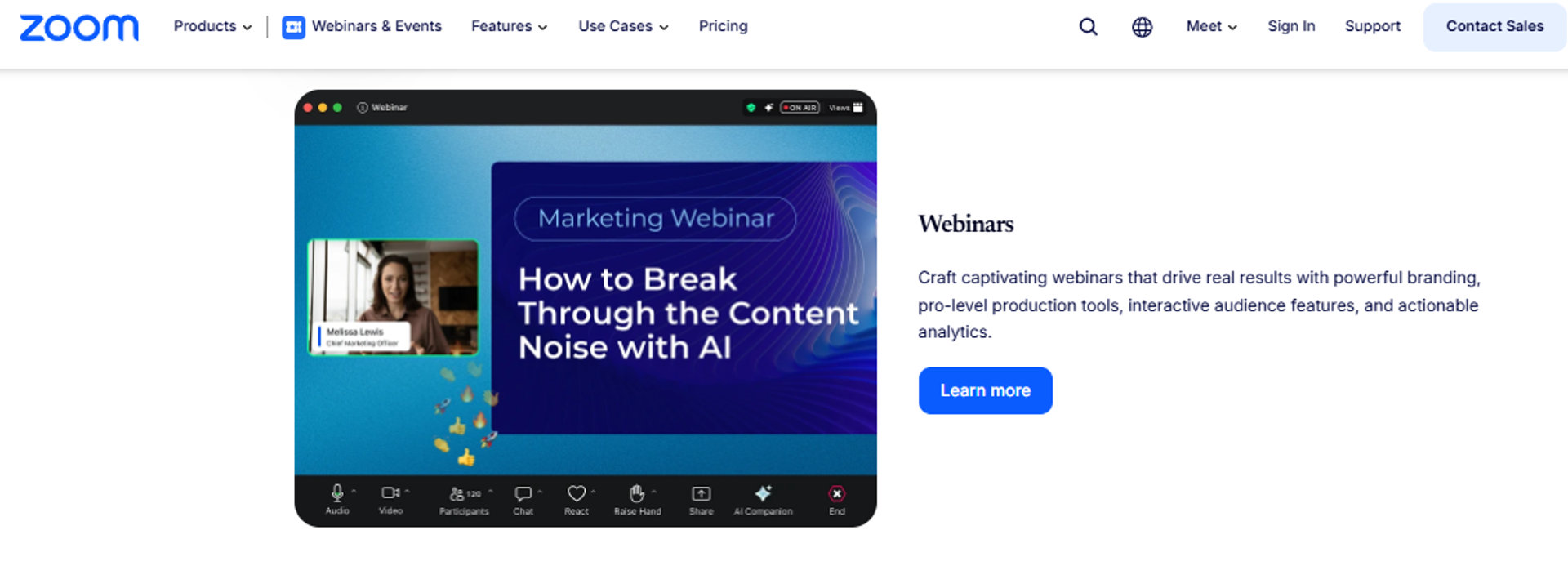
Zoom Webinars Plus is best for influencers running a one-off broadcast to a large, familiar audience, because backstage production controls, simulive streaming, and attendee scale are handled by infrastructure almost everyone has already joined before. It may not fit creators who need funnel pages and automated follow-up, since reviewers report thin customization and limited native conversion tooling.
| Quick fit | Detail |
|---|---|
| Best for | Large one-off broadcasts where familiarity reduces join friction |
| Skip if | You need registration funnels, evergreen delivery, or in-session checkout |
| Strongest edge | Backstage production control and proven attendee scale |
| Biggest trade-off | Minimal page customization and documented reliability complaints |
| Pricing snapshot | Zoom Webinars $83.33 per user monthly billed annually for 500 attendees, Webinars Plus $290.83 for 500 attendees |
Why Zoom Webinars Plus ranks #5
🎛️ Scale and familiarity are real advantages
Zoom Webinars Plus ranks fifth on reach, not revenue mechanics. Pricing scales by attendee capacity, with Webinars at $83.33 per user monthly and Webinars Plus at $290.83 per user monthly for 500 attendees on annual billing, per Zoom's webinar product page. A pay-per-attendee option also exists, with extra charges once you exceed your slot count, per Zoom's events and webinars pricing.
⚠️ The "Zoom is fine for sales webinars" gospel
I push back on this one every month. Zoom is excellent plumbing and a poor sales stage. G2 reviewers describe missing exit pages, rudimentary polling, and almost no landing page customization, a pattern worth reading before you compare EasyWebinar vs Zoom. EasyWebinar supports up to 100,000 live attendees on custom enterprise plans, with in-session checkout and EasyCRM attached at Growth.
What Zoom Webinars Plus does well
- Removes join anxiety. Attendees already know the interface, which lifts show-up on cold or mixed audiences.
- Separates backstage from stage. Hosts and panelists coordinate privately before going on, so handoffs stay clean.
- Runs simulive. Pre-recorded sessions can stream on a schedule with the host present in chat.
- Scales predictably. Capacity-based licensing supports thousands of attendees without re-architecting.
- Integrates broadly. Most marketing automation and CRM tools connect, which matters for teams already invested.
Where Zoom Webinars Plus falls short
- Reviewers report reliability problems during events, including presenters unable to join and delayed reminders, as documented in this G2 review.
- Branding and page customization are minimal, so every webinar looks like every other webinar, per this G2 review.
- No evergreen or just-in-time scheduling, and no in-session offer checkout, which is why some teams evaluate a Zoom alternative webinar platform.
- Support is ticket-based, and reviewers describe slow escalation without a consistent contact, per this G2 review.
Decision scorecard
| Evaluation criterion | Zoom Webinars Plus fit | Why it matters |
|---|---|---|
| Live webinars | Strong | Proven streaming at large capacities with backstage controls. |
| Simulated live | Partial | Simulive streaming exists, without a timed-offer layer. |
| Evergreen automation | Weak | No always-on scheduling or timezone-adjusted sessions. |
| Funnel pages | Weak | Registration pages allow little branding or layout control. |
| Engagement | Partial | Chat, polls, and Q&A exist, described by reviewers as rudimentary. |
| CRM and follow-up | Partial | Integrations are wide, with no native CRM or lead scoring. |
| Monetization | Weak | No native in-session checkout. |
| Analytics | Partial | Attendance and drop-off reporting, with reporting described as a maze. |
| Integrations | Strong | Broad marketing automation and CRM coverage. |
| Pricing fit | Partial | Webinars Plus at $290.83 monthly per user is the premium option here. |
| Best-fit buyer | Marketing or training team broadcasting at scale | Infrastructure first, funnel second. |
Best for / skip if
Choose Zoom Webinars Plus if attendee scale and familiarity matter more than conversion tooling. Skip it if the webinar has to sell something, since registration, offers, and follow-up all live in other tools.
Reviews
Zoom's operator complaints cluster on reliability and support rather than video quality, which is the opposite of what most buyers expect.
"Zoom Webinar is ridiculously glitchy. We've had problems with presenters being able to enter the webinar, with reminder notices going out eight hours after an event has concluded, and with broadcast quality."- Casey S., 1.5/5, 3/16/2021, Zoom G2 - Verified Review
"Zoom Webinars almost completely lacks customization options to the look and feel, so it gives you as a company a minimal chance to stand out."- Gabor F., 2/5, 2/23/2023, Zoom G2 - Verified Review
6. Skool
Skool is best for influencers who want community, courses, and unlimited live calls under one flat fee, because the Pro plan bundles all three at $99 per month with a 2.9% transaction fee. It may not fit creators who need a registration funnel or evergreen webinar delivery, since Skool calls are member-facing rather than lead-facing.
| Quick fit | Detail |
|---|---|
| Best for | Creators bundling community, courses, and group calls in one price |
| Skip if | You need a webinar registration funnel or automated sessions |
| Strongest edge | Flat pricing with unlimited members, courses, videos, and live calls |
| Biggest trade-off | Fixed layouts, and a separate account per community |
| Pricing snapshot | Hobby $9 per month with a 10% transaction fee, Pro $99 per month with 2.9% |
Why Skool ranks #6
💰 The flat fee is the whole argument
Skool ranks sixth because the price model is unusually honest. Pro is $99 per month with unlimited members, courses, videos, and live calls, and the transaction fee drops from 10% on Hobby to 2.9%, per Skool's pricing page. For a creator selling a $97 membership, that fee difference decides the plan fast.
🧱 Simplicity has a ceiling
The same simplicity that makes Skool fast also caps it. There is no webinar registration software layer, no reminder sequence you control, and no evergreen scheduling. EasyWebinar sits at $44 per month on Launch, with automation and EasyCRM arriving at $116 on Growth. My read is that these two coexist well, since Skool holds the members and EasyWebinar brings them in.
What Skool does well
- Prices without penalty. Unlimited members and unlimited live calls mean growth does not raise the subscription.
- Drives participation. Gamified leaderboards keep members returning between calls, which lifts renewal.
- Bundles the course. Unlimited courses and videos sit beside the discussion, so students never leave.
- Runs affiliates. Affiliate tooling is included on both plans, which matters for partner-led growth, much like an affiliate program does for a webinar launch.
- Starts cheap. The $9 Hobby plan lets you validate a paid group before committing.
Where Skool falls short
- Layout options are deliberately fixed, so brand expression is limited.
- Running two distinct communities requires two separate accounts.
- No evergreen webinar engine, registration funnel, or in-session offer overlay.
- The 10% Hobby transaction fee is expensive once sales start.
Decision scorecard
| Evaluation criterion | Skool fit | Why it matters |
|---|---|---|
| Live webinars | Partial | Unlimited live calls, built for members rather than prospects. |
| Simulated live | Weak | Not supported. |
| Evergreen automation | Weak | No always-on sessions. |
| Funnel pages | Weak | No webinar registration or replay funnel. |
| Engagement | Strong | Gamification and discussion drive repeat attendance. |
| CRM and follow-up | Weak | No lead scoring or behavior-triggered sequences. |
| Monetization | Strong | Native payments at a 2.9% fee on Pro. |
| Analytics | Partial | Community activity data, no webinar watch-time reporting. |
| Integrations | Weak | Intentionally narrow integration surface. |
| Pricing fit | Strong | One flat $99 covers community, courses, and calls. |
| Best-fit buyer | Creator selling a recurring group program | Simplicity beats configurability. |
Best for / skip if
Choose Skool if you sell a membership and want one bill covering community, courses, and calls. Skip it if you need a webinar funnel that captures, reminds, and converts strangers.
7. Heartbeat

Heartbeat is best for influencers running event-driven communities and masterminds, because voice and video rooms hold up to 256 attendees on every plan with unlimited hours, and recordings post back into the group automatically. It may not fit creators who need threaded discussion or a webinar sales funnel, since channels stack in a flat list.
| Quick fit | Detail |
|---|---|
| Best for | Cohort programs and masterminds built around recurring live sessions |
| Skip if | You need threaded discussions or a registration-to-checkout funnel |
| Strongest edge | 256-attendee video rooms with unlimited hours on every tier |
| Biggest trade-off | No thread topic organization, and steep jumps between tiers |
| Pricing snapshot | Build $49, Grow $149, Scale $849 per month, with annual at $490, $1,490, and $9,200 |
Why Heartbeat ranks #7
🎙️ Unlimited live hours is the standout
Heartbeat ranks seventh because its live layer is more generous than most community tools. Voice and video rooms support up to 256 attendees with unlimited hours on all three plans, per Heartbeat's pricing page. Transaction fees fall from 5% on Build to 2.5% on Grow and 1.25% on Scale.
📈 Mind the member cap, not the price
Build caps membership at 350, which a mid-size creator passes quickly, and the next step is $149 per month. EasyWebinar prices on attendee capacity rather than member count, with live overage at $0.78 per extra live attendee, and its all features list shows what that capacity includes. Two different meters, and worth checking against your actual growth curve.
What Heartbeat does well
- Handles big rooms. 256 attendees with unlimited hours supports weekly cohort calls without add-ons.
- Closes the loop on recordings. Zoom integration auto-posts session recordings back to the group.
- Automates member actions. Grow adds unlimited workflows and auto-responder rules.
- Hosts video natively. Grow includes 50 hours of native video hosting, so content stays inside the community.
- Supports landing pages. 15 custom landing pages on Grow cover simple event signup needs, though they are lighter than proven webinar landing page examples.
Where Heartbeat falls short
- No thread topic organization, so busy channels become hard to navigate.
- The 350-member cap on Build forces an early jump to $149 per month.
- No evergreen webinar scheduling, just-in-time sessions, or timed in-session offers.
- The 5% transaction fee on the entry plan is the highest of the community tools here.
Decision scorecard
| Evaluation criterion | Heartbeat fit | Why it matters |
|---|---|---|
| Live webinars | Partial | 256-attendee rooms with unlimited hours, without funnel tooling. |
| Simulated live | Weak | No scheduled pre-recorded sessions with live chat. |
| Evergreen automation | Weak | No always-on delivery. |
| Funnel pages | Partial | Custom landing pages exist on higher tiers. |
| Engagement | Strong | Events, courses, and rooms are the core experience. |
| CRM and follow-up | Partial | Workflows and auto-responder rules, no lead scoring on watch time. |
| Monetization | Partial | Native payments carry a 5% fee at entry. |
| Analytics | Partial | Conversion tracking on Grow, no webinar attribution. |
| Integrations | Partial | Zapier, Zoom, Google Calendar, plus API on Grow. |
| Pricing fit | Partial | $49 entry looks cheap until the 350-member cap bites. |
| Best-fit buyer | Cohort or mastermind operator | Live sessions are the product, not the funnel. |
Best for / skip if
Choose Heartbeat if your program runs on frequent live calls with an engaged group under 5,000 members. Skip it if you need threaded conversation or a webinar that sells to people who are not yet members.
8. Meetn
Meetn is best for influencers who want a stable room with in-meeting selling at a low monthly cost, because Pro starts at $19.95 per seat and checkout, evergreen replays, and higher attendee caps attach as per-room add-ons. It may not fit creators who need a full funnel or native CRM, since Meetn CRM is still listed as coming soon.
| Quick fit | Detail |
|---|---|
| Best for | Budget-conscious creators who need a reliable room with selling built in |
| Skip if | You need a complete funnel, native CRM, or deep analytics |
| Strongest edge | Modular pricing where you pay only for the tools a given room needs |
| Biggest trade-off | Add-ons multiply, and CRM follow-up is unavailable today |
| Pricing snapshot | Pro $19.95 and Business $49.95 per seat monthly, Ultimate $125 per room, so $174.95 all in |
Why Meetn ranks #8
🧮 Modular pricing done unusually well
Meetn ranks eighth because the price transparency is genuinely good. Pro covers 100 attendees, Business covers 500, and Ultimate raises one room to 1,000 attendees with evergreen replays included, per Meetn's pricing page. Attendee raises are priced openly at $50 for 1,000, $100 for 3,000, and $500 for 5,000 per room.
💸 Where the modularity costs you
Selling from the room is an add-on, and the commission depends on which tier you buy. Meetn keeps 5% at $9 per room, 3% at $29, and 1% at $79. EasyWebinar includes checkout and paid webinar gating from the $116 Growth plan, with no platform commission on sales, which is the practical difference when you make money with webinars at higher price points. I could be over-indexing on fees, though for a $2,000 program the math gets loud fast.
What Meetn does well
- Keeps entry cost low. $19.95 per seat with a 100-attendee room is the cheapest real webcast room on this list.
- Prices scale openly. Attendee raises and storage blocks are published, not quote-gated.
- Adds evergreen replays. A $29 per room add-on runs a replay that behaves like a scheduled session.
- Supports stealth hosting. Admin mode lets a host enter without alerting attendees, which helps when coaching a presenter.
- Streams and engages. Polls, quizzes, whiteboard, response forms, and 2 to 5 stream destinations are included by plan.
Where Meetn falls short
- Meetn CRM is listed as coming soon, so follow-up happens elsewhere today.
- Selling costs a per-room add-on plus a platform commission of 1% to 5%.
- No registration funnel with thank-you and replay pages, and no timezone-adjusted scheduling.
- Signature and storage limits are low at entry, at 3 signatures monthly and 10 GB.
Decision scorecard
| Evaluation criterion | Meetn fit | Why it matters |
|---|---|---|
| Live webinars | Strong | Stable webcast mode with waiting rooms and breakouts from Pro. |
| Simulated live | Partial | Premiere and on-demand replays exist, without a live chat layer equivalent. |
| Evergreen automation | Partial | Evergreen replays are a $29 per room add-on. |
| Funnel pages | Weak | No registration, thank-you, or replay page builder. |
| Engagement | Strong | Polls, quizzes, whiteboard, and action buttons are standard. |
| CRM and follow-up | Weak | CRM is not yet available. |
| Monetization | Partial | In-room checkout exists, at an added fee plus commission. |
| Analytics | Partial | Session data without offer-click attribution. |
| Integrations | Weak | Limited published integration surface. |
| Pricing fit | Strong | Lowest entry cost, with transparent scaling. |
| Best-fit buyer | Solo operator running frequent small sessions | Pay only for what one room needs. |
Best for / skip if
Choose Meetn if you run regular sessions under 500 attendees and want the lowest transparent monthly cost. Skip it if follow-up and funnel pages matter, since both live outside the platform today.
9. Descript
Descript is best for influencers who edit the recording after the session, because text-based editing lets you cut video by deleting words in a transcript, and AI tools strip filler words and retakes automatically. It may not fit anyone looking for a webinar platform, since Descript does not host or deliver live sessions.
| Quick fit | Detail |
|---|---|
| Best for | Creators post-producing webinar recordings into clips and courses |
| Skip if | You need to host, schedule, or monetize the session itself |
| Strongest edge | Editing video by editing a document, plus AI filler-word removal |
| Biggest trade-off | No webinar delivery, registration, or monetization at all |
| Pricing snapshot | Free $0, Hobbyist $24, Creator $35, Business $65 per person monthly, cheaper on annual |
Why Descript ranks #9
✂️ It earns its place on time saved
Descript ranks ninth because it changes your post-webinar hours, not your revenue architecture. Monthly pricing runs $24 Hobbyist, $35 Creator, and $65 Business, dropping to $16, $24, and $50 on annual billing, per Descript's pricing page. Media hours are metered at 10, 30, and 40 hours per month by plan.
🔁 Pair it with the delivery layer
I use a tool like this after the session, never instead of one. EasyWebinar's Instant Replay and evergreen scheduling handle delivery, and a text-based editor turns the same recording into promotional clips, which is the split explained in pre-recorded webinar platforms. Two tools, two clearly different jobs, and no overlap to argue about.
What Descript does well
- Cuts editing time sharply. Deleting a sentence in the transcript deletes it in the video.
- Removes verbal clutter. AI strips filler words, silences, and retakes in one pass.
- Creates clips automatically. Underlord pulls highlight moments into short-form cuts.
- Cleans bad audio. Studio Sound rescues recordings made in imperfect rooms.
- Clears enterprise review. SOC 2 Type II, SSO, and SCIM are available on Enterprise.
Where Descript falls short
- No webinar hosting, registration, reminders, or attendee management.
- Media hours and AI credits are metered, so heavy months need top-ups.
- Seats are per person, so a two-person team pays twice.
- Room recording caps at 10 participants, which limits multi-guest panels.
Decision scorecard
| Evaluation criterion | Descript fit | Why it matters |
|---|---|---|
| Live webinars | Weak | Not a delivery platform. |
| Simulated live | Weak | Not supported. |
| Evergreen automation | Weak | Not supported. |
| Funnel pages | Weak | Shareable publish pages only. |
| Engagement | Weak | No live audience tooling. |
| CRM and follow-up | Weak | No contact or pipeline management. |
| Monetization | Weak | No checkout or paid access. |
| Analytics | Partial | Publishing and podcast analytics, no webinar data. |
| Integrations | Partial | Strong publishing and timeline exports. |
| Pricing fit | Strong | A free tier plus $16 annual entry is low risk. |
| Best-fit buyer | Creator repurposing recordings | Post-production, not delivery. |
Best for / skip if
Choose Descript if your bottleneck is editing and repurposing after the session. Skip it as a webinar platform entirely, since it never touches registration, delivery, or the offer.
10. GoHighLevel
GoHighLevel is best for agencies and consultants already running client funnels inside one CRM, because pipelines, funnel pages, email, SMS, calling, and payments share a single account from $97 per month. It may not fit influencers whose main event is the webinar itself, since video delivery is the thinnest layer in the suite.
| Quick fit | Detail |
|---|---|
| Best for | Agencies managing many client funnels from one CRM |
| Skip if | The webinar room and evergreen delivery are your core need |
| Strongest edge | Broad CRM, funnel, and automation coverage under one subscription |
| Biggest trade-off | No purpose-built webinar engine, plus usage-based charges on top |
| Pricing snapshot | Starter $97, Unlimited $297, Agency Pro $497 per month, annual from $970 |
Why GoHighLevel ranks #10
🧰 Breadth is the pitch, and the problem
GoHighLevel ranks tenth because breadth is not the same as depth. Starter covers 3 sub-accounts, Unlimited removes the cap at $297, and Agency Pro adds SaaS mode at $497, per HighLevel's pricing page. Telephony, SMS, email, and premium AI usage bill separately on top of the subscription.
⚠️ The all-in-one critique lands here
This is where the honest warning about all-in-one tools applies. When one platform claims to be your CRM, email provider, community, and video layer, something is usually mediocre, and it is normally the video. EasyWebinar's approach is narrower on purpose. It unifies the webinar revenue chain and connects out to 13 CRM and email integrations instead of replacing them, and agencies often run EasyWebinar and HighLevel together for that reason.
What GoHighLevel does well
- Consolidates client operations. CRM, pipelines, funnels, calendars, and reputation tools share one login.
- Scales across accounts. Unlimited sub-accounts from $297 keeps agency software cost flat as clients grow.
- Automates outreach. Workflow automation, email, SMS, and inbound or outbound calling run natively.
- Handles payments. Stripe, PayPal, Square, Razorpay, and others connect for invoicing and checkout.
- Enables resale. SaaS mode on Agency Pro lets agencies rebill usage with markup.
Where GoHighLevel falls short
- No purpose-built webinar room, so live and evergreen delivery still needs a separate live webinar software layer.
- Usage-based charges for phone, SMS, email, and AI sit on top of the plan price.
- Premium support is a $500 per month add-on, and HIPAA compliance costs $297 per month.
- The configuration surface is large, which slows a solo creator down considerably.
Decision scorecard
| Evaluation criterion | GoHighLevel fit | Why it matters |
|---|---|---|
| Live webinars | Weak | No native webinar delivery engine. |
| Simulated live | Weak | Not supported natively. |
| Evergreen automation | Partial | Funnel and email automation exist, webinar automation does not. |
| Funnel pages | Strong | Full website and funnel builder included on all plans. |
| Engagement | Weak | No in-session chat, polls, or timed offers. |
| CRM and follow-up | Strong | Native CRM, pipelines, workflows, and outbound calling. |
| Monetization | Strong | Payments and invoicing with many providers. |
| Analytics | Strong | Custom dashboards and reporting across accounts. |
| Integrations | Strong | Wide integration and API coverage. |
| Pricing fit | Partial | $97 entry, with usage charges and paid add-ons stacking up. |
| Best-fit buyer | Agency running many client funnels | Strong around the webinar, absent inside it. |
Best for / skip if
Choose GoHighLevel if you manage multiple client funnels and want CRM, pages, and automation in one account. Skip it as your webinar layer, and connect a delivery platform to it instead.
EasyWebinar sits at the top of this list for one structural reason. Live, simulated live, and evergreen sessions, funnel pages, in-session checkout, and EasyCRM follow-up run from one account starting at $44 per month, with automation at $116, as the webinar platform comparison pages set out in detail. Circle holds members, Riverside holds footage, and Skool holds the group. None of them run the session that sells the offer.
Q2. How did we score these platforms, and what do real user reviews say?
Every platform was scored out of 100 across five weighted criteria: Unified Live and Automated Architecture (25%), Audience Monetization and Checkout (20%), Stream Reliability and Scale at Launch (20%), Repurposing and Follow-Up Automation (20%), and Pricing Transparency plus Verified Peer Reviews (15%). Scores convert to stars in 20-point bands, so 81 to 100 earns five stars. EasyWebinar holds 4.5 out of 5 across 119 G2 reviews, where support and setup lead the praise and page customization leads the complaints, per its G2 review profile.
📐 Why five criteria instead of a feature count
Feature counts reward the platform with the longest list. That is not how a launch breaks. It breaks when a registrant never gets the reminder, or when the automated session strips out the chat that made the live version convert.
So the rubric measures architecture and follow-up at 45% combined. EasyWebinar's own taxonomy is what that 25% weight tests, since Simulated Live and Evergreen both sit under the automated webinar umbrella in one account. I have watched operators spend six months on page design and zero weeks validating an offer. The weighting is a correction for that.
⭐ How scores become stars
| Score band | Stars | What it signals |
|---|---|---|
| 81 to 100 | ⭐⭐⭐⭐⭐ | Clears all five criteria without a second subscription |
| 61 to 80 | ⭐⭐⭐⭐ | Strong in three or four, with one real gap |
| 41 to 60 | ⭐⭐⭐ | Solves one job well, needs help for the rest |
| 21 to 40 | ⭐⭐ | Adjacent tool, not a webinar engine |
| 0 to 20 | ⭐ | Outside the category |
What the review data actually says
⚠️ The gap between "easy" and "worth it"
Peer review averages hide the useful signal. Tools often score high on ease of use and lower on value for money, and that gap is where launch budgets quietly disappear. On G2, EasyWebinar's most repeated complaints are limited page and email customization, named in 5 reviews, and cost, named in 3, which is the same pattern visible across its customer reviews.
Competitor complaints follow a different pattern. They cluster on delivery failures during the event itself, which is the expensive kind.
"It didn't fully integrate with my CRM (Highlevel) and the replay didn't show the live polls and CTAs."- Ivanhoe S., 4/5, 8/5/2024, Demio G2 - Verified Review
"The automated email sequences are full of bugs, and customer support is extremely unhelpful. There is no consistent POC."- Verified User in Translation and Localization, 0.5/5, 5/27/2024, Zoom G2 - Verified Review
What we deliberately did not score
💸 Page polish got zero weight
Registration page aesthetics carry no points in this rubric. Jason Fladlien has said the templates behind his $57.9M launch were ugly, and shipped anyway, because the presentation and the offer carried the sale. Simple scales. Fancy fails. If you want the counter-evidence on design, study proven webinar landing page examples and note how plain most of them are.
EasyWebinar reports attendance, watch time, and CTA clicks per session, which is what the follow-up weight measures, and the same numbers are explained in its guide to webinar analytics. My read is that operators over-invest in the container and under-invest in what fills it. I could be too harsh on design, though the review data keeps pointing the same direction.
EasyWebinar scores five stars here because it clears all five bands inside one subscription, from $44 per month with automation at $116, per its published webinar pricing. The rubric is published on purpose. Reweight it toward monetization or scale, and watch which platform moves.
Q3. What does an influencer actually need from a webinar platform?
Influencers need five things from a webinar platform: stream quality that holds during a traffic spike, a browser join flow with no downloads, an automated replay path, branding they control, and live interaction that makes an offer land. All five serve one requirement, which is sustained attention. EasyWebinar was built after its founder's first year of live webinars produced a 14,000-person email list and $245,000 in course sales, from an audience that had already ignored the same course.
🎯 The five needs, with the failure attached to each
Each need exists because of a specific failure I have watched happen.
- Stream quality. A partner email lands, 900 people arrive at once, and the room stutters through the pitch.
- Frictionless join. A download prompt appears on mobile, and a third of your audience leaves before minute one.
- Replay path. The recording sits in a folder because converting it means re-uploading everything.
- Controlled branding. The registration page looks like every other webinar, so the click feels generic.
- Live interaction. No chat, no polls, no timed offer, so the close has nowhere to land, which is exactly what webinar engagement tools are meant to prevent.
🦗 The crickets year
I built a YouTube course over six months. When I launched it, nobody bought. Not a slow start, actual silence.
The content was fine. The sequence was wrong. The only thing that started generating sales was a webinar, and I mean the only thing, which is the argument laid out in why webinars are the best way to sell online courses.
📊 The 60 / 30 / 3 math
Here is the weekly baseline that changed my business. Sixty people registered. Thirty showed up. Three bought a $1,000 program.
That is $12,000 per month from one repeated session. Scaled across a year, it became $245,000 and a 14,000-person list. EasyWebinar tracks exactly these three numbers per session, because registrations, attendance, and buyers are the whole scoreboard, and its all features list shows where each one is reported.
⏰ Scrolling is not attention
Now the part the creator economy avoids saying. Posting Reels and TikToks is reach, not time on brand.
Yuri Elkaim, who has run webinar funnels generating more than $217M, puts it plainly. People sitting down and consuming your content is the thing that moves high-ticket buyers. Ten-second scrolls do not build the belief a $2,000 purchase requires, which is why a creator monetization platform built on long-form attention behaves differently.
🧮 Why the benchmarks back this up
The numbers support the format, not the hype. Livestorm's 2026 report, covering 33,786 sessions and more than 7 million registrations, found an average show-up rate of 47.7%, per Livestorm's published webinar metrics. Univid's 2026 data shows 86% of viewing happens live, and CTA conversion peaks at 26% in sessions with 50 to 100 attendees, per Univid's webinar statistics report.
That last number matters more than it looks. Small rooms convert best. EasyWebinar's entry plans cover 50 to 100 live attendees at $44 and $116 per month, which is where most creator webinars actually sit.
🏗️ You are buying attention infrastructure
So the real purchase is not a video call. It is the machinery that captures attention, holds it for 40 minutes, and does something with it afterward.
Judge platforms on that chain, not on the room. A tool with a beautiful room and no follow-up leaves your best lead, the one who left at minute 38, completely untouched.
EasyWebinar exists because of the gap between having attention and converting it. It was built by someone with a finished course and no sales until a webinar reordered the sequence. That is why funnel pages, the live room, the automated tiers, and sales CRM follow-up ship together instead of arriving as four separate upgrades.
Q4. Should you run live, Simulated Live, or Evergreen?
Run live first, then graduate the winner. Media buyer Jeremy Haynes finds live sessions outperform automated ones on cold paid traffic. Yuri Elkaim finds weekly live webinars an inefficient time trap, and scaled pre-recorded delivery to seven figures in seven weeks. The resolution is sequencing: run 5 to 10 live sessions, clear a 10% attendee-to-buyer rate, then promote the winner. EasyWebinar converts a past live recording into a Simulated Live or Evergreen event without re-uploading the video.
⚖️ Two camps, both holding real data
Haynes is blunt. On cold ad traffic, he finds automated webinars underperform badly against live, and he has spent $80,000 on ads for a single webinar to learn it.
Elkaim is equally blunt in the other direction. Running weekly live sessions burns your calendar, and pre-recorded delivery running around the clock hit seven figures in seven weeks for him. The full trade-off is mapped in live vs automated webinars.
🔀 Why both are right
Traffic temperature explains the split. Cold audiences need the proof that only a real presenter provides, and up to half of high-ticket buyers watch two or three sessions before buying.
Warm audiences already believe you. EasyWebinar's client work shows the same pattern repeatedly, which is that automation works once the message is proven, and fails when it is used to skip the proving. I might be reading that too strongly, though the pattern has held for years.
🏁 The sequencing rule
Here is the progression I use, and it is not negotiable in my own funnels.
- Run 5 to 10 live webinar software sessions and fine-tune the message and offer.
- Measure attendee-to-buyer conversion, not registrations.
- Clear 10% attendee-to-buyer before automating anything.
- Promote the single best-performing session.
Automate what is proven. Automating an unvalidated session just runs a weak conversion rate around the clock.
🗂️ Get the taxonomy right
Most articles describe this badly, so here is the structure. Automated is the umbrella, and it has exactly two tiers underneath it.
- Simulated Live is a pre-recorded session on a fixed schedule, with real-time chat, polls, and timed offers active. Think of it as testing the water, and the mechanics are broken down in this guide to the simulated live webinar.
- Evergreen is the deeper tier, with pre-configured polls and offers plus an asynchronous question box instead of live chat.
Just-in-time scheduling, timezone-adjusted delivery, and multiple daily slots belong to Evergreen only. Never to Simulated Live.
⏰ How the immediacy mechanics work
Just-in-time means the registration page shows a session starting within the next 15 minutes, so a visitor registers and attends in one sitting. That removes the multi-day gap where intent decays.
EasyWebinar's Evergreen tier stacks these mechanics together: just-in-time sessions, timezone-adjusted times so a follower in Manila gets a local slot, recurring daily schedules, blackout dates for holidays, and Instant Replay from the registration page, all part of one evergreen sales funnel. Goldcast's 2026 data found 91% of on-demand viewers watch nearly the whole recording, per Goldcast's 2026 B2B webinar benchmark report, which is why the replay window deserves real attention.
⚠️ Where automation usually goes wrong
The common failure is not automation itself. It is automation that strips the interactive layer out and leaves a glorified replay behind.
"It didn't fully integrate with my CRM (Highlevel) and the replay didn't show the live polls and CTAs."- Ivanhoe S., 4/5, 8/5/2024, Demio G2 - Verified Review
Duration is the argument I still have not settled. Jon Penberthy and Elkaim favor 30 to 40 minutes. Jason Fladlien argues multi-hour sessions convert better because they answer every objection. My honest position is that it depends on price point, and I test it every quarter.
EasyWebinar is built around this progression rather than forcing a choice on day one. Thursday's live session becomes a Simulated Live event with chat intact, or an Evergreen funnel with just-in-time and timezone-adjusted scheduling, with no re-upload and no second product to buy, which is the distinction drawn across the webinar platform comparison pages. Simulated Chat can carry prior session chats into new events.
Q5. How do you monetize and distribute an influencer webinar?
Influencer webinars monetize in three ways: paid ticketed access, a free registration with a timed offer inside the session, or an external checkout linked from that offer. EasyWebinar supports both paid webinars gating and in-session checkout from its Growth plan at $116 per month, with no platform commission on sales. Distribution runs through RTMP simulcasting to YouTube, Facebook, and LinkedIn, plus partner audiences recruited on revenue share. Repurposing the recording into short clips extends reach after the session ends.
💰 Ticket the workshop or gate the offer
Price decides this. Charge at the door for low-ticket workshops, where $20 to $50 filters for intent. Keep registration free above roughly $500, and put the offer inside the presentation instead.
| Path | Best price range | Where the buyer pays |
|---|---|---|
| Ticketed access | $20 to $200 workshops | Registration page, before value is shown |
| Free plus in-session offer | $500 and above | Inside the session, after belief is built |
| Free plus external checkout | Any price, complex products | Sales page linked from a timed CTA |
EasyWebinar's in-webinar CTA overlays carry custom headlines, images, and any destination URL, so a $2,000 program never has to survive a paywall before the pitch, as its webinar pricing page sets out by plan.
📡 Simulcast, then cut it up
Distribution is two moves, not one. Stream to multiple destinations live, then mine the recording afterward.
EasyWebinar's EasyCast multistreaming pushes one session to YouTube, LinkedIn, Facebook, and custom RTMP, with 3 destinations on Growth and 10 or more on Pro. Riverside handles the other half, recording separate tracks per guest locally so a connection dip does not ruin the footage, then generating clips from it, per Riverside's plans and pricing page.
🤝 The six-step partner play
Partner audiences are the cheapest registrants you will ever get. Here is the sequence I use.
- Pick a partner whose audience overlaps your offer, not your follower count.
- Make the ask directly, by DM or text, with a specific date.
- Own every logistic yourself, including pages, emails, and the deck.
- Set the split, up to 70% for a major endorsement, which is how an affiliate program is normally structured.
- Embed the registration form on their own site or newsletter page.
- Keep the email list and the replay asset.
That last point is the whole trade. Thirty percent of a massive number beats thirty percent of zero. EasyWebinar's embeddable registration widget drops the form straight into a partner's page builder, so their audience never leaves a familiar environment, and the same approach powers webinar lead generation across borrowed audiences.
🔁 Turn registrants into distribution
The thank-you page is wasted real estate on most funnels. EasyWebinar's social share feature there documents an additional 10% to 15% viral traffic, and an optional locked gift, like a PDF, unlocks only after a share. It costs nothing to switch on, and it is one of the cheapest ways to drive webinar attendance.
One failure mode ends this section. Never let a partner build their own slide deck. I have watched a guest presenter improvise a three-hour deck to a sophisticated audience and produce exactly one sale.
"After canceling, I was shocked to find out I couldn't export the list unless I subscribed again."- Sheida M., 0/5, 5/12/2025, Demio G2 - Verified Review
Stan Store sits at the other end of the price ladder, with $29 and $99 plans and zero platform fee, per Stan's published pricing, and a 4.8 out of 5 rating across roughly 1,900 reviews on its Trustpilot profile.
EasyWebinar keeps monetization and distribution in the same account as delivery. Checkout, paid gating, EasyCast multistreaming, and the share loop all sit inside one subscription from $116. Carla Biesinger built a $5M evergreen funnel on that stack, documented in her course creator case study. The list stays yours, exportable, on every plan.
Q6. What show-up and conversion rates should you expect, and how do you hit them?
Warm organic and partner traffic delivers 30% to 40% or higher show-up rates. Cold paid traffic runs 10% to 15%, at $8 to $12 cost per lead. Livestorm's 2026 report measured a 47.7% average show-up rate across 33,786 sessions and more than 7 million registrations. EasyWebinar reports registration, attendance, watch time, and CTA clicks per session, which is how the 10% attendee-to-buyer gate gets verified before a session is automated.
| Metric | Warm or partner traffic | Cold paid traffic |
|---|---|---|
| Show-up rate | 30% to 40%+ | 10% to 15% |
| Cost per lead | $0 upfront, paid on revenue share | $8 to $12 |
| Platform average show-up | 47.7% across 33,786 sessions, per Livestorm's webinar metrics | - |
| Share of views that happen live | 86%, per Univid's webinar statistics | - |
| Peak CTA conversion | 26% in 50 to 100 attendee sessions | - |
📈 Why influencers start ahead
You already own the expensive part. A creator with an engaged list starts at three times the show-up rate of a media buyer spending $80,000 on ads for one session.
That advantage disappears if the reminder sequence is weak. If your show-up sits under 30% on a warm list, the defect is your emails, not your audience, and the fixes are catalogued in this guide on how to improve webinar attendance.
🎯 The 10% gate
One number decides whether you are allowed to automate. Hit 10% attendee-to-buyer conversion across 5 to 10 live runs first.
EasyWebinar tracks attendance and drop-off per session so that gate can be checked, not guessed, and its all features page lists where each metric is reported. Automating an unmeasured session just runs a weak conversion rate around the clock.
⏰ The reminder cadence that works
Send 12 to 14 emails total across the promotion window. Then concentrate them.
- Send 6 emails the day before, and 6 on the day of the session.
- Expect 40% to 60% open rates on those final blasts.
- Add a one-click calendar save, since EasyWebinar's thank-you page pushes the event to iCal or Google Calendar.
- Schedule mid-afternoon midweek, where Univid found attendance peaks, and cross-check it against the best day and time to host a webinar.
📵 Withhold the join link in SMS
This one surprised me. Removing the join link from text reminders increased sales call bookings.
Texting the link sends people to their phone, where intent is low and they half-watch while walking. Without the link, they open the email on a desktop, and completion rates climb. EasyWebinar's read is that device choice is a conversion variable, though I would test it on your own list before trusting me.
🔁 The 25-video retargeting build
For paid reinforcement, build 25 short videos in one retargeting campaign aimed at registrants. Configure each ad set to exclude anyone who watched 3 seconds of that specific ad.
Each registrant then sees a fresh piece instead of the same clip repeating. One warning. Never ship unedited AI copy in reminder emails, because prospects spot template language instantly, which is why webinar marketing automation still needs a human pass.
🔒 Hold retention to the pitch
Announce an attendee-only bonus early, available to people still there at the end. That holds roughly 80% of peak attendance into the offer, and the supporting tactics sit in this breakdown of webinar interaction.
Then cap the replay at 72 hours, with one email on day one, one on day two, and two on day three. Goldcast found 91% of on-demand viewers watch nearly the entire recording, per its 2026 B2B webinar benchmark report, so the replay is worth protecting.
EasyWebinar's Instant Replay makes that 72-hour window a setting with a configurable duration, rather than a manual takedown you remember on a Sunday night. K21 Academy moved show-up from 28% to 47% on this exact reminder and scheduling discipline, as recorded in its edtech case study. Nobody needs a new platform to fix a 15% show-up rate.
Q7. What does an influencer webinar stack really cost, and which one should you pick?
Entry pricing for influencer webinar tools runs $9 to $99 per month, with scale tiers reaching $200 to $500. EasyWebinar starts at $44 per month, unlocks automation and EasyCRM at $116, and charges $0.78 per extra live attendee beyond plan capacity. The costs that surprise operators are overage during a launch spike, automation gated above entry tiers, transaction fees on community platforms, and the months a stitched multi-tool funnel takes to stabilize.
Verified pricing, September 29, 2026
| Platform | Entry price | Scale tier | The cost to watch |
|---|---|---|---|
| EasyWebinar | $44/mo | $349/mo Scale | $0.78 per extra live attendee, per EasyWebinar pricing |
| Stan Store | $29/mo | $99/mo Pro | Email flows gated at $99, per Stan Store pricing |
| Circle | $89/mo | $419/mo Scale | 2% transaction fee, $99 Email Hub add-on, per Circle pricing |
| Riverside | $0 free | $408/yr Webinar plan | 100 registrant cap, per Riverside pricing |
| Zoom Webinars Plus | $290.83/user/mo annual | Capacity-based | Per-attendee overage above slots, per Zoom Webinars pricing |
| Skool | $9/mo Hobby | $99/mo Pro | 10% transaction fee on Hobby, per Skool pricing |
| Heartbeat | $49/mo Build | $849/mo Scale | 5% fee, 350 member cap at entry, per Heartbeat pricing |
| Meetn | $19.95/seat/mo | $174.95 Ultimate | Selling add-on plus 1% to 5% commission, per Meetn pricing |
| Descript | $0 free | $65/mo Business | Metered media hours, per Descript pricing |
| GoHighLevel | $97/mo | $497/mo Agency Pro | Usage billing for SMS, calls, and AI, per HighLevel pricing |
💸 The overage trap
Your best day is when the bill breaks. A partner endorsement lands 900 people in a room sized for 500.
Metered platforms charge per head at that exact moment. EasyWebinar publishes its rate openly at $0.78 per extra live attendee and $0.078 per extra automated viewer, so the spike is at least predictable, which matters most when you plan a webinar platform for 1000 attendees.
⚠️ The gating trap
Entry tiers rarely include the feature you bought the tool for. Stan gates email flows at $99, Skool charges a 10% transaction fee until you reach $99, and Circle sells email as a $99 add-on.
EasyWebinar gates automation too, at the $116 Growth tier, so I will not pretend otherwise. The difference is what arrives with it: Simulated Live, Evergreen, checkout, and sales CRM follow-up in the same step.
🗺️ The tube map cost nobody prices
The real expense is time. Jon Penberthy's rule is that if your funnel starts looking like a subway map, backtrack immediately, because you have built dozens of failure points.
My own estimate for stabilizing a stitched stack is two months at best, and realistically six months to a year. EasyWebinar documents a comparable stitched stack at roughly $1,063 to $1,500 per month across eight tools, which is the arithmetic behind a single webinar funnel.
✅ Where the all-in-one critique is fair
Consolidation has a failure mode, and it deserves saying out loud. When one platform claims to be your community, CRM, email provider, storage, and video layer, the video is usually the weakest part.
EasyWebinar draws the line at the webinar revenue chain and connects out to 13 CRM and email integrations instead of replacing them. That is consolidation, not bloat.
Pick by scenario
| Your situation | Pick | Skip |
|---|---|---|
| High-ticket offer, warm list | EasyWebinar | Descript as a primary tool |
| Low-ticket DM commerce | Stan Store | Zoom Webinars Plus |
| Paid community with events | Skool or Circle | Riverside |
| Clip-first content strategy | Riverside | Skool |
| One-off broadcast at scale | Zoom Webinars Plus | Meetn |
| Tightest possible budget | Meetn or Skool Hobby | GoHighLevel |
"Do not expect to get answers to technical questions... they responded after three more days with a completely irrelevant answer."- Pavel P., 1/5, 1/12/2021, Zoom G2 - Verified Review
"EasyWebinar is stable and feature-rich. I especially like the Evergreen simulated chat. The main drawback is the dated UX."- Peter Y., Investment Banking, 4.5/5, EasyWebinar G2 - Verified Review
EasyWebinar prices by plan instead of metering you mid-launch, and the page builder, automation tiers, and CRM follow-up sit inside the subscription rather than arriving as three upgrades. For a warm audience and an offer above $500, which describes most creators with an engaged list, it is the pick, and the trade-offs are laid out across the compare webinar platforms pages. Cost is its most cited complaint, named in 3 G2 reviews on its G2 profile.
Frequently Asked Questions

Casey Zeman
Founder of EasyWebinar
About Author
Over the past decade, I've helped thousands of entrepreneurs, coaches, and consultants turn webinars into a predictable, powerful way to grow their audience, build trust, and scale, without the constant hustle. I created EasyWebinar because I couldn't find a system that combined authenticity, engagement, and automation the way I needed. So, I built one.
Related Posts

10 Best Community Engagement Platforms in 2026
Compare the 10 best community engagement platforms in 2026. Course creators, evaluate live hosting, analytics, and replay to pick your winner today.

10 Best Online Coaching Tools in 2026: Live Session Quality, Scheduling, Recording, and Client Engagement Analytics
Compare the 10 best online coaching tools of 2026 on session quality, scheduling, and analytics. Discover the right fit for your coaching revenue model.
10 Best Webinar Hosting Platforms Ranked by Uptime, Streaming Quality & Cost
Compare 10 webinar hosting platforms ranked by uptime, streaming quality, and cost. Discover which tool actually turns attendees into revenue.
Turn every webinar into a revenue stream
Launch your first paid event in just a few clicks - and start monetizing your expertise.
Book a Call