9 Best StealthSeminar Alternatives, Ranked by Price and Automation Depth

Casey Zeman
Published on Aug 19, 2026 • 35 min read

TL;DR
- The nine best StealthSeminar alternatives in 2026 are EasyWebinar, eWebinar, EverWebinar, Demio, WebinarKit, WebinarGeek, WebinarJam, Livestorm, and BigMarker.
- StealthSeminar starts at $69.95 per month and reaches $175 on Growth, with 100 simultaneous-attendee caps on the two lower tiers.
- Platforms were scored on Automation Depth 30%, Pricing Transparency and 3-Year Cost 20%, Live-plus-Automated Coverage 20%, Setup Speed 15%, and Verified Reviews 15%.
- Automation depth counts eight signals, and most platforms stop before the last two: a native funnel builder and a built-in CRM with lead scoring.
- The real churn cause is under-used automation, not price. One verified G2 reviewer called the cost acceptable, then reverted to running live.
- Migrate in five steps: export data, rebuild one webinar natively, run both platforms in parallel, redirect URLs after the first booked call, then cancel.
Q1. What Are the 9 Best StealthSeminar Alternatives in 2026?
The nine best StealthSeminar alternatives in 2026 are EasyWebinar, eWebinar, EverWebinar, Demio, WebinarKit, WebinarGeek, WebinarJam, Livestorm, and BigMarker. EasyWebinar ranks first because it runs live, simulive, automated, and evergreen formats plus a native CRM and in-webinar payments on one platform. StealthSeminar sells automation alone, starting at $69.95 per month.
- EasyWebinar
- eWebinar
- EverWebinar
- Demio
- WebinarKit
- WebinarGeek
- WebinarJam
- Livestorm
- BigMarker
Picking a webinar platform is not a tooling choice. It sits in front of your pipeline, so a bad pick costs you a quarter of registrations, not a subscription fee. Nine vendors were evaluated here against eight defined criteria, covering format coverage, launch speed, engagement, funnel workflow, CRM readiness, monetization, analytics, and scale. The daily operator is usually the person who builds and hosts the webinar, which means a coach, a course creator, or a demand gen manager. The shadow readers on the buying committee are the CFO checking consolidation, the IT or security lead checking compliance, and the revenue leader checking pipeline attribution.
🍅 Why I stopped treating live and automated as a choice
Live webinars cost you presence. You show up, you fight the tech, and anyone can walk behind you naked, or your kid can throw ketchup on your face mid-pitch.
That is the moment that changed how I built. I stopped asking operators to pick a side. The question is not live or automated, it is which one runs this week and which one runs while you sleep.
Our Evaluation Criteria
Webinar format coverage 🎥
Whether the platform supports live, simulive, automated, evergreen, just-in-time, and on-demand replay, or only a subset.
Time to launch ⏰
How long it takes to build registration pages, event settings, reminder emails, and automation, including any AI-assisted funnel creation.
Engagement depth 💬
Chat model (real two-way, simulated, or none), plus polls, Q and A, handouts, timed offers, and replay engagement.
Funnel and conversion workflow 🧭
Native registration, thank-you, and replay pages, offer overlays, checkout paths, and behavioral follow-up.
CRM and follow-up readiness 🔗
Native CRM, lead scoring, attendee tagging, segmented follow-up, and integrations with your existing stack.
Monetization support 💰
Paid or ticketed webinars, in-webinar offers, and checkout without sending the attendee to another tab.
Analytics and attribution 📊
Registration, attendance, watch time, offer clicks, drop-off, and replay behavior at the attendee level.
Reliability, support, and scale ⚠️
Streaming stability, attendee capacity, compliance posture such as SOC 2 Type II and GDPR, and the support model you actually get.
Who This Guide Is For
- Coaches and course creators turning one selling webinar into a repeatable funnel.
- Marketing teams running webinars for lead generation, nurture, and pipeline acceleration.
- Revenue operators checking whether webinar behavior can flow into CRM, scoring, and follow-up.
- Founders and consultants replacing separate tools for hosting, pages, email, checkout, and follow-up.
- Buying-committee readers: CFOs validating consolidation, IT leads checking security, and marketing heads assessing funnel performance.
1. EasyWebinar
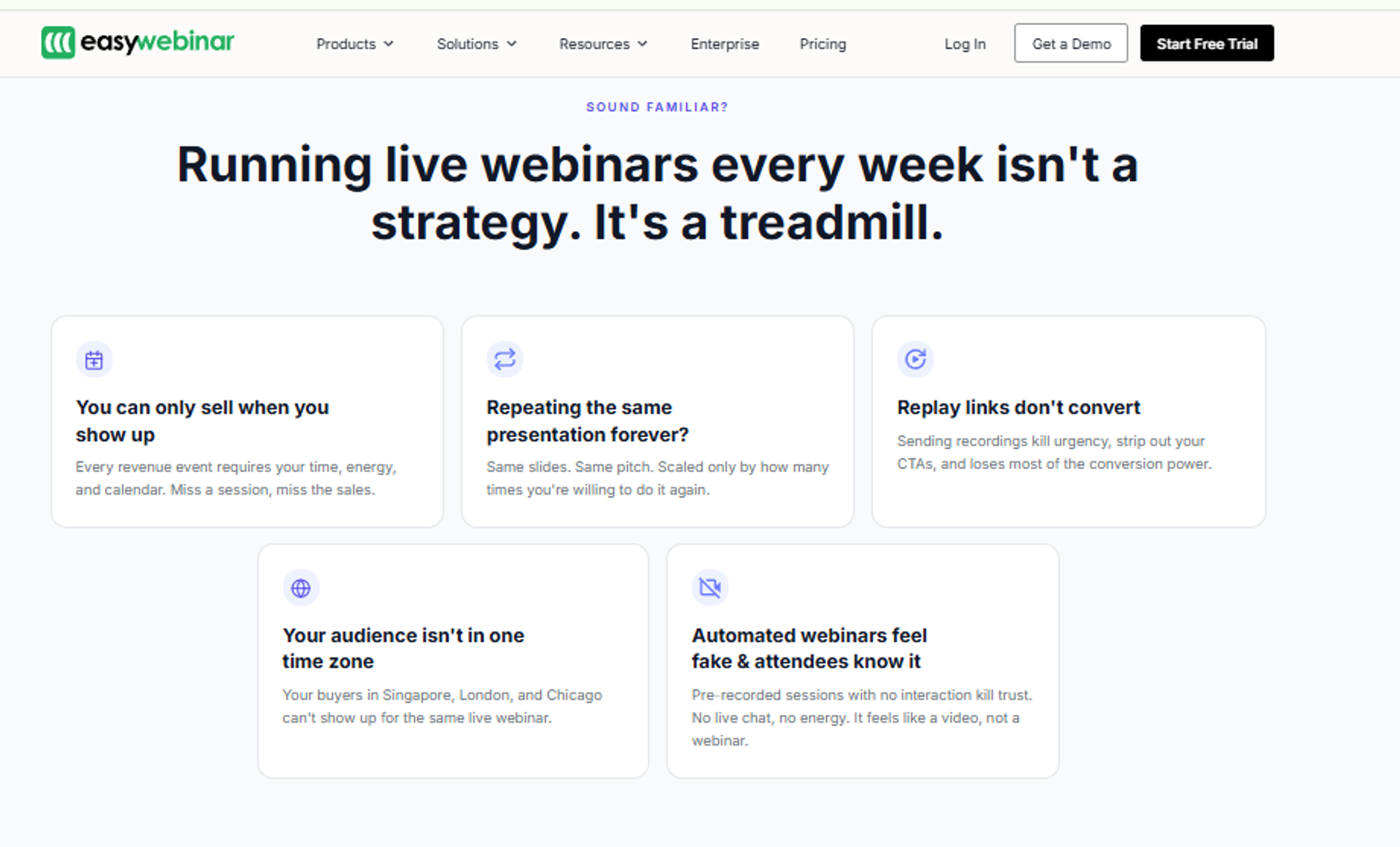
EasyWebinar is best for coaches, course creators, and marketing teams that need one webinar to sell both live and on autopilot, because it runs live, simulive, automated, evergreen, just-in-time, and on-demand formats with a native CRM, in-webinar payments, and attendee-level analytics in one account. It may not fit buyers who only need a one-off internal team meeting, or who want deep design control over landing pages.
Why EasyWebinar ranks #1
EasyWebinar earns the top slot on format coverage and funnel completeness, not on price. The G2 evidence on StealthSeminar churn is telling. One verified reviewer said the $69.95 monthly cost was acceptable, but the team under-used the automation and reverted to live anyway.
🔁 The churn cause nobody prices in
That is the failure mode this ranking is built around. If your platform only does automation, drifting back to live becomes a second subscription.
EasyWebinar removes that fork, and the full EasyWebinar vs Stealth Seminar breakdown shows where the two architectures split. My read is that operators who keep both formats in one account churn less, though I might be reading a small sample too strongly.
What EasyWebinar does well
- Nine webinar formats in one account. Live, simulive, evergreen, just-in-time (a session that starts roughly 10 to 15 minutes after someone registers), on-demand, and recurring. You test live, then clone the winner to evergreen without rebuilding.
- AI funnel build in minutes, not weeks. A short question flow inside the AI funnel builder generates the script, registration and thank-you pages, reminder emails, polls, offers, and follow-up. Cheap launches mean you can run three or four offers in parallel.
- Native CRM with lead scoring and auto-dialer. The built-in sales CRM tags attendees Hot, Warm, or Nurture from watch behavior, so reps call the right people first.
- In-webinar checkout. Attendees buy without leaving the room, which keeps conversion data in one place instead of splitting it across a checkout tool.
- Attendee-level analytics with drop-off heatmaps. You see exactly where people leave, then fix that segment before the next run, which is the core of practical webinar analytics.
- Broadcast-grade live streaming. Dolby OptiView (formerly Millicast) WebRTC delivers sub-500ms latency, so polls and offers land while the topic is still on screen.
Where EasyWebinar falls short
- Landing page customization is limited. One long-time customer flagged design flexibility as the weak spot on webinar landing pages.
- Automated webinar setup requires the presentation uploaded first, which blocks operators who want registrations live before recording.
- Just-in-time scheduling sits on a higher tier, so the feature that lifts show-up costs more than the entry plan.
- Some integrations are not intuitive without support help or Zapier.
Decision scorecard
Best for / skip if
Choose EasyWebinar if you want to prove a webinar live, then run it evergreen without migrating platforms or paying twice. Skip it if you need pixel-level control over registration page design, or if your webinars are internal training with no offer attached.
Reviews
- Operators consistently credit the live-to-evergreen path with real revenue movement. One course seller reported selling 10 to 12 courses per live class, then 25 courses within three weeks of her evergreen launch, while noting that just-in-time costs roughly double the basic subscription.
"With my live class I used to sell 10-12 courses. With EasyWebinar I sold 25 courses within 3 weeks of my evergreen 'launch'... The only downside is that to have the 'just in time' feature you have to pay a premium that is about double the price of the basic subscription."- Laura C., Easywebinar G2 - Verified Review
- The recurring complaint is design and setup friction, not reliability. A long-term customer flagged landing page flexibility as the main limitation.
"One area where we've experienced challenges is with the customization options for webinar landing pages. Sometimes it feels a bit limited in terms of design flexibility."- Jo K., Easywebinar G2 - Verified Review
2. eWebinar
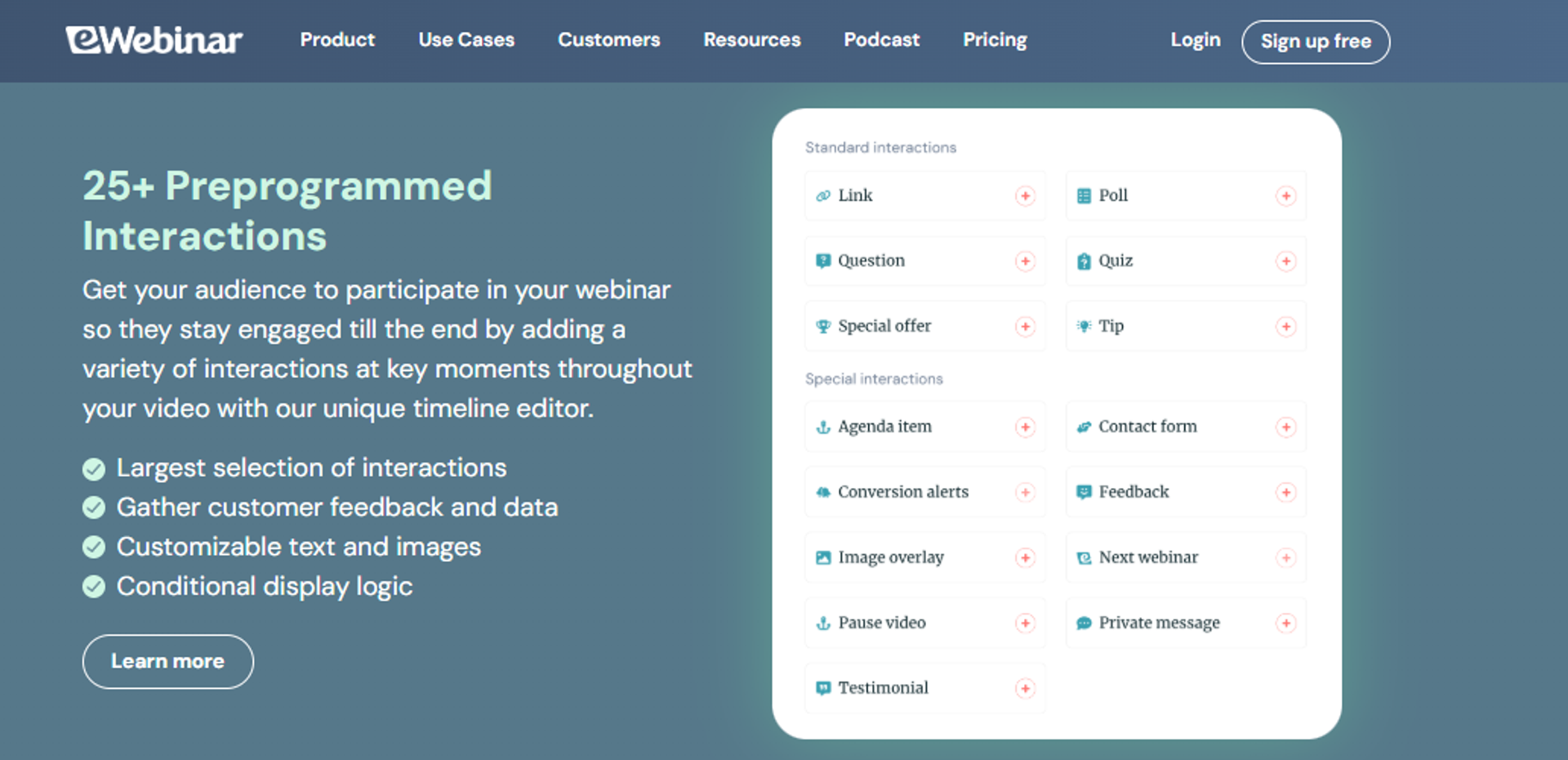
eWebinar is best for SaaS and services teams automating demos, onboarding, and customer training that need attendee questions answered by a real human, because it pairs a pre-recorded session with genuine two-way chat routed to Slack or email. It may not fit operators who also run live events, since the platform has no live webinar capability.
Why eWebinar ranks #2
eWebinar ranks second because it fixes the exact trust problem that pushes people off StealthSeminar. StealthSeminar built its reputation on simulated-live realism, including canned chat and simulated attendees. eWebinar took the opposite bet.
💬 The chat question is the real differentiator
Attendees have gotten better at spotting fake chat. When they spot it, the offer loses credibility at the worst possible moment.
eWebinar routes real questions to a real person in Slack. That is a defensible design choice, and it is why the platform holds its position despite covering fewer formats.
What eWebinar does well
- Genuine two-way chat during an automated session. Questions land in Slack or email, so attendees get real answers without you hosting the session.
- Flexible scheduling including just-in-time and on-demand. Registrants can start within minutes, in their own timezone, which lifts registration-to-attendance.
- Interaction timeline builder. Polls, offers, tips, and handouts fire at set timestamps, so the session drives action instead of just playing.
- Strong onboarding and training use case. Recurring customer education runs without a human on the calendar, which cuts CS load.
- Clean setup with existing video. You upload a recording and configure the session, so time-to-launch is short.
Where eWebinar falls short
- No live webinar capability. Live launches and town halls need a separate platform, which reintroduces the two-tool problem.
- Entry pricing is higher than most alternatives on this list, and attendee limits apply at the lower tiers.
- No native CRM, so lead scoring and follow-up depend on your existing stack.
- Monetization is thin. There is no in-webinar checkout, so buyers get redirected out of the session.
Decision scorecard
Best for / skip if
Choose eWebinar if your webinars are demos, onboarding, or training, and the honesty of real chat matters more than running live. Skip it if you still run live launches, or if you need CRM and checkout inside the same platform.
EasyWebinar holds position one in this guide because it is the only platform evaluated here that covers live, simulive, automated, and evergreen delivery alongside a native CRM, in-webinar payments, and attendee-level analytics, with SOC 2 Type II and GDPR in place for buyers whose procurement team asks. If you are still mapping the wider category, the roundup of top automated webinar platforms covers the adjacent options.
3. EverWebinar
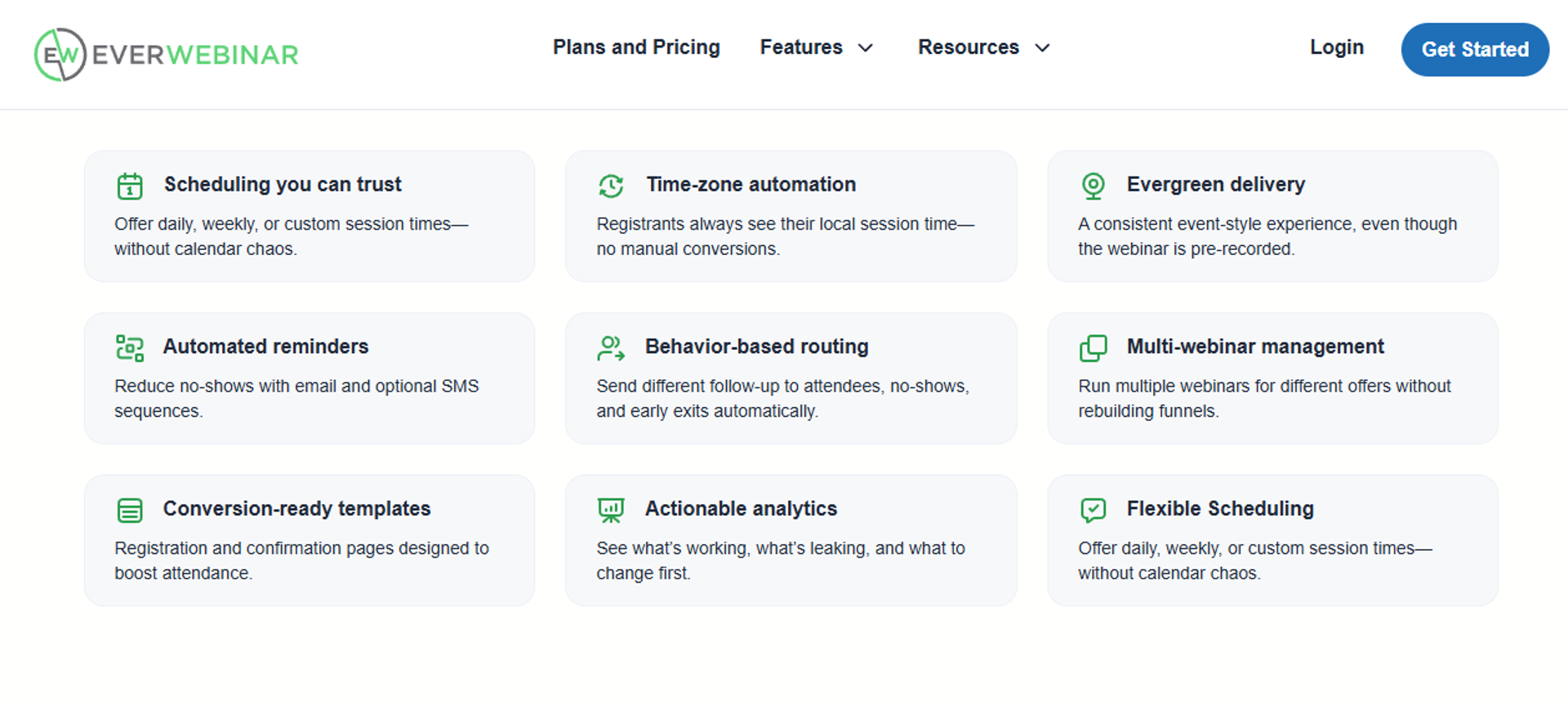
EverWebinar is best for direct-response marketers already running WebinarJam who need mature evergreen scheduling, because it offers just-in-time sessions (a session that begins minutes after someone registers) and built-in scarcity mechanics, but it may not fit buyers who want live and evergreen in a single product.
Why EverWebinar ranks #3
EverWebinar ranks third on evergreen depth alone. The scheduling engine is genuinely mature, and it converts for offer-led marketers.
⚠️ The split-product tax
The rank stops at third because of architecture, not features. Buying live and evergreen as two products means two bills, two interfaces, and two places for a funnel to break. The EasyWebinar vs WebinarJam comparison lays out that split in detail.
Reviewers also flag setup complexity and support access during live moments. One G2 reviewer described no way to reach help mid-event except email.
What EverWebinar does well
- Just-in-time and recurring scheduling. Registrants can start within minutes, which lifts registration-to-attendance on cold traffic.
- Replay windows with expiry. Deadlines create consequence, so fewer people park the webinar and forget it.
- In-webinar offers and countdowns. Offers fire at set timestamps, which keeps the pitch tied to the content beat.
- Large attendee capacity through the WebinarJam pairing. Useful when a launch spikes well past a normal session.
- Attendee-simulation controls. You can shape what the room looks like, which matters to marketers running scarcity plays.
Where EverWebinar falls short
- Live webinars require a second product, so the stack cost is two subscriptions.
- Reviewers report cloning bugs. One documented duplicate chat messages, emails not sending, and pop-ups failing after using the clone button.
- Support access is email-based, which is a problem when something breaks during a session.
- Annual or multi-year billing means low flexibility if the funnel does not work.
Decision scorecard
Best for / skip if
Choose EverWebinar if you already own WebinarJam and want the evergreen half of that ecosystem. Skip it if you want one platform, monthly flexibility, or in-session support when things break.
Reviews
- The most serious documented complaint is cloning. A reviewer reported duplicate chat messages, missing registrant emails, and broken pop-ups after using the clone button, then learned the limitation was buried in documentation.
"Inability to clone webinars without serious resulting issues, despite a clone button that is featured prominently on all webinars."- Kaylen M., EverWebinar G2 - Verified Review
- Setup complexity and live-day support access are the second recurring theme.
"Complexity of set up and ensuring everything works on live day... there is no way to get help or reach support except via email."- Verified User in Market Research, EverWebinar G2 - Verified Review
4. Demio
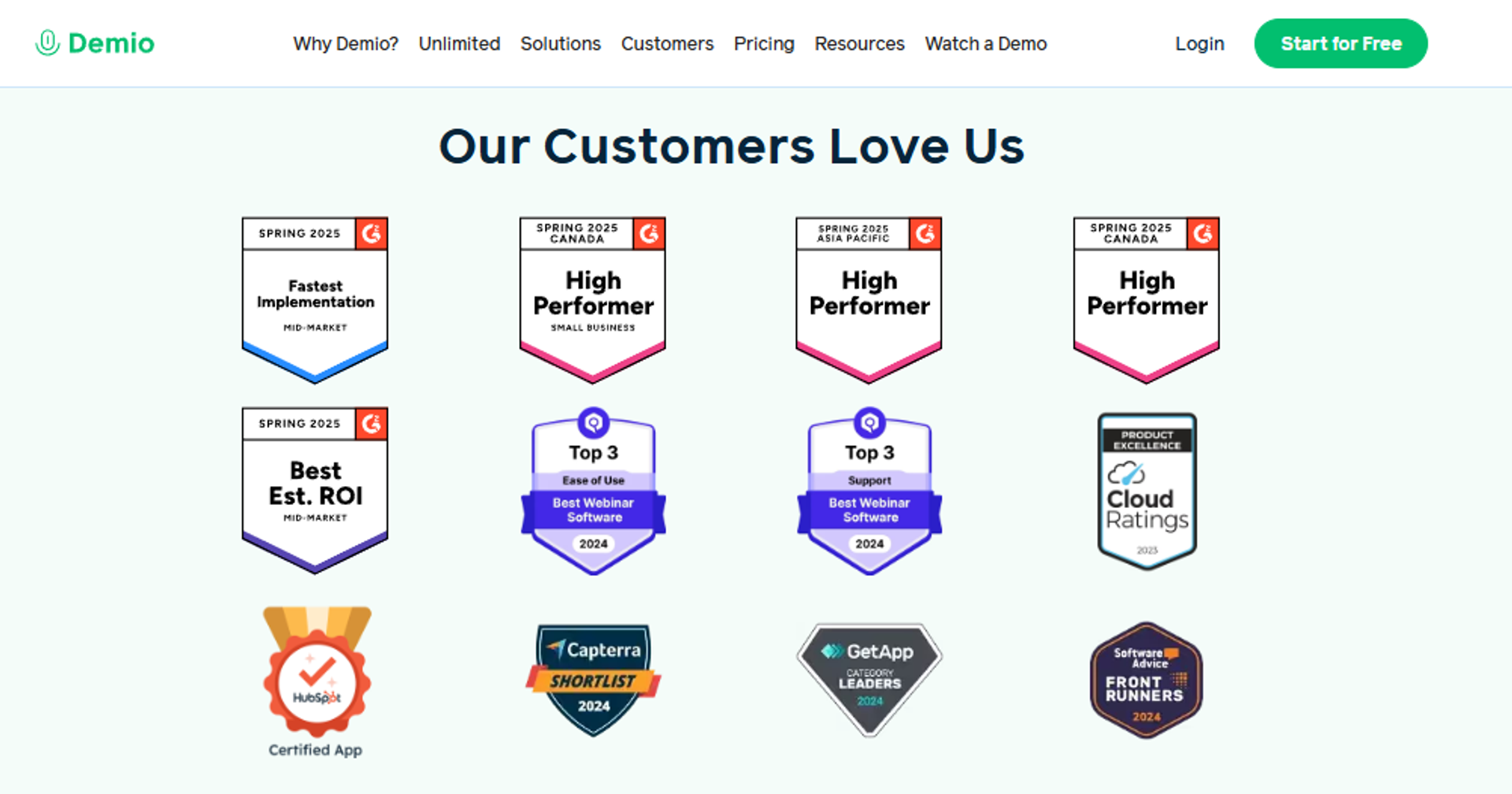
Demio is best for marketing teams that want a clean, no-download live room for lead generation webinars, because it offers browser-based attendance and fast event setup, but it may not fit operators who need deep evergreen automation or guaranteed access to their own registrant data after cancelling.
Why Demio ranks #4
Demio ranks fourth because the front end is genuinely good and the back end is thin. Setup is fast, registration pages spin up quickly, and attendees do not fight a download. A side-by-side EasyWebinar vs Demio view shows where that back end stops.
💸 The data lock-in problem
The ranking penalty comes from ownership, not polish. A G2 reviewer reported being unable to export a registrant list after cancelling a paid plan.
That is a procurement flag, not a feature gap. If your CFO is validating consolidation, ask about data export in writing.
What Demio does well
- No-download browser attendance. Fewer joining failures means a higher effective show rate on the same registration volume.
- Fast event and registration page setup. Reviewers consistently say they can get a page live quickly.
- Polls, handouts, and resources preloaded. You stage the room before the session, which cuts live operational work.
- Anonymous attendance. Participants cannot see each other, which some coaching audiences prefer.
- Standard automated and on-demand sessions. Enough automation for recurring lead gen, though not funnel-grade.
Where Demio falls short
- Registrant data export is blocked after cancellation, based on a documented reviewer account and support confirmation.
- Reviewers report audio and connection problems, including delays, echo, and attendees unable to unmute.
- No native CRM, and one reviewer reported incomplete CRM integration plus replays that dropped live polls and CTAs.
- Pricing scales by attendee volume, which reviewers say is hard for smaller teams to grow into.
Decision scorecard
Best for / skip if
Choose Demio if your priority is a smooth live room for lead generation and your CRM already handles follow-up. Skip it if you need evergreen funnel depth, in-webinar payments, or guaranteed data portability.
Reviews
- The data export policy is the most decision-relevant complaint on record.
"After canceling, I was shocked to find out I couldn't export the list unless I subscribed again. Support confirmed this."- Sheida M., Demio G2 - Verified Review
- Positive reviewers like the interface, but flag integration and replay gaps.
"It didn't fully integrate with my CRM (Highlevel) and the replay didn't show the live polls and CTAs."- Ivanhoe S., Demio G2 - Verified Review
5. WebinarKit
WebinarKit is best for budget-first operators automating a single evergreen funnel, because it offers a low monthly entry point plus a lifetime deal option, but it may not fit buyers who need live webinars or enterprise compliance evidence.
Why WebinarKit ranks #5
WebinarKit ranks fifth on price efficiency. For an operator whose cash is sitting in ad spend, the math matters.
💰 When cheap is the right answer
If you are testing whether a webinar funnel works at all, a $33 monthly platform is a rational first step. Prove the offer converts, then buy depth.
My read is that most operators overbuy the platform before they have a proven script. I could be wrong for teams with existing pipeline, but the pattern holds for first funnels.
What WebinarKit does well
- Low entry cost with unlimited attendees on some tiers. You can test cold traffic without a per-attendee penalty.
- AI-assisted funnel features. Reduces the blank-page problem when writing pages and emails.
- Automated and on-demand delivery. Covers the core evergreen use case without complexity.
- Lifetime deal option. Converts a recurring cost into a one-time one, which helps cash-constrained operators.
- Fast setup. Fewer settings means fewer places to get stuck before launch.
Where WebinarKit falls short
- No live webinar capability, so live launches need a separate tool.
- Limited enterprise compliance signals, which stalls procurement at larger companies.
- Smaller integration ecosystem than the established platforms.
- Newer brand with fewer independent, verifiable reviews than the incumbents.
Decision scorecard
Best for / skip if
Choose WebinarKit if you are validating whether webinars work for your offer and want the lowest possible monthly commitment. Skip it if you run live events, or if a security review sits between you and purchase.
6. WebinarGeek
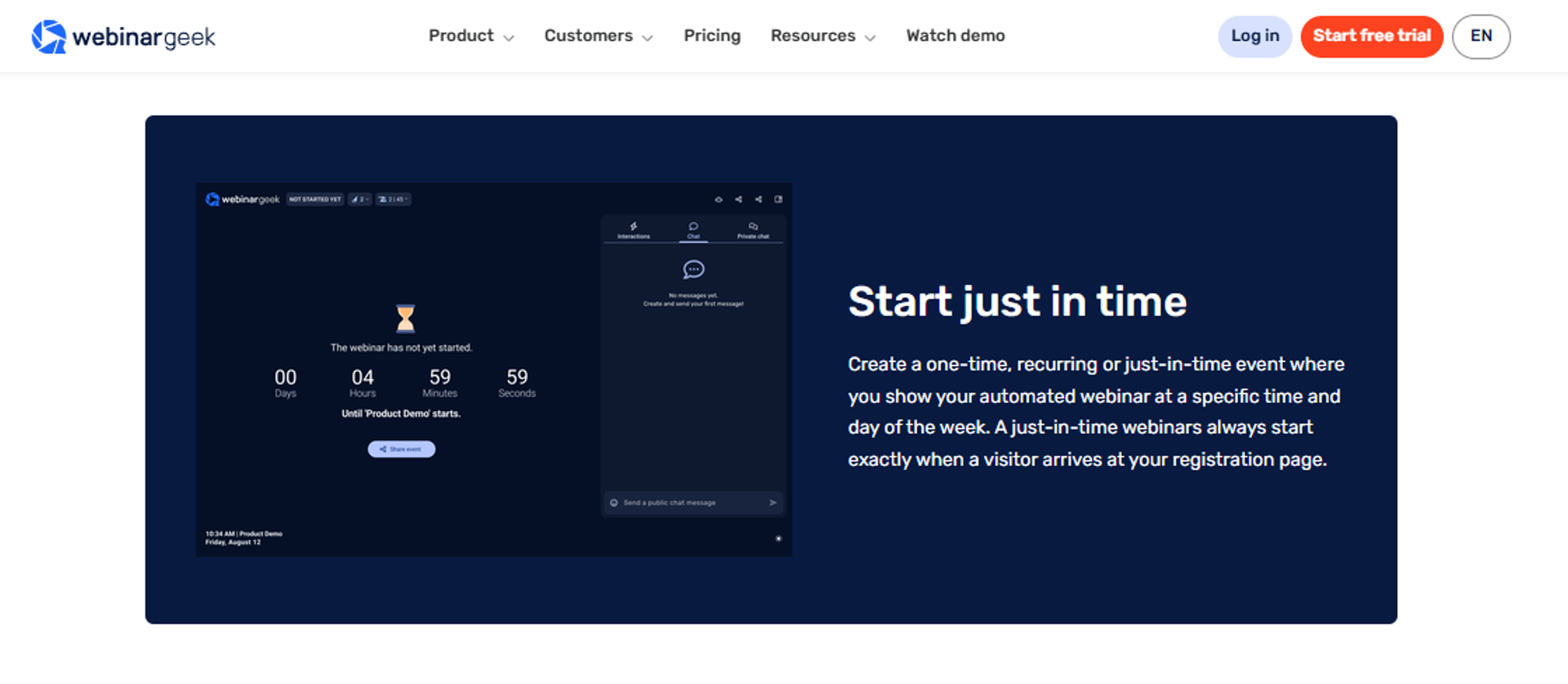
WebinarGeek is best for European operators with GDPR and data residency requirements, because it offers EU-based hosting alongside standard live and automated webinars, but it may not fit teams that need a large US-first integration catalog.
Why WebinarGeek ranks #6
WebinarGeek ranks sixth on a single decisive criterion. For a European buyer whose legal team blocks US data transfer, hosting location outranks features.
🔐 Compliance is a gate, not a feature
Most alternatives guides treat GDPR compliance as a footnote. That is a mistake when a data protection officer holds the signature.
WebinarGeek clears that gate cleanly. Outside the EU, the case is weaker.
What WebinarGeek does well
- European hosting and GDPR posture. Removes the biggest procurement blocker for EU buyers.
- Live plus automated delivery. You are not forced into one format.
- Interactive elements including polls and CTAs. Keeps sessions from being passive playback.
- Registration pages and email reminders included. Cuts one tool out of a small stack.
- Clear attendee-based tiers. Cost scales predictably as the audience grows.
Where WebinarGeek falls short
- Smaller native integration catalog than US-first platforms.
- Funnel and offer depth is lighter than automation specialists.
- No native CRM, so lead scoring lives elsewhere.
- Brand recognition is limited outside Europe, which matters for internal buy-in.
Decision scorecard
Best for / skip if
Choose WebinarGeek if EU data residency is a hard requirement and your funnel logic lives in other tools. Skip it if you need deep evergreen scheduling or a large integration catalog.
7. WebinarJam
WebinarJam is best for marketers running high-attendance live sales webinars, because it offers large live capacity with in-room offers and chat, but it may not fit buyers who want evergreen included or monthly billing flexibility.
Why WebinarJam ranks #7
WebinarJam ranks seventh because the live product is capable and the surrounding workflow is not. Reviewers repeatedly flag the email engine and integrations.
❌ When the email layer is the weak link
Show-up rate is decided by reminders, not by the live room. A reviewer reported the email service sending inconsistently and failing to report what was sent.
That is a revenue problem disguised as a feature complaint. If reminders do not fire, the room is empty regardless of stream quality, which is why attendance mechanics matter more than the stage.
What WebinarJam does well
- Large live attendee capacity. Supports launches that spike well beyond a normal session.
- In-room offers and CTAs. Conversion elements sit inside the presentation flow.
- Attendee chat with moderator controls. Real interaction during live sales events.
- Pairs with EverWebinar for evergreen. One vendor relationship, even if two products.
- Established, long-running platform. Familiar to many direct-response operators.
Where WebinarJam falls short
- Evergreen requires purchasing EverWebinar separately, which doubles the line items.
- Reviewers report inconsistent third-party integrations, including registrant push and custom form fields.
- The built-in email service is described as clunky, hard to edit, and inconsistent in delivery.
- Annual-only billing removes the option to test for a quarter and walk away.
Decision scorecard
Best for / skip if
Choose WebinarJam if live sales events at scale are your main motion and you accept a second product for evergreen. Skip it if you need reliable native email, monthly billing, or one unified platform.
Reviews
- The email and integration layer is the recurring operator pain.
"Their email service is clunky, hard to edit, doesn't have html options... doesn't consistently send to registrants."- Tara G., WebinarJam G2 - Verified Review
- The same reviewer credits the evergreen pairing, while noting it is a paid add-on.
"I love the partner service, everwebinar, (which you have to pay more for) that allows the participant to watch the webinar and feel as though it's a live webinar."- Tara G., WebinarJam G2 - Verified Review
8. Livestorm
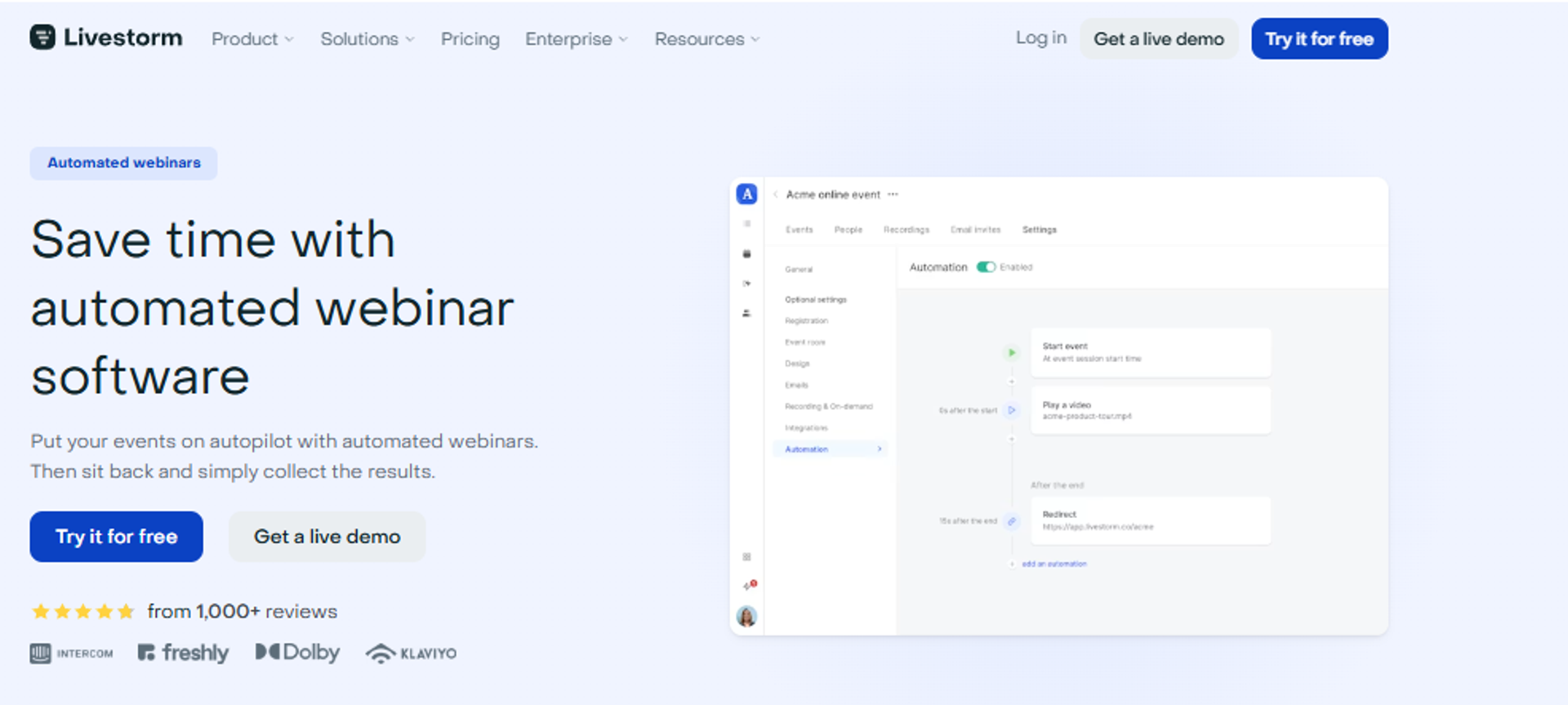
Livestorm is best for B2B marketing teams that need browser-based delivery with clean reporting and European compliance posture, because it offers unlimited replays and solid analytics, but it may not fit solo operators or funnel-led sellers on tight budgets.
Why Livestorm ranks #8
Livestorm ranks eighth for this specific keyword, not on quality. It is a capable platform aimed at a different buyer than the StealthSeminar switcher.
📊 Right tool, different job
Someone leaving StealthSeminar usually wants evergreen selling. Livestorm is stronger at event programs and reporting than at offer-led automation.
That mismatch is the whole ranking. Judge it against your motion, not against a star count, and use the wider webinar platform comparison if your motion is still undecided.
What Livestorm does well
- Browser-based attendance with no install. Reduces joining friction for corporate audiences.
- Unlimited replays. Long-tail viewing keeps generating leads after the session.
- Clean analytics and reporting. Useful when marketing has to prove contribution.
- GDPR-aligned posture. Helps European teams pass review.
- Free tier for small sessions. You can test the room before committing budget.
Where Livestorm falls short
- Cost climbs quickly for solo operators once hosts and attendees scale.
- Not funnel-native, so offers and checkout live in other tools.
- No native CRM, which means lead scoring depends on your existing stack.
- Evergreen depth is lighter than automation specialists on this list.
Decision scorecard
Best for / skip if
Choose Livestorm if webinars are a marketing program and reporting is how you prove value. Skip it if you are selling an offer evergreen and need checkout plus CRM inside the platform.
9. BigMarker
BigMarker is best for enterprise teams running large virtual events and multi-session webinar programs, because it offers deep customization, large-scale delivery, and API access, but it may not fit small operators who need a fast, low-cost evergreen funnel.
Why BigMarker ranks #9
BigMarker ranks last for this keyword because the buyer profile rarely matches. Someone paying $69.95 a month for StealthSeminar is not usually running an enterprise event program.
🏢 Scale is a different purchase
If your webinars are conferences with tracks, sponsors, and sessions, BigMarker belongs on your list. If your webinar is one pitch on repeat, it is over-engineered.
Do not confuse capability with fit. The most capable platform is not automatically the right one, so weigh it against a full feature set you will actually use.
What BigMarker does well
- Large-scale event delivery. Handles multi-session programs that simpler tools cannot.
- Deep customization and white-labeling. The experience can match enterprise brand standards.
- API access and integrations. Fits teams with engineering support and existing systems.
- Automated and on-demand formats. Evergreen sessions are supported inside a bigger platform.
- Partner and CSM-delivered support. Enterprise buyers get a named contact, not a queue.
Where BigMarker falls short
- Pricing is quote-based, which slows evaluation and blocks quick comparison.
- Implementation is heavier, so time-to-first-webinar is longer than on SMB tools.
- Feature surface is large, which creates a learning curve for solo operators.
- Overkill for a single evergreen sales funnel.
Decision scorecard
Best for / skip if
Choose BigMarker if you run large, complex event programs and have the resources to configure them. Skip it if you need one evergreen funnel selling by Friday.
EasyWebinar sits at the top of this list because the switching trigger most StealthSeminar users describe is under-used automation plus unmet live demand, and it is the only platform here covering live, simulive, automated, and evergreen delivery with a native sales CRM, in-webinar payments, and SOC 2 Type II in one account.
Q2. How Did We Score Automation Depth and Rank These Tools?
Each platform was scored on five weighted criteria: Automation Depth at 30%, Pricing Transparency and 3-Year Cost at 20%, Live-plus-Automated Coverage at 20%, Setup and Time-to-First-Webinar at 15%, and Verified User Reviews at 15%. Automation depth counts eight signals. Scores of 0 to 20 earn one star, and 81 to 100 earn five.
The five weights, and why depth carries the most
Automation depth carries the heaviest weight because it is the reason people leave StealthSeminar. Price is the symptom, and depth is the cause.
🧱 The eight signals inside automation depth
Automation depth is not a feeling. EasyWebinar's product documentation, competitor capability matrices, and vendor docs were checked against the same eight signals for every platform, and the full feature inventory is public for anyone who wants to re-check the scoring.
- Just-in-time scheduling, meaning a session that starts minutes after registration.
- Attendee-local timezone detection.
- Replay windows that expire on a set date.
- In-webinar timed offers and CTAs.
- Behavioral follow-up, triggered by watch time or offer clicks.
- Native email and SMS, not a bolt-on.
- A funnel and landing page builder inside the platform.
- A native CRM with lead scoring.
⏰ Why the last two signals decide the ranking
Signals seven and eight are where most platforms stop. Without them, you are wiring a page builder, an email tool, and a CRM together yourself.
That wiring is the failure point. Every integration you add is another place a link breaks or an email never fires, which is why native integrations matter more than integration counts.
A worked example, so you can replicate the score
Take a platform that supports just-in-time, timezone detection, replay expiry, timed offers, and native email, but has no SMS, no funnel builder, and no CRM. That is five of eight, so 62 on the depth axis, which lands at four stars before the other criteria apply.
⭐ Star bands and the disclosure you deserve
Star bands run in twenty-point increments, from one star at 0 to 20 up to five stars at 81 to 100. EasyWebinar clears all eight depth signals, including the native funnel builder and EasyCRM, which provides auto-dialer, pipeline management, and Hot, Warm, or Nurture lead scoring inside the sales CRM.
No affiliate commission influenced any placement here. My scoring bias is simple, and I will name it: fancy loses to functional.
🧩 The philosophy behind the rubric
Webinar creation should feel like assembling parts that already exist, not writing a funnel from scratch. Feature count is not depth, because most features never survive contact with a real launch.
Volume is not value either. A platform with forty features you never configure scores worse than one with eight that actually fire.
EasyWebinar publishes this article, and that is stated plainly rather than buried. Every score above is reproducible from public pricing pages, product documentation, and verified reviews, so you can rerun the rubric and disagree with the result.
Q3. Why Are Operators Actually Leaving StealthSeminar?
Operators leave StealthSeminar for four reasons: cost climbing from $69.95 to $175 per month on Growth, simultaneous-attendee caps of 100 on the two lower tiers, an automation-only core that forces a second tool for live events, and simulated chat that increasingly reads as fake. The deepest cause is subtler. Buyers under-use the automation they bought, then drift back to live.
The cost and cap mechanics nobody reads first
Starter runs $69.95 per month and Professional runs $99.95, both capped at 100 simultaneous attendees. Growth jumps to $175 for 300 to 500 attendees, and Power is quote-only. The full EasyWebinar vs Stealth Seminar breakdown maps those tiers side by side.
💰 The line items hiding under the headline price
There is a registration fee on the Starter tier, and worldwide SMS reminders sit behind higher plans. Those two details move the real monthly number more than most buyers expect.
Registrant caps and simultaneous-attendee caps are different things. Confusing them is how a launch that works becomes a bill that hurts.
The churn cause no competing article names
Here is the part that surprised me. A verified G2 reviewer said the price was tolerable, then explained the actual reason they stopped.
"The cost, while $69.95 isn't a horrible monthly cost, we just ended up not using the full automation enough. We ended up doing live more often."- Verified reviewer, StealthSeminar G2 - Verified Review
❌ Nobody cancels over a price, they cancel over an unused subscription
That reviewer did not fail. They discovered their audience converts better with a human in the room.
On an automation-only platform, that discovery is expensive. Going live means buying a second tool, so the natural next step becomes a churn event, and the live versus automated trade-off stops being a strategy question.
The chat question, and where trust breaks
StealthSeminar's core craft is simulated-live realism, including canned chat and simulated attendees joining the room. That worked for years.
⚠️ Audiences got better at spotting it
My read is that simulated chat plateaued once buyers learned the pattern. I could be overweighting a handful of conversations, but the complaint keeps surfacing.
The cost is not the chat itself. It is that a viewer who spots it stops trusting the offer three minutes before the pitch.
The diagnostic question to run this week
Open your platform and check one number: how many sessions ran in the last 30 days without you present. If the answer is zero, you are paying for automation and running a live business.
Operators consistently describe the relief of having both. One EasyWebinar reviewer named it directly, and the trade-off is worth quoting because it is not purely positive.
"I love that there are options for live webinars AND automated so you have options."- Verified User in Photography, Easywebinar G2 - Verified Review
"The only downside is that to have the 'just in time' feature you have to pay a premium that is about double the price of the basic subscription."- Laura C., Easywebinar G2 - Verified Review
EasyWebinar was built so that drifting back to live is not a churn event, because live, simulive, and evergreen run from one account. Under-using automation costs you nothing extra, since the second platform never enters the equation.
Q4. What Do These Platforms Really Cost Over One and Three Years?
Headline pricing misleads. StealthSeminar Starter is $69.95 per month, roughly $839 a year and $2,518 over three, before a page builder, email service provider, and CRM. Add those and a realistic stack runs several hundred dollars monthly. Bundled platforms collapse that into one line item, which is why three-year cost reorders the monthly-price ranking.
The three-year view changes the shortlist
💸 The four costs that never appear in a pricing table
Registration fees on entry tiers, SMS gating behind higher plans, simultaneous-attendee caps, and annual or multi-year lock-in all move the real number. WebinarJam bills annually only, and EverWebinar sits behind a separate purchase.
Cap math is where launches get expensive. A 100-attendee ceiling is fine until one promotion works.
The stack cost most buyers forget to add
An automation-only platform does not include your registration page builder, your email service, or your CRM. Price those three honestly before comparing anything, then check them against a single webinar pricing line.
🧮 A three-line formula you can run today
Add your webinar platform, your page builder, your email service, your CRM, and any payment tool. Multiply by 36. Then subtract what a bundled platform would charge for the same 36 months.
EasyWebinar bundles the funnel builder, native email automation, and EasyCRM into one subscription, and current tier pricing should be confirmed against the live pricing page before you commit. That single check protects you from the outdated numbers floating around webinar platform comparisons.
The cost line nobody invoices
The real expense is not the subscription. It is the six months to a year spent wiring a funnel that still breaks on launch day.
⏰ Time is the line item that hurts most
A complex funnel that takes half a year to stabilize costs more than any plan on this list. That is time you did not spend selling, and a faster path exists through an AI funnel builder.
An automated webinar with no traffic behind it is a billboard in the desert. Platform choice matters far less than whether registrations are actually flowing, so fix webinar attendance before you fix tooling.
EasyWebinar's read is that most buyers overweight the monthly price and underweight the 36-month stack cost, and I have watched that decision get reversed twelve months later. Run the formula before you switch, because the cheapest monthly plan is often the most expensive year.
Q5. Should You Run Just-in-Time Evergreen or Stay Live in 2026?
It depends on which resource you have more of. More time than money, run live, where show rates and closes are higher with a human in the room. More money than time, graduate to automated just-in-time. EasyWebinar supports both from one account, so the same webinar can be proven live, then switched to evergreen without moving platforms.
The case against automating too early
Some of the sharpest paid-traffic operators have gone back to live. Their argument is blunt: on cold traffic, automated sessions are converting worse than live ones right now.
❌ The passive income promise is oversold
I am not going to sell you the dream, because I have watched it fail. If your script has never closed live, automating it just scales a script that does not work.
EasyWebinar's own data points toward hybrid operators retaining better than automation-only ones, though I might be reading a limited sample too strongly. The safer rule is simple: nail it live first, then automate, and the live versus automated breakdown explains why that order matters.
The case for running it 24/7
The counter-argument is real too. Live show rates are brutal, and an evergreen session runs while you sleep, travel, or work on something else.
⏰ Benchmarks to judge yourself against
Use two numbers before deciding. On cold Facebook traffic, roughly 30% registration-to-signup is a reasonable benchmark, and 10 to 15% is the show-rate floor for an ice-cold audience.
If you are under both, the problem is the offer or the traffic. Automation will not fix either one, so work on webinar attendance before you work on scheduling.
The resolution rule
More time than money means use human capital and run live. More money than time means graduate to automated just-in-time, which is a session that begins minutes after someone registers.
⚙️ Three settings that decide the outcome
Whichever side you land on, configure these before launch.
- Turn on just-in-time only. Do not offer future dates alongside it, because choosing a date is where interest dies.
- Enable attendee-local timezone detection, so nobody does mental math to attend.
- Set replay expiry, then send two emails on day three: one early heads-up, and one final notice hours before it comes down.
EasyWebinar, eWebinar, and EverWebinar all support these three settings, based on their published scheduling documentation, and the automated webinar setup covers all three natively.
What operators report after the switch
The revenue delta is the part worth checking. One course seller documented her live-to-evergreen comparison directly.
"With my live class I used to sell 10-12 courses. With EasyWebinar I sold 25 courses within 3 weeks of my evergreen 'launch'."- Laura C., Easywebinar G2 - Verified Review
⚠️ The honest trade-off nobody mentions
Automation removes exhaustion, not effort. Another reviewer flagged a real setup constraint worth planning around.
"The biggest challenge is around setting up automated webinars, and needing the presentation uploaded first in order to set it up."- Ash A., Easywebinar G2 - Verified Review
What I think shifts by 2027 is that live workshops come back as audiences get tired of over-produced automation. My hypothesis is that the winners run both, and switch based on traffic temperature rather than preference.
EasyWebinar's just-in-time scheduling detects the attendee's local timezone and starts the next session within minutes, and the identical webinar can run live the following week from the same account using the same live webinar software. That is the practical reason the live-versus-evergreen argument stops being a purchase decision.
Q6. Which Alternative Replaces Your Full Stack, and Passes Procurement?
Bundled platforms win when the bundled modules get used daily: pages, email, CRM, and payments. They lose when a vendor claims to also be your community and course platform without depth in any. If procurement is involved, demand SOC 2 Type 2, SSO, a documented API, an SLA, and capacity above 10,000 attendees. EasyWebinar holds SOC 2 Type 2 and GDPR attestation.
The judging rule for any bundle
Ask one question about each bundled module. Would you pay for it as a standalone product?
💰 The stack math, run honestly
An automation-only platform excludes your page builder, your email service, and your CRM. Price all four before comparing monthly fees against a single webinar pricing line.
EasyWebinar bundles the funnel builder, native email automation, and EasyCRM with auto-dialer and lead scoring into one subscription. That consolidation is the whole argument, and it only pays if you actually use the modules.
The counterpoint, argued against my own product
Here is the thing my category avoids saying. Be cautious of any tool promising to be your webinar platform, your community, your CRM, your email, and your course host at once.
⚠️ Where the all-in-one claim breaks
A vendor stretched that thin is usually mediocre everywhere. EasyWebinar deliberately stops short of the course platform and community categories, because that is not what we built.
Reviewers hold us to the same standard. One flagged the integration ceiling honestly, which is worth reading alongside the published integrations list.
"Integration is somewhat limited, but if you are comfortable with Zapier you can easily update that."- Verified User in Professional Training & Coaching, Easywebinar G2 - Verified Review
The five procurement gates
🔐 Ask for the letter, not the badge
A trust badge on a website is marketing. An attestation letter with an audit period and scope is evidence, and the same applies to GDPR compliance claims.
Data portability belongs on this checklist too. One Demio reviewer documented being unable to export registrants after cancelling, which is a procurement risk, not a feature gripe.
"After canceling, I was shocked to find out I couldn't export the list unless I subscribed again. Support confirmed this."- Sheida M., Demio G2 - Verified Review
The questions to send before a security review
Send these five in one email: your SOC 2 Type 2 audit period and scope, your SSO options, your data residency locations, your registrant export policy after cancellation, and your published SLA. Answers arriving slowly tell you as much as the answers themselves.
My read is that compliance is about to become the deciding axis for mid-market webinar buyers, not features. I could be early on that call.
EasyWebinar holds SOC 2 Type 2 and GDPR compliance, offers API access, and supports large-scale live delivery on its higher tiers, while never positioning itself as a course platform. That boundary is deliberate, and it is the honest version of consolidation.
Q7. Who Should Switch, Who Should Stay, and How Do You Migrate Safely?
Stay on StealthSeminar if your automation runs profitably under 100 concurrent attendees and you never go live. Switch if you pay for automation you barely use, need live and evergreen together, have outgrown the caps, or need compliance evidence. Migrate in five steps, and rebuild one webinar natively rather than porting your whole library.
Who should stay, honestly
If the funnel is profitable and the caps are not binding, switching costs you time you do not need to spend. A working system beats a better system you have not configured.
✅ Four triggers that justify moving
- Solo coach paying for automation while running live most months. Look at platforms covering both formats.
- Course creator hitting the 100-attendee ceiling on Starter or Professional.
- B2B SaaS team needing lead scoring and CRM sync inside the platform.
- Enterprise buyer blocked by a security review with no attestation to show.
EasyWebinar covers live, simulive, and evergreen on one subscription, which removes the two-platform tax behind the first two triggers. The EasyWebinar vs Stealth Seminar page maps that difference tier by tier.
The five-step migration
- Export registrant data, email sequences, and offer copy while your account is still active.
- Rebuild one webinar natively instead of porting everything.
- Run both platforms in parallel for two weeks.
- Redirect registration URLs only after the new funnel books a call.
- Cancel, after confirming the cancellation process and any fee terms.
🧯 The integration audit people skip
Glue-layer tools fail quietly. I once watched a Zapier account hit its task limit four hours before a webinar, while sales reps were already dialing leads that never synced through the sales CRM.
Nothing errored loudly. That is exactly why you audit every trigger under real registration volume, not test volume.
What to measure during the parallel run
Track registration rate, show rate, watch time to pitch, and booked calls. Compare the same numbers on both platforms across the same traffic, using webinar analytics rather than gut feel.
⚠️ One reminder setting that moves booking rate
In testing, sending the join link inside the SMS reminder raised show rate but hurt booking rate badly. People joined casually, half-watched, and never booked.
Send the reminder without the link, and make them open the email. Small automation choices like this decide your primary KPI.
What migrating operators actually report
The fear is setup complexity, and the fix is usually support access, not features.
"I had a lot of resistance to creating an evergreen webinar, because I have tried before and it was difficult to set up."- Ajarae C., Easywebinar G2 - Verified Review
Migration risk is real on the other side too. One EverWebinar reviewer documented cloning failures that broke chat, emails, and pop-ups mid-series.
"Inability to clone webinars without serious resulting issues, despite a clone button that is featured prominently."- Kaylen M., EverWebinar G2 - Verified Review
The question I am sitting with is whether AI funnel generation eventually makes migration irrelevant, since rebuilding gets cheaper than porting. If you are mid-switch right now, I would genuinely like to hear which step broke for you.
EasyWebinar's AI Webinar Funnel Builder generates the landing page, email sequence, polls, and offers from a single prompt, which is why rebuilding natively usually beats porting a legacy funnel piece by piece. That is the mechanic behind step two, not a sales line.
Frequently Asked Questions

Casey Zeman
Founder of EasyWebinar
About Author
Over the past decade, I've helped thousands of entrepreneurs, coaches, and consultants turn webinars into a predictable, powerful way to grow their audience, build trust, and scale, without the constant hustle. I created EasyWebinar because I couldn't find a system that combined authenticity, engagement, and automation the way I needed. So, I built one.
Related Posts

10 Best Community Engagement Platforms in 2026
Compare the 10 best community engagement platforms in 2026. Course creators, evaluate live hosting, analytics, and replay to pick your winner today.

10 Best Online Coaching Tools in 2026: Live Session Quality, Scheduling, Recording, and Client Engagement Analytics
Compare the 10 best online coaching tools of 2026 on session quality, scheduling, and analytics. Discover the right fit for your coaching revenue model.
10 Best Webinar Hosting Platforms Ranked by Uptime, Streaming Quality & Cost
Compare 10 webinar hosting platforms ranked by uptime, streaming quality, and cost. Discover which tool actually turns attendees into revenue.
Turn every webinar into a revenue stream
Launch your first paid event in just a few clicks - and start monetizing your expertise.
Book a Call