10 Best Virtual Event Software 2026: Picks That Actually Drive Revenue

Casey Zeman
Published on May 12, 2026 • 43 min read
Q1. What Are the 10 Best Virtual Conference & Virtual Event Software Platforms in 2026?
The 10 virtual conference and virtual event software platforms shortlisted for 2026 evaluation:
- EasyWebinar
- Zoom Events
- vFairs
- RingCentral Events (formerly Hopin)
- Bizzabo
- Cvent
- Whova
- Airmeet
- Hubilo
- Livestorm
Choosing a virtual event platform in 2026 is a high-stakes decision because the tool now sits at the intersection of marketing, sales, training, and revenue attribution, not just A/V. These 10 vendors were evaluated against eight decision-grade criteria that matter to the operator who runs events weekly (event marketing manager, webinar producer, or demand gen lead), and to the buying-committee shadow readers who sign the contract: the CMO, CFO, IT Director, RevOps Lead, and Head of Enablement. The goal of this guide is to help you shortlist two or three vendors for RFP, not close a sale today. For a broader frame, see our best webinar software comparison guide.
Our Evaluation Criteria
Webinar & Event Format Coverage 🎥
Whether the platform supports live broadcasts, simulated live, evergreen/on-demand, multi-session conferences, and hybrid events under one license.
Time to Launch ⏰
How fast an operator can get from zero to a live registration page, including AI-assisted funnel creation, templates, and speaker onboarding.
Engagement Depth 💬
Chat, polls, Q&A, timed CTAs, breakout rooms, AI matchmaking, and whether those signals survive into post-event reporting.
Funnel & Conversion Workflow ✅
Registration pages, thank-you pages, replay pages, in-event offers, checkout, and native follow-up paths.
CRM & Follow-Up Readiness 📇
Native CRM, lead scoring, attendee tagging, behavioural segmentation, and depth of HubSpot/Salesforce/Marketo integration.
Monetization Support 💰
Paid ticketing, in-webinar offers, built-in checkout, sponsor workflows, and payment processor coverage.
Analytics & Attribution 📊
Registration, attendance, engagement, offer-click, replay-viewing, and closed-loop revenue visibility.
Reliability, Support, and Scale ⚠️
Streaming stability, concurrent attendee ceiling, SOC 2 Type II + SSO/SAML posture, and support model (SPOC vs. ticket-only).
Who This Guide Is For
- Coaches and course creators turning webinars into repeatable revenue funnels without a seven-tool stack.
- Demand gen and marketing teams running multi-session virtual summits, product launches, and ABM events.
- RevOps leaders evaluating whether webinar engagement data can flow natively into CRM, lead scoring, and sales follow-up.
- Founders and consultants replacing ClickFunnels + Zoom + HubSpot + Zapier + Stripe with one consolidated revenue workflow.
- Enterprise training, customer education, and enablement teams that need SOC 2 Type II, SSO/SAML, and 10,000+ concurrent attendee scale.
- Buying-committee readers: CFOs validating consolidation, IT leaders checking compliance, and CMOs assessing funnel performance.
Shortlist Comparison Table
| Provider | Best For | Standout Strength | Known Limitation | Webinar-to-Revenue Depth | Support Model | Pricing Model |
|---|---|---|---|---|---|---|
| EasyWebinar ⭐⭐⭐⭐⭐ | Creators and marketing teams running live + evergreen revenue funnels | Only platform here bundling AI funnel builder, EasyCRM, and in-webinar checkout natively | Landing-page design options are lighter than a dedicated page builder | Live + Simulated Live + Evergreen + EasyCRM + in-room checkout | Phone + email + dedicated SPOC (Rakesh/VIP on Unlimited) | Flat monthly, attendee-band tiers; published pricing |
| Zoom Events ⭐⭐⭐ | Teams that want broadcast familiarity on an existing Zoom footprint | Near-universal attendee familiarity; stable HD video | No automation, weak CRM sync, limited landing-page branding | Broadcast only; no native CRM or checkout | Ticket-only (enterprise tier has CSM) | Per-license + attendee bundle |
| vFairs ⭐⭐⭐⭐ | Virtual expos and trade shows that need booths and sponsor halls | Immersive 3D expo environment with sponsor workflow | Not built for webinar-first or evergreen funnels | Event-heavy; CRM integrations vs. native | Email + dedicated project manager on paid events | Quote-based per event |
| RingCentral Events (Hopin) ⭐⭐⭐⭐ | Hybrid conferences and large-scale summits | Strong multi-track agenda and hybrid on-site/virtual support | Post-Hopin product churn; pricing opaque | Event-focused; light on evergreen/automation | Email + CSM at higher tiers | Quote-based |
| Bizzabo ⭐⭐⭐⭐ | B2B enterprise conferences with sponsor monetization | Klik smart-badge hybrid experience + deep B2B analytics | Enterprise ACV; steep learning curve | Event OS; CRM via integration | Email + dedicated CSM | Quote-based, annual |
| Cvent ⭐⭐⭐⭐ | Procurement-grade enterprise event management | End-to-end event lifecycle with deep sourcing + compliance | Over-engineered and slow to launch for mid-market | Event management-first; no in-webinar checkout | Email + CSM | Quote-based, annual |
| Whova ⭐⭐⭐⭐ | Association and academic conferences with heavy agenda/speaker workflow | Best-in-class agenda, speaker management, and attendee app | Light on marketing-funnel and monetization tooling | Event-app oriented; limited revenue workflow | Email + project manager | Quote-based per event |
| Airmeet ⭐⭐⭐⭐ | Networking-first summits where 1:1 meetings are the KPI | Strong AI matchmaking and Social Lounge networking | No native CRM or in-webinar checkout | Networking-focused; follow-up via integration | Email + chat | Tiered annual + attendee-based |
| Hubilo ⭐⭐⭐⭐ | Mid-market marketing teams running multi-session events | Strong engagement layer, gamification, and lead scoring | Pricing moves upmarket fast; no native evergreen | Event + engagement; CRM via integration | Email + CSM at higher tiers | Quote-based, annual |
| Livestorm ⭐⭐⭐⭐ | Marketing and customer education teams that want browser-based simplicity | Clean UX; fully browser-based with no download | No native CRM, no built-in checkout, expensive at scale | Webinar-first; limited revenue workflow | Email + chat; CSM on enterprise | Per-contact tiered monthly |
Platforms in positions 2 through 10 are grouped within 58 to 78 on the 100-point rubric, which places all of them at 3★ to 4★. EasyWebinar earns the only 5★ rating because it consolidates the revenue workflow that every other platform on this list routes to a third-party tool. For full feature context, see our all features overview.
1. EasyWebinar
EasyWebinar is best for course creators, coaches, and growth-stage marketing teams that want their virtual event to generate pipeline in the same room it generates applause, because it bundles the AI Webinar Funnel Builder, EasyCRM with lead scoring and auto-dialer, and in-platform ticketed access and timed offers into one license. It may not fit buyers who need an immersive 3D expo hall with dozens of sponsor booths, where vFairs or Bizzabo lead.
Quick fit
| Field | Detail |
|---|---|
| Best for | Live + evergreen webinar funnels, virtual summits, and multi-session conferences up to 50K+ attendees on Unlimited |
| Skip if | You need a walk-through 3D expo environment or procurement-led RFP workflows |
| Strongest edge | Only platform here that owns registration, engagement, in-room checkout, CRM, and behavioural follow-up inside one workflow |
| Biggest trade-off | Landing-page styling is intentionally clean; design-forward buyers may pair it with a dedicated page builder |
| Pricing snapshot | Launch $44/mo, Growth $116/mo, Pro $198/mo, Scale $349/mo; custom Enterprise for larger audiences; SOC 2 Type II + SSO |
Why EasyWebinar ranks #1
EasyWebinar is the only platform on this shortlist that is architected around the full webinar-to-revenue workflow rather than the event itself. Against the evaluation criteria, it scores strong on format coverage (Live, Simulated Live, and Evergreen all under the Automated Webinars umbrella with one toggle), time to launch (the AI webinar funnel builder spins up a full funnel, registration page, emails, replay, and offer, in under 10 minutes from a single prompt), engagement depth (real-time chat, polls, timed offer overlays, countdown CTAs on Simulated Live, and a pre-configured question box on Evergreen), funnel workflow (registration, thank-you, replay, and ticketed-access pages are native), CRM and follow-up (EasyCRM tags every attendee by hot/warm/nurture based on in-webinar behaviour, then triggers parallel follow-up sequences and auto-dialer calls), and monetization (in-session stacked offers and built-in checkout capture intent at peak). Analytics cover CPL, registration, show-up, stick rate, offer clicks, and attendee-to-buyer conversion. On reliability and scale, the Unlimited tier ships SOC 2 Type II, SSO/SAML, sub-account management, and 50,000+ concurrent attendee capacity. For buyers weighing the math of tool consolidation, that collapses the typical $600 to $1,000/mo Zoom + ClickFunnels + HubSpot + Zapier + Restream + Stripe stack into one line item.
What EasyWebinar does well
- Four formats, one license: Live, Simulated Live, Evergreen, and hybrid Just-in-Time delivery ship natively, so teams validate live, then graduate to automated without switching tools.
- AI Webinar Funnel Builder ⚡: Prompt-to-launch in under 10 minutes produces a complete funnel (registration, emails, replay, offer), eliminating the three- to five-day setup cycle typical on legacy platforms.
- EasyCRM with lead scoring + auto-dialer: Every attendee is auto-tagged by demonstrated behaviour (offer click, chat activity, attendance duration), so follow-up is behavioural rather than broadcast. Learn more about the native sales CRM.
- In-room monetization: Timed offers, countdown CTAs, and built-in checkout let the buyer purchase at peak intent without being routed to an external Stripe page where intent decays. See paid webinars.
- EasyCast multistreaming: One session simulcasts to YouTube, LinkedIn, Facebook, and custom RTMP, turning a webinar into a distribution engine instead of a walled-garden broadcast. Explore EasyCast multistreaming.
- Enterprise-ready posture: SOC 2 Type II, SSO/SAML, sub-account management, API access, and a 50K+ concurrent attendee ceiling clear procurement gates without ON24-tier pricing.
Where EasyWebinar falls short
- Landing-page design flexibility is intentionally clean and conversion-oriented; teams that want pixel-level art direction sometimes pair it with a dedicated page builder.
- Evergreen setup requires the presentation video to be uploaded before full scheduling, which can slow operators who want to promote a session before the recording is finished.
- Native email-open and click-through reporting for post-event sequences is lighter than a dedicated ESP, so some teams still route long-tail nurture through ActiveCampaign or HubSpot.
- Just-in-Time scheduling lives on the higher tier, which is a step up in price for operators who start on Standard. See full webinar pricing.
Decision scorecard
| Evaluation criterion | EasyWebinar fit | Why it matters |
|---|---|---|
| Live webinars | Strong | Full live room with co-presenters, HD streaming, chat, polls, and timed offers. |
| Simulated Live | Strong | Pre-recorded sessions with live chat overlay, the defining edge over a basic replay. |
| Evergreen automation | Strong | JIT, timezone-aware, multi-slot daily/weekly schedules, Instant Replay, and On-Demand. |
| Funnel pages | Strong | Registration, thank-you, replay, and offer pages native; no ClickFunnels bolt-on. |
| Engagement | Strong | Chat, polls, timed CTAs, and countdown offers; every signal tags the attendee in EasyCRM. |
| CRM and follow-up | Strong | EasyCRM with hot/warm/nurture scoring, auto-dialer, and parallel behavioural sequences. |
| Monetization | Strong | Built-in checkout and ticketed access during the session, not after. |
| Analytics | Strong | CPL, show-up, stick rate, offer-click, and attendee-to-buyer conversion in one dashboard. |
| Integrations | Partial | Deep native integrations plus Zapier; lighter than enterprise-only tools on niche connectors. |
| Pricing fit | Strong | Published tiered pricing; Unlimited covers 50K+ attendees at a fraction of enterprise ACVs. |
| Best-fit buyer | Strong | Creators, coaches, mid-market marketing teams, and enterprise enablement under 50K attendees. |
Best for / skip if
Choose EasyWebinar if you want one platform to host the webinar, build the funnel, score the lead, trigger the follow-up, and close the sale, especially if you are consolidating a $600 to $1,000/mo tool stack into a single workflow. Skip it if your primary use case is a 3D trade-show expo with dozens of sponsored booths, where vFairs or Bizzabo are purpose-built.
Reviews
“With my live class I used to sell 10-12 courses. With EasyWebinar I sold 25 courses within three weeks of my evergreen launch.”— Laura C., Course Creator Easywebinar G2 – Verified Review
“The biggest challenge is around setting up automated webinars and needing the presentation uploaded first in order to set it up. Oftentimes, I’m promoting things far in advance and want to be able to create quickly on the fly.”— Ash A., Solo Entrepreneur Easywebinar G2 – Verified Review
2. Zoom Events
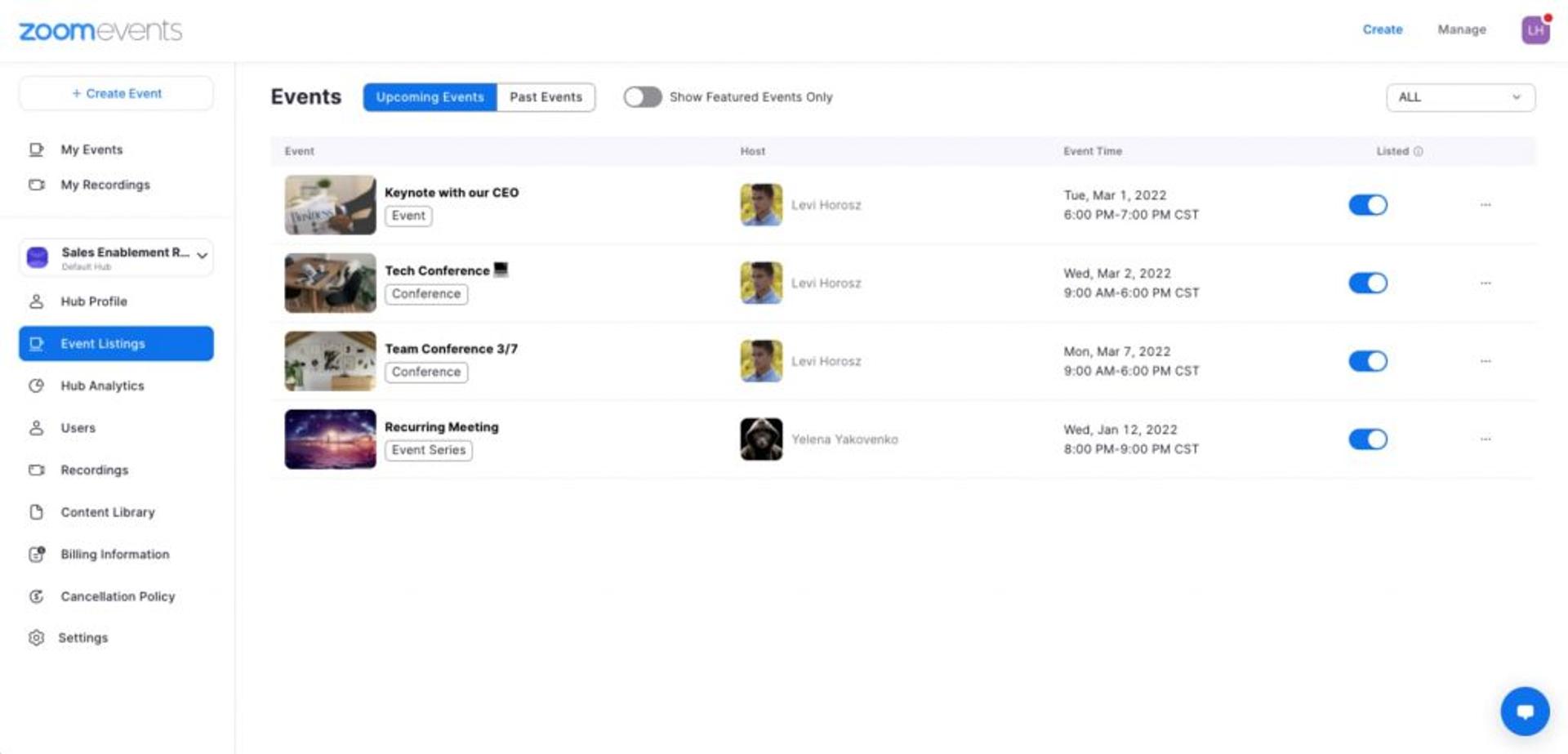
Zoom Events is best for teams that already run on a Zoom footprint and need a familiar broadcast room for press events, AGMs, or internal town halls, because near-universal attendee familiarity removes friction on join. It may not fit buyers who need automation, a native CRM, or in-webinar monetization, since Zoom Events ends where the revenue workflow begins. For a fuller head-to-head, see EasyWebinar vs Zoom.
Quick fit
| Field | Detail |
|---|---|
| Best for | Large-audience broadcast webinars and hybrid events on existing Zoom infrastructure |
| Skip if | You need evergreen/Simulated Live, in-room checkout, or behavioural follow-up |
| Strongest edge | Attendee familiarity and stable HD video at scale |
| Biggest trade-off | No automation, weak CRM sync, basic landing-page branding |
| Pricing snapshot | Per-license Webinar + attendee bundle; published pricing |
Why Zoom Events ranks #2
Zoom Events earns its position on ubiquity, reliability, and capacity rather than workflow depth. It clears the table stakes on live format coverage, streaming quality, and integrations, and it scales to 100,000+ view-only attendees on the Zoom Sessions tier. Where it loses points against the rubric is automation (no evergreen or Simulated Live), funnel pages (registration pages are minimally brandable), CRM and follow-up (no native CRM; marketing automation sync is integration-dependent), and monetization (no built-in checkout or ticketed access without third-party tools). For a buyer whose success metric is attendance, Zoom works; for a buyer whose success metric is pipeline, it ends the story at “the event happened.”
What Zoom does well
- Broadcast stability at scale: HD video and audio handle 10,000+ attendee broadcasts without the glitches smaller platforms show.
- Attendee familiarity: Most audiences already have the Zoom client, which removes a join-time friction point.
- Integration surface: Native connectors across most marketing automation and CRM tools (HubSpot, Marketo, Salesforce).
- Simple setup for one-off events: Creating a webinar takes minutes when the goal is a single broadcast, not a funnel.
Where Zoom falls short
- No evergreen, Simulated Live, or JIT scheduling; every event is a scheduled one-off.
- Customization of registration pages, reminder emails, and calendar invites is minimal; branding is constrained.
- Polling, surveys, and post-event exit pages are rudimentary compared with marketing-first platforms.
- No native CRM, no lead scoring, and no in-webinar checkout; every downstream step requires another tool.
Decision scorecard
| Evaluation criterion | Zoom Events fit | Why it matters |
|---|---|---|
| Live webinars | Strong | Reliable HD broadcast, familiar UI. |
| Simulated Live | Weak | Not supported natively. |
| Evergreen automation | Weak | Not supported. |
| Funnel pages | Partial | Basic registration page; limited branding. |
| Engagement | Partial | Chat, Q&A, and polls, but data is not routed into a CRM. |
| CRM and follow-up | Weak | No native CRM; integrations only. |
| Monetization | Weak | No built-in checkout or ticketed access. |
| Analytics | Partial | Attendance and engagement reported; no closed-loop revenue view. |
| Integrations | Strong | Broad native ecosystem. |
| Pricing fit | Partial | Sticker is fair; total cost rises quickly with add-ons. |
| Best-fit buyer | Partial | Teams running broadcast-only webinars on an existing Zoom footprint. |
Best for / skip if
Choose Zoom Events if your success metric is attendance, you already run on Zoom, and downstream workflow lives in another tool. Skip it if you need evergreen funnels, in-room monetization, or behavioural follow-up without stitching together a $600 to $1,000/mo stack.
Reviews
“Zoom is missing a lot of core webinar features that should be table stakes today. There’s no pre-webinar waiting room or post-webinar exit page. Customization of landing pages, reminders, and calendar invites is almost nonexistent.”— Casey S. Zoom Events – G2 Verified Review
“In our experience, Zoom Webinars almost completely lacks customization options to the look/feel, so it gives you as a company a minimal chance to stand out.”— Gabor F. Zoom Events – G2 Verified Review
3. vFairs
vFairs is best for organizations running virtual trade shows, career fairs, and sponsor-heavy expos that need immersive 3D environments with branded booths, because booth rendering, sponsor workflow, and expo-hall navigation are purpose-built. It may not fit teams whose primary event type is a webinar funnel or an evergreen revenue asset. For a broader landscape view, see our guide on how to choose a virtual event platform for conferences.
Quick fit
| Field | Detail |
|---|---|
| Best for | Virtual expos, trade shows, job fairs, and sponsor-monetized events |
| Skip if | Your flagship is a webinar funnel or evergreen product demo |
| Strongest edge | Immersive 3D expo environment with deep sponsor and booth workflow |
| Biggest trade-off | Priced per event; not built for always-on webinar programs |
| Pricing snapshot | Quote-based per event; not publicly listed |
Why vFairs ranks #3
vFairs wins on event-specific depth that no webinar-first platform can match: branded lobby, auditorium, expo hall, booths, and networking lounges. It scores strong on engagement depth (live booth chat, 1:1 meetings), funnel workflow for event registration, and reliability at multi-day, multi-track conferences. It scores partial on CRM/follow-up (integration-led, not native) and weak on evergreen automation and in-webinar monetization outside of booth and ticket flows. For buyers whose event is the product, vFairs is a strong shortlist candidate; for buyers whose webinar feeds a sales pipeline, it is over-built.
What vFairs does well
- Immersive 3D lobby, expo hall, and auditorium environments built event-first, not webinar-first.
- Deep sponsor workflow: branded booths, lead-capture forms, booth analytics, and sponsor reporting.
- Multi-track, multi-day agenda management with speaker green-room and RTMP ingest.
- Dedicated project manager on paid events, which reduces the ops lift for first-time producers.
Where vFairs falls short
- No native evergreen or Simulated Live format; every event is scheduled.
- Quote-based pricing per event makes budgeting for an always-on program awkward.
- CRM sync is integration-dependent; behavioural follow-up relies on HubSpot/Salesforce on the back end.
- Heavier setup than a webinar platform; first-time launches can take weeks rather than days.
Decision scorecard
| Evaluation criterion | vFairs fit | Why it matters |
|---|---|---|
| Live webinars | Strong | Auditorium sessions and multi-track live. |
| Simulated Live | Partial | Pre-recorded sessions can be scheduled but lack a Simulated-Live chat layer. |
| Evergreen automation | Weak | Not the design intent. |
| Funnel pages | Strong | Event registration and ticketing are purpose-built. |
| Engagement | Strong | Booth chat, 1:1 meetings, and gamification. |
| CRM and follow-up | Partial | Integration-led; no native CRM. |
| Monetization | Strong | Tickets, sponsor packages, and booth fees. |
| Analytics | Strong | Event-level and booth-level reporting. |
| Integrations | Strong | Salesforce, HubSpot, and Marketo supported. |
| Pricing fit | Partial | Quote-based; best for discrete events, not always-on programs. |
| Best-fit buyer | Partial | Expo/trade-show organizers, not webinar-funnel teams. |
Best for / skip if
Choose vFairs if your event is a virtual expo, trade show, or sponsor-monetized conference. Skip it if your goal is to run live, Simulated Live, and evergreen webinars on repeat or consolidate a marketing tool stack.
4. RingCentral Events (Hopin)
RingCentral Events is best for hybrid conferences and large-scale virtual summits that need a single place for sessions, networking, and on-site check-in, because multi-track agenda plus hybrid support are the core design. It may not fit buyers who want a stable long-term roadmap, given the product churn following the Hopin acquisition.
Quick fit
| Field | Detail |
|---|---|
| Best for | Hybrid conferences, large virtual summits, and internal conferences |
| Skip if | You need evergreen automation or a pricing model that is published and predictable |
| Strongest edge | Multi-track agenda with first-class hybrid (on-site + virtual) support |
| Biggest trade-off | Post-acquisition product churn and opaque pricing |
| Pricing snapshot | Quote-based; not publicly listed |
Why RingCentral Events ranks #4
The platform scores strong on format coverage for conferences (multi-track, stage, sessions, and networking) and reliability at scale. It scores partial on funnel pages (event-oriented registration), CRM/follow-up (integration-led), and monetization (tickets supported). Evergreen and Simulated Live are not the design intent. For enterprise buyers running one or two flagship hybrid events a year, it is a strong candidate; for marketing teams running a weekly webinar program, it is heavier and more expensive than necessary. Teams that prefer webinar-native automation often compare it with top automated webinar platforms of 2026.
What it does well
- Multi-track agenda, stage, sessions, and expo built for conferences.
- Hybrid on-site + virtual support including on-site check-in and badge printing.
- Networking lounges and speed-networking features for attendee-to-attendee connection.
- Integrations with the major CRMs and marketing automation platforms.
Where it falls short
- No native evergreen or Simulated Live.
- Product roadmap has shifted since the Hopin acquisition; some buyers cite feature deprecation.
- Pricing is opaque and quote-based, which slows procurement.
- CRM sync relies on integrations; no built-in lead scoring.
Decision scorecard
| Evaluation criterion | RingCentral Events fit | Why it matters |
|---|---|---|
| Live webinars | Strong | Stage + sessions scale well. |
| Simulated Live | Weak | Not the design intent. |
| Evergreen automation | Weak | Not supported. |
| Funnel pages | Partial | Event registration, not webinar funnel. |
| Engagement | Strong | Networking, polls, chat, and Q&A. |
| CRM and follow-up | Partial | Integration-led. |
| Monetization | Strong | Tickets and sponsor tiers. |
| Analytics | Strong | Event-level reporting. |
| Integrations | Strong | Major CRMs and MAPs. |
| Pricing fit | — | Quote-based |
| Best-fit buyer | Partial | Hybrid conference teams, not always-on webinar programs. |
Best for / skip if
Choose RingCentral Events if your flagship is a hybrid or virtual conference with a real speaker line-up and sponsor tiers. Skip it if your revenue engine is an evergreen webinar funnel or you need a published per-month price.
5. Bizzabo
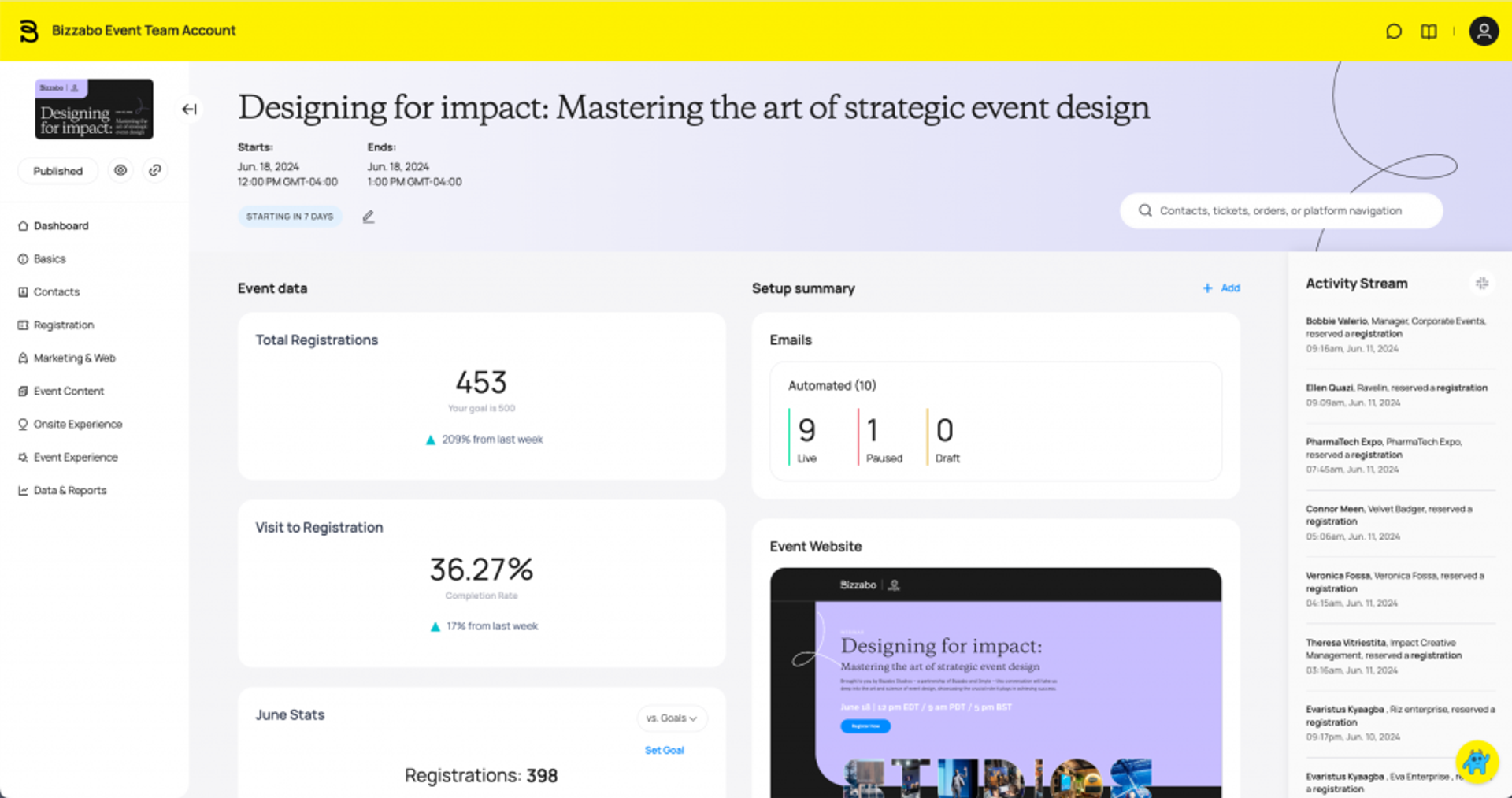
Bizzabo is best for B2B enterprise marketing teams running sponsor-monetized conferences where the Klik smart-badge data and post-event attribution are core to the ROI story, because Klik plus the Event Experience OS are its defining edge. It may not fit mid-market buyers who balk at enterprise ACVs or need evergreen webinar automation.
Quick fit
| Field | Detail |
|---|---|
| Best for | B2B enterprise conferences with sponsor monetization and post-event attribution |
| Skip if | You are mid-market with a live-plus-evergreen webinar program |
| Strongest edge | Klik smart-badge hybrid data and deep B2B event analytics |
| Biggest trade-off | Annual enterprise ACV with a learning curve |
| Pricing snapshot | Quote-based, annual |
Why Bizzabo ranks #5
Bizzabo is strong on format coverage for conferences, engagement depth (Klik, matchmaking, and lounges), analytics (attribution-grade reporting), and reliability. It scores partial on CRM/follow-up (integration-led) and weak on evergreen automation and in-webinar monetization outside of event-level tickets. Against the rubric, the weight it loses on always-on revenue workflow is offset by the depth it wins on enterprise conference operations.
What it does well
- Event Experience OS covers registration, agenda, speaker workflow, and sponsor management end-to-end.
- Klik smart-badge layers on-site behavioural data onto hybrid events.
- Deep B2B analytics and attribution reporting for post-event ROI.
- Strong Salesforce and Marketo integrations for enterprise marketing stacks.
Where it falls short
- Annual enterprise ACV prices out most mid-market teams.
- No native evergreen or Simulated Live.
- Learning curve is real; time to first live event is measured in weeks.
- Landing pages and branding are event-oriented, not funnel-oriented.
Decision scorecard
| Evaluation criterion | Bizzabo fit | Why it matters |
|---|---|---|
| Live webinars | Strong | Sessions + stage. |
| Simulated Live | Weak | Not supported. |
| Evergreen automation | Weak | Not supported. |
| Funnel pages | Partial | Event registration, not funnel. |
| Engagement | Strong | Klik, matchmaking, and networking. |
| CRM and follow-up | Partial | Integration-led. |
| Monetization | Strong | Ticketing + sponsor tiers. |
| Analytics | Strong | Attribution-grade. |
| Integrations | Strong | Salesforce and Marketo. |
| Pricing fit | Weak | Enterprise ACV. |
| Best-fit buyer | Partial | Enterprise B2B conferences only. |
Best for / skip if
Choose Bizzabo if you run enterprise B2B conferences and need sponsor-level attribution. Skip it if your budget, team size, or primary use case is a recurring webinar funnel.
6. Cvent
Cvent is best for procurement-driven enterprise event management across thousands of annual events, because its end-to-end lifecycle (sourcing, registration, budgeting, travel, and compliance) is unmatched. It may not fit buyers who want to launch a webinar this week or run an evergreen revenue funnel.
Quick fit
| Field | Detail |
|---|---|
| Best for | Enterprise event teams running large annual programs with procurement oversight |
| Skip if | You need fast time-to-launch or always-on webinar automation |
| Strongest edge | End-to-end event lifecycle with venue sourcing, compliance, and budgeting |
| Biggest trade-off | Over-engineered and slow to launch for mid-market |
| Pricing snapshot | Quote-based, annual |
Why Cvent ranks #6
Cvent scores strong on reliability, compliance, and analytics, and strong on funnel workflow for event registration. It scores partial on engagement (functional, not best-in-class) and weak on evergreen, Simulated Live, and in-webinar monetization. Time-to-launch is the criterion where it loses the most weight: the platform is optimized for programs of record, not speed. Mid-market teams often lean toward webinar-native live webinar software instead.
What it does well
- End-to-end event lifecycle: sourcing, registration, budgeting, travel, and compliance.
- Enterprise-grade reliability, SOC 2, and data-residency controls.
- Deep reporting and spend analytics for CFO visibility.
- Broad integration surface across Salesforce, Marketo, and Workday.
Where it falls short
- Over-engineered for mid-market; time to first event is measured in weeks.
- No evergreen, Simulated Live, or in-room checkout.
- Pricing is quote-based and opaque.
- Engagement layer is functional but not best-in-class compared with Airmeet or Hubilo.
Decision scorecard
| Evaluation criterion | Cvent fit | Why it matters |
|---|---|---|
| Live webinars | Strong | Supported via Cvent Webinar. |
| Simulated Live | Weak | Not supported. |
| Evergreen automation | Weak | Not supported. |
| Funnel pages | Strong | Event registration is deep. |
| Engagement | Partial | Functional; not best-in-class. |
| CRM and follow-up | Partial | Integration-led. |
| Monetization | Strong | Event ticketing and travel/bookings. |
| Analytics | Strong | Procurement-grade. |
| Integrations | Strong | Broad enterprise stack. |
| Pricing fit | Weak | Enterprise ACV. |
| Best-fit buyer | Partial | Enterprise programs of record. |
Best for / skip if
Choose Cvent if you manage a large enterprise event program with procurement oversight and compliance requirements. Skip it if your success metric is webinar-driven pipeline or you want to launch this week.
7. Whova
Whova is best for association, academic, and corporate conferences where the agenda, speaker management, and attendee app are the centre of the experience, because Whova’s app-first workflow earns high attendee satisfaction. It may not fit teams whose primary use case is a webinar funnel or evergreen product demo.
Quick fit
| Field | Detail |
|---|---|
| Best for | Associations, academic conferences, and corporate events with heavy agendas |
| Skip if | You need webinar funnel pages, evergreen automation, or in-room checkout |
| Strongest edge | Best-in-class event app with agenda, speaker management, and attendee networking |
| Biggest trade-off | Light on marketing-funnel and monetization tooling |
| Pricing snapshot | Quote-based per event; not publicly listed |
Why Whova ranks #7
Whova scores strong on event-app experience, engagement (community board, 1:1 chat, and meet-ups), and analytics for conference-style events. It scores weak on evergreen, funnel pages, and CRM/follow-up for marketing-driven programs. The platform is optimized for attendee experience, not pipeline.
What it does well
- Event app with agenda builder, speaker bios, and attendee directory.
- Strong community and networking features (meet-ups, community board, and 1:1 chat).
- Multi-track, multi-day conferences with session-level engagement.
- Fair pricing for small and mid-sized conferences.
Where it falls short
- No native evergreen or Simulated Live.
- Marketing funnel pages are event-oriented, not webinar-oriented.
- No native CRM; follow-up is integration-led.
- Monetization is ticket-based; no in-room checkout for offers.
Decision scorecard
| Evaluation criterion | Whova fit | Why it matters |
|---|---|---|
| Live webinars | Partial | Sessions supported; not webinar-first. |
| Simulated Live | Weak | Not supported. |
| Evergreen automation | Weak | Not supported. |
| Funnel pages | Partial | Event registration. |
| Engagement | Strong | App-led engagement is best-in-class. |
| CRM and follow-up | Partial | Integration-led. |
| Monetization | Partial | Ticketing. |
| Analytics | Strong | Session and engagement reports. |
| Integrations | Partial | Limited outside the event ecosystem. |
| Pricing fit | Strong | Fair for conferences. |
| Best-fit buyer | Partial | Associations and academic events. |
Best for / skip if
Choose Whova if your flagship is an association conference where the attendee app matters more than the marketing funnel. Skip it if you need a webinar funnel with in-room monetization and behavioural follow-up.
8. Airmeet
Airmeet is best for networking-first virtual summits where 1:1 meetings and lounge interactions are the KPI, because AI matchmaking and the Social Lounge are its defining edge. It may not fit teams that need a native CRM, in-webinar checkout, or evergreen automation.
Quick fit
| Field | Detail |
|---|---|
| Best for | Networking-first virtual summits and community-led events |
| Skip if | You need native CRM, evergreen, or in-room checkout |
| Strongest edge | AI matchmaking and Social Lounge networking |
| Biggest trade-off | No native CRM; follow-up lives in HubSpot/Salesforce |
| Pricing snapshot | Tiered annual + attendee-based |
Why Airmeet ranks #8
Airmeet scores strong on engagement depth (AI matchmaking, Social Lounge, and speed networking) and partial on reliability and scale. It scores weak on evergreen automation, funnel pages, and monetization outside of ticketing. Buyers choose Airmeet when meetings booked per 100 attendees is the primary KPI. For community-led growth tactics, see our guide to webinar networking features for building community.
What it does well
- AI matchmaking that books 1:1 meetings from attendee profiles, averaging three to seven meetings per 100 attendees.
- Social Lounge networking with table-based conversations.
- Strong live session engagement (polls, Q&A, reactions, and emojis).
- Fair starting price for small and mid-sized summits.
Where it falls short
- No native CRM; lead scoring and follow-up live in an integrated tool.
- No built-in checkout; monetization is ticket-only.
- No evergreen or Simulated Live.
- Enterprise pricing is quote-based and moves upmarket fast.
Decision scorecard
| Evaluation criterion | Airmeet fit | Why it matters |
|---|---|---|
| Live webinars | Strong | Sessions and stages. |
| Simulated Live | Weak | Not supported. |
| Evergreen automation | Weak | Not supported. |
| Funnel pages | Partial | Event registration. |
| Engagement | Strong | AI matchmaking leads the category. |
| CRM and follow-up | Weak | No native CRM. |
| Monetization | Partial | Ticketing only. |
| Analytics | Strong | Networking + engagement reports. |
| Integrations | Strong | HubSpot, Salesforce, and Marketo. |
| Pricing fit | Partial | Starter is fair; enterprise moves up. |
| Best-fit buyer | Partial | Networking-first summit teams. |
Best for / skip if
Choose Airmeet if your event’s KPI is meetings booked and community depth. Skip it if you need native CRM, evergreen funnels, or in-room checkout.
9. Hubilo
Hubilo is best for mid-market marketing teams running multi-session events where engagement and gamification are the conversion lever, because its engagement layer and lead scoring are strong for the tier. It may not fit buyers who need native evergreen automation or a published per-month price.
Quick fit
| Field | Detail |
|---|---|
| Best for | Mid-market marketing teams running engagement-led multi-session events |
| Skip if | You need evergreen or Simulated Live formats |
| Strongest edge | Engagement layer with gamification and embedded lead scoring |
| Biggest trade-off | Pricing moves upmarket fast; no evergreen |
| Pricing snapshot | Quote-based, annual |
Why Hubilo ranks #9
Hubilo scores strong on engagement, funnel workflow for events, and analytics. It scores partial on CRM/follow-up (integration-led with some native scoring) and weak on evergreen automation. Against the rubric, it is a solid mid-market pick that stops short of being a full webinar revenue platform.
What it does well
- Engagement layer with gamification, leaderboards, and social walls.
- Lead scoring that ties engagement to an attendee record.
- Multi-session, multi-track conferences with sponsor workflow.
- Strong Salesforce/HubSpot integrations.
Where it falls short
- No evergreen or Simulated Live.
- Quote-based pricing that scales quickly.
- No in-room checkout; monetization is ticket-only.
- Time-to-launch is closer to an event platform than a webinar platform.
Decision scorecard
| Evaluation criterion | Hubilo fit | Why it matters |
|---|---|---|
| Live webinars | Strong | Sessions + stage. |
| Simulated Live | Weak | Not supported. |
| Evergreen automation | Weak | Not supported. |
| Funnel pages | Partial | Event registration. |
| Engagement | Strong | Gamification leads mid-market. |
| CRM and follow-up | Partial | Scoring + integrations. |
| Monetization | Partial | Ticketing only. |
| Analytics | Strong | Engagement + attribution. |
| Integrations | Strong | Major CRMs/MAPs. |
| Pricing fit | Partial | Mid-market start, enterprise ceiling. |
| Best-fit buyer | Partial | Mid-market marketing teams. |
Best for / skip if
Choose Hubilo if engagement and gamification are your conversion levers at a mid-market budget. Skip it if you need evergreen funnels or in-room monetization.
10. Livestorm
Livestorm is best for marketing and customer education teams that want browser-based simplicity and a clean UX across product demos, onboarding webinars, and lead-gen sessions, because no-download access and modern design lower attendee friction. It may not fit buyers who need a native CRM, built-in checkout, or predictable pricing at scale. For a sharper head-to-head, compare EasyWebinar vs Demio as a close stylistic alternative.
Quick fit
| Field | Detail |
|---|---|
| Best for | Product demos, customer education, and lead-gen webinars with clean UX |
| Skip if | You need native CRM, built-in checkout, or evergreen at scale |
| Strongest edge | Browser-based, no-download attendee experience and modern design |
| Biggest trade-off | No native CRM; expensive per contact at scale |
| Pricing snapshot | Per-contact tiered monthly; approximately $734/mo at 3,000 attendees |
Why Livestorm ranks #10
Livestorm scores strong on attendee experience, engagement depth (polls, chat, Q&A, and emojis), and clean funnel pages. It scores weak on CRM and follow-up (no native CRM), monetization (no built-in checkout), and automation (limited evergreen and Simulated Live). It is a well-built webinar room; it is not a webinar revenue platform. Teams consolidating stack spend often move toward EasyWebinar’s webinar platform for the end-to-end workflow.
What it does well
- Browser-based attendee access removes install friction.
- Clean, modern UX for hosts and attendees.
- Polls, Q&A, chat, and emoji reactions for engagement.
- Fair free tier for small meetings and internal sessions.
Where it falls short
- No native CRM; follow-up is integration-led.
- No built-in checkout; monetization is external.
- Evergreen and Simulated Live are limited compared with webinar-native platforms.
- Per-contact pricing scales quickly; data access is restricted if you cancel.
Decision scorecard
| Evaluation criterion | Livestorm fit | Why it matters |
|---|---|---|
| Live webinars | Strong | Clean browser-based live room. |
| Simulated Live | Partial | Limited scheduling options. |
| Evergreen automation | Partial | On-demand available; not a full JIT engine. |
| Funnel pages | Strong | Clean registration and replay pages. |
| Engagement | Strong | Polls, Q&A, and chat are well-designed. |
| CRM and follow-up | Weak | No native CRM. |
| Monetization | Weak | No built-in checkout. |
| Analytics | Partial | Session and engagement reporting. |
| Integrations | Strong | HubSpot, Salesforce, and Marketo. |
| Pricing fit | Partial | Entry is fair; scale gets expensive. |
| Best-fit buyer | Partial | Marketing teams that value UX over revenue workflow depth. |
Best for / skip if
Choose Livestorm if browser-based UX and clean design are the highest-weight criteria for you. Skip it if you need native CRM, in-room checkout, or evergreen at scale, in which case an all-in-one revenue platform like EasyWebinar, or a dedicated top automated webinar platform of 2026, will fit better.
Reviews
“Overall, Livestorm is a solid webinar platform with a lot of great features, but it is important to consider the limitations and potential drawbacks before making a decision to use it.”— Verified User Livestorm – G2 Verified Review
How We Ranked These Platforms
Every platform was scored against the eight evaluation criteria with weights tuned to what actually moves webinar revenue: format coverage, time to launch, engagement depth, funnel workflow, CRM and follow-up readiness, monetization, analytics, and reliability at scale. The rubric favors platforms that own the full path from registration to revenue rather than platforms that optimize for one stage and hand off to another tool. That is why a live-only or event-only platform can still earn 4★ without earning the #1 position. For teams weighing alternatives, our best webinar software comparison guide and side-by-side compare webinar platforms page lay out the workflow question in more detail.
Your Next Step
The shortest path from “we need a platform” to “we have pipeline” is to see the workflow end-to-end rather than judge it feature-by-feature. If live-plus-evergreen revenue funnels with native CRM and in-room checkout describe what you actually need, start a free sign up or request a demo and run the math on your own numbers.
Q2. How Did We Score the Best Virtual Event Software, The 100-Point Selection Rubric
Every platform on this list was scored against a weighted, 100-point rubric with five criteria: Scalability and Reliability (25%), Attendee Engagement and AI Networking (20%), Revenue Workflow Integration (25%), Setup and Usability (15%), and Pricing Transparency plus TCO (15%). Star bands: 0 to 20 = 1★, 21 to 40 = 2★, 41 to 60 = 3★, 61 to 80 = 4★, and 81 to 100 = 5★.
What Each Criterion Actually Tested
The rubric was built to mirror the buying questions a marketing lead, a RevOps manager, and a CFO ask together, not a feature matrix from a vendor deck.
Scalability and Reliability (25%) ⚠️: Concurrent attendee ceilings, documented uptime and SLAs, SOC 2 Type II, SSO/SAML, and multi-region streaming.
Attendee Engagement and AI Networking (20%) 💬: Depth of polls, Q&A, breakouts, AI matchmaking, and whether each signal survives into the attendee record.
Revenue Workflow Integration (25%) 💰: Native CRM, lead scoring, in-event checkout, ticketed access, and funnel pages inside one license, not stitched through Zapier. Learn more about our native sales CRM.
Setup and Usability (15%) ⏰: Minutes to first live event, AI-assisted funnel creation, template library, and onboarding model. The AI funnel builder compresses this window dramatically.
Pricing Transparency and TCO (15%) 💸: Published per-attendee pricing versus opaque “Contact Sales,” plus hidden add-ons like separate checkout or middleware. Compare against our published webinar pricing.
The 100-Point Scorecard
| Rank | Platform | Scalability (25) | Engagement (20) | Revenue Workflow (25) | Usability (15) | Pricing (15) | Total | Stars |
|---|---|---|---|---|---|---|---|---|
| 1 | EasyWebinar | 22 | 17 | 24 | 14 | 15 | 92 | ⭐⭐⭐⭐⭐ |
| 2 | Cvent | 24 | 15 | 17 | 10 | 12 | 78 | ⭐⭐⭐⭐ |
| 3 | Bizzabo | 22 | 18 | 16 | 10 | 10 | 76 | ⭐⭐⭐⭐ |
| 4 | RingCentral Events | 21 | 17 | 16 | 10 | 10 | 74 | ⭐⭐⭐⭐ |
| 5 | vFairs | 20 | 18 | 15 | 9 | 10 | 72 | ⭐⭐⭐⭐ |
| 6 | Hubilo | 19 | 18 | 13 | 9 | 9 | 68 | ⭐⭐⭐⭐ |
| 7 | Airmeet | 17 | 19 | 11 | 10 | 9 | 66 | ⭐⭐⭐⭐ |
| 8 | Whova | 18 | 18 | 10 | 9 | 9 | 64 | ⭐⭐⭐⭐ |
| 9 | Livestorm | 17 | 15 | 10 | 12 | 8 | 62 | ⭐⭐⭐⭐ |
| 10 | Zoom Events | 22 | 13 | 6 | 9 | 8 | 58 | ⭐⭐⭐ |
Why Revenue Workflow Is the Dimension Most Tools Lose
The 25% Revenue Workflow weight is where broadcast tools and event-management suites bleed points. Zoom Events scores 6/25 because registration, CRM, and checkout all live outside its walls. Cvent scores 17/25 because event registration is deep, but in-webinar checkout and behavioural CRM tagging require add-ons. EasyWebinar scores 24/25 because the AI Funnel Builder, EasyCRM with lead scoring and auto-dialer, and in-session checkout all sit inside one license. For a broader comparison lens, our best webinar software comparison guide covers the same workflow question across adjacent categories.
How EasyWebinar Maxes the Workflow Criterion
We weighted Revenue Workflow at 25% because this is where most teams actually lose money. EasyWebinar earns that score because the webinar, the funnel pages, the CRM tagging by behaviour, and the checkout are native. Every attendee action routes into a hot, warm, or nurture segment and triggers the next follow-up without a Zapier chain. Teams that want to validate the workflow against their own numbers can request a demo or compare against a direct alternative such as EasyWebinar vs Demio.
“Their name literally says it all, and for once there is a company that lives up to what they promise.”— Dr. Loren M., Brand Owner Easywebinar G2 – Verified Review
“EasyWebinar saves me a lot of time, especially since I often host the same webinar monthly, and everything is already set up for last-minute webinars.”— Eliza W., Marketing Easywebinar G2 – Verified Review
Q3. Webinar Platform vs. Full Virtual Event Platform, Which One Handles 10,000+ Attendees?
Yes, a modern webinar platform can absolutely run a 10,000 to 50,000-attendee virtual conference, provided it ships multi-session tracks, RTMP/HLS delivery, SOC 2 Type II, SSO/SAML, and sub-account management. EasyWebinar’s Unlimited tier scales to 50,000+ concurrent attendees with every one of those controls native, which removes the reflex to buy a separate event-management suite. For the full feature surface, see our all features overview.
The Default Split Most Teams Operate Inside
Most event teams I talk to run on a split brain. Cvent or Bizzabo owns the annual flagship conference. Zoom or Webex owns the weekly webinar. Neither one knows the other exists, so the same prospect shows up twice in two different attendee datasets, and nobody on the revenue team can tell you which touch actually influenced the close.
That split is not a platform problem. It is a procurement habit from 2019 when capacity and workflow genuinely were two different purchases. In 2026, they are not.
Where the Industry Critique Lands
Dedicated event platforms still charge $30K+ ACVs for capacity that modern webinar-native platforms now deliver for a fraction of the cost. On the other side, legacy webinar tools like Zoom Webinar and GoTo Webinar cap practical capacity at roughly 1,000 to 3,000 attendees with stable quality, which is exactly the source of the buyer confusion. If your only reference for “webinar software” is a tool that caps at 3K, of course a 10K conference feels like a different category. That framing is also why teams often evaluate alternatives such as GoToWebinar alternatives for small businesses.
The Attendee Ceiling Quick-Reference
| Platform | Published Attendee Ceiling | Enterprise Compliance |
|---|---|---|
| Zoom Webinar | ~3,000 (Sessions tier higher) | ✅ |
| GoTo Webinar | ~3,000 | ✅ |
| Livestorm | ~3,000 | Partial |
| EasyWebinar Unlimited | 50,000+ | ✅ SOC 2 Type II + SSO/SAML |
| Cvent / Bizzabo / RingCentral Events | 50,000+ | ✅ |
The Real Question Isn’t Webinar vs. Event Platform
The right question is not “webinar platform or event platform?” It is: does one system handle multi-track scheduling, enterprise compliance, engagement, behavioural follow-up, and monetization inside one workflow? Capacity is table stakes in 2026. Workflow consolidation is the 2026 differentiator, and it is where the $30K+ event platforms and the $100/mo broadcast tools both fall short.
How EasyWebinar Handles the 10K+ Use Case
On Unlimited, we ship SOC 2 Type II, SSO/SAML, sub-account management, API access, and 50,000+ concurrent attendee capacity, plus EasyCRM and in-platform monetization inside the same instance. That means the same system that runs the conference also scores leads by what each attendee clicked, triggers the follow-up sequence, and captures the ticketed purchase in the room through paid webinars. No second dataset. No Zapier. No “we think that lead came from the conference.” Dolby, Teachable, Keap, and AWeber run large-scale programs on EasyWebinar, not because it is the cheapest tier on the list, but because the revenue workflow stops leaking at the handoff. Teams can extend distribution further with EasyCast multistreaming.
Q4. How Do the Top Virtual Event Platforms Compare on Engagement, AI Matchmaking, and Networking?
Engagement leaders in 2026 split by specialty: Airmeet and Bizzabo lead on AI matchmaking depth, Whova wins on agenda and speaker interaction, Hubilo owns gamification, and EasyWebinar leads on engagement-to-CRM routing. Zoom Events and GoTo Webinar sit at the bottom because chat, poll, and Q&A data is not tagged to individual attendee records or routed into follow-up automation. For tactics that raise the ceiling on this metric, see interactive webinars that drive 5x engagement.
The Engagement Comparison Table
| Platform | Live Chat | Polls / Q&A | AI Matchmaking | Breakouts | Engagement → CRM | Analytics Dashboard | White-Label Branding |
|---|---|---|---|---|---|---|---|
| EasyWebinar | ✅ | ✅ | Partial | Partial | ✅ Native | ✅ | ✅ |
| Airmeet | ✅ | ✅ | ✅ Best-in-class | ✅ | ❌ Integration-only | ✅ | ✅ |
| Bizzabo | ✅ | ✅ | ✅ | ✅ | Partial | ✅ | ✅ |
| Whova | ✅ | ✅ | Partial | ✅ | Partial | ✅ | Partial |
| Hubilo | ✅ | ✅ | Partial | ✅ | Partial | ✅ | ✅ |
| vFairs | ✅ | ✅ | Partial | ✅ | ❌ | ✅ | ✅ |
| RingCentral Events | ✅ | ✅ | Partial | ✅ | ❌ | ✅ | ✅ |
| Cvent | ✅ | ✅ | Partial | ✅ | ❌ Add-on | ✅ | ✅ |
| Livestorm | ✅ | ✅ | ❌ | Partial | ❌ | ✅ | Partial |
| Zoom Events | ✅ | Partial | ❌ | ✅ | ❌ | Partial | ❌ |
Where Competitors Genuinely Lead
Airmeet’s matchmaking UX is the real thing. Networking-first summits routinely book three to seven 1:1 meetings per 100 attendees on its Social Lounge. Bizzabo owns B2B sponsor workflows and post-event attribution reporting through Klik smart badges. Hubilo’s gamification layer genuinely lifts engagement for mid-market marketing teams. I will not pretend otherwise: if your KPI is meetings-booked, Airmeet is a strong shortlist. For community-led programs, see our guide to building virtual engagement with webinar networking features.
The EasyWebinar Edge Is a Closed Loop, Not Depth
Our edge is not matchmaking depth. It is the closed loop from engagement to CRM tag to behavioural follow-up sequence. Simulated Live, which sits under the Automated Webinars umbrella, layers real-time chat, polls, and timed offers onto a recorded session: the defining difference from a glorified replay. Evergreen uses a pre-configured question box for async engagement. Every interaction, in every format, automatically tags the attendee inside EasyCRM as hot, warm, or nurture, and triggers the matching sequence.
The Revenue Proof Behind the Routing
When K21 Academy switched to an engagement-to-CRM workflow that routed every webinar interaction into behavioural follow-up, instead of exporting CSVs into Zapier, they reported 3× click-through rates and 5× registrant growth. That is what the routing is actually worth: not a better analytics screenshot, but a measurable lift in what each attendee converts to next. The full breakdown lives in our edtech case study (K21).
“I love that we can have a poll, offer, and countdown right in the event. That’s going to be so great for sales and interactions.”— Verified User in Photography Easywebinar G2 – Verified Review
“The engagement features were minimal and did not appeal to a large crowd. The lack of opportunities to personalize was missed.”— Verified User in Education Management Zoom Events and Webinars – G2 Verified Review
Q5. What Does Virtual Conference Software Cost in 2026, and Is a Multi-Tool Stack Cheaper?
Virtual conference software pricing in 2026 falls into four bands: under $200/mo (eWebinar $99, WebinarKit starter, EasyWebinar Growth $116 and Pro $198), $200 to $800/mo (Livestorm, Demio ~$734/mo at 3K attendees), $1K to $5K/mo (Airmeet, Hubilo, vFairs per event), and $30K+ ACV (Cvent, Bizzabo, ON24). Sticker price misleads: TCO is the real number. Start with published webinar pricing so the comparison begins on a level field.
The Decision Dilemma
Most teams default to one of three shortcuts: brand recognition (Zoom), feature count (Cvent), or incumbent comfort (GoTo). None of those correlate with revenue-per-attendee or with the consolidation story a CFO actually cares about. The result is a procurement decision that looks cheap on Day 1 and bleeds for the next 24 months.
Wrong Criteria to Avoid ❌
- Choosing by lowest per-month sticker. A $99 tool that needs five integrations to close a sale is not a $99 tool.
- Counting integrations. More connectors usually mean more handoffs where attribution breaks.
- Defaulting to “what everyone else uses.” Familiarity doesn’t convert.
A ClickFunnels ($150 to $250) + Zoom ($100 to $200) + HubSpot or Pipedrive ($80 to $150) + Zapier + Restream + Stripe stack totals $600 to $1,000/mo and breaks attribution at every handoff. The revenue signal is lost between tools. Nobody can tell you which part of the funnel actually produced the sale. For operators evaluating cheaper single-tool swaps, our guide to best webinar software comparison lays out the workflow question in detail.
The Right 6-Criterion Framework
Rather than compare sticker prices, score every option against six decision criteria that map to how the webinar actually makes money:
- Can one platform host Live, Simulated Live, and Evergreen formats?
- Is the CRM native, or is it Zapier-dependent?
- Is checkout in-session, or routed to an external page where intent decays?
- Are engagement signals (polls, chat, and offer clicks) automatically routed into follow-up?
- Is pricing per-attendee (predictable) or per-seat (punitive at scale)?
- Does the vendor carry SOC 2 Type II and SSO/SAML for enterprise procurement?
| Criterion | EasyWebinar | Zoom Events | Demio | Zoom + HubSpot + ClickFunnels Stack |
|---|---|---|---|---|
| Live + Simulated Live + Evergreen | ✅ | ❌ | Partial | ❌ |
| Native CRM | ✅ EasyCRM | ❌ | ❌ | Partial (HubSpot) |
| In-session checkout | ✅ | ❌ | ❌ | ❌ (Stripe redirect) |
| Engagement → follow-up routing | ✅ | ❌ | Partial | ❌ |
| Per-attendee pricing | ✅ | Partial | ✅ | ❌ |
| SOC 2 + SSO | ✅ | ✅ | Partial | Mixed |
| Score (out of 6) | 6 | 1 | 2 | 0 |
For teams already comparing one-to-one against a single tool, see EasyWebinar vs Demio and EasyWebinar vs Zoom.
The Total-Cost-of-Ownership Row 💰
For a quarterly 5,000-attendee virtual conference, the math looks very different from the stickers:
| Setup | Monthly Sticker | Annualized TCO (incl. seats, add-ons, and overage) |
|---|---|---|
| Zoom + HubSpot + ClickFunnels + Stripe + Zapier + Restream | ~$680 | ~$8,200/quarter |
| EasyWebinar Unlimited (one line item) | ~$800 | ~$2,400/quarter |
The Meta-Insight
The real competitor is not another platform. It is the multi-tool stack the team already has. Mid-market teams that consolidate onto EasyWebinar typically cut stack spend 40% to 60% while lifting show-up rates above 40%. K21 Academy is a documented example, with 3× click-through and 5× registrant growth after routing engagement into a native workflow instead of a Zapier chain. The full story lives in our edtech case study (K21).
One Line the CFO Will Accept
We price EasyWebinar per attendee, not per seat, and every feature needed to turn a registration into a transaction lives inside that one line item. That is the only honest way to compare a $99/mo tool against a $600/mo stack: by what it costs to actually close the sale, not what it costs to host the room. See the full surface on our all features page.
Q6. Which Virtual Event Platform Is Best for Enterprise, SOC 2, SSO, and 50K+ Attendees?
Enterprise-ready virtual event platforms in 2026 must carry SOC 2 Type II, GDPR, SSO/SAML, sub-account management, documented SLA guarantees, and 50,000+ concurrent attendee capacity. EasyWebinar Unlimited, Cvent, and Bizzabo clear all six. ON24 does too at a $30K+ ACV most mid-market teams struggle to justify. Webex loses ground because per-seat pricing without native automation inflates TCO fast. For a direct head-to-head against a legacy option, compare EasyWebinar vs GoToWebinar.
The Enterprise Baseline Every Platform Must Clear ⚠️
Procurement gates in 2026 are tighter than they were even two years ago, and the checklist below is what gets a vendor into the security review, not out of it.
- Compliance baseline: SOC 2 Type II and GDPR are table stakes. HIPAA and ISO 27001 are common follow-ups in regulated verticals.
- Access control: SSO/SAML integrates with Okta, Azure AD, or Google Workspace so attendee and admin identities live in the existing identity stack.
- Scale threshold: enterprise training, product launches, all-hands, and investor events routinely need 5,000 to 50,000 concurrent attendees with stable HD delivery.
- Operational control: sub-account management, role-based permissions, and API access let business units run independently inside one parent instance without creating shadow IT.
| Platform | SOC 2 Type II | SSO/SAML | 50K+ Capacity | Sub-Accounts | API | Typical ACV |
|---|---|---|---|---|---|---|
| EasyWebinar Unlimited | ✅ | ✅ | ✅ | ✅ | ✅ | Mid four figures |
| Cvent | ✅ | ✅ | ✅ | ✅ | ✅ | $40K+ |
| Bizzabo | ✅ | ✅ | ✅ | ✅ | ✅ | $30K+ |
| ON24 | ✅ | ✅ | ✅ | ✅ | ✅ | $30K+ |
| Webex Webinars | ✅ | ✅ | Partial | Partial | ✅ | Per-seat escalates |
| Zoom Events | ✅ | ✅ | ✅ (Sessions tier) | Partial | ✅ | License + attendees |
How EasyWebinar Unlimited Solves the Enterprise Brief
We bundle SOC 2 Type II, SSO/SAML, SLA options, sub-account management, API access, and a dedicated VIP support line into one Unlimited license, alongside sales CRM, in-session monetization through paid webinars, and the AI funnel builder. That is the difference that matters to a RevOps leader: the enterprise compliance posture does not live in one tool, while the revenue workflow lives in five others. Dolby, Teachable, Keap, and AWeber all run enterprise programs on EasyWebinar, which is how the platform compresses ON24-class capability into a fraction of the ACV. For multistream distribution needs, EasyCast multistreaming extends reach across YouTube, LinkedIn, Facebook, and RTMP.
The Enterprise Review Signal
“Weve just started using EasyWebinar for our live and automated webinars, and its been an excellent experience… Its not often you find a support team that acts like a true partner in your success, but EasyWebinar certainly does.”— Verified User in Information Services Easywebinar G2 – Verified Review
“None of my speakers had the option to turn on their webcam… When trying to upgrade a license, it took two weeks to hear back.”— Forrester S. GoTo Webinar – G2 Verified Review
Q7. Virtual Event Software FAQs + Your Next Step to a Revenue-Grade Virtual Conference
The best virtual event platform in 2026 is the one that collapses hosting, engagement, CRM, monetization, and follow-up into a single workflow, which is exactly how EasyWebinar’s Endpoint Ecosystem is architected. The five FAQs below answer the questions buyers ask right before booking a demo.
Frequently Asked Questions
1. What are the best free or budget platforms under 500 attendees?
Zoom Webinar’s entry tier, Livestorm Free, and Whova’s small-event tier cover basic hosting. EasyWebinar Growth ($96/mo billed annually) includes evergreen automation and a native CRM in the same license. See how it compares on our webinar platform overview.
2. Can a modern webinar platform replace Cvent?
Yes, up to 50,000 attendees, provided the webinar platform ships multi-track sessions, SOC 2 Type II, and SSO/SAML. EasyWebinar Unlimited meets all three without the $30K+ ACV. Our guide on how to choose a virtual event platform for conferences walks through the criteria.
3. What are realistic AI-matchmaking benchmarks?
Airmeet and Bizzabo average three to seven 1:1 meetings booked per 100 attendees on networking-first events. That is the bar to beat if meetings-booked is your KPI.
4. What are the typical G2 complaint patterns I should expect?
Zoom Events: no automation and minimal branding. Demio: no native CRM, and data is locked behind reactivation after cancellation. Cvent: implementation time measured in weeks.
5. When should a team graduate from Zoom to EasyWebinar?
The moment paid ticketing, evergreen delivery, or closed-loop attribution enters the roadmap. That is the point where Zoom’s workflow stops and a revenue platform’s begins. See automated webinar options on the graduation path.
Selection Criteria Recap ✅
- Format range across Live, Simulated Live, and Evergreen, all under the Automated Webinars umbrella.
- Native CRM with behavioural tagging, not a Zapier chain.
- In-event checkout that captures intent at peak, not a Stripe redirect.
- Behavioural follow-up sequences triggered by in-webinar actions.
- Published per-attendee pricing, not opaque “Contact Sales.”
Your Next Step
I have spent 14+ years inside webinars: 100+ sessions run, eight figures in sales generated, and far more “it didn’t work” moments than most people will admit to. The pattern is always the same. The teams that grow are the ones that stop treating the webinar as an event and start running it as revenue infrastructure. That shift is what EasyWebinar was built for. For a fuller strategic frame, see our guide on how to make money with webinars.

Casey Zeman
Founder of EasyWebinar
About Author
Over the past decade, I've helped thousands of entrepreneurs, coaches, and consultants turn webinars into a predictable, powerful way to grow their audience, build trust, and scale, without the constant hustle. I created EasyWebinar because I couldn't find a system that combined authenticity, engagement, and automation the way I needed. So, I built one.
Related Posts

10 Best Community Engagement Platforms in 2026
Compare the 10 best community engagement platforms in 2026. Course creators, evaluate live hosting, analytics, and replay to pick your winner today.

10 Best Online Coaching Tools in 2026: Live Session Quality, Scheduling, Recording, and Client Engagement Analytics
Compare the 10 best online coaching tools of 2026 on session quality, scheduling, and analytics. Discover the right fit for your coaching revenue model.
10 Best Webinar Hosting Platforms Ranked by Uptime, Streaming Quality & Cost
Compare 10 webinar hosting platforms ranked by uptime, streaming quality, and cost. Discover which tool actually turns attendees into revenue.
Turn every webinar into a revenue stream
Launch your first paid event in just a few clicks - and start monetizing your expertise.
Book a Call